Junior Graphic Designer Dermot Lindqvist
Junior Graphic Designer
[email protected] | (828) 555-0155 | Asheville, United States
Profile
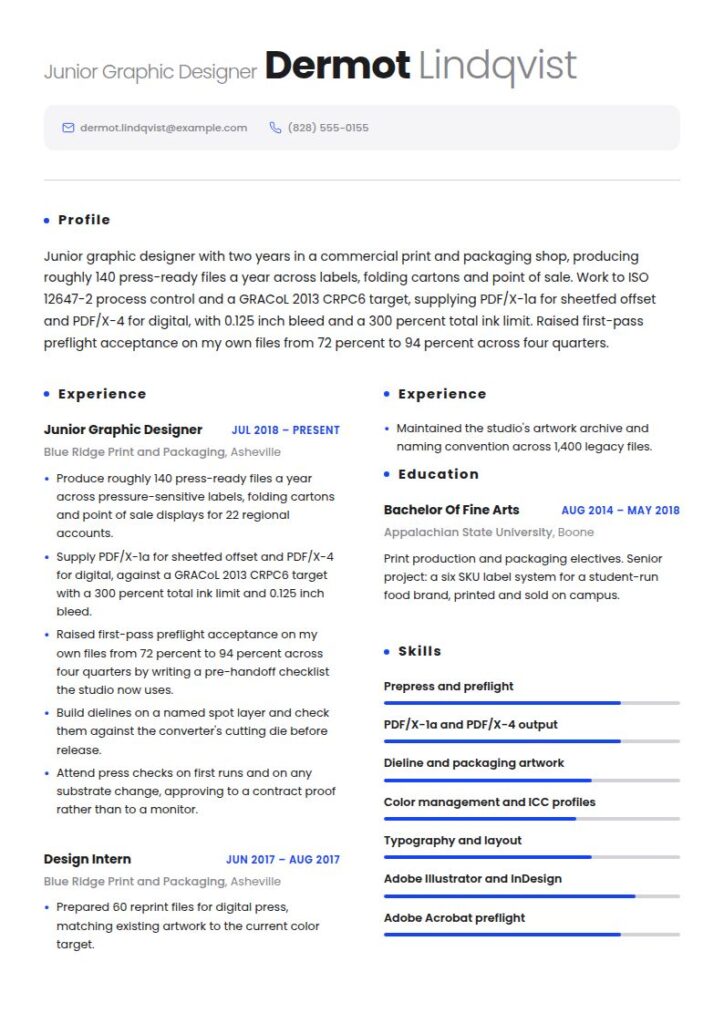
Junior graphic designer with two years in a commercial print and packaging shop, producing roughly 140 press-ready files a year across labels, folding cartons and point of sale. Work to ISO 12647-2 process control and a GRACoL 2013 CRPC6 target, supplying PDF/X-1a for sheetfed offset and PDF/X-4 for digital, with 0.125 inch bleed and a 300 percent total ink limit. Raised first-pass preflight acceptance on my own files from 72 percent to 94 percent across four quarters.
Work Experience
07/2018 - Present, Junior Graphic Designer, Blue Ridge Print and Packaging, Asheville, United States
- Produce roughly 140 press-ready files a year across pressure-sensitive labels, folding cartons and point of sale displays for 22 regional accounts.
- Supply PDF/X-1a for sheetfed offset and PDF/X-4 for digital, against a GRACoL 2013 CRPC6 target with a 300 percent total ink limit and 0.125 inch bleed.
- Raised first-pass preflight acceptance on my own files from 72 percent to 94 percent across four quarters by writing a pre-handoff checklist the studio now uses.
- Build dielines on a named spot layer and check them against the converter's cutting die before release.
- Attend press checks on first runs and on any substrate change, approving to a contract proof rather than to a monitor.
06/2017 - 08/2017, Design Intern, Blue Ridge Print and Packaging, Asheville, United States
- Prepared 60 reprint files for digital press, matching existing artwork to the current color target.
- Maintained the studio's artwork archive and naming convention across 1,400 legacy files.
Education
08/2014 - 05/2018, Bachelor of Fine Arts, Graphic Design, Appalachian State University, Boone, United States
Print production and packaging electives. Senior project: a six SKU label system for a student-run food brand, printed and sold on campus.
Skills
Prepress and preflight, 80
PDF/X-1a and PDF/X-4 output, 80
Dieline and packaging artwork, 70
Color management and ICC profiles, 65
Typography and layout, 70
Adobe Illustrator and InDesign, 85
Adobe Acrobat preflight, 80
Languages
English, native
Swedish, proficient
Certificates
04/2019, Adobe Certified Professional, Visual Design, Adobe and Certiport, ACP-VD-70412
Adobe Illustrator and Adobe Photoshop.
Summary
A graphic designer resume is a one page document plus a portfolio, and the part that separates candidates is the production specification you delivered to: file formats, color space, press and platform specs, proofing, and whether you shipped one artefact or a reusable system with usage rules. This guide gives you three adaptable versions and current Bureau of Labor Statistics pay and outlook.
Graphic Designer resume examples by experience level
A graphic designer resume is a one page document, read alongside a portfolio, and the thing that separates two similar portfolios is almost never taste. It is what each designer actually handed off, and to what standard.
Design hiring has a well-known problem: everyone's portfolio looks finished. Nothing on a case study page tells a studio manager whether the file behind it went to press without a call from prepress, whether the color held across four substrates, or whether anyone but the designer could use it afterwards. The resume is where you answer that, and almost nobody does.
Resume guide for a graphic designer resume
This guide and the corresponding graphic designer resume example will cover:
- How to write a graphic designer resume, section by section
- Why the production specification, not the software list, is what separates files
- Three adaptable summaries: junior, studio designer and senior brand systems designer
- How to label a portfolio piece that shipped and one that did not, honestly
- What the job market looks like and what you can expect to earn
How to write a graphic designer resume
Six blocks: contact header with portfolio link, summary, experience, the production and handoff block, skills, education and certifications. One page for almost everyone. The portfolio carries the work; the resume carries the evidence that the work was deliverable.
Put the portfolio URL in the header, not at the bottom, and make it a plain readable address. A studio that cannot find your work in three seconds will not go looking for it.
| Section | What it is answering | Where it goes |
|---|---|---|
| Portfolio link | Can I see the work right now? | Header, first line after your name |
| Experience | What did they design, at what volume, for what output? | Reverse chronological, numbers in the bullets |
| Production and handoff | Could someone else use these files, and did they come back? | Its own block, above skills |
| Skills | Craft and production competence, grouped, not a software inventory | Short grouped block |
Write the output before you write the project
For every piece of work on your resume, name what came out the other end.
"Designed packaging for a regional coffee roaster" tells a reader nothing. "Designed 9 stand-up pouch SKUs for flexographic print, supplied as PDF/X-4 with dielines, spot white and a 300 percent total ink limit, all 9 released to press on first proof" tells them you have done the job.
The second version is not more technical writing for its own sake. It is the only part of the sentence a production manager can check, and it is the difference between a designer who hands over a beautiful file and a designer who hands over a file that runs.
Run the finished file through the free Rezoom ATS resume checker before you send it. Large in-house creative teams route applications through the same parser as every other role in the business.
Choosing the best resume format for a graphic designer resume
Reverse chronological, one page, single column, set in something you did not design yourself. The temptation to make the resume a portfolio piece is strong and it costs interviews: recruiters at large employers read these inside an applicant system that strips layout, and a studio principal reading a stack of PDFs wants the facts in the same place every time.
Craft is judged on the portfolio. The resume is judged on whether it is easy to use, which is itself a design argument about you.
Include your contact information
| ✅ Right | ❌ Wrong |
|---|---|
| Dermot Lindqvist | Dermot Lindqvist |
| Senior Graphic Designer, brand systems and print production | Creative visual storyteller and design enthusiast |
| dermotlindqvist.design | Portfolio available upon request |
| (828) 555-0155, [email protected], Asheville, NC | (828) 555-0155, [email protected] |
"Portfolio available upon request" is the single most costly line in this occupation. It asks a reader to do work before they have any reason to, in a field where the work is the application.
Make use of a summary
Four lines: what you design, for what output, at what volume, and one production fact that a studio can verify.
Junior graphic designer with two years in a commercial print and packaging shop, producing roughly 140 press-ready files a year across labels, folding cartons and point of sale. Work to ISO 12647-2 process control and a GRACoL 2013 CRPC6 target, supplying PDF/X-1a for sheetfed offset and PDF/X-4 for digital, with 0.125 inch bleed and a 300 percent total ink limit. Raised first-pass preflight acceptance on my own files from 72 percent to 94 percent across four quarters.
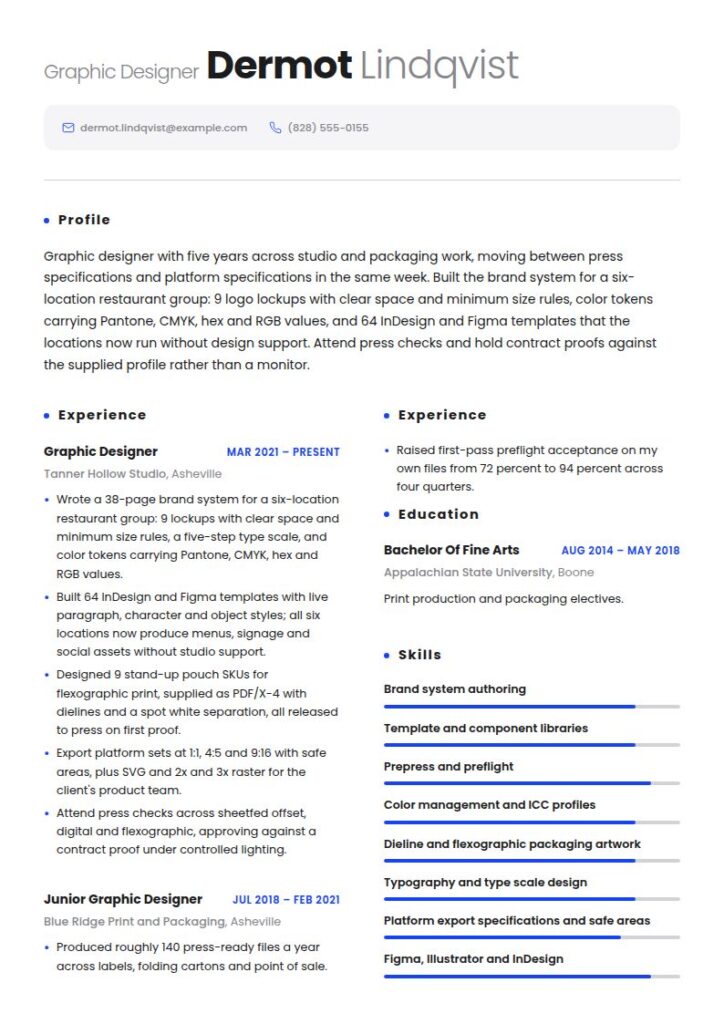
Graphic designer with five years across studio and packaging work, moving between press specifications and platform specifications in the same week. Built the brand system for a six-location restaurant group: 9 logo lockups with clear space and minimum size rules, color tokens carrying Pantone, CMYK, hex and RGB values, and 64 InDesign and Figma templates that the locations now run without design support. Attend press checks and hold contract proofs against the supplied profile rather than a monitor.
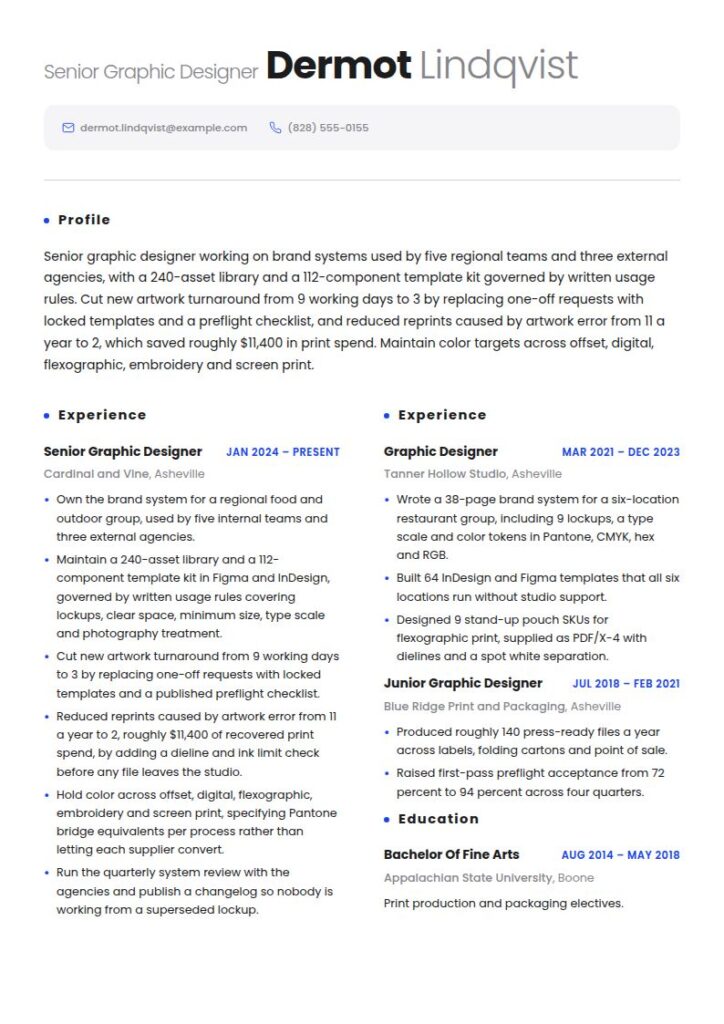
Senior graphic designer working on brand systems used by five regional teams and three external agencies, with a 240-asset library and a 112-component template kit governed by written usage rules. Cut new artwork turnaround from 9 working days to 3 by replacing one-off requests with locked templates and a preflight checklist, and reduced reprints caused by artwork error from 11 a year to 2, which saved roughly $11,400 in print spend. Maintain color targets across offset, digital, flexographic, embroidery and screen print.
Right vs wrong: the same graphic designer summary, twice
| ✅ Right | ❌ Wrong |
|---|---|
| Produces roughly 140 press-ready files a year across labels, folding cartons and point of sale. | Creates beautiful designs across a wide range of print and digital media. |
| Supplies PDF/X-1a for sheetfed offset and PDF/X-4 for digital, to a GRACoL 2013 CRPC6 target. | Proficient in Adobe Creative Suite with an eye for detail. |
| Raised first-pass preflight acceptance from 72 percent to 94 percent across four quarters. | Consistently delivers high-quality work on time and on brief. |
The right column describes a person a production manager can plan around. The left column describes every applicant in the folder.
Outline your design experience
Employer, city, dates, and a one-line description of what the studio or team actually produces. Then three to five bullets, each naming an output format and carrying a number.
| Instead of | Use |
|---|---|
| Designed marketing materials for various clients | Designed 9 stand-up pouch SKUs for flexographic print, supplied as PDF/X-4 with dielines and spot white |
| Proficient in Adobe Illustrator, Photoshop and InDesign | Built a 64-template InDesign and Figma kit with paragraph, character and object styles, used unsupervised by 6 locations |
| Created brand guidelines | Wrote a 38-page brand system: 9 lockups, clear space and minimum size rules, color tokens in Pantone, CMYK, hex and RGB |
| Prepared files for print | Raised first-pass preflight acceptance from 72 percent to 94 percent across four quarters |
| Worked with printers and vendors | Attended 18 press checks across sheetfed offset, flexographic and screen print; approved to contract proof, not to monitor |
| Delivered assets for social media | Exported a 240-asset library at 1:1, 4:5 and 9:16 with safe areas, plus SVG and 2x and 3x raster for product teams |
Senior Graphic Designer, Cardinal and Vine, Asheville, NC, January 2024 to Present
Own the brand system for a regional food and outdoor group, used by five internal teams and three external agencies.
Maintain a 240-asset library and a 112-component template kit in Figma and InDesign, governed by a written usage rule set covering lockups, clear space, minimum size, type scale and photography treatment.
Cut new artwork turnaround from 9 working days to 3 by replacing one-off requests with locked templates and a published preflight checklist.
Reduced reprints caused by artwork error from 11 a year to 2, roughly $11,400 of recovered print spend, by adding a dieline and ink limit check before any file leaves the studio.
Hold color across offset, digital, flexographic, embroidery and screen print, specifying Pantone bridge equivalents for each process rather than letting each supplier convert.
The production specification you delivered to
This is the section that decides between two portfolios that look equally good, and it is the one almost every graphic designer resume leaves out.
Ask what was actually handed over and to what standard. Six things carry it.
File format and version, by destination. PDF/X-1a for sheetfed offset that expects flattened CMYK and spot, PDF/X-4 where live transparency and layers are wanted, packaged native files where the printer imposes, EPS or SVG for vinyl and cutting, DST for embroidery digitizing, and web-ready SVG plus raster at 2x and 3x for product teams. Naming the format tells a reader which industries you have shipped into.
Color space and target. CMYK, RGB, spot, or a mix, and against which characterisation. GRACoL 2013 CRPC6 for US commercial offset, US Web Coated (SWOP) v2 for web offset, ISO 12647-2 as the process control standard, and Pantone Matching System numbers with a stated bridge equivalent where a spot is being simulated in process. A designer who writes "CMYK" alone has usually never had a color argument with a printer.
Press specification versus platform specification. These are different jobs done with the same software. Press work carries bleed, trim and safety, crop and registration marks, dot gain expectations, total ink limit, overprint and trapping, and a dieline on its own layer. Platform work carries aspect ratios, safe areas, file weight budgets, text-in-image limits and per-placement export sets. Say which you have done and at what volume, because studios hire for the one they are short of.
Prepress and proofing. Preflight before handoff, a contract proof viewed under controlled lighting, a press check attended or waived in writing, and what happens when it fails. First-pass acceptance rate is the single most useful number a production-minded designer can put on a resume, and almost nobody has it. If your shop tracks it, use it; if it does not, count your own files for a quarter.
One artefact, or a system. Designing a poster is not the same work as shipping a brand system that other people use without you. A system means lockups with clear space and minimum size, a type scale, color tokens with every equivalent a supplier might need, templates with real paragraph and character styles rather than manually formatted text, an asset library with a naming convention, and written usage rules that answer the questions you would otherwise be asked. Say how many people used it and whether they used it unsupervised, which is the only measure of whether the rules worked.
Handoff and revision reality. Who received the files, what they did with them, and how many came back. A designer who can say "43 of 47 files released on first proof" has said more about their employability than a full page of adjectives.
Print: PDF/X-1a for sheetfed offset, PDF/X-4 for digital and flexographic. GRACoL 2013 CRPC6 target, ISO 12647-2 process control, 300 percent total ink limit, 0.125 inch bleed, dielines on a named spot layer.
Color: Pantone Matching System with stated bridge equivalents per process; spot white and varnish separations for flexible packaging; embroidery color matched to thread standards before digitizing.
Screen and platform: exports at 1:1, 4:5 and 9:16 with safe areas, SVG plus 2x and 3x raster for product teams, file weight budgets agreed with engineering.
Proofing: preflight before every handoff, contract proof under controlled lighting, press checks attended for first runs and for any substrate change.
Systems: 38-page brand system, 9 lockups, color tokens in Pantone, CMYK, hex and RGB, 64 templates with live styles, written usage rules.
Handoff record: first-pass preflight acceptance 94 percent; 43 of 47 packaging files released on first proof in the last 12 months.
Then be honest about the portfolio itself. Label every piece as shipped or not shipped, and say what shipping meant: printed and distributed, sold at shelf, launched on the site, or run as paid media. A concept that never left the studio is still worth showing, because it shows how you think, but presenting it as though it went to market is the thing hiring designers check and remember. A portfolio with four shipped pieces and two clearly labeled concepts reads as more experienced than a portfolio of six unlabelled ones, every time.
Build a snapshot of your key skills
Twelve to sixteen entries in four groups: craft, production, systems, and tools. Tools go last and stay short. Everyone applying has the same software.
Craft: Typography and type scale design, Logo and lockup construction, Layout and grid systems, Color theory and palette construction, Photography art direction briefs
Production: Prepress and preflight, Color management and ICC profiles, PDF/X standards, Dieline and packaging artwork, Trapping and overprint, Large format and substrate specification
Systems: Brand system authoring, Template and component libraries, Asset naming and library management, Usage rules and governance, Design handoff documentation
Tools: Adobe Illustrator, Adobe InDesign, Adobe Photoshop, Adobe Acrobat preflight, Figma, Esko or equivalent packaging workflow
List your education and certifications
Degree first, then the certifications that speak to production rather than to software familiarity, then any workshop that shows currency in a process you have recently taken on.
Bachelor of Fine Arts, Graphic Design, Appalachian State University, Boone, NC, 2018
Adobe Certified Professional, Visual Design using Adobe Illustrator and Photoshop, Adobe and Certiport, #ACP-VD-70412, 2019
Color Management Professional Fundamentals, Idealliance, #CMP-F-3318, 2022
G7 Professional, Idealliance, 2024
Flexographic packaging artwork workshop, supplier-run, 2025
Certifications matter less in design than in most occupations, and they matter most when you are moving between output types. A print designer moving into packaging, or a screen designer moving into print, is making a claim a hiring manager cannot check from a portfolio, and a color management or G7 credential is the cheapest available proof.
Choose the right layout and design
Single column, 10 to 12 point, one typeface with a second at most, generous leading, no color blocks behind text, no skills bar charts. A skills rating graphic tells a reader nothing and parses as garbage.
Put the portfolio URL in the header as plain text. Name output formats and color targets by their proper names. Give a volume figure: files, SKUs, templates, assets. State whether you built one artefact or a system, and how many people used the system without you. Label portfolio pieces as shipped or concept. Include a first-pass or return rate if you have one. Keep the resume to one page and let the portfolio be the portfolio.
Do not set the resume as a designed artefact with columns, boxes and tinted panels; it breaks in the parser and it is not what is being assessed. Do not list software with proficiency percentages. Do not write "various clients" when the categories are what a studio is hiring for. Do not present unshipped concept work as launched. Do not send a 14MB PDF. Do not hide the portfolio behind a request.
Graphic designer job market and outlook
A large occupation with a slowly shrinking base, which changes what a resume has to do: you are competing for replacement openings rather than new headcount.
| Measure | Value |
|---|---|
| Employment, graphic designers, 2025 | ~253,100 |
| Projected change, 2025 to 2035 | Decline 2 percent |
| Projected annual openings | ~16,000 |
| Typical entry-level education | Bachelor's degree in graphic design or a related field |
| Self-employed workers | 20 percent |
| Median annual wage, May 2025 | $62,960 |
Source: U.S. Bureau of Labor Statistics, Occupational Outlook Handbook, May 2025 wage data and 2025 to 2035 projections.
A shrinking base with 16,000 openings a year is a specificity market
Employment of graphic designers is projected to decline 2 percent between 2025 and 2035, from a 2025 base of about 253,100, while still producing roughly 16,000 openings a year on average, nearly all of them replacements rather than growth (BLS Occupational Outlook Handbook, 2025 to 2035 projections).
Pay varies by where the work sits. In May 2025 the median was $63,780 in specialized design services, $62,970 in information, $61,200 in advertising and public relations services, and $47,120 in printing and related support activities, against an occupation median of $62,960 (BLS Occupational Outlook Handbook, May 2025).
One in five graphic designers is self-employed (BLS Occupational Outlook Handbook, May 2025), which is why freelance years are ordinary on a design resume and should be written as engagements with clients, volumes and output formats rather than as a gap.
The practical consequence of a shrinking base is that generalist applications lose. Openings are replacements for a specific person who did a specific thing, and the file that names the output type, the color target and the system it maintained is the one that matches the vacancy the team is actually trying to refill.
Where these jobs sit:
| Setting | Share of employment | Median annual wage, May 2025 |
|---|---|---|
| Specialized design services | 9% | $63,780 |
| Advertising, public relations and related services | 8% | $61,200 |
| Information | 7% | $62,970 |
| Printing and related support activities | 6% | $47,120 |
Source: U.S. Bureau of Labor Statistics, Occupational Outlook Handbook, May 2025.
What salary you can expect as a graphic designer
Graphic designers had a median annual wage of $62,960 in May 2025, with the lowest 10 percent earning less than $39,520 and the highest 10 percent more than $104,910 (BLS Occupational Outlook Handbook, May 2025).
That spread of roughly $65,000 between the tenth and ninetieth percentile is wide for an occupation with one common entry route, and the production specification explains much of it. Designers who only make artefacts are priced against a very large supply; designers who can specify, prepress, color manage and hand off a system that other people run are priced against a much smaller one. The Handbook's industry figures show the same pattern: printing and related support activities pays a median of $47,120 while specialized design services pays $63,780 (BLS, May 2025).
Three things move you through the band. Output breadth comes first: a designer who has shipped to offset, flexographic, screen, embroidery and screen-based platforms has more places to work than one who has shipped to none of them. Systems ownership comes second, because a system is leverage and leverage is what gets paid. Third is sector, since the same craft is priced differently in a print shop, an agency and an in-house team inside an information business.
Key takeaways for a graphic designer resume
- Put the portfolio URL in the header as plain text and never make it a request.
- Name the output format and version for each kind of work you have shipped.
- State the color space and the target, not just "CMYK".
- Separate press specification work from platform specification work.
- Say whether you shipped one artefact or a reusable system, and who used it.
- Give a volume number and, if you have one, a first-pass acceptance rate.
- Label every portfolio piece as shipped or concept, and keep the resume to one page.
Build your graphic designer resume in 15 minutes.
Related marketing resume examples
- Art director resume
- Creative director resume
- UX designer resume
- UX researcher resume
- Digital marketing resume
- Content writer resume
- Marketing coordinator resume
- Brand manager resume
- Social media manager resume
- Marketing associate resume
- Ecommerce resume
- Magazine editor resume
Pair it with a matching graphic designer cover letter.
Graphic designer resume questions, answered
How long should a graphic designer resume be?
One page, in almost every case. The portfolio carries the work, so a second page can only be a longer list of the same claims. The exception is a designer with a long production career across several output types, where the second page is a specification and systems record rather than more projects.
Do I need a portfolio if I have a strong resume?
Yes, and the portfolio is the application. The resume tells a reader what the portfolio cannot: what the files were, what standard they met, and whether anyone else could use them. A resume without a portfolio link is not read; a portfolio without production evidence is compared to twenty others that look just as good.
Should I show work that never launched?
Show it and label it. Concept and speculative work demonstrates range, and everybody in the field has some. The problem is presentation: a piece shown as though it shipped, when a reader knows the client or the shelf, costs you the interview and the reference. Marking pieces as shipped or as concept costs nothing and reads as professional confidence.
How do I list software without it looking like filler?
Put it last, in one grouped line, with no proficiency ratings. Everybody applying has the same three or four applications, so the list has no separating power. What separates is naming workflow-specific tools you have genuinely used, such as a packaging workflow system or a preflight profile you wrote yourself, because those imply an environment rather than a download.
Is graphic design a shrinking career?
The occupation base is shrinking slowly, projected to decline 2 percent between 2025 and 2035, while still producing about 16,000 openings a year, nearly all replacements (BLS Occupational Outlook Handbook, 2025 to 2035 projections). That is a market for specificity rather than volume applications. Designers who can prove production competence and system ownership are competing in a much smaller pool than designers presenting general visual skill.
What should a junior graphic designer put on a resume with little experience?
Volume and standard, from wherever you have them. A student print shop, a campus publication, an internship at a converter, freelance work for two local businesses: each has a file count, an output format and a proof cycle in it. Write them as production work, name the formats and color targets, and add a first-pass rate if you counted. That reads stronger than three case studies of unbriefed concept work.