Digital Marketing Manager, paid search and paid social Cassian Oyelaran
Digital Marketing Manager
[email protected] | (512) 555-0118 | Austin, United States
Profile
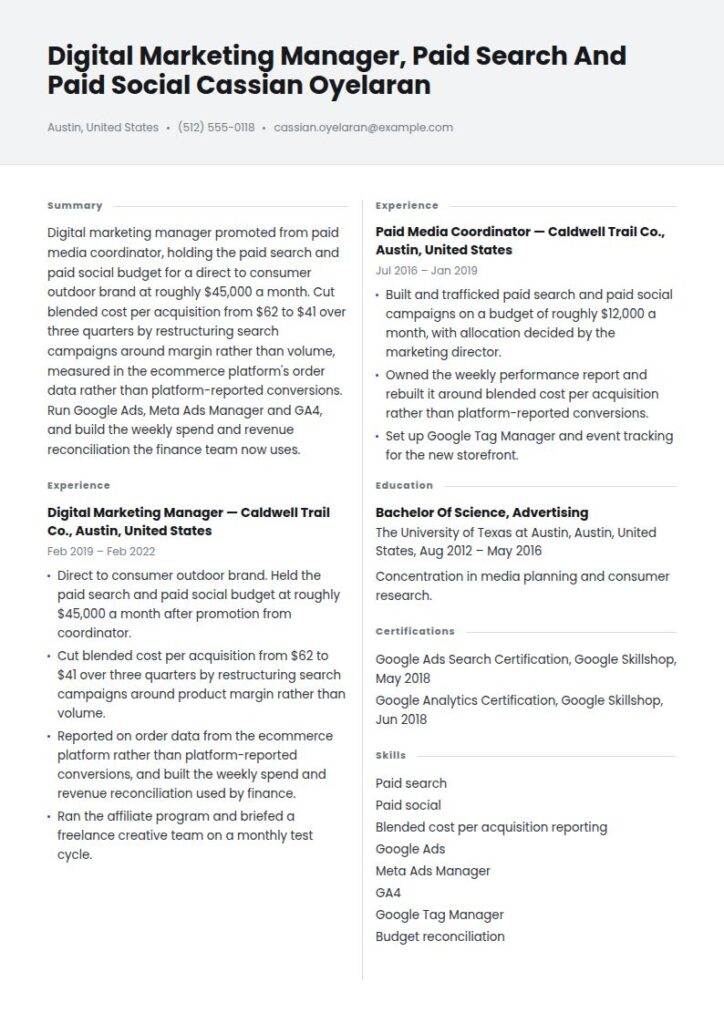
Digital marketing manager promoted from paid media coordinator, holding the paid search and paid social budget for a direct to consumer outdoor brand at roughly $45,000 a month. Cut blended cost per acquisition from $62 to $41 over three quarters by restructuring search campaigns around margin rather than volume, measured in the ecommerce platform's order data rather than platform-reported conversions. Run Google Ads, Meta Ads Manager and GA4, and build the weekly spend and revenue reconciliation the finance team now uses.
Work Experience
02/2019 - 02/2022, Digital Marketing Manager, Caldwell Trail Co., Austin, United States
- Direct to consumer outdoor brand. Held the paid search and paid social budget at roughly $45,000 a month after promotion from coordinator.
- Cut blended cost per acquisition from $62 to $41 over three quarters by restructuring search campaigns around product margin rather than volume.
- Reported on order data from the ecommerce platform rather than platform-reported conversions, and built the weekly spend and revenue reconciliation used by finance.
- Ran the affiliate program and briefed a freelance creative team on a monthly test cycle.
07/2016 - 01/2019, Paid Media Coordinator, Caldwell Trail Co., Austin, United States
- Built and trafficked paid search and paid social campaigns on a budget of roughly $12,000 a month, with allocation decided by the marketing director.
- Owned the weekly performance report and rebuilt it around blended cost per acquisition rather than platform-reported conversions.
- Set up Google Tag Manager and event tracking for the new storefront.
Education
08/2012 - 05/2016, Bachelor of Science, Advertising, The University of Texas at Austin, Austin, United States
Concentration in media planning and consumer research.
Skills
Paid search, 80
Paid social, 75
Blended cost per acquisition reporting, 75
Google Ads, 85
Meta Ads Manager, 75
GA4, 75
Google Tag Manager, 70
Budget reconciliation, 70
Languages
English, native
Yoruba, native
Spanish, intermediate
Certificates
05/2018, Google Ads Search Certification, Google Skillshop
06/2018, Google Analytics Certification, Google Skillshop
Summary
A digital marketing manager resume is a one to two page document naming the channels you held spend authority over, the level of that budget, and the attribution model behind every efficiency number you quote. This guide gives you three adaptable versions, a way to state figures a hiring manager can trust, and current Bureau of Labor Statistics pay and outlook.
Digital Marketing Manager resume examples by experience level
A digital marketing manager resume is a one to two page document that names the channels you held spend authority over, how much money that was, and how the results you quote were attributed.
Those two facts separate a digital marketing manager from someone who assisted one, and experienced readers go looking for them first. Everything else on the page, the tools, the campaigns, the certifications, can be true of a coordinator who never chose where a dollar went.
Resume guide for a digital marketing manager resume
This guide and the corresponding digital marketing manager resume example will cover:
- How to write a digital marketing manager resume, section by section
- How to state the budget you held without overstating it
- Why every efficiency figure needs its attribution model attached
- Three adaptable summaries: first manager role, ecommerce, and B2B demand generation
- What the job market looks like and what you can expect to earn
How to write a digital marketing manager resume
Six blocks: contact header, summary, channels and budget owned, experience, skills and stack, education and certifications. One page under five years, two pages after that.
The budget and attribution block sits directly under the summary because it is the gating fact. A company hiring someone to run $250,000 a month across paid search and paid social will not shortlist a candidate whose largest authority was $8,000, however good the creative work was, and the reverse is also true: a lean team does not want someone who has only operated with an agency doing the buying.
| Section | What it is answering | Where it goes |
|---|---|---|
| Channels and budget owned | What could this person actually spend, and on what? | Directly under the summary |
| Attribution and measurement | Where do their numbers come from, and can I trust them? | Inside the same block, one line |
| Experience | What did they change, on what baseline, over what period? | Reverse chronological, numbers in the bullets |
| Skills and stack | Which platforms and measurement tools have they run themselves? | Short grouped block |
Write the budget line before anything else
Before you draft a single bullet, write one sentence you could defend in a finance meeting: which channels you controlled, at what level, and over what period.
"Held the paid search and paid social budget for the direct to consumer line, averaging $180,000 a month across 2024 and 2025" is a complete answer. So is "recommended allocation on a $60,000 monthly budget, with sign-off held by the marketing director", and it is a smaller claim honestly made rather than a bigger one that collapses in the first interview.
Say monthly if the spend was steady and annual if it was seasonal, and say which. A retail account that runs $40,000 a month for ten months and $400,000 in November is not the same job as a flat $80,000, and quoting the annual total alone hides the part that was hard.
If agencies did the buying, say that too, along with what you did decide: budget splits, targets, creative direction, testing roadmap, which agency kept the account.
Run the finished file through the free Rezoom ATS resume checker before you send it. Marketing roles attract high application volume and are almost always parsed before a human reads them.
Choosing the best resume format for a digital marketing manager resume
Reverse chronological, single column. One page for the first five years, two once you have held budget across more than one company or channel mix.
The thing to resist is a dashboard layout. Digital marketers build the prettiest bad resumes of any profession: donut charts of skills, gauge dials, a heat map of tools. None of it parses, and none of it answers the budget or the attribution question. Put that energy into a portfolio link instead.
Include your contact information
| ✅ Right | ❌ Wrong |
|---|---|
| Cassian Oyelaran | Cassian Oyelaran |
| Digital Marketing Manager, paid search, paid social, lifecycle | Growth hacker and digital marketing guru |
| $180,000 a month in managed spend, B2B and DTC | Data-driven marketer with a passion for performance |
| (512) 555-0118, [email protected], Austin, TX | (512) 555-0118, [email protected] |
The third line is unusual and that is why it works. A number in the header tells a reader in one second which band of role to consider you for, which is the same question they would otherwise spend the whole document trying to answer.
Make use of a summary
Four lines: the channels you own, the budget level, one efficiency result with its attribution named, and the stack.
Digital marketing manager promoted from paid media coordinator, holding the paid search and paid social budget for a direct to consumer outdoor brand at roughly $45,000 a month. Cut blended cost per acquisition from $62 to $41 over three quarters by restructuring search campaigns around margin rather than volume, measured in the ecommerce platform's order data rather than platform-reported conversions. Run Google Ads, Meta Ads Manager and GA4, and build the weekly spend and revenue reconciliation the finance team now uses.
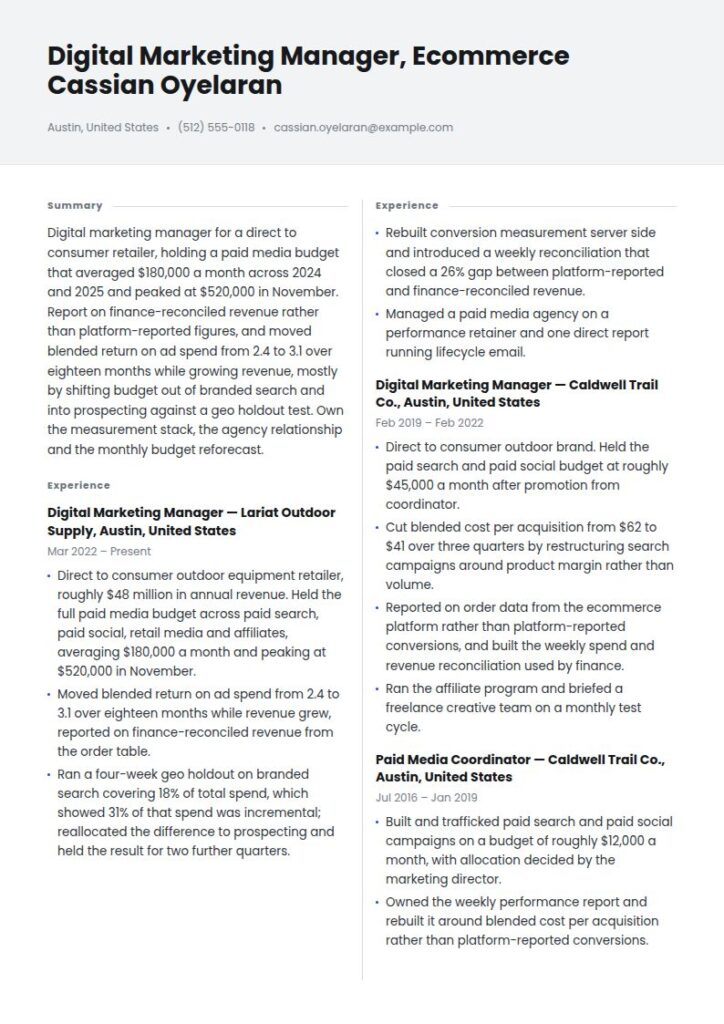
Digital marketing manager for a direct to consumer retailer, holding a paid media budget that averaged $180,000 a month across 2024 and 2025 and peaked at $520,000 in November. Report on finance-reconciled revenue rather than platform-reported figures, and moved blended return on ad spend from 2.4 to 3.1 over eighteen months while growing revenue, mostly by shifting budget out of branded search and into prospecting against a geo holdout test. Own the measurement stack, the agency relationship and the monthly budget reforecast.
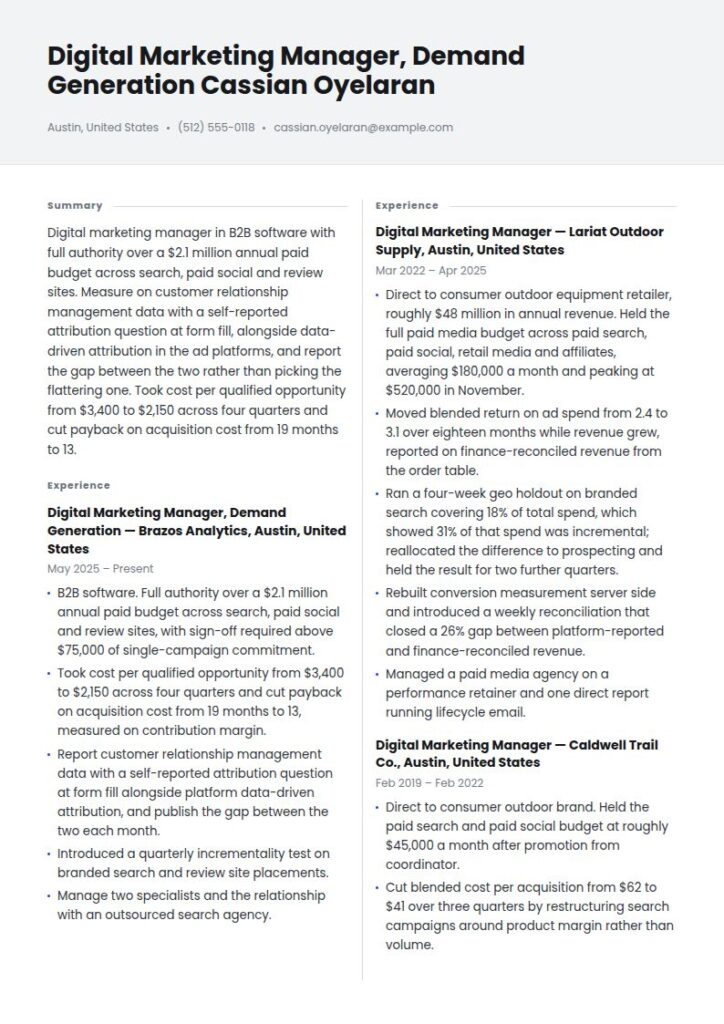
Digital marketing manager in B2B software with full authority over a $2.1 million annual paid budget across search, paid social and review sites. Measure on customer relationship management data with a self-reported attribution question at form fill, alongside data-driven attribution in the ad platforms, and report the gap between the two rather than picking the flattering one. Took cost per qualified opportunity from $3,400 to $2,150 across four quarters and cut payback on acquisition cost from 19 months to 13.
Right vs wrong: the same digital marketing manager summary, twice
| ✅ Right | ❌ Wrong |
|---|---|
| Held a paid media budget averaging $180,000 a month across 2024 and 2025. | Managed significant advertising budgets across multiple channels. |
| Moved blended return on ad spend from 2.4 to 3.1 over eighteen months. | Delivered outstanding ROAS and exceeded all targets. |
| Reported on finance-reconciled revenue rather than platform-reported figures. | Leveraged data-driven insights to optimize campaign performance. |
| Shifted budget out of branded search into prospecting against a geo holdout test. | Optimized campaigns for maximum efficiency and scale. |
The right column can be interrogated for twenty minutes and survive. The left column runs out after one question, which is roughly when an experienced marketing director asks it.
Outline your digital marketing experience
Company, what it sells, the business model, the channels and budget you held, your dates. Then three to five bullets, each with a baseline, a change and the measurement source.
| Instead of | Use |
|---|---|
| Managed paid search and paid social campaigns | Held the paid search and paid social budget at $180,000 a month across two brands |
| Improved ROAS significantly | Blended return on ad spend from 2.4 to 3.1 over eighteen months, measured on finance-reconciled revenue |
| Reduced cost per acquisition | Blended cost per acquisition from $62 to $41 over three quarters while volume grew 22% |
| Ran A/B tests to optimize performance | Ran a four-week geo holdout on branded search covering 18% of spend, which found 31% of it was incremental |
| Used Google Analytics to track performance | Rebuilt server-side conversion tracking and reconciled it weekly against the order table |
| Worked with agencies | Ran the agency relationship, set channel targets and the testing roadmap, kept sign-off on allocation |
Digital Marketing Manager, Lariat Outdoor Supply, Austin, TX, March 2022 to Present
Direct to consumer outdoor equipment retailer, roughly $48 million in annual revenue. Hold the full paid media budget across paid search, paid social, retail media and affiliates, averaging $180,000 a month and peaking at $520,000 in November.
Moved blended return on ad spend from 2.4 to 3.1 over eighteen months while revenue grew, reported on finance-reconciled revenue from the order table rather than platform-reported conversions.
Ran a four-week geo holdout test on branded search covering 18% of total spend, which showed 31% of that spend was incremental; reallocated the difference to prospecting and held the result over the following two quarters.
Rebuilt conversion measurement server side and introduced a weekly reconciliation between ad platform figures and the order table, which closed a 26% gap between the two.
Manage a paid media agency on a performance retainer and a direct report running lifecycle email.
Name your attribution model and the budget you held
This is the section that decides the interview, and almost nobody writes it.
Every efficiency number in digital marketing is a claim about causation, and it is only as good as the model behind it. A return on ad spend of 4.0 reported by a platform and a return on ad spend of 4.0 reconciled against finance are different statements about the world, and the second one is roughly four times harder to produce. If your resume does not say which you mean, a careful reader assumes the first.
| Attribution basis | What it actually measures | How to write it |
|---|---|---|
| Platform-reported conversions | What the platform claims it influenced, on its own click and view window | "Platform-reported, 7-day click window" |
| Last click in analytics | The final touch before conversion, undercounting everything upstream | "Last click in GA4" |
| Data-driven or algorithmic | The platform or analytics tool's own model across observed paths | "Data-driven attribution in GA4, reconciled monthly" |
| CRM or order data | Revenue the business actually recognized, joined to source | "Finance-reconciled revenue from the order table" |
| Media mix modeling | Channel contribution inferred statistically across time, not per user | "Quarterly media mix model, run with an external partner" |
| Incrementality testing | Causal lift measured against a holdout that saw no advertising | "Four-week geo holdout covering 18% of spend" |
Three of those are correlational and three are closer to causal, and the difference is the whole of measurement.
Platform-reported and finance-reconciled are not the same number
Add up what every platform claims and you will usually exceed what the business actually sold. This is not fraud; it is arithmetic. Each platform measures conversions it believes it influenced, inside its own click and view-through window, with no knowledge of the others, so the same purchase gets claimed more than once.
Two consequences for your resume. First, never quote a figure without saying where it came from. "4.2 return on ad spend" is meaningless on its own and a sophisticated reader knows it. Second, if you have ever reconciled platform figures against finance or the order table, that is a headline achievement rather than housekeeping, because it is the work most teams never get to.
The strongest single line you can write is the one that admits a gap and then closes it: "closed a 26% gap between platform-reported and finance-reconciled revenue by rebuilding conversion tracking server side and reconciling weekly."
Then the budget. Be exact about three things: which channels, what level, and what authority you actually held.
Channels owned: paid search, paid social, retail media, affiliates. Lifecycle email and organic search run by colleagues I brief but do not manage.
Budget authority: full allocation authority within an annual envelope of $2.16 million. Monthly average $180,000, November peak $520,000. Sign-off required above $50,000 of single-campaign commitment.
Source of truth: finance-reconciled revenue from the order table, joined to source by a server-side conversion identifier. Platform figures used for in-flight optimization only.
Attribution: data-driven attribution in GA4 for channel comparison, blended cost per acquisition and blended return on ad spend as the reported headline, incrementality tested quarterly by geo holdout.
Metrics reported: blended and channel-level cost per acquisition, blended return on ad spend, contribution margin after media, payback period on acquisition cost, and new versus returning customer mix.
Four notes on writing that block honestly.
Blended and channel-level are different claims. Blended divides all spend by all new customers, which is conservative and hard to game. Channel-level attributes each conversion somewhere, and is the number that flatters. Say which one you are quoting, and if you quote channel-level, say the model. A candidate who volunteers "blended, so it includes the brand spend" has told a marketing director more about their judgement than a page of tool logos would.
Lifetime value and payback need their own definitions. If you claim a payback period, say the window and whether it is gross revenue or contribution margin. "Payback on acquisition cost of 13 months on contribution margin" is a real sentence. "Strong LTV to CAC ratio" is not, because the reader has no idea what went into either term.
Do not claim a test you did not design. Geo holdouts, conversion lift studies and media mix models all leave evidence, and interviewers who have run them will ask about the design within two questions: what the holdout was, how long it ran, what share of spend it covered, and what you did with the answer.
Leave out benchmarks you cannot source. Industry average conversion rates and engagement rates circulate endlessly without provenance. Quoting one that turns out to be someone's blog post from four years ago costs more credibility than the sentence was worth. Use your own numbers, with your own baseline and period attached.
Build a snapshot of your key skills
Twelve to sixteen entries in three groups: channels, measurement, and the stack. Keep it to things you have personally operated.
Channels: Paid search, Paid social, Retail and marketplace media, Affiliate and partner programs, Display and programmatic, Lifecycle email and SMS
Measurement and analysis: Server-side conversion tracking, Data-driven and last click attribution, Incrementality and geo holdout testing, Media mix modeling, Blended and channel-level efficiency reporting, Payback and contribution margin analysis, Budget reforecasting
Stack: Google Ads, Meta Ads Manager, GA4, Google Tag Manager, Looker Studio, Klaviyo, HubSpot, Shopify, SQL for reporting
List your education and certifications
Short and dated. In digital marketing the certifications are low-cost and widely held, so their job is to show currency rather than distinction.
Bachelor of Science, Advertising, The University of Texas at Austin, Austin, TX, 2016.
Google Ads Search Certification, Google Skillshop, most recent renewal 2026.
Meta Certified Media Buying Professional, Meta Blueprint, 2024.
Google Analytics Certification, Google Skillshop, most recent renewal 2026.
Continuing: SQL for marketing analytics, completed 2023.
Do not list a certification without its year. Platform certifications expire, and an undated one reads as a 2019 badge on a 2026 resume.
Choose the right layout and design
Single column, 11 point body type, no photograph, no skill dials, no charts. PDF unless the portal asks for Word. Add one link to a portfolio or a short case study document if you have one, and make sure it works.
State the channels you held budget for and the level, monthly or annual, and say which. Attach the attribution basis to every efficiency figure. Give the baseline before the improvement. Say when an agency did the buying and what you decided. Name the source of truth you reported on. Use blended figures where you have them.
Do not quote a return on ad spend or cost per acquisition with no model attached. Do not present platform-reported revenue as company revenue. Do not claim a budget you recommended rather than controlled. Do not cite an industry benchmark you cannot source. Do not build the page around tool logos; every applicant has the same ones.
Digital marketing manager job market and outlook
Start with the honest caveat: the Bureau of Labor Statistics publishes no Occupational Outlook Handbook profile for a digital marketing manager. The published occupation these roles sit inside is marketing managers, reported with advertising and promotions managers in the Handbook.
| Measure | Value |
|---|---|
| Employment, advertising, promotions and marketing managers, 2025 | 454,800 |
| Projected change, 2025 to 2035 | 6 percent |
| Projected annual openings | ~36,300 |
| Typical entry-level education | Bachelor's degree |
| Median annual wage, marketing managers, May 2025 | $166,790 |
| Median annual wage, advertising and promotions managers, May 2025 | $133,660 |
Source: U.S. Bureau of Labor Statistics, Occupational Outlook Handbook, 2025 to 2035 projections and May 2025 wage data.
Where the money sits, by industry
Marketing manager pay tracks the industry far more closely than the job title. In May 2025 the median for marketing managers was $192,600 in information, $172,580 in management of companies and enterprises and $172,350 in finance and insurance (BLS Occupational Outlook Handbook, May 2025).
The occupation is also concentrated: 23 percent of marketing managers work in professional, scientific and technical services and 12 percent in management of companies and enterprises (BLS Occupational Outlook Handbook, May 2025).
Employment across advertising, promotions and marketing managers is projected to grow 6 percent between 2025 and 2035, with about 36,300 openings a year (BLS Occupational Outlook Handbook, 2025 to 2035 projections).
For your resume, that concentration is the practical point. A large share of these roles sit in agencies, consultancies and holding companies rather than in brands, and those readers care most about budget scale and client accountability. In-house readers care more about the measurement stack and the source of truth. Same document, different first paragraph.
What salary you can expect as a digital marketing manager
Because the Handbook has no digital marketing manager profile, the usable anchor is marketing managers, whose median annual wage was $166,790 in May 2025 (BLS Occupational Outlook Handbook, May 2025). The spread is very wide: the lowest 10 percent earned less than $90,260 and the highest 10 percent more than $293,610 in the same cycle (BLS, May 2025).
Titles in this field are unusually loose, which is exactly why the budget line on your resume matters. "Digital marketing manager" covers a one-person team spending $8,000 a month and a role directing $3 million a year through an agency, and those are not adjacent salaries. A figure in your header moves you into the right conversation before the first call.
Three things move you up the band. Budget scale comes first, because accountability for money is what the title is paid for. Measurement capability comes second: people who can reconcile, model and test are scarce, and they are the ones who survive a chief financial officer asking where the revenue actually came from. Third is business model breadth, since someone who has run both subscription and transactional acquisition can be moved between problems.
Key takeaways for a digital marketing manager resume
- Name the channels you held budget for and the level, monthly or annual.
- Say what authority you actually had, including where sign-off sat.
- Attach the attribution basis to every efficiency figure you quote.
- Prefer blended numbers, and say when a figure is channel-level.
- Treat reconciling platform figures to finance as a headline achievement.
- Define any payback or lifetime value claim, including the window.
- Leave out industry benchmarks you cannot source to a named, dated origin.
Build your digital marketing manager resume in 15 minutes.
Related marketing resume examples
- Marketing manager resume
- Digital marketing resume
- Marketing analyst resume
- Ecommerce resume
- SEO resume
- Social media manager resume
- Content marketing associate resume
- Marketing coordinator resume
- Advertising director resume
- Marketing associate resume
- UX designer resume
- Marketing director resume
Pair it with a matching digital marketing manager cover letter.
Digital marketing manager resume questions, answered
How long should a digital marketing manager resume be?
One page for the first five years, two after that. The extra page is for budget history across more than one company or business model, which is genuinely useful to a reader. It is not for listing every platform you have logged into.
What if I never held the budget myself?
Say what you did hold. Recommending allocation on a $60,000 monthly budget with sign-off elsewhere is a real and common job, and writing it accurately is better than implying authority you did not have, which unravels in the first interview. Then show the decisions you did own: targets, testing roadmap, creative briefs, agency management, the measurement rebuild.
Which attribution model should I say I use?
Whichever you actually used, named plainly, with the source of truth alongside it. There is no correct model, and a candidate who says "data-driven in the platform for optimization, finance-reconciled revenue for reporting, geo holdouts quarterly to check both" has demonstrated more judgement than one who claims a single perfect answer.
Are Google and Meta certifications worth putting on a digital marketing manager resume?
Yes, with dates, and low in the document. They are inexpensive and widely held, so they prove currency rather than ability. What actually differentiates at this level is budget scale, measurement work and a defensible number, none of which any certification tests.
How do I show results if I am under a non-disclosure agreement or the numbers were bad?
Use ratios and directions instead of absolutes: "moved blended return on ad spend from 2.4 to 3.1" without naming revenue, or "cut cost per acquisition by a third on a budget in the low six figures monthly". If a period genuinely went backwards, write what you changed and what you learned from the test that failed. A marketing director who has run paid media knows that budgets shrink and markets move, and a candidate who can describe a loss accurately is easier to trust with the next budget.