Odalys Lemaitre-Fontaine Editor in Chief, Levee Review New Orleans, 70119, United States [email protected] · (504) 555-0121
13 September 2026
Mr. Julian Ashworth Editorial Bellwether Monthly Atlanta, United States
Application for Managing Editor, Bellwether Monthly
Dear Mr. Ashworth,
I am applying for the managing editor post at Bellwether Monthly. I am currently editor in chief of Levee Review, a 132-page quarterly published in print and digital, where I hold the flat plan, an $86,000 annual commissioning budget, a roster of 61 contributors and final sign-off on everything that runs.
The commission I would point to is a four-part series on the working waterfront. I briefed it at 2,400 words a part, commissioned a writer and a photographer I had not used before, and built a six-week fact-checking window into the production calendar because the reporting touched employment records. It ran across two issues, drew the highest newsletter click rate the title has had, and went to press on the scheduled date with no corrections afterwards. Across 22 consecutive issues we have published three corrections in total.
I have read your last four issues closely. The front section carries more short pieces than the quarterly rhythm I am used to, and the back-of-book essay is where your best writers end up rather than where they start. As managing editor I would want to work first on the production calendar, because a monthly with a strong front section lives or dies on how early the flat plan closes.
I have shipped 22 consecutive issues on schedule against a fixed press date, I wrote the corrections policy printed on our masthead page, and I hold the Poynter ACES Advanced Certificate in Editing. I could start at four weeks' notice.
Sincerely, Odalys Lemaitre-Fontaine
Summary
A magazine editor cover letter is a one-page letter that states your masthead position, the commissioning budget and roster it carried, and one commission described from brief to press. This guide gives you a full adaptable letter, the openings that work, how to write about a title you have read closely, and what changes when the publisher is digital rather than print.
Magazine Editor cover letter examples by experience level
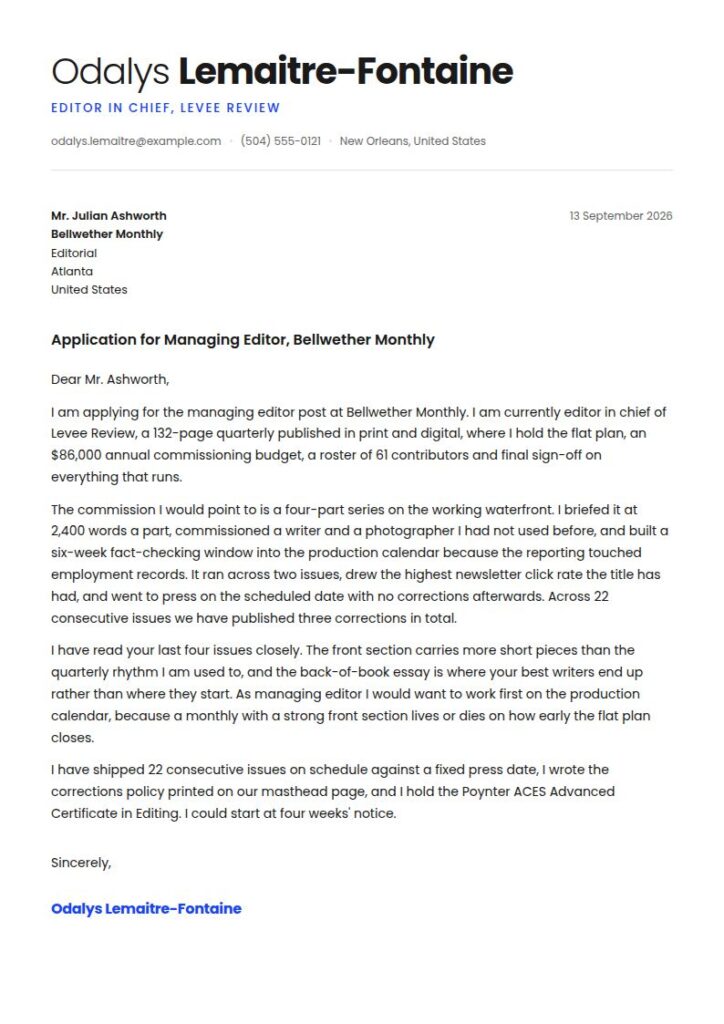
A magazine editor cover letter is a one-page letter that says where you sat on a masthead, what that position let you commission, and what you did with it on one piece.
It is also a writing sample. A hiring editor reads your sentences while reading your claims, and a letter one line too long has already made an editorial argument against itself.
Guide to a magazine editor cover letter
This guide and the corresponding magazine editor cover letter example will cover:
- How to structure the letter, paragraph by paragraph
- Why your masthead position belongs in the first sentence
- How to describe one commission from brief to press
- What changes when the publisher is a brand rather than a title
How to write a magazine editor cover letter
| Paragraph | Its job | Length |
|---|---|---|
| Opening | The post, your masthead position, the title's frequency and format | 2 to 3 sentences |
| Evidence | One commission from brief to press, with its numbers | 4 to 5 sentences |
| Fit | Something true about their title, and what you would do with it | 3 to 4 sentences |
| Close | Volume shipped, corrections record, availability | 2 sentences |
Open with the rung, not the craft
Almost every letter for an editing job opens with a love of words. That is true of the whole applicant pool, so it separates nobody.
Open with the rung. "I am editor in chief of a 132-page quarterly, print and digital, and I hold the flat plan, an $86,000 annual commissioning budget and final sign-off." That tells a publisher what to compare you against. Then translate for the title you are writing to: their monthly has a shorter lead time and a bigger front section, so say what changes.
A magazine editor cover letter example you can adapt
Dear Mr. Ashworth,
I am applying for the managing editor post at Bellwether Monthly. I am currently editor in chief of Levee Review, a 132-page quarterly published in print and digital, where I hold the flat plan, an $86,000 annual commissioning budget, a roster of 61 contributors and final sign-off on everything that runs.
The commission I would point to is a four-part series on the working waterfront. I briefed it at 2,400 words a part, commissioned a writer and a photographer I had not used before, and built a six-week fact-checking window into the production calendar because the reporting touched employment records. It ran across two issues, drew the highest newsletter click rate the title has had, and went to press on the scheduled date with no corrections afterwards. Across 22 consecutive issues we have published three corrections in total.
I have read your last four issues closely. The front section carries more short pieces than the quarterly rhythm I am used to, and the back-of-book essay is where your best writers end up rather than where they start. As managing editor I would want to work first on the production calendar, because a monthly with a strong front section lives or dies on how early the flat plan closes.
I have shipped 22 consecutive issues on schedule against a fixed press date, I wrote the corrections policy printed on our masthead page, and I hold the Poynter ACES Advanced Certificate in Editing. I could start at four weeks' notice.
Sincerely, Odalys Lemaitre-Fontaine
Openings that work
| Instead of | Use |
|---|---|
| I have always had a love of storytelling and the written word | I am editor in chief of a 132-page quarterly and hold the flat plan, the budget and final sign-off |
| I am writing to apply for the position of managing editor | I am applying for the managing editor post, coming from a quarterly rhythm to a monthly one |
| I have extensive editing and proofreading experience | Across 22 consecutive issues we have published three corrections in total |
Describe one commission from brief to press
A hiring editor learns more from one commission described properly than from a list of everything you have edited.
Walk a single piece through. The brief you wrote and the length you set. Who you commissioned and why. What you did about accuracy, and how much time you built in for it. Whether it shipped on the scheduled date. What happened after it ran. That sequence proves five things at once: that you can specify, cast, budget, check and close.
| What to include | Why it reads |
|---|---|
| The brief and the word count | Shows you specify rather than hope |
| Who you commissioned, and whether they were new to you | Building a roster is the part that does not scale from craft |
| The fact-checking window | Proves accuracy is a process, not an intention |
| Shipped on the scheduled date | Proves you close |
Read four issues before you write a word
The fit paragraph is where most editorial letters collapse into flattery. Avoid it by doing the reading.
Four recent issues shows you the shape of a title: how long the front section runs, whether the feature well is two pieces or four, who the regular contributors are, and what the title keeps trying and abandoning. One accurate observation beats a paragraph of admiration, and it cannot be copied into your next letter.
Say what you would do with it, briefly. "I would want to work first on the production calendar" is a proposal. "Your magazine would benefit from a redesign" is a stranger telling a stranger their business is wrong.
Name your masthead position, the title's frequency and format in the first two sentences. Give the commissioning budget and roster size. Describe one commission from brief to press. Quote a corrections figure with its denominator. Name one accurate thing about their title from your own reading.
Do not open with a love of words. Do not claim commissioning authority you did not hold. Do not say zero corrections. Do not name a writer in connection with an error or a difficult edit. Do not send a letter with a typo in it; in this occupation it is close to disqualifying.
When the publisher is not a magazine
Many editing jobs now sit outside titles. In 2025, professional, scientific and technical services accounted for 17 percent of editor employment, newspaper publishers 12 percent, self-employed editors 9 percent, and media streaming and other content providers 7 percent (BLS Occupational Outlook Handbook, 2025).
For those readers, keep the numbers and change the nouns. The flat plan becomes the content plan. The commissioning budget stays a commissioning budget. Issues shipped becomes a delivery record against fixed dates. The corrections record needs no translation, and it is usually the most unusual thing in the pile.
A declining occupation with wide pay bands
Employment of editors was 105,000 in 2025 and is projected to fall to 103,800 by 2035, a decline of 1 percent, with about 7,900 openings a year on average (BLS Occupational Outlook Handbook, 2025 to 2035 projections). The median annual wage was $77,920 in May 2025, with the lowest 10 percent under $41,250 and the highest 10 percent over $153,700 (BLS Occupational Outlook Handbook, May 2025).
Industry sets much of that spread: motion picture and video industries paid a median of $103,320 in May 2025, against $62,600 at newspaper publishers (BLS Occupational Outlook Handbook, May 2025).
Two things follow. Openings exist mostly through replacement, so timing and specificity matter more than volume of applications. And the same masthead numbers argue for very different salaries depending on who reads them, which is a reason to write them in plain nouns.
Length, format and sending it
One page, four paragraphs, 250 to 400 words, PDF unless the portal says otherwise. Match the title's own style on the details a copy desk notices: capitalisation of job titles, date format, serial comma habit. Address a named person; mastheads are public, which removes the only excuse for "Dear Hiring Manager" in this occupation.
Keep every figure identical to the resume. Our magazine editor resume example uses the same masthead, budget and corrections numbers.
Key takeaways
- Open with your masthead position, the frequency and the format.
- Give the commissioning budget and roster size in the first paragraph.
- Describe one commission from brief to press.
- Quote a corrections figure with its denominator.
- Read four issues and say one accurate thing about the title.
- Translate the numbers when the employer is not a magazine.
- One page, no typos, styled the way their copy desk styles things.
Write your magazine editor cover letter in 10 minutes.
Magazine editor cover letter questions, answered
How long should a magazine editor cover letter be?
One page, four paragraphs, 250 to 400 words. The letter is a writing sample, and its length is the first editorial judgement a hiring editor makes about you.
Should I attach clippings or a portfolio?
Link, do not attach, and link to commissions rather than only your own bylines. Three or four pieces you commissioned, with the writer credited and a line on the brief, show judgement rather than output.
What do I write if my masthead title was junior?
Write it accurately and fill the letter with what you did control: the copy schedule, the front section, the style guide, the fact-checking routine, the press deadline. A precise assistant editor letter beats an inflated one, and inflation is usually caught by a phone call.
How do I write to a magazine I have never worked in the sector of?
Read four issues, then say what transfers in process terms: commissioning, flat planning, a production calendar, a fact-checking routine. Name the gap yourself and say how you would close it.
Is it worth applying when the occupation is shrinking?
Yes, with precision. BLS projects editor employment to decline 1 percent from 2025 to 2035 while still generating about 7,900 openings a year on average (BLS Occupational Outlook Handbook, 2025 to 2035 projections). Most are replacements, which rewards a letter carrying the right masthead numbers over one sent everywhere.