Hana Miyashiro Director of Ecommerce Portland, 97214, United States [email protected] · (503) 555-0194
13 September 2026
Mr. Caleb Nwadike Digital Commerce Fernwood Supply Co. Seattle, United States
Application for Director of Ecommerce, Fernwood Supply Co.
Dear Mr. Nwadike,
I am applying for the Director of Ecommerce post at Fernwood Supply Co. I currently run a $38 million online business across direct-to-consumer and wholesale, on Shopify Plus with a separate BigCommerce B2B site, with a team of seven and a development agency retainer. Before that I owned the direct-to-consumer P&L as ecommerce manager and took it from $11.4 million to $19.2 million.
The result I would most want to bring across is the conversion work, because of how it was done rather than how big it was. Site-wide conversion went from 1.6 percent to 2.4 percent over 18 months on about 1.4 million sessions a quarter. It was four changes tested in sequence rather than a redesign: guest checkout, shipping cost shown on the cart rather than at the final step, two steps removed from the checkout flow, and a rebuilt mobile product page. Average order value moved from $68 to $81 separately, through collection merchandising around complete sets. I mention the sequence because the shipping change alone accounted for about a third of the gain, and we would not have known that from a redesign.
I have spent time on your store, and the first thing I would look at is returns rather than traffic. Your category carries fit and dimension risk, and in my last role the return rate fell from 18.9 percent to 15.2 percent once we put measured dimensions, materials and in-room photography on the highest volume product pages. That moved contribution margin more than any acquisition work we did that year, and it is usually the cheapest win available in a store that has been optimizing the top of the funnel.
I have run a Magento 2 to Shopify Plus migration end to end, so a replatform in the first year would not be new ground. I am based in Portland and available at four weeks' notice. Thank you for your time.
Sincerely, Hana Miyashiro
Summary
An ecommerce cover letter names the store you ran, the platform it ran on and one metric you moved with its baseline attached. This guide gives you a full adaptable letter, the openings that survive a hiring manager who reads analytics for a living, and what changes when you are writing to a direct-to-consumer brand rather than a retailer or a marketplace seller.
Ecommerce cover letter examples by experience level
An ecommerce cover letter is a short letter that does one thing a resume cannot: it takes a single number off the resume and explains how you moved it.
The person reading it looks at conversion funnels for a living. They will not be impressed by adjectives and they will spot an unsupported percentage immediately. What they read carefully is a paragraph naming a baseline, a change you made, a result and a period of time, on a store whose scale they can picture.
Guide to an ecommerce cover letter
This guide and the corresponding ecommerce cover letter example will cover:
- How to structure the letter, paragraph by paragraph
- Why one defended number beats five undefended ones
- How to name the platform and your permission level on it
- What changes between a direct-to-consumer brand, a retailer and a marketplace seller
- The openings that survive a reader who knows the numbers by heart
How to write an ecommerce cover letter
| Paragraph | Its job | Length |
|---|---|---|
| Opening | The role, the store you run, the platform, the revenue scale | 2 to 3 sentences |
| Evidence | One metric: baseline, mechanism, result, period | 4 to 6 sentences |
| Fit | Something specific about their store, and what you would look at first | 3 to 4 sentences |
| Close | Availability, thank you | 2 sentences |
One number, defended, beats five asserted
Most ecommerce cover letters list four or five metrics in a single sentence and defend none of them. The letter that gets a call spends a whole paragraph on one result and shows the working: the baseline, so the reader can judge the difficulty; the mechanism, so they know you caused it; the result with both ends stated; and the period, so they can tell whether it was a quarter of luck or eighteen months of work.
"Conversion went from 1.6 percent to 2.4 percent over 18 months" is a claim. "Conversion went from 1.6 percent to 2.4 percent over 18 months, tested in sequence: guest checkout first, then shipping cost on the cart, then two steps removed from checkout" is evidence.
An ecommerce cover letter example you can adapt
Dear Mr. Nwadike,
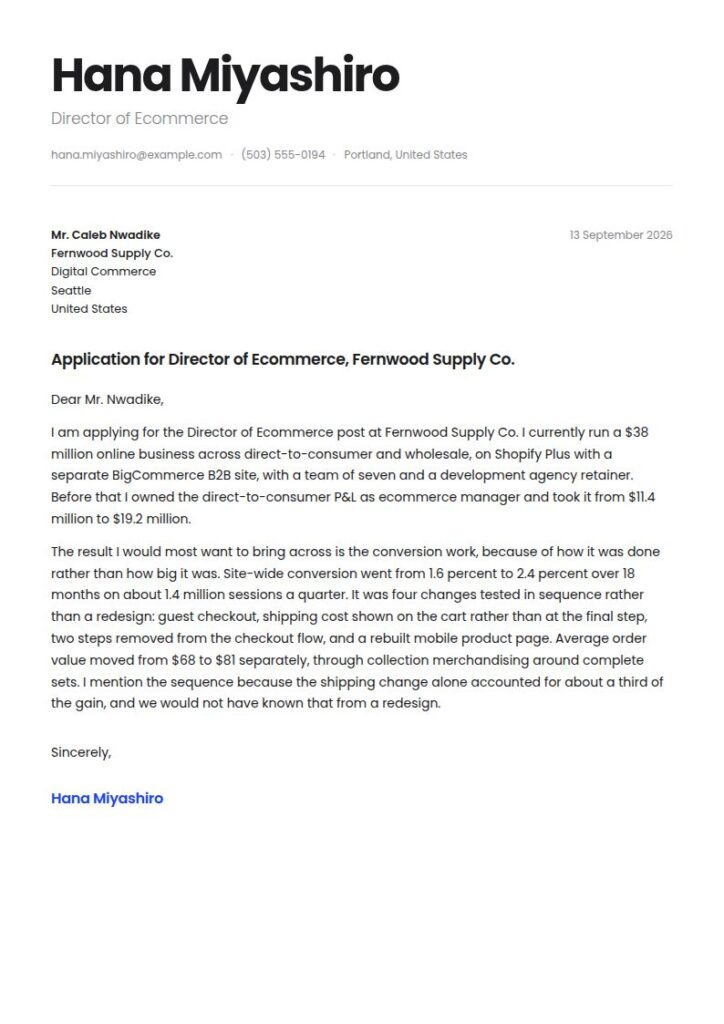
I am applying for the Director of Ecommerce post at Fernwood Supply Co. I currently run a $38 million online business across direct-to-consumer and wholesale, on Shopify Plus with a separate BigCommerce B2B site, with a team of seven and a development agency retainer. Before that I owned the direct-to-consumer P&L as ecommerce manager and took it from $11.4 million to $19.2 million.
The result I would most want to bring across is the conversion work, because of how it was done rather than how big it was. Site-wide conversion went from 1.6 percent to 2.4 percent over 18 months on about 1.4 million sessions a quarter. It was four changes tested in sequence rather than a redesign: guest checkout, shipping cost shown on the cart rather than at the final step, two steps removed from the checkout flow, and a rebuilt mobile product page. Average order value moved from $68 to $81 separately, through collection merchandising around complete sets. I mention the sequence because the shipping change alone accounted for about a third of the gain, and we would not have known that from a redesign.
I have spent time on your store, and the first thing I would look at is returns rather than traffic. Your category carries fit and dimension risk, and in my last role the return rate fell from 18.9 percent to 15.2 percent once we put measured dimensions, materials and in-room photography on the highest volume product pages. That moved contribution margin more than any acquisition work we did that year, and it is usually the cheapest win available in a store that has been optimizing the top of the funnel.
I have run a Magento 2 to Shopify Plus migration end to end, so a replatform in the first year would not be new ground. I am based in Portland and available at four weeks' notice. Thank you for your time.
Sincerely, Hana Miyashiro
Openings that work
| Instead of | Use |
|---|---|
| I am a results-driven ecommerce professional with a passion for online retail | I run a $38 million online business across direct-to-consumer and wholesale, on Shopify Plus with a BigCommerce B2B site |
| I am writing to express my interest in your ecommerce manager position | I am applying for the Director of Ecommerce post, and I have run this store size on both Magento and Shopify Plus |
| I have significantly improved conversion rates and driven revenue growth | Site-wide conversion went from 1.6 percent to 2.4 percent over 18 months on 1.4 million sessions a quarter |
| I am highly analytical and data-driven | Return rate fell from 18.9 percent to 15.2 percent, which moved margin more than any acquisition work that year |
Notice what the right column never does: it never uses a percentage without a baseline, and it never claims a company number as a personal one.
Pick one number and defend it
The second paragraph is the whole letter. Choose the metric that matches what the posting is worried about, then show the working.
| If the posting emphasizes | Lead with |
|---|---|
| Growth and scale | Revenue with both ends, and the split between traffic and on-site improvement |
| Site performance and UX | Conversion rate with the sequence of changes that moved it |
| Margin and profitability | Return rate and contribution margin after returns and shipping |
| Merchandising and assortment | Average order value, sell-through and the collection or bundle work behind it |
| Retention | Repeat purchase rate or email and SMS share of revenue |
| A replatform or migration | Platforms, catalog size, cutover window and what happened to revenue and organic traffic |
The two numbers most letters leave out
The average documented online shopping cart abandonment rate is 70.22 percent across 50 separate studies, with extra costs such as shipping, tax and fees the leading stated reason at 40 percent, followed by slow delivery at 20 percent and being required to create an account at 18 percent (Baymard Institute, cart abandonment rate list, updated September 2025).
Returns are the second leak. The National Retail Federation expected $849.9 billion of merchandise returns in 2025, equal to 15.8 percent of annual retail sales, with an estimated 19.3 percent of online sales returned (National Retail Federation, 15 October 2025).
Meanwhile the channel keeps growing: U.S. retail ecommerce sales were an estimated $340.2 billion in the second quarter of 2026, up 12.2 percent year on year and 17.1 percent of total retail sales (U.S. Census Bureau, Quarterly Retail E-Commerce Sales, released 18 August 2026). Growth is not the hard part of this job, and a letter about growth alone answers a question the hiring manager did not ask.
What changes between a brand, a retailer and a marketplace seller
Name the platform and your permission level on it, because ramp-up time is a real cost to them. Give the revenue scale so the reader can size your claims. Defend one metric properly rather than listing six. Say something specific about their store that you could only know by using it. If you are writing to a marketplace seller, talk about listing quality, buy box and fee structure rather than site conversion, since those are the levers they actually have.
Do not claim a company-wide revenue figure when you owned one channel. Do not quote a percentage improvement without its baseline; it is the fastest way to lose a reader who reads analytics all day. Do not send a letter with no platform in it. Do not describe a redesign as though it were a test. Do not write to a retailer as though they were a brand: their constraint is usually the store estate, the assortment and the existing enterprise stack, not a greenfield build.
The differences change which paragraph you lead with. A direct-to-consumer brand cares most about conversion, basket and retention, because it owns the whole funnel. A multichannel retailer cares about the interaction between site and stores: click and collect, store fulfillment, inventory visibility and the returns path between the two. A marketplace seller lives inside someone else's checkout, so the levers are listing quality, pricing, fulfillment performance and fee structure.
Length, format and sending it
Four paragraphs, 250 to 400 words, one page. An ecommerce hiring manager reads a stack of files between stand-ups, and a longer letter does not read as more thorough.
PDF unless the portal says otherwise, named for yourself and the post: hana-miyashiro-director-of-ecommerce-cover-letter.pdf. Do not attach a dashboard screenshot; it will not survive the applicant tracking system, and if the numbers are a former employer's it should not be traveling by email anyway.
Keep every figure identical to the ones on your resume, because a mismatch between the two is the one error a numerate reader will definitely catch. Our ecommerce resume example is written with the same figures used here.
Key takeaways
- Open with the store, the platform and the revenue scale, in one sentence.
- Spend the second paragraph on one metric, with baseline, mechanism, result and period.
- Never write a percentage change without its baseline.
- Say something about their store that you could only know by using it.
- Match the metric you lead with to what the posting is worried about.
- Name the platform and your permission level, because ramp-up time is a cost to them.
- Keep every number identical to your resume, and keep the letter to one page.
Write your ecommerce cover letter in 10 minutes.
Ecommerce cover letter questions, answered
How long should an ecommerce cover letter be?
Four paragraphs and 250 to 400 words. The length is not what persuades; the defended number is. If the letter runs long it is usually because it is listing metrics rather than explaining one.
What if I cannot share my store's real numbers?
Use ratios and relative changes rather than absolute revenue. "Conversion from 1.6 percent to 2.4 percent" and "return rate from 18.9 percent to 15.2 percent" give a reader everything they need without disclosing revenue, and the category plus rough session volume is usually enough for scale. If you signed something restricting even that, say so in one clause and give the mechanism instead of the number.
Should I mention the platform in the cover letter?
Yes, in the first paragraph, with your permission level. Shopify Plus store owner, Magento admin, BigCommerce admin and headless front end are different jobs, and the hiring manager's second question after "what did you move" is "how long before you are useful in our stack".
How do I write this with no ecommerce job title yet?
Write from whatever part of the funnel you have touched. Customer service tickets tell you why people return things; warehouse work tells you what click to ship costs; retail floor work tells you how people choose. Pick the one that connects to the role, name what you saw and what you changed because of it, then say which platform you have hands-on access to, even if it is a store you built yourself.
Should I mention a replatform I have run?
Yes, with specifics: the two platforms, the catalog size, the URLs redirected, the cutover window and what happened to revenue and organic traffic through it. Replatforms are the most visible way an ecommerce career can go wrong, so a clean one is evidence that is hard to fake.