Corrine Ashcombe Event Manager, Commercial Exhibitions Providence, 02903, United States [email protected] · (401) 555-0517
14 September 2026
Mr. Fintan Trevaskis Commercial Thurlow Trade Events Hartford, United States
Application for Senior Event Manager, Thurlow Trade Events
Dear Mr. Trevaskis,
I am applying for the Senior Event Manager post at Thurlow Trade Events. I currently run a six-show portfolio worth $4.1 million in revenue and $1.4 million in contribution, and I sign venue, general services contractor, registration and production agreements up to $150,000 each, a contracted value of about $790,000 a year. The flagship in that portfolio closed its 2026 edition $50,000 ahead of its contribution budget with reconciliation finished 24 days after move-out.
The piece of work I would most want to bring is one I recommended against my own portfolio. Our food service equipment show carried $84,000 of contribution in 2023 and lost $31,000 by 2025, with exhibitor rebook falling from 61 percent to 38 percent over the same period. Rather than repricing it for a third time I built the case for folding it into the flagship as a co-located pavilion and took that to the commercial director. It removed $190,000 of direct cost, kept 71 percent of its exhibitors, and it is the only year I have deliberately made my own portfolio smaller.
Thurlow runs four shows in adjacent building and infrastructure sectors and has announced a second marine event for 2027, which is the part of your calendar I would want to work on, because a new launch is where portfolio discipline either gets built or gets skipped. On the existing shows the first thing I would look at is the rebook mechanism. Moving our rebook desk into the exhibitor lounge and pricing the on-site rate against the post-show rate took us from 54 percent to 68 percent in three editions, and it cost nothing.
I hold the Certified in Exhibition Management designation and manage three coordinators, so the floor runs properly while I am with exhibitors and sponsors. I can start with six weeks of notice, which would put me in place before your spring move-in. Thank you for your time.
Sincerely, Corrine Ashcombe, CEM
Summary
An event manager cover letter opens with the portfolio and the money, names the contracts that carry your signature, and spends its strongest paragraph on an event you changed or stopped. This guide gives you a full adaptable letter, what to write when your events are funded rather than sold, and the openings that separate a manager from a very good coordinator.
Event Manager cover letter examples by experience level
An event manager cover letter is a one-page letter that answers a commercial question, not an operational one.
The reader already assumes you can deliver an event, because everyone who applies can. What they do not know is whether you can be handed a budget line and a calendar and trusted to say what the events are for, what they may cost, what they must return, and which of them should stop. That is the job, and the letter is where you show you have done it.
Guide to an event manager cover letter
This guide and the corresponding event manager cover letter example will cover:
- How to structure the letter, paragraph by paragraph
- Why the portfolio and the money belong in the first three sentences
- Why the event you changed or stopped is your strongest paragraph
- What to write when your events are funded internally rather than sold
- The openings that separate a manager from a very good coordinator
How to write an event manager cover letter
| Paragraph | Its job | Length |
|---|---|---|
| Opening | The post, the portfolio, the money, the signing limit | 3 sentences |
| Evidence | One commercial decision you made and what it did | 4 to 5 sentences |
| Fit | Something concrete about their portfolio and what you would look at first | 3 to 4 sentences |
| Close | Credential, team, notice period, thank you | 2 sentences |
Open with three numbers a finance director would recognize
The first sentence should place you commercially. Events a year, what they are worth, and what you are trusted to sign.
"I run a six-show portfolio worth $4.1 million in revenue and $1.4 million in contribution, and I sign venue, contractor, registration and production agreements to $150,000 each" does all three in one line and could be confirmed in a single reference call.
Reach for contribution or budget answered for, rather than attendance. Attendance describes a crowd. Contribution describes what the organization got for funding you, and the person hiring an event manager reports to somebody who thinks in that unit.
If your events are funded rather than sold, use the internal measure instead: cost per qualified opportunity, renewal among attendees, non-dues revenue. Use the number your own finance or marketing team already publishes.
An event manager cover letter example you can adapt
Dear Mr. Trevaskis,
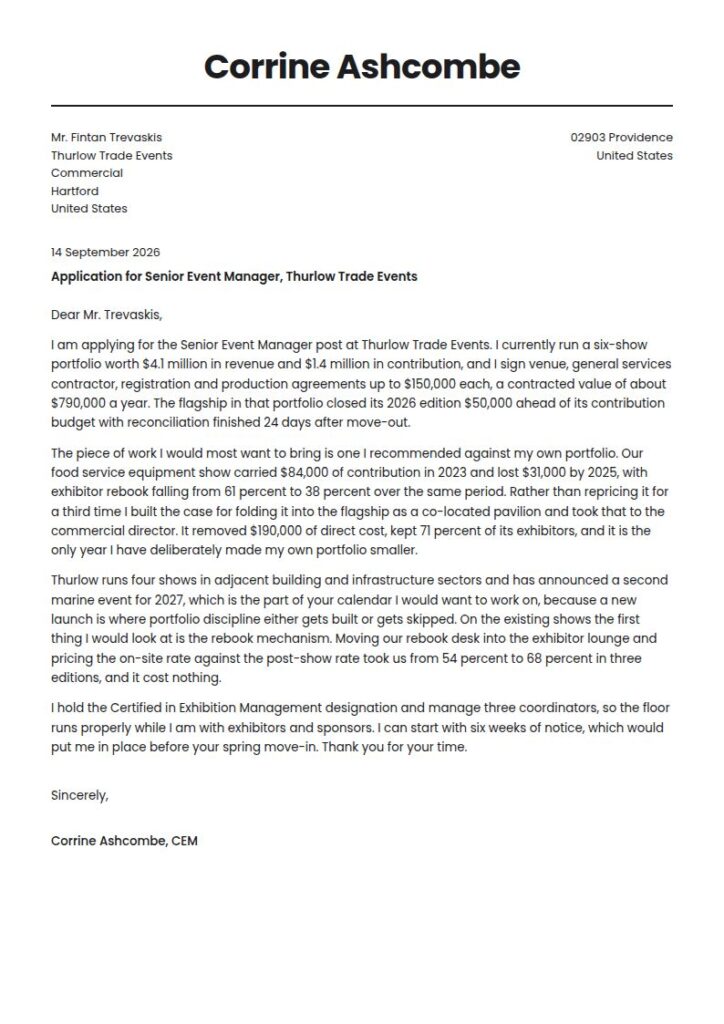
I am applying for the Senior Event Manager post at Thurlow Trade Events. I currently run a six-show portfolio worth $4.1 million in revenue and $1.4 million in contribution, and I sign venue, general services contractor, registration and production agreements up to $150,000 each, a contracted value of about $790,000 a year. The flagship in that portfolio closed its 2026 edition $50,000 ahead of its contribution budget with reconciliation finished 24 days after move-out.
The piece of work I would most want to bring is one I recommended against my own portfolio. Our food service equipment show carried $84,000 of contribution in 2023 and lost $31,000 by 2025, with exhibitor rebook falling from 61 percent to 38 percent over the same period. Rather than repricing it for a third time I built the case for folding it into the flagship as a co-located pavilion and took that to the commercial director. It removed $190,000 of direct cost, kept 71 percent of its exhibitors, and it is the only year I have deliberately made my own portfolio smaller.
Thurlow runs four shows in adjacent building and infrastructure sectors and has announced a second marine event for 2027, which is the part of your calendar I would want to work on, because a new launch is where portfolio discipline either gets built or gets skipped. On the existing shows the first thing I would look at is the rebook mechanism. Moving our rebook desk into the exhibitor lounge and pricing the on-site rate against the post-show rate took us from 54 percent to 68 percent in three editions, and it cost nothing.
I hold the Certified in Exhibition Management designation and manage three coordinators, so the floor runs properly while I am with exhibitors and sponsors. I can start with six weeks of notice, which would put me in place before your spring move-in. Thank you for your time.
Sincerely, Corrine Ashcombe, CEM
Openings that work
| Instead of | Use |
|---|---|
| I am an experienced events professional with a passion for live experiences | I run a six-show portfolio worth $4.1 million in revenue and $1.4 million in contribution |
| I am writing to express my interest in your event manager vacancy | I am applying for the Senior Event Manager post and sign contracts to $150,000 each |
| I have a proven record of delivering successful large-scale events | The flagship closed $50,000 ahead of its contribution budget, reconciled 24 days after move-out |
| I am highly organized and thrive under pressure | I manage three coordinators, so the floor runs properly while I am with exhibitors |
The right column is what a manager sounds like. The left column is what a very good coordinator sounds like, and if that is what the letter says, that is the job the reader will offer.
Write the event you changed or stopped
Give this its own paragraph. It is the one thing in an event manager's letter that a coordinator could not write, and most applicants leave it out because it feels like an admission.
It is the opposite. An event that grew every year for five years proves the market was good. An event you reviewed, judged, and then changed, repriced, merged or closed proves you were doing the job you are now applying for.
Five sentences: the trend over at least two editions, the measure that failed, what you recommended, who decided, and what happened afterwards.
| Kind of decision | What it looks like in a sentence |
|---|---|
| Closed | Contribution fell from $84,000 to a $31,000 loss over two years; I recommended closure and carried it |
| Merged | Folded a declining show into the flagship as a co-located pavilion, keeping 71 percent of its exhibitors |
| Reformatted | Moved a two-day conference to a one-day format after 62 percent of attendees left before the second morning |
| Repriced | Rebuilt the sponsorship inventory into four tiers and grew sponsorship from $180,000 to $310,000 |
| Moved | Changed the date after a venue availability clash forced a competing week two years running |
| Declined | Recommended against a new launch after the pre-sale reached 31 percent of the floor by the decision date |
Keep it mechanical and keep it to one. Name no exhibitor, sponsor, client, vendor or colleague, and do not attribute the decline to anybody. The event stopped working; you noticed, you measured it, and you acted.
What to write when your events are funded rather than sold
Most event managers work in-house, where nobody buys a ticket and the event is a line in somebody else's budget. The commercial argument still exists; it is just written in a different currency.
Name the sponsor and their measure. Marketing funds events for pipeline and launch coverage. Membership funds them for renewal. Human resources funds them for retention and onboarding. Sales funds them for meetings with named accounts. Ask what your event's budget was approved against and write that, because it is the sentence your reader will recognize.
Then give the return in the organization's own reporting, not in a number you built for the letter. Cost per qualified opportunity, attendance by target account, renewal rate among attendees, non-dues revenue, applications received. Say who publishes the figure. A number that comes out of the finance or marketing system carries far more weight than a number that comes out of your spreadsheet.
A measured sector, and the pay band that follows ownership
Business events are large enough to be measured properly, which is why a commercial vocabulary is available to you. The Events Industry Council, working with Oxford Economics across more than 180 countries, reports that business events generated US$1.3 trillion in direct spending in 2025 with 1.65 billion participants, supporting 9.7 million direct jobs and US$759 billion in direct GDP (Events Industry Council, 2026 Global Economic Significance of Business Events, published 15 May 2026).
The federal picture is where the pay argument sits. Meeting, convention and event planners numbered 172,100 in 2025, are projected at 182,100 in 2035, a 6 percent rise described as faster than the average for all occupations, with about 16,800 openings a year and a median annual wage of $61,160 in May 2025 (U.S. Bureau of Labor Statistics, Occupational Outlook Handbook, published 27 August 2026). General and operations managers, where a director of events carrying a portfolio and a team is often counted, had a median of $105,770 and employment of 3,599,000, projected to rise 5 percent, or 181,300 jobs, to 2035 (BLS, same cycle).
That gap is not seniority in the abstract. It is ownership: a budget line answered for, contracts signed, people managed and events that can be stopped. Which of those two rows your letter sounds like is a choice you make in the first paragraph.
Open with events a year, what they were worth and what you can sign. Give one commercial decision in full. Say what the event was funded for, in the funder's words. Use a return figure your organization already publishes. Name something concrete about their portfolio. State the team you manage and your notice period.
Do not describe the run of show; at this level it is assumed and it reads as the job below. Do not claim a budget you tracked rather than answered for. Do not name an exhibitor, sponsor, client, vendor or colleague. Do not send a letter that could go to any organizer. Do not call an event successful without the measure it was judged on.
Length, format and sending it
One page, four paragraphs, 250 to 400 words, PDF unless the portal asks otherwise, named for yourself and the post.
Address a person. Commercial event teams are small and publicly listed, and a letter that is otherwise specific undoes itself with a salutation to nobody.
Spend twenty minutes on their calendar before you write. A new launch, a show that moved venue, a sector that has consolidated, a date that now collides with a bigger event: any of those gives you the concrete sentence the third paragraph needs. Keep every figure identical to your resume; our event manager resume example uses the same portfolio, and the free ATS checker will read the file before a person does.
Key takeaways
- Open with events a year, revenue or budget, and your signing limit.
- Give contribution or the figure you answered for, not attendance.
- Spend the second paragraph on one commercial decision, in five sentences.
- Include the event you changed or stopped; a coordinator could not write it.
- Translate into the funder's measure when your events are not sold.
- Name one concrete thing about their calendar and what you would look at first.
- One page, a named recipient, figures matching the resume.
Write your event manager cover letter in 10 minutes with our AI cover letter builder.
Event manager cover letter questions, answered
How long should an event manager cover letter be?
One page, four paragraphs, 250 to 400 words. These are read alongside forty others by somebody who is also building a calendar, and the commercial judgment they are making is settled in the first three sentences.
What if I have never had signing authority?
Say exactly what you did hold. "Negotiated and redlined venue, production and registration agreements for signature by the commercial director; held the certificate of insurance file" is precise and a reader respects it. Then name the next step you are ready for, because an employer would rather read an accurate account plus a stated ambition than a vague implication of authority that a reference call will unpick.
How do I write about an event that failed?
Write it as a decision rather than a disaster. The trend over two or more editions, the measure that failed, what you recommended, who decided, and what happened. That is a manager's account. A story about a bad day on site is a coordinator's account, and it belongs in a different letter.
Do I mention the team I manage?
Yes, in the closing paragraph, and say what it buys the reader. "I manage three coordinators, so the floor runs properly while I am with exhibitors and sponsors" tells them you will not disappear into logistics the moment something needs chasing, which is the specific worry about promoting a strong coordinator into a manager seat.
My events are internal and nobody buys a ticket. What is my equivalent of revenue?
Whatever the budget was approved against. Pipeline, launch coverage, renewal, retention, applications, member attendance share. Report it in your organization's own numbers and say who publishes them. The Handbook notes that no prior work experience in a related occupation is typical for entry to this occupation (BLS Occupational Outlook Handbook, published 27 August 2026), which is why the field is crowded and why a funder's measure in your first paragraph moves you past most of the folder.