

Summary
Put a job you were fired from on your resume if you held it for several months, it shows skills the new role needs, or removing it leaves a visible gap. Leave it off if it lasted only weeks and adds nothing. Never write "fired" on the resume itself. List the job like any other, with results-focused bullets, then answer honestly when an application or interviewer asks why you left.
Should I put a job I was fired from on my resume? Usually yes, if you held it for several months and it proves relevant skills. Being fired from a job does not erase what you accomplished there, and a resume never has to say how a job ended.
Leave it off only when the job was brief, unrelated, and removing it creates no noticeable gap. The harder part is not the resume. It is the application form, the background check, and the interview question that follows.
This guide gives you a decision rule, copy-ready resume lines, and the honesty lines you should never cross.
Should I put a job I was fired from on my resume?
Yes, in most cases. Include the job if you worked there for several months, it shows skills the new role needs, or leaving it off would create an obvious gap. Omit it if it lasted only a few weeks, adds nothing relevant, and your timeline stays clean without it. The resume lists the job, not the reason it ended.
A resume is a marketing document, not a sworn employment history. Boston University's resume guide tells students to "include only the positions and experience that will prove your qualifications". That rule applies to every job, including one that ended badly.
So the question is not "Was I fired?" It is "Does this job help my case more than the gap would hurt it?"
Being let go is also more common than it feels. The Bureau of Labor Statistics counted 1.7 million layoffs and discharges in July 2026 alone. Hiring managers have seen plenty of candidates who were fired from a job and went on to do well.
How do you decide whether to include it?
Weigh three factors: how long you held the job, how relevant it is to the role you want, and whether removing it leaves a gap. A long, relevant job almost always stays. A short, unrelated job with no gap usually goes. When the factors conflict, the gap usually decides it, because unexplained gaps prompt more questions.
Use this table as your decision rule. Find the row that matches your situation.
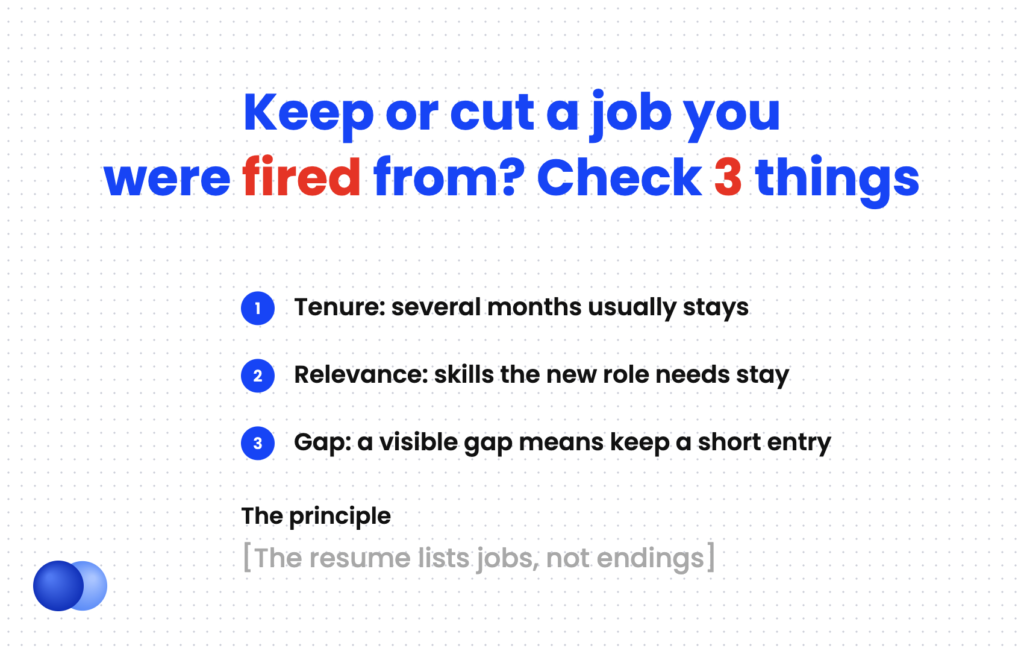
| Your situation | Include on resume? | Why |
|---|---|---|
| Held 6+ months, relevant to target role | Yes | Your results there are proof of skill |
| Held 6+ months, unrelated, only recent job | Yes | Removing it creates a long gap |
| Held a few weeks, unrelated, no gap | Usually no | Adds nothing and invites questions |
| Held a few weeks, but fills a gap of several months | Yes, as a short entry | A short entry beats an unexplained gap |
| It was your only experience in the field | Yes | Relevance outweighs the ending |
| Several recent firings in a row | Keep the strongest ones | A cluster of short stints reads as a pattern |
Tenure matters because recruiters compare it with the norm. BLS reports that median tenure with a current employer was 4.1 years in January 2026, and 1.5 years for workers ages 20 to 24. A single short job rarely stands out. A string of them does. Our sibling guide on how many jobs you should list on a resume covers how to trim older roles.
If the job was very brief and you quit rather than being let go, see our companion guide on whether to list a job you quit after a month.
What should you write for a job you were fired from?
Write the entry exactly as you would for any other job: title, employer, location, dates, and two to four results-focused bullets. Do not add "terminated," "let go," or a reason for leaving. Resumes do not include reasons for leaving any job, so leaving it out is standard practice, not concealment.
No resume lists why each job ended. Adding "fired" would make yours the only one that does. Focus the bullets on what you delivered while you were there.
Customer Success Specialist | Brightline Software, Austin, TX | Mar 2025 – Nov 2025
- Managed onboarding for 40+ mid-market accounts in HubSpot and Zendesk
- Cut average first-response time from 9 hours to 4 by building a shared macro library
- Trained 3 new hires on the support workflow and escalation rules
For a short job you keep only to cover a gap, one line is enough. It shows the dates are accounted for without drawing attention.
Sales Associate | Harbor Outdoor Supply, Portland, OR | Jun 2025 – Aug 2025
- Handled point-of-sale and inventory counts in a high-volume seasonal store
Use the same date format as your other jobs. If you use month and year elsewhere, use it here too. Switching to years only for one job looks like hiding. Our guide on writing work experience on a resume covers bullet structure in more depth.
Can you leave it off, and will employers find out?
You can leave a job off your resume. But a background check or an application asking for full work history may surface it. Employers need your written permission to run a background check through a reporting company. If a form asks you to list every employer or asks whether you were ever fired, answer truthfully.
Omitting a job from a resume is legal and common. The risk comes later, in documents you sign.
The Federal Trade Commission explains that employers must get your written permission before running a background check with a reporting company. Those checks can include employment history. If a report contains something inaccurate, you have the right to dispute it.
Former employers are often cautious about what they share. SHRM advises employers with limited-reference policies to consider confirming titles and dates of employment and little else. Do not count on that, though. Policies vary, and a former manager may still speak informally.
Federal jobs set a stricter bar. The OPM's Declaration for Federal Employment asks whether, during the last 5 years, you have "been fired from any job for any reason", quit after being told you would be fired, or left by mutual agreement because of problems. The form warns that a false statement can be grounds for not hiring you or firing you later.
Resume can be selective, applications cannot
Treat your resume and your application as two different documents. The resume can leave out a job. A signed application that asks for all employment, or asks whether you were ever fired from a job, needs a complete and truthful answer. Keep a private master list of every employer and date so your answers stay consistent.
How do you answer "reason for leaving" on an application?
Application forms often have a small "reason for leaving" box. Short, honest phrasing works best:
- "Terminated. Role was not a fit for my strengths; happy to discuss."
- "Let go during probation. Will discuss in interview."
- "Position ended. Will discuss in interview."
Use the last one only if it is accurate. If the application asks directly, "Have you ever been terminated?", answer yes. Our guide to reasons for leaving a job has more wording for different situations.
A layoff is different from being fired. If your role was cut for business reasons, say so plainly. Our resume after being laid off guide covers that case.
How do you explain being fired from a job in an interview?
Use a three-part answer: state what happened in one sentence, name what you learned or changed, then pivot to why you fit this role. Keep it under 30 seconds. Take responsibility where it applies, avoid blaming your former manager, and never lie, since references or background checks can contradict you.
Interviewers care less about the firing than about how you talk about it. A calm, brief answer signals maturity.
Try this structure:
- What happened. "I was let go after eight months. My sales numbers were below target."
- What changed. "I realized I work best with a consultative sales cycle, not high-volume cold calling. I took a course in solution selling."
- Why this role fits. "This role focuses on account management, which is where my results were strongest."
If you were fired from a job for misconduct, the same structure applies, but ownership matters more. Name the mistake, show what you have done since, and stop. Practice aloud until it sounds natural.
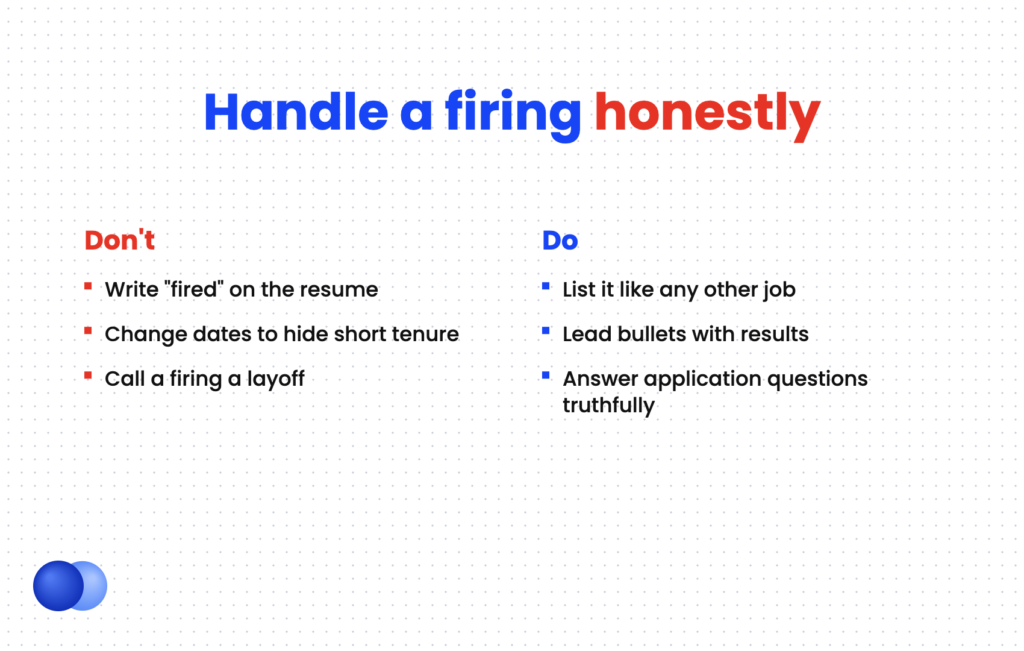
List the job with the same format as your other roles do: Focus bullets on results you delivered there do: Answer application questions about firing truthfully do: Prepare a short, calm interview answer
Write "fired" or "terminated" on the resume dont: Change dates to hide a short tenure dont: Blame or criticize your former employer dont: Call a firing a layoff or a resignation
What if you were fired more than once?
Multiple firings call for more careful curation. Keep the jobs that show the strongest, most relevant results, and drop very short, unrelated ones where no gap results. Consider a combination format that leads with skills. In interviews, show the pattern has changed by pointing to a longer, stable role or new training.
One firing is a story. Several can look like a pattern, so your resume needs to show momentum.
Start by removing jobs older than 10 to 15 years, which most candidates can drop anyway. Our guide on how far back a resume should go explains the cutoff. Then decide on each recent job using the table above.
A hybrid or combination layout can lead with skills and achievements before the timeline. Compare options in our resume format types guide. Avoid a purely functional resume with no dates, since many recruiters read it as a sign of hidden problems.
Choose references carefully, too. A former colleague or a manager from a different role can speak to your work. Once your experience section is drafted, Rezoom's AI resume builder can help you rewrite bullets so they lead with results.

Frequently asked questions
Do I have to put a job I was fired from on my resume?
No. A resume is a selective document, so you can omit any job. Include it when it shows relevant skills or when leaving it off creates a gap.
Should I write "fired" or "terminated" on my resume?
No. Resumes do not list reasons for leaving any job. Save the explanation for application questions and interviews, where you should answer honestly.
Will a new employer know I was fired from a job?
Possibly. A background check or reference call can reveal it, though many employers limit references to dates and titles. Assume it may come up, and prepare an honest answer.
Can I leave a job off my application if I was fired?
Only if the application does not ask for complete work history. If it asks for all employers or whether you were ever fired, a false or incomplete answer can cost you the offer or the job.
How long should I have worked somewhere to include it after being fired?
There is no fixed rule. A few weeks with no gap can usually go. Several months of relevant work usually stays, because the results are worth more than the risk.
Can I use a manager from a job I was fired from as a reference?
Only if you are confident they will speak well of your work. Otherwise, ask a peer or a manager from another role at that company.



Comments