Felony on Job Application: How to Answer the Question
Asked about a felony on job application forms? Learn what the question covers, when sealed records count, fair-chance laws and what to write and say.

On this pageWhat does a felony on job application forms actually cover?
- What does a felony on job application forms actually cover?
- Should you tell the truth about a felony on a job application?
- Can employers ask about a felony? Ban-the-box and fair-chance laws
- How do you answer the felony box when the form requires it?
- How do you talk about a felony in an interview?
- How can your resume and cover letter help?
- What should you check before you submit?
- FAQ
- Sources
If a job application asks about felony convictions, answer honestly, because the background check will show the record and a false "no" can cost you the offer. The question covers convictions, not arrests. Sealed or expunged records often don't count, depending on your state. Many states and cities delay the question until later in hiring. Keep any explanation short, factual and focused on what changed.
If a form asks about a felony on job application pages, answer the exact question honestly. It covers convictions, not arrests. Then use the explanation field for one short, factual note on what changed.
A record does not end your search. Many states and cities now delay the question until after an interview or offer. And employers still have to look at the whole person, not just a checkbox.
This is general information, not legal advice. Rules differ by state, so check your own state's law or a legal aid office.
Quick answers by situation
| Your situation | What to say/do | Example line |
|---|---|---|
| Felony conviction, not sealed | Check "yes" and add a short note | "Yes. 2019 conviction, sentence complete, steady work since 2021." |
| Arrest with no conviction | Check "no" if the form asks about convictions only | "No." (An arrest is not a conviction.) |
| Misdemeanor only | Check "no" if the form asks about felonies only | "No." |
| Record sealed or expunged | Often "no", but check your state's rules and the job type | "No." (only if your state allows it for this job) |
| Conviction older than the form's time limit | Check "no" if it falls outside the window, such as 7 years | "No." |
| Case still open or pending | Answer what the form asks; a pending charge is not a conviction | "No convictions. I can discuss a pending matter if needed." |
What does a felony on job application forms actually cover?
The question usually covers convictions only, not arrests or charges that were dropped. It may ask about felonies, misdemeanors or both, and it may set a time limit like "within the last 7 years." Sealed or expunged records often don't count. Read the exact wording, then answer only what it asks.
Most forms ask some version of "Have you ever been convicted of a felony?" The words matter. So read each part before you click.
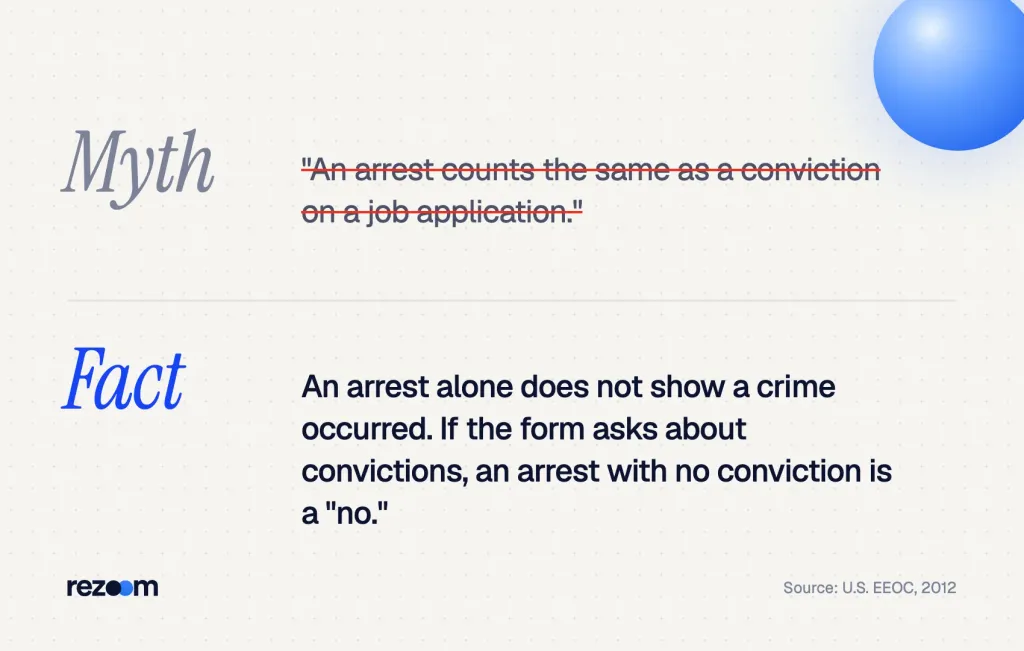
Conviction vs. arrest
A conviction means a court found you guilty, or you pleaded guilty or no contest. An arrest alone is not a conviction. The EEOC makes this point in its guidance on criminal records.
The fact of an arrest does not establish that criminal conduct has occurred.
U.S. Equal Employment Opportunity Commission, 2012
The EEOC guidance1 adds that a conviction record "will usually serve as sufficient evidence" of the conduct. So if the form asks about convictions, an arrest with no conviction means you check "no."
Felony vs. misdemeanor, sealed records and time limits
| What the form says | What it includes | What it leaves out |
|---|---|---|
| "Convicted of a felony" | Felony convictions | Arrests, misdemeanors, dropped charges |
| "Convicted of a crime" | Felonies and misdemeanors | Arrests with no conviction |
| "In the last 7 years" | Convictions inside that window | Older convictions |
| "Including sealed records" | Some jobs may require it | Depends on state law and job type |
Sealed and expunged records follow state law. In Illinois, Illinois Legal Aid Online5 says you do not have to tell employers about expunged or sealed records. But jobs that need fingerprint checks, like schools and healthcare, may still see sealed records.
California works in a similar way. The Legal Aid Foundation of Los Angeles expungement FAQ6 says you do not have to report expunged convictions if asked. Still, it lists exceptions for many government and healthcare jobs and for licensing boards.
Order a copy of your state record before you apply. Then you know exactly what a check will show, which charges ended in a conviction and what dates to use.
Should you tell the truth about a felony on a job application?
Yes. Most employers run a background check before you start, and it will show any record that is not sealed. A false "no" often hurts more than the record itself, because it turns a past mistake into a fresh honesty problem. An honest "yes" with a short note keeps the door open.
Lying about a felony on job application forms is the bigger risk. The record can come up in a background check, and the mismatch can end the offer or the job later.
Federal law also gives you rights in that check. The FTC and EEOC4 say an employer must get your written permission before it runs a background report from a screening company. If it plans to reject you based on that report, it must first send you a copy of the report and a summary of your rights.
That notice gives you a chance to explain or fix errors. So an honest answer up front and a calm follow-up put you in a stronger spot than a "no" the report contradicts.
Why honesty works in your favor
- No surprise: the hiring manager hears your story from you, not from a report.
- Context: you get to add dates, what you did since, and why you fit the job.
- Trust: a short, honest answer shows the same reliability the employer wants.
Reason for leaving on job application examples for layoffs, contracts, school, moves and firing: the exact words to type, what HR checks and what to avoid.
Can employers ask about a felony? Ban-the-box and fair-chance laws
Often yes, but the timing depends on where you apply. Federal agencies and federal contractors can't ask before a conditional offer under the Fair Chance to Compete for Jobs Act. Many states and cities have similar "ban-the-box" rules. Private employers in other places may still ask on the first form.
"Ban the box" means removing the conviction checkbox from the first application. Employers can still run a check, but usually later in hiring.
The federal Fair Chance Act
The Fair Chance to Compete for Jobs Act of 2019 covers federal jobs. OPM2 says it bars federal agencies and federal contractors from asking about criminal history before a conditional offer of employment. OPM's 2023 rules also give applicants a complaint process.
State and city laws
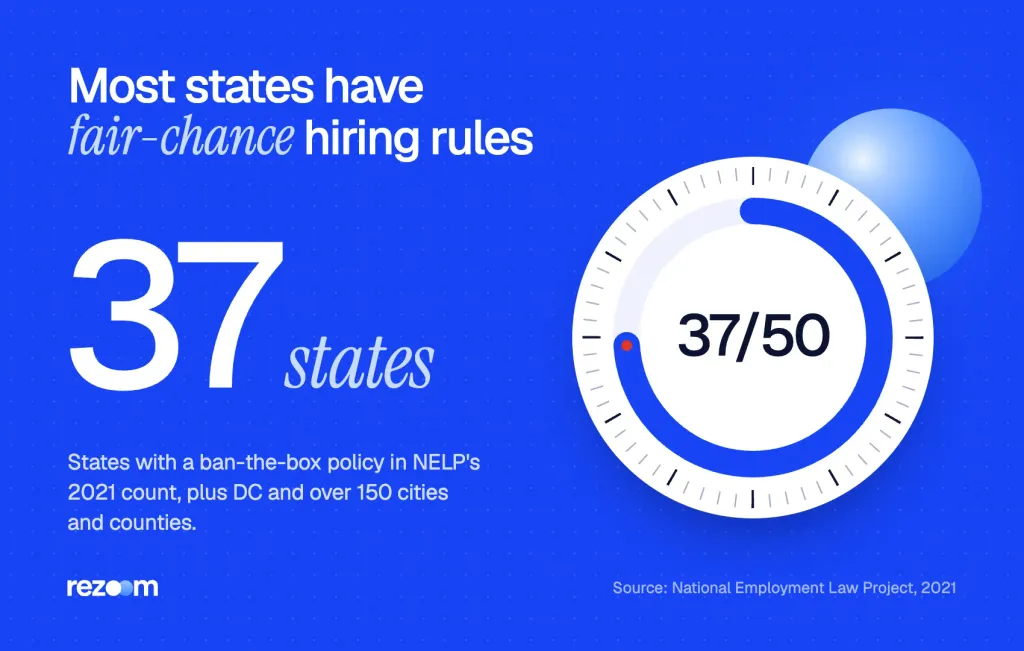
The National Employment Law Project tracks these laws in its ban-the-box guide3. As of its 2021 count, 37 states, the District of Columbia and over 150 cities and counties had a fair-chance policy. Only 15 states and 22 cities and counties extended those rules to private employers.
So the same question may be legal at one store and banned at a city job across the street. If you think a form broke your local law, a legal aid office can tell you your options.
What the EEOC expects
The EEOC recommends1 that employers not ask about convictions on job applications. When they do look at a record, it points to three factors:
- The offense: how serious it was.
- Time: how long ago it happened or the sentence ended.
- The job: how the offense relates to the duties.
That means an old conviction that has nothing to do with the work should weigh less. You can use those same three points in your own answer.
How do you answer the felony box when the form requires it?
Check "yes" if you have a conviction that fits the question's wording. Then use the explanation field for two or three plain sentences: the offense type and year, that your sentence is complete, and what you have done since. Skip details of the case and don't argue with the court's decision.
- Read the wordingNote whether it asks about felonies, all crimes, a time window or sealed records.
- Match your recordCompare the wording to your own record, dates and any sealing or expungement order.
- Check the box honestlyPick "yes" only for convictions the question covers, and "no" for the rest.
- Write a short noteGive the offense type, year, completed sentence and what you have done since.
- Prepare for the callPractice a 30-second spoken version for the interview.
What to write in the explanation field
Keep it under 60 words. Name the offense in general terms, give the year and move fast to the present.
"In 2018 I had a felony conviction for a nonviolent property offense. I completed my sentence in 2020. Since then I have worked full time in a warehouse, earned a forklift certification and kept a perfect attendance record."
"In [year], I had a felony conviction for [general offense type]. I completed my sentence in [year]. Since then, I have [job, training or certification], and I am glad to discuss it in an interview."
When the box says "explain" but you have no room
Some forms give you one line. Then write: "Yes, [year] conviction, sentence complete, happy to discuss in an interview." It answers the question and moves the talk to a place where you can give context.
Do
- Answer the exact question the form asks.
- Give the year and say your sentence is complete.
- Point to work, training or steady attendance since then.
Don’t
- Check "no" for a conviction the question covers.
- Retell the full case or blame the court or others.
- List arrests or sealed records the form doesn't ask about.
Free ATS score, the text the software extracts and your missing keywords. No sign-up.
How do you talk about a felony in an interview?
Keep it short, factual and forward-looking. Take ownership in one sentence, say your sentence is complete, then spend most of your answer on what changed and why you fit this job. Aim for 30 to 45 seconds, then stop and let the interviewer ask more if they want to.
The interviewer wants to know two things. First, can they trust you? Second, can you do this job well?
A three-part answer
- Own it: "In 2019 I made a serious mistake and had a felony conviction."
- Close it: "I completed my sentence and have been on track since."
- Pivot: "For the past three years I have worked as a production associate with no missed shifts."
"In 2019 I made a bad choice and had a felony conviction for a drug offense. I completed my sentence in 2021. Since then I've worked full time on a packaging line, earned my OSHA 10 card and trained two new hires. I'm ready to bring that same reliability here."
The same short style works for other tough form questions. Our guide on how to answer reason for leaving on application when fired uses the same "own it, then move on" pattern. And if you need to say why a past job ended, see the reason for leaving on job application guide.
What to say if they push back
- "Why should we take the risk?" Point to proof: "My last supervisor can speak to my attendance and work. I'm happy to give you her number."
- "What exactly happened?" Stay brief: "It was a nonviolent offense in 2019. I own it, and I've built a steady work record since."
- "Could it happen again?" Show what changed: "I've stayed in steady work, I finished my program and I spend my time on my family and my job."
Interviewer: "I see you checked yes on the felony question. Can you tell me about that?"
"Yes. In 2019 I had a conviction for a property offense, and I completed my sentence in 2021."
Interviewer: "How do I know it won't affect your work here?"
"For three years I've worked on a production line with no missed shifts and no write-ups. My supervisor can confirm that, and I'd be glad to share her contact."
Say your answer out loud five times before the interview. When it feels calm and short, you will sound sure of yourself instead of nervous, and you won't over-explain.
Reason for leaving when fired: copy a short, true phrase for any form field, see what terminated means, and learn what old employers and checks can show.
How can your resume and cover letter help?
Lead with skills, certifications and steady recent work, so the reader sees your value before any background question comes up. You don't list a conviction on a resume. A short cover letter can stress reliability and training. Fair-chance employers in production and manufacturing often hire on skills and attendance.
Your resume does not need to mention a record. Instead, lead with skills and recent results. Browse these production resume examples to see how people show output, safety and attendance.
For a closer match, these production worker resume examples show a skills-first layout that works well for second-chance hiring.
Production worker resume example
A skills-first resume for second-chance hiring roles.
SAM CARTER
Dayton, OH | (937) 555-0147 | sam.carter@email.com
Production associate with 3 years on packaging and assembly lines
OSHA 10 certified; forklift certified
Zero missed shifts in 2025; trained 2 new team members
A cover letter can say the same thing in a warmer voice. This production worker cover letter example leads with reliability and hands-on skills.
Production worker cover letter example
A short letter that leads with reliability and skills.
You can also browse more manufacturing cover letter examples for plant, line and warehouse roles. And if a form asks about past jobs at the same company, see have you ever worked for this company before.
What should you check before you submit?
Before you submit, confirm what the question asks, what your record actually shows and whether your state seals or limits it. Make sure your explanation is short and factual. Then line up a reference who can speak to your recent work and practice your interview answer.
Before you answer the felony question
Next, build a resume that makes your skills the first thing a reader sees. Our AI resume builder helps you write a skills-first summary and clean bullets fast.
Tailored to the job post, checked against ATS.
Frequently asked questions
Do I have to disclose a felony on a job application?
If the form asks and the conviction fits its wording, answer honestly. Some states and cities bar the question on the first form, and federal agencies can't ask before a conditional offer.
Do I have to list an arrest that didn't lead to a conviction?
Not if the question asks only about convictions. An arrest is not a conviction, and the EEOC says an arrest alone does not show that a crime occurred.
Do I have to report a sealed or expunged felony?
Often no, but it depends on your state and the job. Some government, healthcare and licensed jobs can still see or ask about sealed records.
What does "within the last 7 years" mean on the felony question?
It means you only report convictions inside that time window. Count from the date the form names, and if it doesn't say, use the conviction date.
Can a company reject me because of a felony?
It can in some cases, but federal guidance asks employers to weigh the offense, the time passed and the job. If a background report drives the decision, you must get a copy first.
Should I mention my felony in my cover letter?
Usually no. Use the letter to show skills and reliability, and save the record for the form or the interview.
What does a felony on job application forms mean for my chances?
A felony on job application forms is one fact among many. Answer honestly, keep any explanation short and factual, and show what you have done since; many employers hire people with records, and some places limit when they can ask.
Sources
We opened and read each page below. The small numbers in the text point here. Pages that carry no publication date show n.d.
- U.S. Equal Employment Opportunity Commission2012
An arrest does not establish criminal conduct, and the EEOC recommends employers not ask about convictions on job applications.
- U.S. Office of Personnel Management2023
The Fair Chance Act bars federal agencies and contractors from asking about criminal history before a conditional offer.
- National Employment Law Project2021
In 2021, 37 states, DC and over 150 cities and counties had fair-chance policies, and 15 states covered private employers.
- Federal Trade Commission and EEOC2014
Employers need written permission for a background report and must share it before rejecting an applicant based on it.
- Illinois Legal Aid Onlinen.d.
In Illinois you do not have to tell employers about expunged or sealed records, with some exceptions.
- Legal Aid Foundation of Los Angeles2025
In California you do not have to report expunged convictions if asked, except for some government, healthcare and licensed jobs.
Mohammad has spent more than ten years designing consumer products and leads product at Rezoom, deciding what gets built and what gets left out. His guides cover the whole job search, from resume sections and cover letters to interview answers and career moves.
Goodi, M. (2026, November 15). Felony on Job Application: How to Answer the Question. Rezoom. https://rezoom.io/felony-question-on-job-application/