Have You Ever Worked for This Company Before? How to Answer It
Have you ever worked for this company before? Learn when temp, contract and intern work counts, how to answer yes, and what to do if you were fired.

On this pageWhat does "have you ever worked for this company before" mean on an application?
- What does "have you ever worked for this company before" mean on an application?
- Do temp, contract, intern or acquired-company jobs count?
- How do you answer yes on a job application?
- What if you were fired or are not eligible for rehire?
- What happens if you lie and say no?
- How do you talk about it in the interview?
- What should you check before you submit?
- FAQ
- Sources
Answer yes if you were ever on the company's payroll, even years ago or for one summer, and add your job title, dates, manager and reason for leaving. If you worked there through a staffing agency or as a contractor, follow the form's wording or add a short note. HR systems often match former workers to old records, so a false no can cost you the offer or the job later.
When a form asks "have you ever worked for this company before," answer yes if you were ever on its payroll, then add your title, dates and reason for leaving. If you worked there through an agency or as a contractor, add a one-line note.
Former employees apply all the time, and many get rehired. So a yes is rarely a problem. A false no, though, can turn a small issue into a reason to reject you.
Quick answers by situation
| Your situation | What to say/do | Example line |
|---|---|---|
| You were a regular employee, part time or full time | Yes, with title, dates and manager | "Yes: Cashier, Store 214, June 2022 to Aug 2023" |
| You worked there through a temp or staffing agency | Follow the form's wording, or Yes with a note | "Yes, via Kelly Services, as a temp stocker, 2024" |
| You were a paid or unpaid intern | Yes if you were on payroll; add "intern" | "Yes: Summer intern, Marketing, 2021" |
| Your old employer was bought by this company | Usually yes, with the old company name | "Yes: Hired by Smith Foods, acquired in 2023" |
| You were fired or let go | Yes, then a short, factual reason | "Yes, 2022. My manager let me go for attendance." |
| You only applied or interviewed before | No; this asks about work, not applications | "No" |
What does "have you ever worked for this company before" mean on an application?
The question asks if you were ever employed by this employer, at any location, in any role, for any length of time. Employers use it to find your old HR record, check if you are eligible for rehire and contact your past manager. It does not ask if you applied before, only if you worked there.
You'll see the field worded in many ways. Workday's admin guide on eligibility questions1 lists "Have you been previously employed by our company?" as a sample screening question.
A U.S. District Court sample job application2 asks "Have you ever been employed with us in the past?" and then wants your title, supervisor, dates and reason for leaving.
Why employers ask
The answer links you to what HR already knows. Cornerstone's rehire guide3 says the system spots former employees by the personal email they use and ties the new account to the old record. Then it checks one field: eligible for rehire, or not.
Rehires are common now
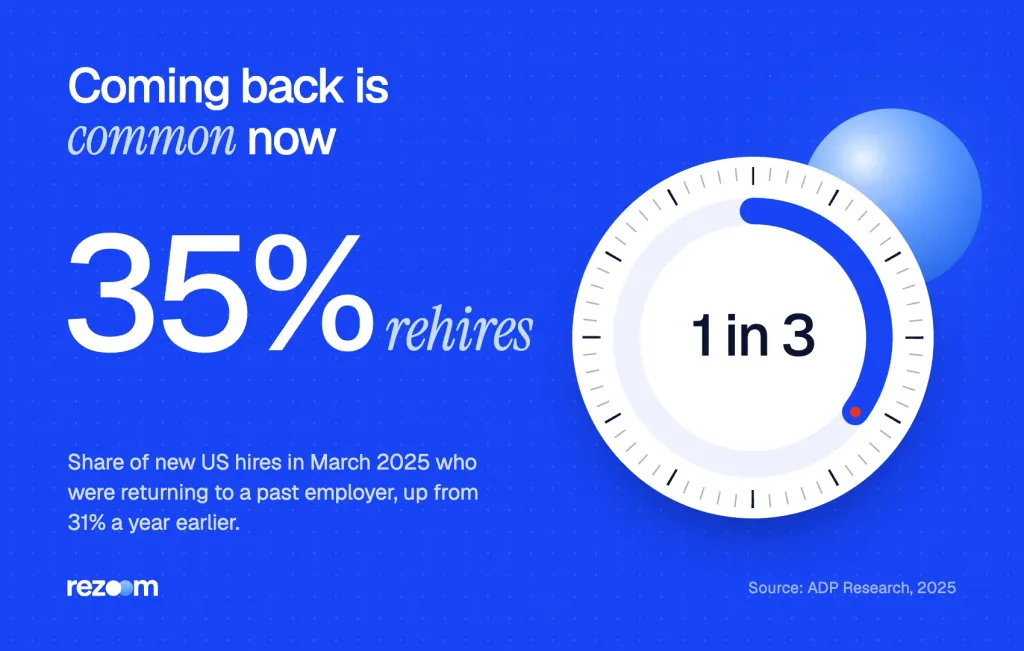
Coming back is normal. ADP Research's boomerang hiring report4 found that 35% of new hires in March 2025 were people returning to a past employer, up from 31% a year earlier. And in a 2015 SHRM report on a Kronos survey5, 85% of HR pros said they had received applications from former employees in the prior five years.
Do temp, contract, intern or acquired-company jobs count?
Count any job where this company paid you directly, including part-time, seasonal and intern roles. Temp and contract work through an agency is a gray area, because the agency was your employer of record. If the form doesn't define the term, answer yes and name the agency, or answer no and explain in the notes box.
The word that matters is "employed." If you got a paycheck or W-2 from this company, you worked there. That includes a summer job at 17 and a two-week holiday stint.
Agency temps and contractors
Staffing firms treat themselves as your employer. Kelly's guide to listing temp jobs6 says the agency is your employer of record, so you list it first and the client company second. That means a strict no can be accurate, but a short note is safer, because the hiring manager may remember you.
| How you worked there | Usually answer | What to add |
|---|---|---|
| Direct employee, any length | Yes | Title, location, dates, manager |
| Seasonal or holiday hire | Yes | "Seasonal" plus the dates |
| Intern on the company payroll | Yes | "Intern," team and year |
| Temp through a staffing agency | Yes with a note, or per the form | Agency name and the dates |
| Independent contractor (1099) | Per the form; add a note | "Contractor, not on payroll" |
| Company that this employer later acquired | Usually yes | Old company name and the year it was bought |
Acquired or merged companies
After a merger, the buyer often loads old staff into one HR system. A Salisbury University Workday guide7 says former workers were loaded into Workday to prevent duplicate records. So your old ID may follow you to the new parent company, even if the name on your pay stub changed.
A yes with a clear note never looks like hiding. A no that HR later contradicts can look like a lie. If the form has an "additional information" box, use it for one line about how and when you worked there.
Can you reapply to a company that rejected you? Yes. See how long to wait, what the ATS remembers, when reapplying to the same role works and what to change.
How do you answer yes on a job application?
Pick Yes, then fill every follow-up field: job title, location or department, start and end dates, manager's name and a short reason for leaving. Use the same dates as your resume. If the form has only a checkbox, add the details in a notes box or the work history section.
The follow-up fields are where most people slip. If the dates on the form don't match your resume, a recruiter may assume you're stretching one of them.
- Find your old detailsDig up an old pay stub, W-2 or offer letter for your exact title and dates. Your old employee ID helps too, if you have it.
- Use your legal name from thenIf your name has changed, list the name you worked under so HR can match the file.
- Name your managerGive your direct supervisor's name and the store, team or department.
- Write a short reason for leavingOne plain phrase, like "Moved for school" or "Took a full-time role."
- Match your resumeMake sure your resume shows the same title and dates for this job.
If your name changed since you left, see our guide on previous names on a job application. The form likely asks for your legal name on a job application too, and HR uses both to find you.
Yes. Cashier, Store #214, Dayton, OH Dates: June 2022 to August 2023 Manager: Lisa Grant, Store Manager Reason for leaving: Moved to Columbus for school
I worked here as a [job title] at [location or team] from [month, year] to [month, year], reporting to [manager's name]. I left to [short reason], and I'm eligible to return.
Keep the reason for leaving short
The reason field is not the place for the full story. Our guide to reason for leaving on a job application has short phrases for quitting, layoffs and moves.
A retail cashier example
Say you ran a register at a grocery chain two years ago and want to go back as a lead. Browse these retail resume examples to see how strong applicants show sales, shrink and customer counts. Then compare your draft with these retail cashier resume examples, since your old title and dates must match the form.
Retail cashier resume example
See how a cashier resume lists one store, clear dates and numbers a returning hire can reuse.
If you're applying to your old store, say so in your letter, too. These retail cover letter examples show how to open with your past role and what you've learned since.
What if you were fired or are not eligible for rehire?
Still answer yes, and give a short, factual reason in active voice. HR will see the record anyway. Many employers code staff as not eligible for rehire only for serious misconduct, so a firing for attendance or fit may not bar you. If you're unsure of your status, ask your old HR team before you apply.
Rehire rules vary, but they follow a pattern. Duke's eligibility for rehire policy8 marks staff ineligible for serious conduct, such as theft, violence or falsifying an application. Poor performance and attendance fall into a softer "Not Recommended" group instead.
What a "not eligible" code does
Some systems act on the code at once. Cornerstone says its "Not Eligible for Rehire" status removes the former employee from the applicant pool. So if you were coded that way, a new application may stop at the first screen, whatever you write.
Find out before you apply
Call or email the HR team at your old location and ask, "Am I eligible for rehire?" Many will tell you. If the answer is no, put your effort into other employers instead.
Yes. Stock associate, Warehouse 3, 2021 to 2022. Reason for leaving: My manager let me go for missed shifts. I've had a perfect attendance record at my current job for 18 months.
For more ways to word it, see how to answer reason for leaving on an application when fired.
Free ATS score, the text the software extracts and your missing keywords. No sign-up.
What happens if you lie and say no?
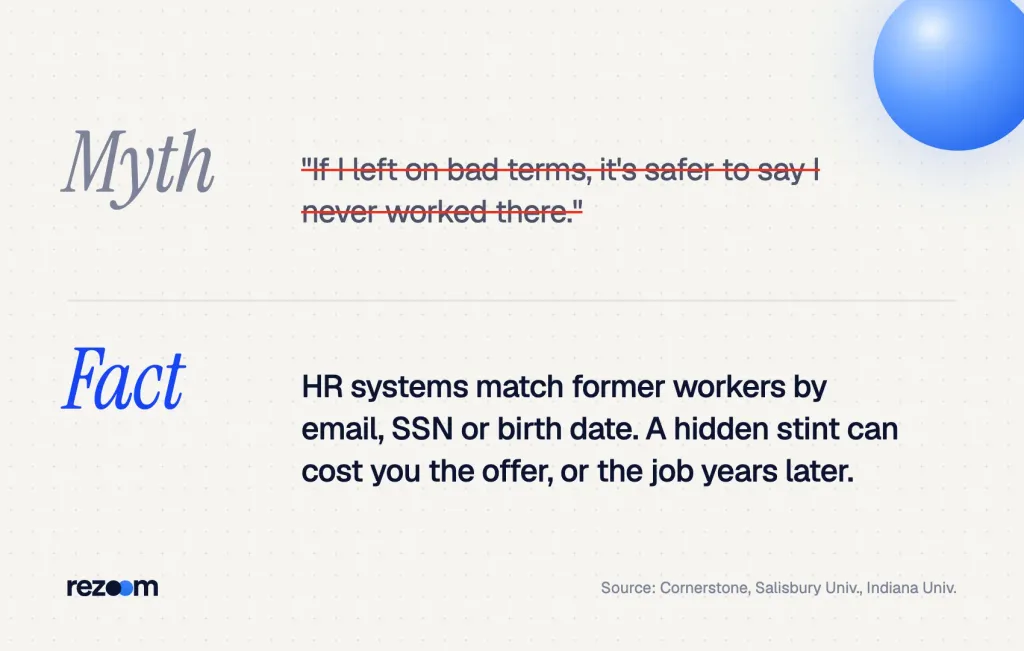
A false no can get your offer pulled or get you fired later, even years after you start. Most applications end with a signed statement that your answers are true. HR systems also match former workers by email, Social Security number or birth date, so a hidden stint often shows up during onboarding.
The signature line is the trap. Missouri's Public Service Commission application9 says any misstatement can lead to "immediate discharge if I am employed, regardless of the time elapsed before discovery."
How HR finds out
You don't have to confess for HR to know. Salisbury's Workday guide tells HR staff to search former workers and match people by Social Security number and date of birth. Cornerstone matches by personal email.
Omission can count as falsification
Indiana University's reemployment policy10 covers rehires who left their past IU job off the application. HR asks them to explain and show that the omission wasn't falsification.
In the absence of such evidence, the employee will be subject to separation from the position.
Indiana University, Eligibility for Reemployment policy
And a 2019 Workforce article11 by two employment lawyers notes that a falsified application can be a complete defense for the employer in some failure-to-hire claims. In short, the lie can outlast the reason you told it.
Do
- Answer yes for any job where this company paid you.
- Use the same title and dates as your resume.
- Add a note for agency, contract or acquired-company work.
- Give a short, factual reason if you were fired.
Don’t
- Say no to hide a firing; HR can match your old record.
- Guess at dates when an old pay stub can confirm them.
- Write a long story in the reason field.
- Confuse "applied before" with "worked here before."
How do you talk about it in the interview?
Bring it up first and treat it as a strength. Say what you did there, why you left and what you learned since, in three or four sentences. Then explain why you want to come back now. If you left on bad terms, own it briefly and point to proof that you've changed.
Interviewers will ask about it, so prepare. SHRM's 2015 report quotes one view that sums up the bar: "Being a good boomerang worker is all about what you did with the company while you were there."
"I worked here as a cashier from 2022 to 2023 and left to finish my degree. Since then, I've led a team of four at a pharmacy. I'd like to bring that back to a store I already know."
What to say if they push back
- "Why did you leave the first time?" Give the same reason as the form: "I moved for school, and now I'm back in the area."
- "Why should we rehire you?" Name one new skill: "I now train new hires and close out the register every night."
- "Your file says you were let go." Own it in one line, then show proof: "I missed shifts. I fixed my schedule and haven't missed one in 18 months."
- "Won't you leave again?" Tie it to a reason that lasts: "I'm settled here now, and this role is the step up I want."
Interviewer: "Our records show you were let go in 2022. What happened?"
"I missed too many shifts while I was caring for a family member. I should have asked for a schedule change, and I didn't."
Interviewer: "What's different now?"
"My schedule is stable, and my current manager can confirm 18 months without an absence."
For a deeper script, read how to explain being fired in an interview.
If you still know someone there, ask them to vouch for you. Then name them on the form, as our guide to how did you hear about us on a job application explains. A current employee's word can outweigh an old file note.
Reason for leaving on job application examples for layoffs, contracts, school, moves and firing: the exact words to type, what HR checks and what to avoid.
What should you check before you submit?
Before you submit, confirm you answered yes for any job this company paid you for, and that the title, dates and manager match your resume. Check that your reason for leaving is short and true. If you worked there under another name or through an agency, make sure the form says so.
Before you submit
Next, polish the resume that goes with the form. Our AI resume builder can draft a clean version that lists your past role at this company the right way.
Tailored to the job post, checked against ATS.
Frequently asked questions
Does "previously employed by this company" include part-time jobs?
Yes. Any paid job counts, including part-time, seasonal and holiday work. Add the dates so HR can find your record.
Should I say yes if I worked there through a temp agency?
Follow the form's wording if it defines the term. If it doesn't, answer yes and name the agency in a note, or answer no and explain in the notes box.
Does an internship count as working for the company?
It counts if the company paid you or put you on its payroll. Answer yes and write "intern" with the team and year.
Will being fired stop me from getting rehired?
Not always. Many employers bar rehire only for serious misconduct, while firings for attendance or fit get a softer code. Ask your old HR team about your status.
Can a company find out if I worked there before?
Usually, yes. HR systems match former workers by email, Social Security number or birth date, and they check that record when they hire you.
What if I can't remember my exact dates?
Check an old pay stub, W-2 or bank deposit. If you still can't confirm them, give the month and year you're sure of and add "approximately."
Sources
We opened and read each page below. The small numbers in the text point here. Pages that carry no publication date show n.d.
- Workdayn.d.
Workday lists "Have you been previously employed by our company?" as a sample eligibility question for job applications.
- U.S. District Court, Eastern District of Missourin.d.
The sample application asks former employees for their title, department, supervisor, dates and reason for leaving.
- Cornerstone OnDemandn.d.
Cornerstone matches former employees by personal email and removes those marked not eligible for rehire from the applicant pool.
- ADP Research2025
Boomerang employees made up 35% of new hires in March 2025, up from 31% a year earlier.
- SHRM2015
In a 2015 Kronos survey, 85% of HR professionals said they had received applications from former employees in the prior five years.
- Kelly Servicesn.d.
The staffing agency is a temp worker's employer of record, so it is listed before the client company.
- Salisbury Universityn.d.
Former workers were loaded into Workday, and HR matches them by Social Security number and date of birth.
- Duke Universityn.d.
Duke codes staff fired for serious misconduct as not eligible for rehire, while poor performance falls under Not Recommended.
- Missouri Public Service Commission2024
Any misstatement on the application can lead to discharge, regardless of the time elapsed before discovery.
- Indiana University2022
Rehires who omit past IU employment must show the omission was not falsification or face separation.
- Workforce2019
A falsified application can be a complete defense for employers in some failure-to-hire claims.
Mohammad has spent more than ten years designing consumer products and leads product at Rezoom, deciding what gets built and what gets left out. His guides cover the whole job search, from resume sections and cover letters to interview answers and career moves.
Goodi, M. (2026, November 11). Have You Ever Worked for This Company Before? How to Answer It. Rezoom. https://rezoom.io/have-you-ever-worked-for-this-company-before/