How Did You Hear About Us on Job Application Forms: What to Pick
How did you hear about us on job application forms: pick the true source, name a referrer the right way, fill in Other, and answer it well in the interview.

On this pageWhy do employers ask how did you hear about us on job application forms?
- Why do employers ask how did you hear about us on job application forms?
- What should you pick for LinkedIn, Indeed and other sources?
- How do you name a referrer on a job application?
- What should you write in the "Other" box?
- Does how you heard about the job affect your chances?
- What do you say when an interviewer asks how you heard about the job?
- What should you check before you submit?
- FAQ
- Sources
Pick the source that actually led you to the job, such as LinkedIn, Indeed, the company careers page or a recruiter. Employers use the answer to see which ads work and to pay referral bonuses. It rarely hurts your chances, but a real employee referral can help, so name that person exactly as the form asks. Never claim a referral you do not have.
For how did you hear about us on job application forms, pick the source that truly led you to the opening: a job board, the company site, a recruiter or a person. If an employee referred you, choose Referral and type their full name.
The field looks like a throwaway. But it feeds two things: the employer's ad budget and, often, a coworker's referral bonus. So a careless click can send a bonus to nobody, while an honest answer costs you nothing.
Quick answers by situation
| Your situation | What to pick | Example line |
|---|---|---|
| You saw the post on LinkedIn or Indeed | That job board by name | "LinkedIn" |
| You found it on the company careers page | Company website | "Company website" |
| A current employee told you about it | Employee referral, plus their name | "Referral: Dana Ortiz, Billing" |
| A recruiter contacted you | Recruiter or agency, plus the name | "Recruiter: Sam Lee, Apex Staffing" |
| You met the team at a career fair | Career fair or event | "Career fair: State U, March 2026" |
| Nothing on the list fits | Other, then a short source | "Other: Local Facebook jobs group" |
Why do employers ask how did you hear about us on job application forms?
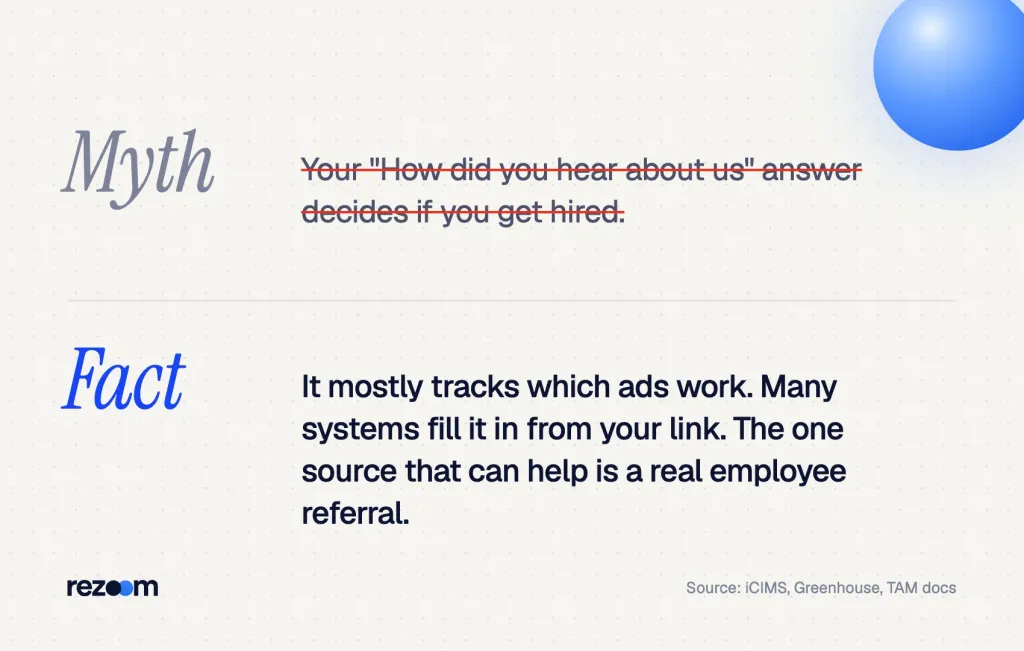
Employers ask to track which recruiting channels bring in applicants and hires. Many systems fill in the source on their own from the link you clicked. The question still matters for sources no link can catch, like employee referrals, outside recruiters, job fairs and walk-ins. A named referral can also trigger a bonus for that employee.
The field goes by many names. You may see "How did you hear about this position?", "Referral source" or "How did you learn of the job?" The University of Michigan's job application steps1 tell staff to pick a value from a "How did you learn of the job?" list. It's the same question in different words.
Source tracking pays for the ads
Recruiting teams buy ads on many sites. So they want to know which ones bring in people they hire. UKG's applicant source guide2 shows admins building the list of answers you see under "How did you hear about this opportunity?" That means the options reflect the employer's ad spend, not a test of you.
The system often knows already
Many applicant tracking systems record the source on their own. Greenhouse's source tracking guide3 says a tracking link adds the source to a candidate's profile automatically. And iCIMS's source data guide4 says the link can fill in the source question, and some candidates can't change it.
Some sources only you can report
A link can't tell that your neighbor works there. The TAM applicant tracking help center puts it plainly.
the only way to track sources such as Employee referrals, External recruiters, Job fairs and Walk-ins.
TAM Support, How does TAM track sources
So the question earns its keep for people-based sources. If a person sent you, this is where you prove it.
What should you pick for LinkedIn, Indeed and other sources?
Pick the last place you saw the job before you clicked Apply, unless a person led you there. Choose the job board by name if it's listed, Company website if you started on the careers page, and Recruiter, Referral or Career fair when a person or event brought you in. A person-based source beats a website when both are true.
Most people find a job in two or three steps. You might see it on LinkedIn, then apply on the company's site. TAM's help center notes that its tracking sees only the most recent link, so it would log the company site in that case.
A simple rule for two sources
If a person played a part, pick the person. That's the source the employer can't track any other way. If no person was involved, pick the site where you first decided to apply.
| Where you found it | Best option to pick | What to add if there's a box |
|---|---|---|
| LinkedIn post or job alert | Nothing, or "LinkedIn job alert" | |
| Indeed, ZipRecruiter or Glassdoor | That board by name | Nothing |
| Company careers page | Company website | "Careers page" |
| Google search results | Search engine or job board | "Google Jobs" |
| A recruiter emailed or called you | Recruiter or staffing agency | Recruiter's name and firm |
| A current employee told you | Employee referral | Their full name and team |
| Career fair, campus event or meetup | Career fair or event | Event name and month |
| Social media post or newsletter | Social media, or Other | Platform and account name |
When the list doesn't match
If your board isn't on the list, look for "Job board" or "Online posting." Pick Other only when nothing comes close. Then type the real name, because "Other" alone tells the recruiter nothing.
When you apply to many jobs, you forget where each one came from. Add a "source" column to your job application tracker the day you save a post. Then you can answer the form, and the interview question, without guessing.
How do you name a referrer on a job application?
Choose Employee referral, then type the person's full name exactly as it appears at work, plus their team or email if the form asks. Tell them before you apply. Many employers pay the referral bonus only to the first name listed, and some also need the employee to endorse you in their own system.
Referral rules decide who gets paid. Carnegie Mellon's staff referral program6 tells applicants to list the employee's name, email or Andrew ID as the referral source. It also pays the first name listed when more than one shows up.
Why the bonus depends on you
Bonuses are common. In a SHRM report on a 2015 SmashFly survey7, 86% of firms with a formal program paid a bonus for successful referrals. At Carnegie Mellon, the reward runs from $500 to $1,5006, and the hire must finish a provisional period first.
So if you skip the name, your contact may lose that money. And if the employee's own endorsement is missing, CMU says the reward won't pay out.
- Ask firstText or email your contact and ask if they're comfortable referring you. Some prefer to submit you through their own portal.
- Get their exact nameAsk how their name appears in the company directory, plus their team or work email.
- Use their link if they send oneA referral link from the employee can credit them before you even reach the form.
- Fill the fieldPick Employee referral and type the full name in the box, not in your cover letter only.
- Confirm it landedTell your contact you applied, with the job title and date, so they can endorse you.
Referral: Dana Ortiz, Billing Department Referred by Dana Ortiz (dana.ortiz@company.com) Employee referral: Dana Ortiz, Accounts Payable, Chicago office
When you know someone but they didn't refer you
Knowing a staff member isn't the same as a referral. If they didn't agree to vouch for you, pick the real source instead. You can still mention the connection in your cover letter, with their permission.
Previous names on job application forms: list former legal names like a maiden name, skip nicknames, and copy exact lines for marriage, divorce and more.
What should you write in the "Other" box?
Write the real source in a few plain words: the site, person, group or event, plus a detail like a date or account name. Keep it under one line. Skip jokes, "Google" alone, or "I don't remember." If you truly forgot, pick the job board where the post lives now.
The "Other" box is free text that a recruiter may read. So treat it as a label, not a story.
Other: Chicago Front Desk Jobs Facebook group Other: Former manager, Lisa Grant, now at your Elm St. office Other: Your company newsletter, October 2026 Other: Walked in and asked at the front desk
Other: [Site, group, person or event] ([detail: date, account name or location])
Short answers beat clever ones
The same form will ask more fields, like your pay range or start date. Keep the tone the same across all of them. Our guide on desired salary on a job application shows the same plain, honest style for a harder field.
Do
- Pick the true source, even if it feels ordinary.
- Name a referrer only after they agree to vouch for you.
- Spell the referrer's name the way it appears at work.
- Add a date or account name when you use Other.
Don’t
- Claim a referral you don't have; recruiters can check.
- Leave the box blank when the form gives you room.
- Type "Google" or "Internet" with no detail.
- Pick Referral just because it sounds stronger.
Free ATS score, the text the software extracts and your missing keywords. No sign-up.
Does how you heard about the job affect your chances?
For most sources, no. Picking LinkedIn over Indeed won't change how a recruiter reads your resume. A real employee referral is the exception: research and hiring data show referred applicants reach interviews far more often. A fake referral can backfire, since the recruiter may contact the employee you named.
Picking one job board over another is a budget question. None of the vendor docs above tie the source to resume scoring.
Referrals move the needle
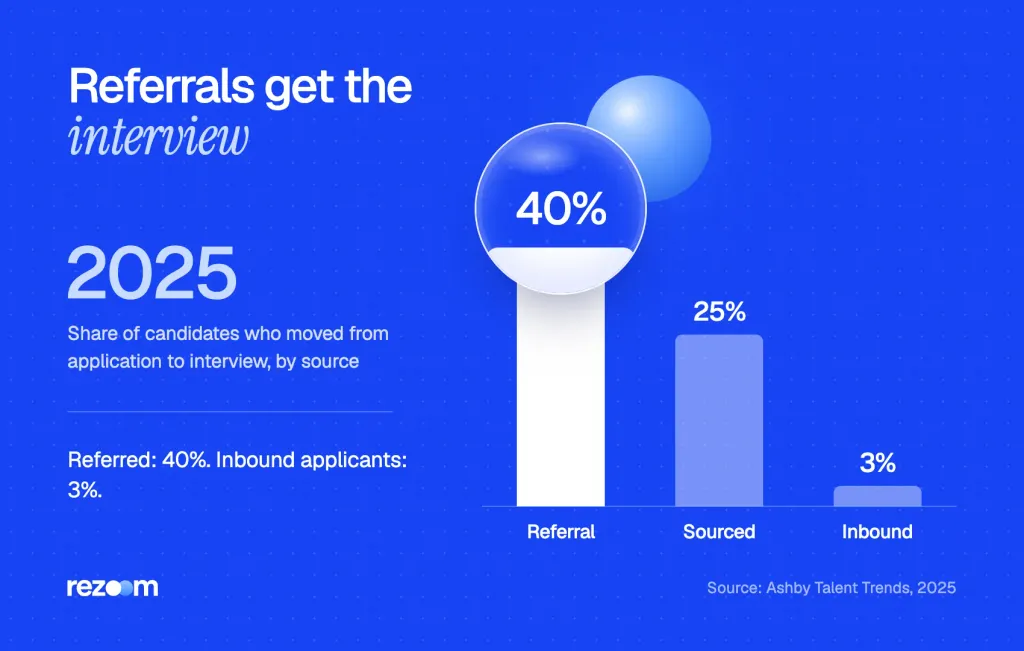
Referrals are different, and the data is consistent. Ashby's 2025 referrals report8 found that 40% of referred candidates moved from application to interview, compared with 25% of sourced candidates and 3% of inbound applicants. Gem's 2026 benchmarks summary9 says referrals convert at 11 times the rate of inbound applicants.
Older research points the same way. In a 2014 study of one large firm10, referrals made up 6% of applicants but 29% of hires. The authors note their data can't prove the referral itself caused the gap.
Why a fake referral backfires
The upside only works if the referral is real. Career Sherpa's interview guide11 warns that the hiring manager may reach out to the person you named. If that person barely knows you, your best edge turns into a trust problem.
A receptionist example
Say you saw a front desk role on Indeed: pick Indeed, then put your effort into the resume. Browse our office and admin resume samples to see how strong applicants show phone, scheduling and visitor skills. Then compare your draft with these receptionist resume examples, which show the numbers front desk hiring managers look for.
Receptionist resume example
See how a receptionist resume shows call volume, scheduling and visitor counts in plain lines.
If a coworker at the clinic told you about the opening, mention them in your letter, too. A receptionist cover letter example shows how to name a contact in the first lines without sounding pushy.
Type the referrer's name in the form field, then mention them in your cover letter's first sentence. The field credits the bonus, and the letter makes sure a person reading your file sees the connection.
What do you say when an interviewer asks how you heard about the job?
Name the source in one sentence, then say why the role caught your eye and how you fit. If someone referred you, credit them and say what they told you about the team. Keep it short and match what you put on the form.
Interviewers ask this at the start of many screens. The 4 Corner Resources guide12 says a strong answer names the source, explains your interest and shows fit. Insight Global's hiring blog13 adds that employers use it to gauge your research and spot internal connections.
Keep the form and the answer in sync
The recruiter may have your application open. So if you picked LinkedIn on the form, don't say a friend told you. If both are true, say both: "Dana mentioned it, and then I saw the post on LinkedIn."
Interviewer: "How did you hear about this position?"
"I saw it on Indeed last week. The focus on patient check-in caught my eye, since I handled 80 visitors a day at my last front desk."
Interviewer: "How did you hear about us?"
"Dana Ortiz in Billing told me about it. She said the team trains new hires well, and that's what I want next."
Interviewer: "How do you know Dana?"
"We worked together at Lakeview Dental for two years."
"I found it on [source]. What stood out was [one detail from the post or company], and it fits my [skill or result]."
What to say if they push back
- "Did you just apply everywhere?" Say how you picked this one: "I set alerts for front desk roles in healthcare, and yours matched."
- "Who referred you, exactly?" Give the full name and how you know them. Then add one thing they said about the job.
- "Why didn't you pick Referral on the form?" Be honest: "I wasn't sure she'd want to be named, so I chose LinkedIn. I'm glad to add her now."
- "You don't remember where you saw it?" Avoid that answer. Instead, name the most likely board and move to why you applied.
For the follow-up question that usually comes next, see our guide on why do you want to work here. And if you're aiming at a front desk job, practice with these receptionist interview questions.
What to put for earliest start date on job application forms: the first day you could begin if hired. Examples if employed, unemployed or a student.
What should you check before you submit?
Before you submit, confirm the source you picked is true and matches what you'll say in the interview. If a person referred you, check their name spelling and tell them you applied. If you used Other, make sure the box names a real site, group or event in a few words.
Before you submit
After you apply, give it a week, then follow up. Our guide on how to follow up on a job application has short scripts. If your resume needs work before you send more applications, our AI resume builder can draft a clean, job-matched version in minutes.
Tailored to the job post, checked against ATS.
Frequently asked questions
Does "How did you hear about us" affect my application?
Usually not. It mostly helps employers track their ads. A real employee referral can help, though, because referred candidates reach interviews more often.
Is it OK to pick Referral if I know someone at the company?
Only if that person agreed to vouch for you. Otherwise pick the real source and mention the connection in your cover letter with their permission.
What if I found the job on two sites?
Pick the one where you decided to apply. If a person was part of it, pick the person, since no tracking link can capture that.
What should I put if I don't remember?
Pick the job board where the post appears now, or Company website. Don't write "I don't remember," because it suggests you applied without much thought.
Can I change my answer after I submit?
Usually not through the portal, and some systems lock the source from your link. If a referrer was left off, email the recruiter and name them.
Do I need to write anything if the field is optional?
It's worth a few seconds, especially for a referral. A blank field can cost your contact a bonus and hide a connection that helps you.
Sources
We opened and read each page below. The small numbers in the text point here. Pages that carry no publication date show n.d.
- University of Michigann.d.
Michigan's job application steps ask applicants to pick an answer from a "How did you learn of the job?" list in the Referral Source box.
- UKGn.d.
UKG admins build the list of answers applicants see under "How did you hear about this opportunity?"
- Greenhousen.d.
Greenhouse records a candidate's source automatically when they apply through a tracking link.
- iCIMSn.d.
iCIMS can fill the application source question from the link, and those candidates can't change it.
- TAM Supportn.d.
The question is the only way to track referrals, outside recruiters, job fairs and walk-ins, and tracking sees only the most recent link.
- Carnegie Mellon Universityn.d.
CMU asks applicants to list the referring employee as the referral source, pays the first name listed, and offers rewards from $500 to $1,500.
- SHRM2015
In a 2015 SmashFly survey, 86% of organizations with a formal referral program paid a bonus for successful referrals.
- Ashby2025
40% of referred candidates moved from application to interview, compared with 3% of inbound applicants.
- Gem2025
Gem's 2026 benchmarks found referrals convert at 11 times the rate of inbound applicants.
- Brown, Setren and Topa (IZA)2014
At one large firm, referrals were 6% of applicants but 29% of hires, and the authors make no causal claim.
- Career Sherpan.d.
Faking a referral is risky because the hiring manager may contact the person you named.
- 4 Corner Resourcesn.d.
A strong interview answer names the source, explains your interest and shows fit.
- Insight Globaln.d.
Employers use the question to learn which channels work, gauge research and spot internal connections.
Mohammad has spent more than ten years designing consumer products and leads product at Rezoom, deciding what gets built and what gets left out. His guides cover the whole job search, from resume sections and cover letters to interview answers and career moves.
Goodi, M. (2026, November 10). How Did You Hear About Us on Job Application Forms: What to Pick. Rezoom. https://rezoom.io/how-did-you-hear-about-us-on-job-application/