

Summary
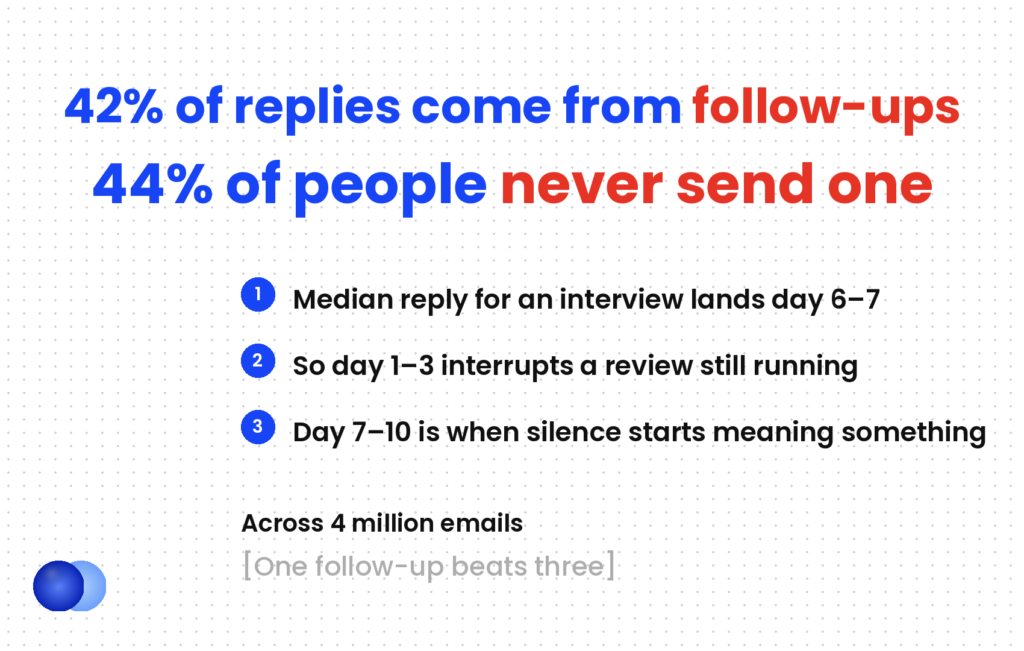
Advice on follow-up timing ranges from three days to two weeks, because every source picks a number rather than deriving one. The response data settles it: the median reply for candidates who get an interview arrives at day six or seven, so a follow-up before then interrupts a process still running. Analysis of 4 million recruiting emails found 42% of replies come from follow-ups — and separate testing suggests one is the optimum, not three.
Ask how to follow up on a job application and you will get four different answers with equal confidence: three to five business days, five to seven, seven to ten, one to two weeks.
Nobody is lying. Everybody is picking a number. And the disagreement is unresolvable at that level, because none of those recommendations explains where the figure came from.
There is a better route. Instead of choosing a camp, derive the timing from what recruiters actually do — and that data is far more consistent than the advice built on top of it.
When should you follow up on a job application?
After the normal response window has passed, which is day seven to ten. Careery's dataset of over 1,000 job seekers found the median response for candidates who receive an interview email arrives at day six or seven, with 25% arriving by day four or five. Following up before then interrupts a process that is still running normally.
That is how to follow up on a job application without guessing, and the derivation is worth seeing rather than being told.
If most positive responses land between day four and day seven, then a follow-up on day three lands in the middle of a review that has not finished. It cannot help, and it reads as anxious because it is.
Wait until the normal window has closed and the message changes meaning entirely. Now you are not interrupting — you are surfacing after silence, which is exactly the moment a nudge does something.
| Day | What is happening |
|---|---|
| 0 | You apply |
| 1–3 | Too early. The review has not happened yet |
| 4–7 | Most positive responses arrive in this window |
| 7–10 | Send the follow-up. The window has closed |
| 14+ | Likely a silent rejection. Move on |
That last row deserves a caveat. Response windows vary enormously by company size — startups often reply in days, large enterprises can take a month — so “likely” is doing real work there.
Does following up actually change anything?
Substantially. Analysis of 4 million recruiting emails found 42% of all replies come from follow-ups rather than the first message. Yet 44% of job seekers never send a second message after their first goes unanswered, which is a large payoff with low participation.
In practice, those two numbers sit next to each other and describe an opportunity.
42% of replies come from the follow-up. If you send once and stop, you are forgoing nearly half of the responses available to you before the recruiter has formed any view about your persistence.
44% of candidates never follow up at all. So the behaviour that produces almost half the replies is one that nearly half the field skips.
The context makes it sharper. Ashby’s analysis of 109 million applications found applications per hire tripled between 2021 and 2024 and stayed above 300 through 2025. HiringThing’s 2026 data puts the invitation-to-interview rate at 3%, down from 8.4% in 2023.
At that volume, a recruiter is not deliberating over your application. They have not reached it, or they read it three weeks ago among two hundred others. A follow-up is the mechanism that returns your name to the top of a pile that has grown since you applied.
Follow up with a person, never a portal
An application portal is a submission mechanism, not a communication channel — replying into it does nothing, and neither does a general HR inbox. Spend five minutes finding the recruiter or hiring manager on LinkedIn or the company site. The follow-up that reaches an individual is a different action from the one that reaches a queue, and only one of them can produce a reply.
How many times should you follow up on a job application?
Once, in most cases. Belkins' analysis of 16.5 million emails found one initial contact plus one follow-up produced the highest reply rate at around 8%, with additional messages reducing response. Advice recommending two or three follow-ups is not supported by that testing.
Notably, this is where the common advice and the evidence part company, and it is worth knowing which to trust.
Most guides suggest two or three follow-ups before moving on. The largest dataset available points the other way: one plus one is the optimum, and each additional message costs you rather than helping.
When a second one earns its place
The practical reading is not “never send a second follow-up” — it is that the second one should be earning its place rather than repeating the first. A second message is defensible when something has genuinely changed: you have a competing offer with a deadline, a new certification, or the posting deadline has passed and you are asking about the process rather than about yourself.
Sending the same status request twice is what the data says stops working.
Status request: "Hi Priya, I wanted to follow up on my application for the Senior Analyst role submitted on the 3rd. Could you let me know where things stand? Thanks for your time."
Value-added: "Hi Priya, following up on the Senior Analyst application from the 3rd. Since applying I finished the warehouse migration I mentioned — cut the monthly close from twelve days to five. Happy to send the write-up if useful. Is the role still open?"
The first asks the recruiter to do a task. The second gives them something and ends with a question they can answer in one word. Both are under 60 words.
What should the message say?
Four lines under 100 words: context naming the role and date, one proof point that was not in your application, a single easy question, and thanks. Recruiters read follow-ups on phones between meetings, so length works against you.
How to follow up on a job application, in four elements:
1. Context. The role and roughly when you applied. One line.
2. One new thing. A result, a certification, a specific reason this company. Something that was not in the original application, so the message has a reason to exist beyond your impatience.
3. One question. Easy to answer. “Is the role still open?” beats “Could you update me on the status and timeline and next steps?”
4. Thanks. One clause.
Then stop. Under 100 words, in the same email thread if one exists, on a Tuesday to Thursday morning rather than a Friday afternoon.
Add one sentence that was not in your application. It gives the recruiter a reason to reopen your file rather than simply confirming a status they would have communicated anyway.
Send a bare status request. It creates work for a recruiter who is already at 300 applications per hire, and it offers them nothing in exchange for the two minutes it costs.
What if you never hear back at all?
It is now the norm rather than the exception. Criteria Corp's 2026 Candidate Experience Report found 53% of job seekers were ghosted by an employer in the past year, a three-year high the authors attributed partly to AI-driven application volume. Even candidates who reached salary negotiations reported a 4% ghosting rate.
Worth stating plainly, because people take the silence personally when it is structural.
Employers ghosted more than half of job seekers last year. The report’s authors linked the rise to AI tools making it easier to apply and tailor at scale, leaving hiring teams reviewing more applications and getting less signal from each.
So after one follow-up and another week of silence, the productive response is to move on rather than to escalate. Signs an interview went well covers why silence is usually about process rather than about you, and the same logic applies before any interview happens.
One more thing worth checking rather than assuming: whether the role was ever real. Roughly one in five listings is a ghost job, and a posting that never responds to anyone is the clearest tell there is.
Does the follow-up work if the application was weak?
It has a lower ceiling. A follow-up returns your file to the top of the pile, but the file still has to survive the same screen it failed the first time. The sequence that works is to check the application first, then follow up on one worth a second look.
Finally, an honest limit on everything above.
A follow-up buys attention, not qualification. If your resume did not parse cleanly or did not match the posting’s vocabulary, a second look produces the same result as the first — and you have spent your one high-value message on it.
The order that makes sense: confirm the application is worth resurfacing, then resurface it. An AI resume checker run against that specific posting shows what the parser extracted and where the language missed, and how an ATS works covers why a knockout answer or a missing skill matters more than the follow-up ever will.

42% of all replies come from follow-ups, not the first message.
What does the whole sequence look like?
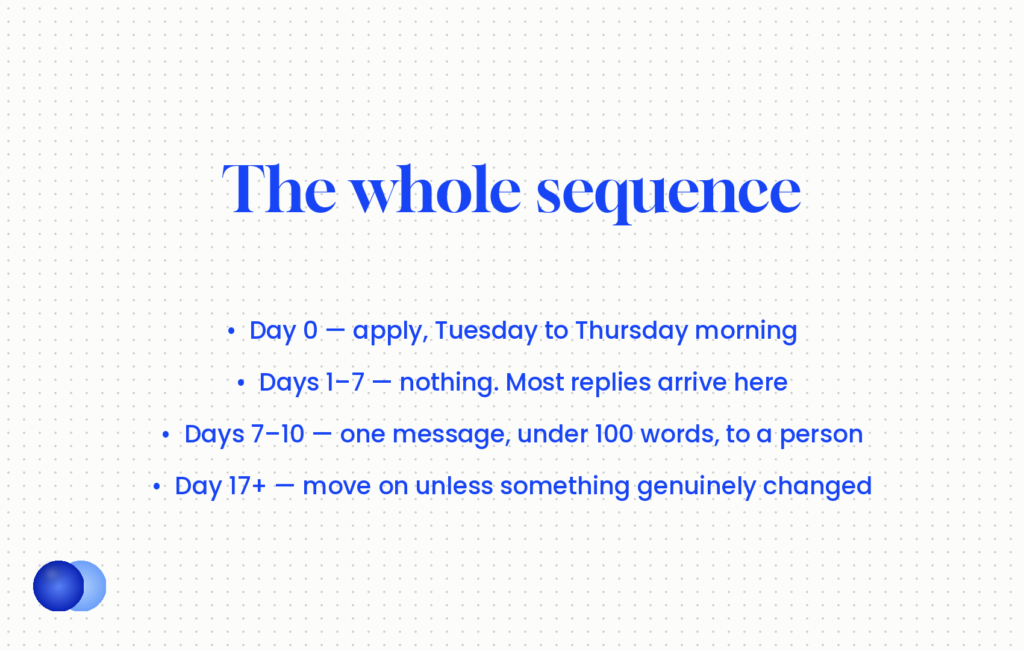
Apply, wait through the response window, send one follow-up on day seven to ten with something new in it, then let it go after another week. Two follow-ups only when a genuine change justifies the second — a competing offer, a new credential, or a passed deadline.
The complete timeline for how to follow up on a job application:
Day 0. Apply, ideally Tuesday to Thursday morning.
Days 1–7. Nothing. Most positive responses arrive in this window and interrupting it helps nobody.
Days 7–10. One follow-up, under 100 words, to a named person, containing one thing that was not in the application.
Days 10–17. Wait. A second message here repeats the first, which the data says reduces your odds.
Day 17+. Move on, unless something genuinely changed. Keep the application in a tracker and redirect the energy to new opportunities, since volume and system beat rumination on any single application.
Above all, that final point is worth internalising. With interview rates at 3% and ghosting above 50%, no individual application deserves more than one well-timed follow-up — and the candidates who do well are the ones who kept applying while they waited.
Frequently asked questions
When should you follow up on a job application?
Between day seven and day ten. Median response time for candidates who receive an interview email is day six or seven, so following up before then interrupts a review that is still running.
How many times should you follow up?
Once in most cases. Analysis of 16.5 million emails found one initial contact plus one follow-up produced the highest reply rate, with additional messages reducing response.
Does following up actually help?
Yes. Analysis of 4 million recruiting emails found 42% of replies come from follow-ups rather than the first message, and 44% of job seekers never send a second message at all.
Who should I send the follow-up to?
A named recruiter or hiring manager, found on LinkedIn or the company site. An application portal is a submission mechanism rather than a communication channel, and a general HR inbox rarely produces a reply.
How long should a follow-up email be?
Under 100 words in four lines: context, one proof point that was not in your application, one easy question, and thanks. Recruiters read these on phones between meetings.
What if I never hear back?
It is now common — Criteria Corp's 2026 report found 53% of job seekers were ghosted in the past year, a three-year high. After one follow-up and another week of silence, move on.
Should I call instead of emailing?
Only when the posting invites it or the recruiter is a known contact. Email first if you have a real address, LinkedIn second, and never the application portal.
Is it too late to follow up after three weeks?
Usually, though not always for slow-moving enterprise processes. After two weeks of silence the application is likely a silent rejection, and your time is better spent on new applications.



Comments