

Summary
Application statuses are workflow labels a recruiter updates by hand, not live signals about who is reading your file. That makes them reliable in one direction only: rejection labels are explicit and accurate, while "Under Review", "In Progress" and "Under Consideration" all mean the same thing at most companies — your application is still open. The distinction people try to decode does not exist.
Application status meanings are the thing you are trying to decode when you refresh the portal again. It still says “In Progress.” Yesterday it said “In Progress.” Someone on Reddit says “Under Review” is better than “In Progress,” and you are trying to work out which one you have.
Here is the part that resolves it: at most companies those two labels mean the same thing. The wording depends on how the employer configured their system, not on where you sit in the pipeline.
But the statuses are not useless. They carry real information in exactly one direction, and knowing which direction saves a great deal of refreshing.
What do application status meanings actually tell you?
They are workflow labels a recruiter updates by hand when moving your record between pipeline stages — not live signals that someone is reading your file. "Under Review" commonly means your application is sitting in the requisition's queue rather than in front of a person.
In practice, the mechanism explains everything that follows.
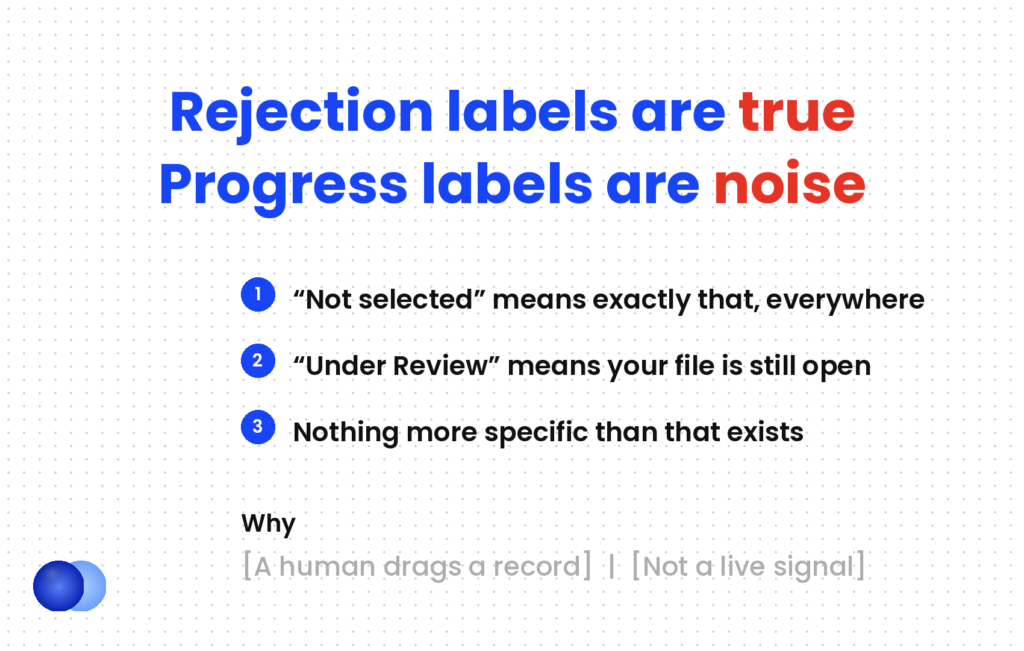
A status changes when a human drags your record from one column to another, or when a configured rule fires. Nothing tracks anybody’s attention. If a recruiter reviews forty applications on Thursday and updates the pipeline on Monday, your status was wrong for four days and nobody noticed.
Three consequences follow, and together they explain why application status meanings feel so unreliable:
Statuses lag reality. Often by days, sometimes by weeks.
Statuses can be stale. A record can sit at “In Progress” long after someone filled or paused the role, because closing it out helps nobody internally.
Employers rename the labels. They customise candidate-facing stages, so identical words map to different internal steps at different companies.
Is “Under Review” better than “In Progress”?
Unfortunately, this is the comparison people most want to make, and it does not survive contact with how the systems work.
| Label | What people think it means | What it usually means |
|---|---|---|
| Submitted / Received | Confirmed and queued | Confirmed and queued |
| In Progress | Actively moving forward | In a workflow, possibly not yet reviewed |
| In Process | Further along than In Progress | The same as In Progress |
| Under Review | A human is reading it now | In a screening queue |
| Under Consideration | Shortlisted | Still open |
| Active Candidate | Advancing | Still open |
Every row below the first says the same thing: nobody has closed your file. That is genuinely worth knowing, and it is all these labels can tell you.
Check spam before you check the portal
Many employers send assessments, screening questionnaires or scheduling links within the first 72 hours, and those emails land in spam more often than anyone expects. Search your inbox and junk folder for the company name, the word "assessment", and the name of the system — Workday, Greenhouse, iCIMS. A missed assessment looks identical to silence from the outside, and it is the one form of silence you can actually fix.
Which statuses do tell you something?
The rejection ones. "Not selected", "No longer under consideration", "Closed" and "Inactive" are explicit and accurate across every major platform. The system is informative in one direction — it reliably tells you when you are out, and tells you nothing useful when you are still in.
Crucially, that asymmetry is the most practical thing on this page.
Rejection labels are trustworthy. No platform uses “Not selected” to mean anything other than not selected. When the status turns explicit, believe it and move on.
Progress labels are not. They cannot distinguish between “a recruiter shortlisted you this morning” and “your record has sat untouched for three weeks.”
So the correct use of the portal is narrow: check it occasionally for an explicit rejection, and ignore it entirely as a measure of how well things are going.
What are the real signals?
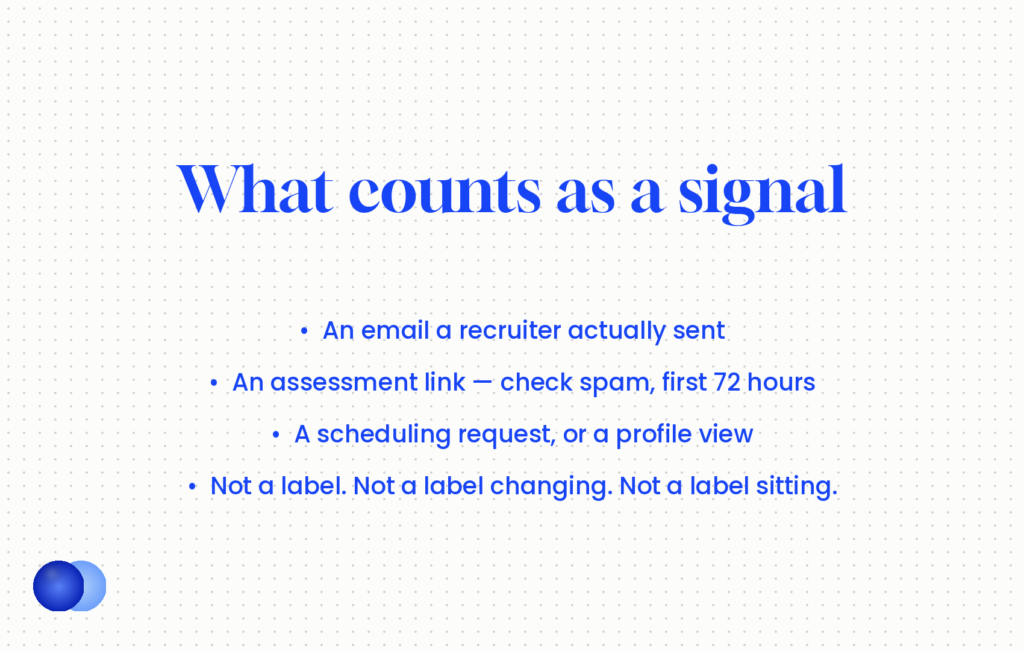
Direct communication. An email, an assessment invitation, a scheduling request, a recruiter viewing your profile. Anything a person actively sent you carries information; anything the system displays passively does not.
Here the test is simple: did a human do something, or did a database render a field?
Real signals: an email from a recruiter, an assessment link, an interview scheduling request, a request for references or availability, a recruiter viewing your LinkedIn profile.
Not signals: a status label, a status changing, a status not changing, how long a status has been showing, the order of labels in a dropdown.
Candidate A. "Under Review" for three weeks. No emails. Refreshes daily.
Candidate B. Still says "Submitted." An assessment link arrived on day four and a recruiter viewed their LinkedIn on day six.
Candidate B is further along, and the portal says the opposite. The label reflects who updated a record, not who read a resume.
What should you do while a status sits unchanged?
Use the response-time benchmark rather than the portal. Median first reply lands at day six or seven, so follow up between day seven and ten, once, to a named person. Then keep applying — the average posting draws around 73 applicants and interviews three.
Four things, none of which involves reading application status meanings:
1. Verify your submission. Confirmation email received, correct file attached, contact details right. A typo in your email address blocks every message that follows.
2. Check spam for the first 72 hours. Assessments and screening questionnaires end up there routinely.
3. Follow up on the calendar, not the label. How long to hear back after applying covers the benchmark; how to follow up on a job application covers the message. Day seven to ten, once, to a named recruiter.
4. Keep applying. The average posting attracts around 73 applicants and interviews three. The other seventy watch a status for weeks, sometimes long after the role has been filled.
Track your applications somewhere outside the portals — a spreadsheet with the date applied, the follow-up date and the contact. Five portals with five vocabularies is not a system.
Reapply to the same requisition hoping to reset the status. It creates a duplicate record that confuses the recruiter's workflow. Save reapplying for when the role is genuinely reposted under a new requisition number.
Does the platform change what the labels mean?
Somewhat, but less than the employer's configuration does. Workday, Greenhouse, Lever, iCIMS and SmartRecruiters each use their own vocabulary, and every one of them lets employers rename candidate-facing stages. Two companies on the same platform can show different words for the same step.
A rough guide to application status meanings by platform, with the caveat that configuration overrides all of it:
| Platform | Common labels |
|---|---|
| Workday | Submitted, In Progress, In Process, Under Review, Active Candidate |
| Greenhouse | Active, In Review, Rejected |
| iCIMS | Under Review, Under Consideration |
| SmartRecruiters | In Review, Transferred |
| Lever | Typically minimal candidate-facing status |
Notice how little separates them. Each platform has one or two words for “still open” and one explicit word for “closed” — which is the same one-way signal in different vocabularies.

Statuses are workflow labels a recruiter updates when they move your application between pipeline stages — not live signals that someone is reading your resume right now.
When does an unchanged status mean rejection?
When it stops mattering rather than when it changes. After two to three weeks with no direct communication and one follow-up sent, treat the application as closed regardless of what the label says — many roles are filled without candidate records ever being updated.
Finally, portals frequently never update at all. Someone fills the requisition, the recruiter moves on, and forty candidate records sit at “Under Review” indefinitely because closing them out helps nobody internally.
So the decision rule cannot depend on the label changing. Use the calendar instead: median first response at day six or seven, one follow-up at day seven to ten, and after another week of silence, treat it as a no and reallocate your time. Signs an interview went well covers the same principle for the later stages — the reliable signals are always things people actively do, not things systems passively display.
One last thing worth checking if several applications stall in the same way: whether the roles were real. Roughly one in five listings is a ghost job, and a permanently unchanged status on an evergreen posting is one of the quieter tells.
Frequently asked questions
What does "Under Review" mean on a job application?
Usually that your application is sitting in the requisition's queue rather than in front of a person. It confirms your file is still open and nothing more specific than that.
Is "Under Review" better than "In Progress"?
No. At most companies both mean your application is still open. The difference reflects how the employer configured their labels, not your position in the process.
Do application statuses update in real time?
No. A recruiter updates them by hand when moving records between pipeline stages, so they commonly lag reality by days and sometimes never update at all.
Which application statuses actually mean something?
The rejection ones. "Not selected", "No longer under consideration", "Closed" and "Inactive" are explicit and accurate across every major platform. Progress labels carry no comparable reliability.
Does "In Progress" mean someone is reading my resume?
Not necessarily. In Workday it typically means your application is moving through an internal workflow, which can include automated checks or routing to a queue before any human sees it.
Should I reapply if my status never changes?
No. Reapplying to the same requisition creates a duplicate record that confuses the recruiter's workflow. Reapply only when the role is genuinely reposted under a new requisition number.
How long should a status stay unchanged before I move on?
Two to three weeks with no direct communication, after one follow-up. Many roles are filled without candidate records ever being updated, so the label changing cannot be your decision rule.
What are the real signs my application is progressing?
Things a person actively did — an email, an assessment link, a scheduling request, a recruiter viewing your profile. Anything the system displays passively tells you nothing.


Comments