

Summary
Yes, you can reapply to a company that turned you down. But the applicant tracking system keeps your earlier application, and merged profiles carry interview scorecards with them. Official cooldowns such as Google's 90 days for the same job are eligibility minimums, not advice. Reapply when something in your file has genuinely changed, and keep simultaneous applications to two or three related roles.
You can reapply to a company that turned you down, and most people assume the real question is how long to wait. Advice columns answer with three months, six months or a year, and the numbers disagree because they measure different things.
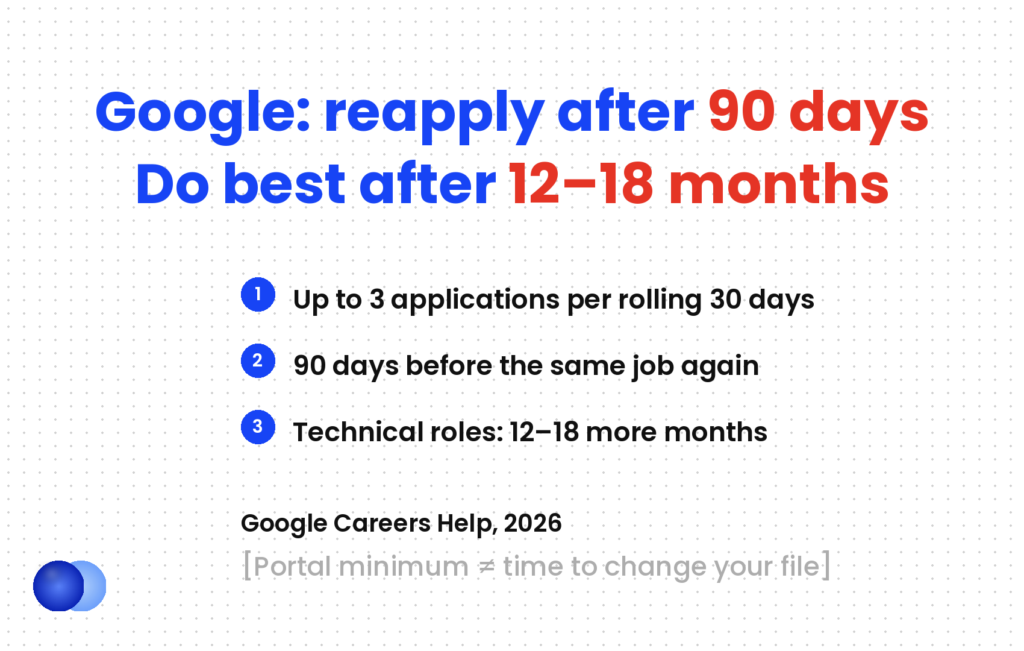
A company's official waiting period tells you when the portal will accept another application. It says nothing about when that application will succeed. Google allows a new application for the same job after 90 days, and on the same help page says technical candidates tend to do best after 12 to 18 months of extra experience. One employer, two figures, a year apart.
The gap between them is the whole article. Your earlier application does not vanish when the rejection arrives. It sits in the applicant tracking system, attached to your name, where the next reader can see it. Reapplying works when the new file answers the old one.
Can you reapply to a company that rejected you?
Yes. Rejection closes one requisition, not the company. You can reapply to a company for a different role straight away and for the same role after any stated cooldown. What decides the outcome is whether your new application shows something the recruiter could not see last time.
A rejection judges one application against one shortlist. Nothing in it bans you from trying again. Three situations differ:
A different role at the same company. Usually fine immediately, if the role genuinely fits. A new requisition often means a new hiring manager.
The same role, reposted. You are asking the same reader to reverse a decision, which takes new evidence.
After an interview loop. Your scorecards exist, and the next team may read them before your new resume.
Most people treat a reapplication as a fresh start. The system treats it as a sequel.
What does the company's ATS remember about you?
Applicant tracking systems identify people, not documents. Greenhouse's own support documentation says it flags potential duplicates by the same email address, phone number, LinkedIn profile URL or name, with email, phone and LinkedIn enabled by default. When a recruiter merges two profiles, the activity feed, scorecards and attachments combine into one record.
In practice, a second application lands on top of the first. A recruiter opening it can see the earlier role, the stage you reached, and any interviewer feedback. Greenhouse's candidate-facing guide adds that recruiters may set rules limiting how often a candidate can apply for a role, or stopping previously rejected applicants from applying again and again. The cap you meet is often a company setting, not a universal rule.
| What happened last time | What is likely on file | What the next reader sees first |
|---|---|---|
| Rejected at screen, no human contact | Resume, application answers, rejection reason code | Your old resume, next to the new one |
| Phone screen, then rejected | Recruiter notes on fit, pay and level | Why the recruiter said no |
| Interview loop, then rejected | Scorecards from each interviewer | Specific weaknesses, in writing |
| Offer declined by you | Full loop plus the offer record | A candidate who already said yes to the work once |
The further you got, the more the file says, and the more your new application has to answer.
How long should you wait before you reapply?
Follow any published rule first, then wait until something real has changed. Google allows three applications in a rolling 30 days and 90 days before reapplying to the same job. Where no rule exists, the common guidance of about six months is a proxy for enough time to change the file.
Few employers publish their policy, so treat forum claims about specific companies with caution. Google does, on its careers help page:
| Rule | Google's published position |
|---|---|
| Applications at once | Up to three jobs in a rolling 30-day window |
| Same job again | Wait 90 days |
| Technical roles | Candidates tend to succeed best after 12–18 more months of experience |
Where a company says nothing, Dice advises waiting at least six months before you reapply to a company for the same role, with three good triggers: the role is reposted, a hiring manager invited you back, or six to twelve months show visible growth.
The two figures look like they conflict, but they answer different questions. Google's 90 days is when the system lets you through. Dice's six months estimates how long it takes to gain something new to show, which Google's 12–18 month note for technical roles also implies.
The better unit is change, not time
Ask what the last reader lacked and whether you can now supply it: a finished certification, a result with a number, a promotion, a referral. The calendar alone is not a reason.
Reapply to a company with a one-line bridge
When you reapply to a company, name the earlier application yourself, in one line, before the recruiter finds it. "I applied for the analyst role in March; since then I have led the migration of our reporting to dbt and cut refresh time from six hours to forty minutes." That turns a record the reader might hold against you into a before-and-after. Put it atop the cover letter or recruiter message, never in the resume.
Should you apply to several roles at the same company at once?
Two or three related roles at the same level is normal and often sensible. Ten roles across different functions and seniorities signals a scattershot search. Tailor each application, because the recruiter may see every one of them together on a single profile.
Big employers expect overlap between related roles. The line sits where the roles stop making sense together. In her answer on this question, Alison Green of Ask a Manager says the trouble starts with roles that are wildly different in substance or level, and that you should vary your cover letter each time. Teal suggests a ceiling of two or three.
Don't let your interest in working there spur you to apply for everything you're slightly qualified for; that's when it's most likely to start looking bad.
Applications collect on one profile, so a recruiter may see a junior marketing role, a senior product role and an operations role side by side, which suggests you have not decided what you want.
Keep the set coherent. Same function, same level, or a clear one-step move.
Tailor each one. Generic applications convert at roughly 2–3% and tailored ones at 7–9%, a spread covered in how many jobs should I apply to.
Mention flexibility in conversation, not in volume. Telling a recruiter you would also fit a related team does the work of five extra applications.
When is reapplying to the same role worth it?
When the role reappears and you have something new, or when someone inside invited you back. A reposted listing does not always mean the old search failed; roughly one in five listings may not be a live opening at all, so check before you invest another tailored application.
A reposted role feels like a second chance. Sometimes the first hire fell through. Sometimes the listing never closed properly, or it belongs to the roughly one in five postings that are ghost jobs. Before you reapply, ask a recruiter or team contact whether the search is live.
Portal statuses will not settle this. As application status meanings explains, rejection labels are reliable and progress labels are not, so an old application still showing "Under Review" tells you little.
Repeat: Priya hears no at the screen for a fintech Product Analyst role in January. It reappears in April, and she sends the same resume with a reworded letter. The recruiter sees two near-identical files and closes the second in a minute.
Answer: Priya waits until June, having led a pricing experiment that lifted conversion by 4%. Her letter opens with one line naming the January application and the new result, and a former colleague on the payments team refers her. The recruiter reads progress against the old file.
The second version wins because it answers the file, not because of the gap.
What should change before you apply again?
At least one piece of evidence the last reader did not have: a new result, skill, credential, referral or clearer match to the role. Then rewrite the resume summary and top bullets around it, name the earlier application in one line, and use a different route in if you can.
1. New evidence. A result with a number, a finished credential, a shipped project. Without one of these, wait.
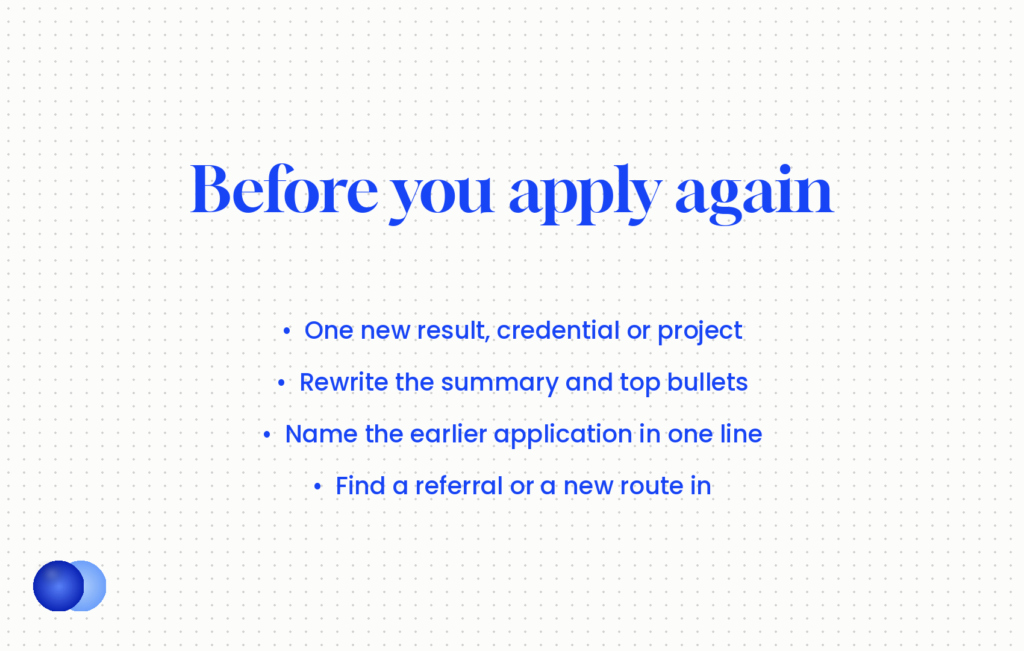
2. A rewritten top third. The summary and first bullets should lead with the new evidence.
3. A different route in. A referral or a hiring manager who asked you to keep in touch puts a person between you and the old file.
4. One acknowledgement line. Name the earlier application briefly and pivot to what has changed.
5. A record of what you sent. A job application tracker with role, date, resume version and outcome stops you sending last year's file by accident.
Ask for feedback after an interview loop and reapply only once you can show you have closed the gap it named.
Create a second profile with a new email address to look like a new candidate, because phone numbers and LinkedIn URLs still match and the merge will expose it.
Follow up once, then let it run
After you reapply to a company, normal logistics hold. Median first replies arrive around day six or seven, and one follow-up between day seven and day ten is enough; how to follow up on a job application has the wording.
What can reapplying not fix?
A mismatch in level or experience that only time closes, a team that has marked you as not a fit for reasons you cannot change, and hiring freezes. In those cases the better move is a different team, a later year, or a different company.
Some rejections carry a message no cover letter can answer. If the role needs five years in a regulated industry and you have two, the fix is three more years. If interviewers wrote that you sit at the wrong level, applying one level down can make sense; the same level again rarely does. And no reworked file changes a budget freeze.
The honest limit: reapplying shows change. When nothing has changed, the file already holds the answer.
Frequently asked questions
Can you reapply to a company after being rejected?
Yes. You can apply for a different role straight away and for the same role after any published cooldown, but the new application should show something the last reader did not see.
How long should I wait to reapply to the same job?
Follow any published rule first; Google, for example, requires 90 days. Otherwise about six months is common guidance, roughly the time it takes to gain new evidence.
Can recruiters see my previous applications?
Usually. Applicant tracking systems such as Greenhouse match candidates by email, phone number and LinkedIn URL, and merged profiles keep the activity feed, scorecards and attachments from earlier applications.
Is it bad to apply for multiple jobs at the same company?
Not if the roles are related and at a similar level. Two or three targeted applications is normal; applying to everything across functions and seniorities reads as unfocused.
Does Google limit how many jobs you can apply for?
Yes. Google's careers help page allows up to three applications within a rolling 30-day window and asks candidates to wait 90 days before reapplying for the same job.
Should I mention my previous application in my cover letter?
Yes, in one line near the top: the role, the date, and what has changed since. It turns a record the reader will find anyway into evidence of progress.
Should I reapply if the same job is reposted?
Only if you have something new to show and the role looks genuinely live. Some reposted listings are not real openings, so check with a recruiter or team contact first.
Can I use a different email to reapply as a new candidate?
It rarely works. Duplicate detection also matches phone numbers and LinkedIn URLs, so the profiles tend to merge and the disguise becomes part of the record.


Comments