How to Ask for More Time to Consider a Job Offer: Scripts
Need more time to consider a job offer? Get email and phone scripts by reason, a fill-in template, normal deadlines, and what to do if the employer says no.

On this pageHow do you ask for more time to consider a job offer?
- How do you ask for more time to consider a job offer?
- How much time is normal to decide on a job offer?
- What should an email asking for more time to decide on a job offer say?
- How do you ask for more time over the phone or when you want to negotiate?
- What if the employer says no to more time?
- When should you not ask for more time?
- How do you use the extra time well?
- FAQ
- Sources
To ask for more time to consider a job offer, thank the employer, say you are excited, and ask for a specific new date, usually a few days to one week out. Give one honest reason, such as a family talk or a benefits review. Ask by phone or email as soon as you know you need it, and decide by the date you named.
To ask for more time to consider a job offer, thank the employer, show real interest, and request a specific date a few days to a week away. Give one short, honest reason, then keep your word.
Most employers say yes to a polite, short request. The trouble starts when you ask late, ask twice or stay vague.
Quick answers by situation
| Your situation | What to say/do | Example line |
|---|---|---|
| You are waiting on another offer | Ask for a short, firm date | "Could I give you my answer by Friday?" |
| You need to talk with family or plan a move | Name the reason in one line | "I want to talk this through with my family before I commit." |
| You need to review benefits | Ask for the full package first | "Could you send the benefits summary so I can review it?" |
| You want to negotiate | Thank them, then set up a call | "Before I decide, could we talk about the base salary?" |
| You got an exploding offer | Ask for a few business days | "Could I have until Wednesday to give you a clear answer?" |
| You already know your answer | Don't stall; reply now | "Thank you, I'm happy to accept." |
How do you ask for more time to consider a job offer?
Call or email the recruiter within a day of the offer. Thank them, say you are excited about the role, and ask for a specific new date, usually a few days to one week out. Give one honest reason. Then confirm the date in writing and reply on or before it.
The Ladders suggests you acknowledge the offer within 24 hours8, even before you decide. If you ask on day one, it reads as care. If you ask on the last day, it reads as doubt.
Boston University's career team says the same thing in plain terms. Ask early7 once you know you need time, and make the request only once.
- Reply fastThank them within 24 hours, even if you can't decide yet.
- Show interestSay what you like about the role, so the delay doesn't sound like a no.
- Name a dateAsk for a specific day, not "a little more time."
- Give one reasonPick the real one: another offer, family, benefits or pay.
- Confirm in writingSend a short email that repeats the new date.
Why a specific date works
A clear date gives the recruiter something to plan around. Robert Half notes that hiring managers are usually more open5 when you give a set deadline, and that missing it can backfire.
So say "by Thursday at noon," not "soon." Then answer on time, even if the answer is no.
How much time is normal to decide on a job offer?
For most jobs, a few days to one week is normal. Junior roles often get two to three days, senior roles one to two weeks. Campus offers to students often run one to two weeks or more under NACE guidance. Less than a week can be a sign of pressure.
The right window depends on the role and on who made the offer. Here is how career centers and recruiters describe it.
| Offer type | Typical window | What to ask for |
|---|---|---|
| Exploding or same-day offer | Under one week1, often far less | A few business days |
| Junior or hourly role | Two to three days5 | One or two extra days |
| Standard professional role | 24 to 48 hours to about a week6 | Three to five days |
| Campus offer to a student | One to two weeks1 is common | Up to your school's guideline |
| Senior or executive role | One to two weeks5 | Up to two weeks, more with a move |
What NACE says about student offer deadlines
The National Association of Colleges and Employers sets the ethics rules most campus recruiters follow. Its 2026 advisory opinion says a one- to two-week deadline is common1. It also says some employers give students up to two months.
Less time than this can constitute undue pressure on applicants.
NACE, Setting Reasonable Deadlines for Job Offers
UT Austin's College of Natural Sciences asks employers to give two weeks minimum3 to accept. UCF says students should not be pressured4 to accept exploding offers. But NACE also tells career centers that an employer may still turn down a request for more time.
How long do people really take?
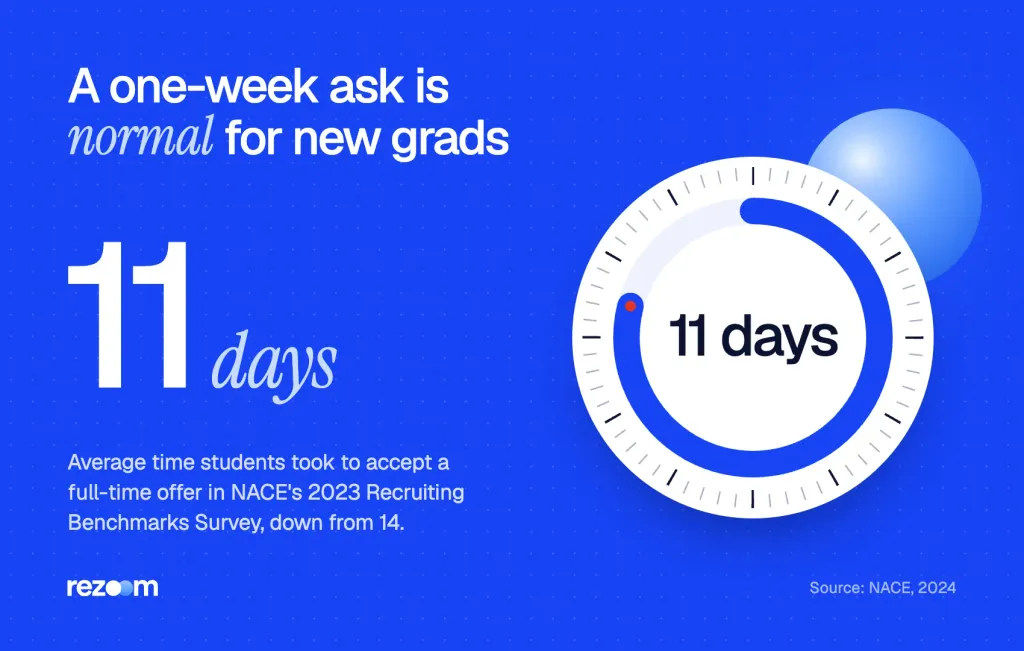
Most people decide fast. In NACE's 2023 survey, students took about 11 days to accept2 an offer, down from 14 days before the pandemic. In the same survey, 69% of offers were accepted.
So a week-long request is normal for a new grad. For an experienced hire, The Ladders advises you to never request longer than a week8, because the company may start calling its backup pick.
Got multiple job offers? Learn how to ask for more time, use one offer as leverage, compare them side by side and decline the others without burning bridges.
What should an email asking for more time to decide on a job offer say?
Keep it to four or five short lines. Thank them, restate the role, say you are excited, give one reason and ask for a specific date. End by saying you will reply by that date. Don't share other salary numbers or company names unless you plan to use them to negotiate.
Use these scripts by reason, and change the names and dates.
Waiting on another offer
Meet Alex Rivera, a data analyst with two offers in play. Company A made an offer on Monday with a Wednesday deadline. Company B has a final round on Thursday.
Subject: Data Analyst offer - Alex Rivera Hi Dana, thank you again for the offer. I'm excited about the analytics work on your pricing team. I'm finishing one other process I committed to before your offer arrived. Could I give you my answer by Monday, March 9? I want to give you a clear yes or no, not a rushed one. Thank you for understanding.
You don't have to name the other company. The Ladders notes you can also tell the second employer you have an offer, which may prompt them to act faster8. While you wait, keep your materials current: Company B asked Alex for an updated resume, and this data analyst resume example shows the kind of results-first bullets they want.
Data analyst resume example
See how a data analyst resume leads with numbers and tools.
For the full decision process, read our guide on handling multiple job offers.
Family or relocation
Hi Dana, thank you for the offer. I'm very glad to have it. Because the role means a move to Denver, I want to talk it through with my partner this weekend. Could I reply by Tuesday?
Reviewing benefits
Hi Dana, thanks so much for the offer. I'd like to review the full package before I decide. Could you send the benefits summary and the 401(k) match details? Once I have them, I'll reply within three business days.
If the written offer is missing key terms, our guide to the job offer letter lists what it should include.
Fill-in-the-blank template
Subject: [Job title] offer - [Your name]
Hi [Recruiter name], thank you for the offer for the [job title] role. I'm excited about [one specific thing].
[One-line reason: I'm wrapping up another process / I want to talk with my family / I'm reviewing the benefits].
Could I give you my decision by [day, date and time]?
Thank you, [Your name]
Do
- Name a specific day and time.
- Give one honest reason in one line.
- Restate your interest in the role.
Don’t
- Ask for "a few weeks" with no date.
- Invent a fake competing offer.
- Go silent until the deadline passes.
How do you ask for more time over the phone or when you want to negotiate?
On the phone, say thank you first, then ask for a short window and set a time to follow up. If you want to negotiate, ask for the pay talk before you ask for time. Keep the call short, stay warm, and send a recap email the same day.
A call feels harder, but it often lands better, because the recruiter can answer on the spot.
"Thank you, I'm really glad you called. The role is a great fit." "Before I give you a final answer, I'd like to talk through the base salary. Is there a good time tomorrow?" "After that call, I'd need until Friday to decide."
If you plan to counter, see how to frame it in our counter offer letter guide. And if you are weighing a raise, check what counts as a good salary increase when changing jobs before the call.
What to say if they push back
Some recruiters test your interest when you ask for time. Stay calm, restate your interest and offer a shorter window.
- "We need an answer today." Offer a middle date: "I understand. Could I have until Thursday morning?"
- "Do you have another offer?" Be honest but brief: "I'm finishing one other process. Your team is a top choice."
- "Other candidates are waiting." Show respect for their timeline: "That makes sense. I'll reply by Wednesday at noon."
Recruiter: "We'd really like an answer by end of day."
"I understand. I'm excited about this role, and I want to give you a firm answer. Could I have until Wednesday at noon?"
Recruiter: "Wednesday is tight. Is there anything holding you back?"
"I want to review the benefits with my family first. If you can send the summary today, I'll reply by Wednesday at noon."
Recruiter: "Okay, Wednesday at noon works."
Say your ask out loud three times before you dial. It keeps your voice steady when the recruiter pushes. You can also practice the negotiation call with an AI mock interview and hear how you sound.
A counter offer letter has one job the email doesn't: putting the agreement on paper. Plus the one-or-two-ask rule and the retention counter-offer trap.
Free ATS score, the text the software extracts and your missing keywords. No sign-up.
What if the employer says no to more time?
If they say no, you have two real choices: decide by the original deadline, or decline. Don't accept as a backup plan and back out later. Ask one last question that helps you decide, such as a start date or pay detail, then give your answer on time.
Boston University's career team frames it simply: an extension request ends in a yes or a no, so plan for both. It also warns that you should never accept an offer7 as a contingency plan.
So if Company A says no, Alex has to choose with the facts he has. If he takes the role, he should withdraw from the interview at Company B the same day.
If you decide to pass, use our scripts on how to say no to a job offer to keep the door open. Reneging after a yes is much worse; read about how to decline a job offer after accepting only as a last resort.
Signs an extension request is going badly
Watch the recruiter's replies. These signals mean you should decide soon, not ask again.
- Shorter replies: warm emails turn into one-line answers.
- A moved deadline: the date gets earlier instead of later.
- New conditions: they ask you to sign first and "sort details later."
- Silence: no reply after a day on a live offer.
- Pressure tactics: they hint that the offer may disappear.
Robert Half calls aggressive pressure for a quick answer a red flag5. So treat it as data about the culture, not just about the deadline.
Keep your search ready
If you walk away, the next application should be ready to go. Browse IT resume examples for layouts that suit analyst and tech roles. Then pair the resume with one of our IT cover letter examples so you can apply within a day.
When should you not ask for more time?
Don't ask if you already know your answer, if you only hope a better offer appears, or if you've already asked once. Skip it for short-term or hourly roles that need someone this week. In those cases, a quick yes or a polite no serves you better.
A request for time only works when you plan to use it. Boston University warns against asking just to see whether other offers come in7.
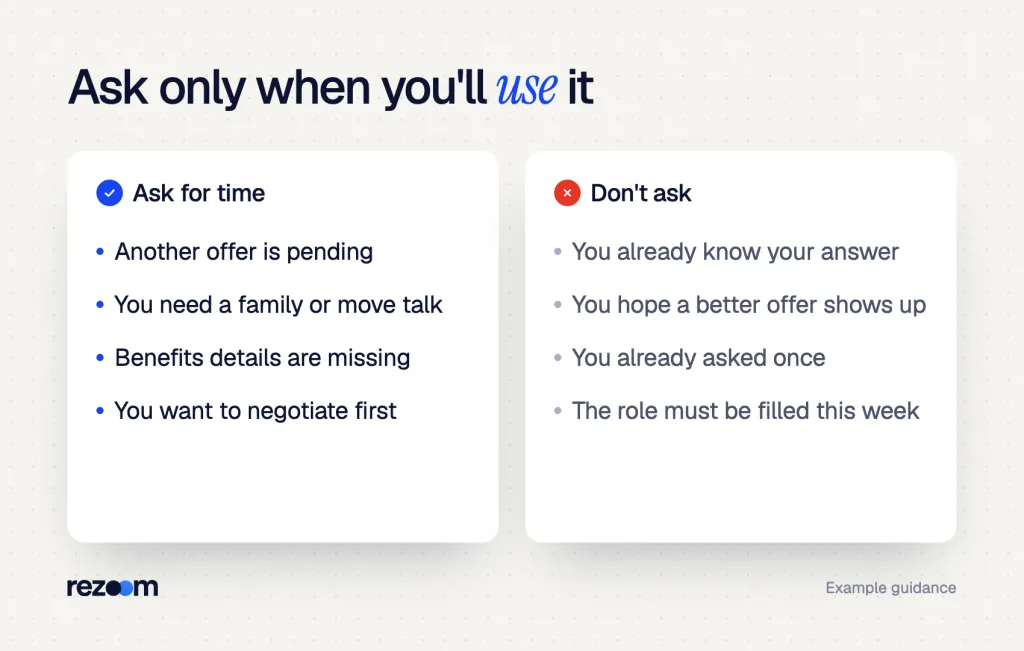
- You already know: if it is a clear yes or no, say it now.
- You are fishing: if you have no other process in motion, you are just stalling.
- You already asked: a second request, BU notes, looks poor on you.
- The job starts now: temp and hourly roles often fill within days.
Before you ask, rank your options on paper. If the current offer is already your first choice, you don't need the extra days. Accept it, and stop interviewing elsewhere.
How do you use the extra time well?
Use the extra days to compare the full package, not just base pay. Check benefits, start date, commute, growth and the team. Talk to one current employee if you can. Then make your call a day early, so you have room to send a clean reply.
Extra time helps only if you spend it on the right questions. Here is a short list to work through.
Before your new deadline
When the day comes, send your answer early. If you accept, confirm the start date and thank the recruiter.
Practice out loud with an AI voice coach.
Frequently asked questions
Is it okay to ask for more time to consider a job offer?
Yes. Recruiters expect it, and most agree to a short, polite request with a clear date. Ask early and ask only once.
How long can you take to accept a job offer?
A few days to one week is normal for most roles. NACE guidance says one to two weeks is common for students, and senior roles often get up to two weeks.
Can asking for more time make them pull the offer?
It is rare with a short, polite request. The risk grows when you ask for weeks, go silent or ask twice.
What is an exploding offer?
It is an offer with a deadline much shorter than normal, sometimes the same day. Many university career centers ask employers not to use them, so you can ask for a few business days.
Should I tell them I'm waiting on another offer?
You can say you are finishing another process without naming the company. Share details only if you plan to use them to negotiate.
Should I ask for an extension by email or phone?
Either works. A call shows interest and gets a quick answer, and a follow-up email puts the new date in writing.
Sources
We opened and read each page below. The small numbers in the text point here. Pages that carry no publication date show n.d.
- NACE2026
NACE says a one- to two-week offer deadline is common, some employers give students up to two months, and less time can be undue pressure.
- NACE2024
NACE's 2023 Recruiting Benchmarks Survey found students took about 11 days to accept an offer and 69% of offers were accepted.
- UT Austin College of Natural Sciences Career Servicesn.d.
UT Austin CNS asks employers to give students a two-week minimum to accept an offer and to avoid exploding offers.
- UCF Career Services2024
UCF discourages exploding offers and encourages students to contact employers well before the deadline if they need more time.
- Robert Halfn.d.
Robert Half says two to three days suits junior roles, one to two weeks suits senior roles, and a set deadline helps.
- Kean University Career Services (The Muse)2025
Kean's career blog says 24 to 48 hours is often enough, with three to five days as a standard request.
- Boston University Questrom2018
BU advises asking for an extension early and only once, and never accepting an offer as a contingency plan.
- The Laddersn.d.
The Ladders advises never requesting longer than a week and telling other employers you have an offer.
Mohammad has spent more than ten years designing consumer products and leads product at Rezoom, deciding what gets built and what gets left out. His guides cover the whole job search, from resume sections and cover letters to interview answers and career moves.
Goodi, M. (2026, November 18). How to Ask for More Time to Consider a Job Offer: Scripts. Rezoom. https://rezoom.io/how-to-ask-for-more-time-to-consider-a-job-offer/