

Summary
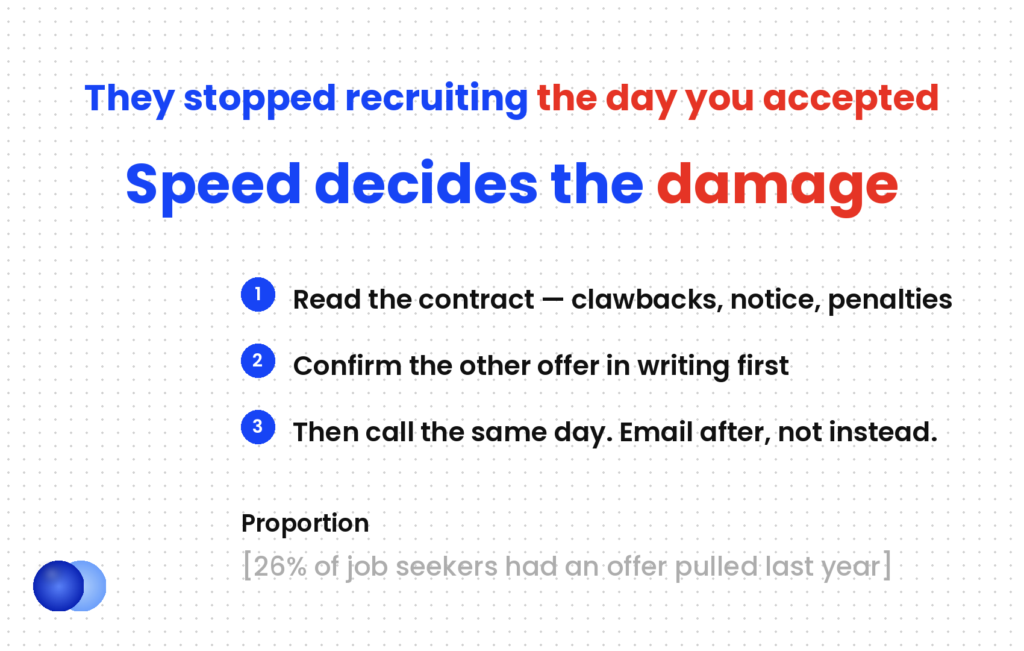
Backing out of an accepted offer is legal in most US at-will situations and carries real obligations where a signed contract, signing bonus or relocation payment exists. The variable that decides how much damage it does is speed — the employer has stopped recruiting, so every day you delay costs them more. Check the contract, confirm the alternative is signed, then call the same day.
Declining a job offer after accepting it usually starts the same way. A better offer arrived after you said yes to the first one. Or the company you accepted had layoffs. Or something in the onboarding paperwork changed your mind.
Whatever brought you here, one variable matters more than the wording of your email: how quickly you tell them. The moment you accepted, they stopped recruiting, told internal stakeholders the role had someone in it, and probably released the other candidates. Every day you wait makes the hole deeper. If you have already started the job, the exit is a resignation rather than a declined offer — see how to write a resignation letter that keeps the reference intact.
Before the how, two things to establish.
Is it legal to decline a job offer after accepting?
In most US situations, yes. At-will employment means either side can change their mind before a start date. A signed employment contract, common outside the US and in some senior roles, can carry notice periods or penalty clauses — and any signing bonus or relocation already paid is normally repayable.
This is general information rather than legal advice, and a contract worth real money is worth twenty minutes of a lawyer's time.
At-will employment. Most US states operate this way, which means accepting an offer does not obligate you to start. The employer has the same freedom in reverse.
A signed contract. More common outside the US and in senior or specialist roles. Read it for notice requirements, minimum-tenure clauses, and penalties before you do anything. What a notice period can genuinely oblige you to do is usually narrower than the clause makes it sound.
Money already paid. Signing bonuses and relocation assistance almost always carry clawback provisions for unearned amounts. Those are standard and enforceable — expect to return anything you have received.
| What you signed | What it usually means |
|---|---|
| At-will offer letter, US | No obligation to start; either side can withdraw |
| Signed employment contract | Check notice period and any penalty clause |
| Signing bonus already paid | Repayable — clawback on unearned amounts is standard |
| Relocation assistance paid | Repayable on the same basis |
| Minimum-tenure clause | Binding; ask whether they will release you in writing |
| Nothing signed yet | Withdrawing is a courtesy call, not a legal event |
Practical risk of being sued. Low in ordinary circumstances, and it rises with the harm your departure causes. An employer is more likely to act where the role was urgent and your absence compromises something specific.
How much does it actually hurt your reputation?
Less than the anxiety suggests, and it scales with how you handle it rather than with the act. Employers rescind offers routinely — one 2024 study found 26% of job seekers had an offer withdrawn in the past year. Handled fast and directly, reneging rarely has lasting consequences.
In practice, worth stating for proportion rather than as permission.
The asymmetry. A quarter of job seekers had an offer pulled in a single year. Companies withdraw offers for budget changes, reorganisations and hiring freezes, and they generally do not consider it a character issue. Candidates agonise over doing it once.
The real risk is narrow. In small industries, a specific hiring manager may remember. That is a genuine cost in a field of two hundred people and close to irrelevant in a field of two hundred thousand.
What creates lasting damage is the handling. Silence, a late notice, ghosting the start date, or an email where a call was possible. Those are the versions people remember.
None of that makes it a free action. It makes the cost proportional to something you control.
Do not act until the other thing is signed
Verbal offers evaporate. Before you withdraw from anything, have the new offer in writing, with a start date, and with any contingencies — background check, references, right to work — either cleared or clearly understood. Candidates who back out of offer A on the strength of a promised offer B occasionally end up with neither, and that is a far worse position than the one they were trying to improve.
What is the right sequence?
Read the contract, confirm the alternative in writing, call the same day you decide, and follow with a short email for the record. The call comes first because a decision this consequential delivered only by email reads as avoidance.
Four steps, in order:
1. Read what you signed. Notice period, penalty clauses, clawbacks on any money received. Ten minutes, and it changes what you say.
2. Confirm the alternative. In writing, with a start date, contingencies resolved.
3. Call. The recruiter or the hiring manager, the same day you decide. Not next week, not after the weekend.
4. Email afterwards. Short, same message, so there is a written record for both sides.
Reversing steps three and four is the common error. An email arriving cold on a Friday afternoon is the version people remember badly.
On the phone, roughly 30 seconds:
"Priya, I need to tell you something difficult. I've accepted another offer and I won't be able to start on the 14th. I'm sorry — I know this creates a problem and I wanted you to hear it immediately rather than later. I'm grateful for the process and for the offer."
The email, same day:
> Subject: Withdrawing from the Senior Analyst role — Sam Rivera > > Hi Priya, > > Following our call, I'm writing to confirm that I'm withdrawing from the Senior Analyst position with a start date of 14 April. > > I'm genuinely sorry for the timing and for the disruption this causes. I appreciated how straightforward the process was, and the decision was not a reflection on the role or the team. > > Please let me know if there is anything I need to return or sign. > > Best, > Sam Rivera
Under 100 words, no elaborate justification, and it offers to settle any obligations. That last line matters more than the apology.
How much should you explain?
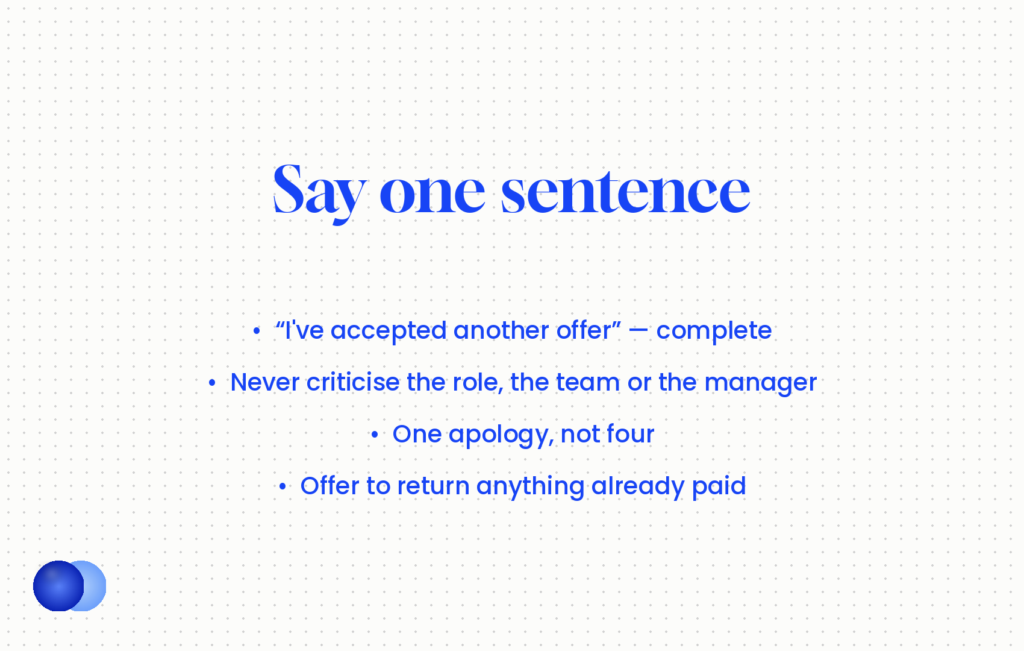
One sentence. "I've accepted another offer" or "my circumstances have changed" is sufficient. A long justification invites negotiation, and detailed criticism of the role or the manager creates a record you do not want to have created.
Here restraint does more work than sincerity.
Say what happened, not why it was better. "I've accepted another position" is complete. Comparing the two offers turns a notification into a debate.
Never criticise. If you are leaving because of the manager, the culture or something in the onboarding paperwork, "it won't be the right fit long term" is the version that does not follow you.
Do not over-apologise. One genuine apology reads as respect. Four reads as a request for absolution, which puts the other person in the position of managing your feelings about a problem you just handed them.
What if they push back?
Expect a counter-offer or pressure — "we already announced you internally", "let us match it". Unless the counter genuinely resolves why you are leaving, hold the decision. You do not owe a renegotiation, and reopening one after withdrawing rarely ends well.
Two responses are common and both are manageable.
The counter-offer. Sometimes genuine. But you have already worked through this decision, and the reasons you chose the other role usually do not disappear because the number moved. If money was the only issue and they match it, that is worth considering — otherwise it is not.
The guilt. "We already told the team." "We turned down two other candidates." Both may be true, and neither obliges you to start a job you have decided against.
The line that closes it without hostility:
"I appreciate that, and I don't make this decision casually. My decision is final — I wanted to give you as much time as possible to act on it."
That last clause is doing real work. It reframes the conversation around the thing you can still offer them, which is time.
Offer to return anything you have received. Signing bonuses and relocation payments carry standard clawback terms, and raising it yourself is better than being asked.
Ghost the start date. It converts a recoverable situation into the one version that genuinely damages a reputation, and it takes more effort than the call would have.
When is it clearly the right call?
When the company's situation changed after you accepted — layoffs, a funding collapse, a leadership exit — or when something surfaced in onboarding that you could not have known. Those reasons are self-evidently legitimate and worth stating plainly rather than softening.
Four situations where declining a job offer after accepting is straightforward:
The company changed. Layoffs, a funding round that failed, the hiring manager leaving. State it directly — the reason speaks for itself.
Onboarding revealed something. A non-compete far broader than discussed, a request you consider unreasonable, terms that differ from what you agreed.
Your circumstances changed. A health matter, a family situation, a partner's relocation.
A materially better opportunity. The most common reason and the one people feel worst about. It is also the one employers understand best, because they make the equivalent calculation constantly.
A professionally handled reneging — fast, honest, direct — almost never has lasting consequences.
How do you avoid being here again?
Do not accept until you have decided. The pressure to say yes quickly is real and it is not binding — asking for a few days to review a written offer is normal and costs nothing.
Finally, most reneging traces back to one avoidable moment: accepting under time pressure while another process was still running.
Ask for time. "Could I have until Thursday to review it properly?" is a standard request. An employer who refuses it has told you something.
Tell the other process. If you are weighing more than one, handling multiple job offers starts with the band each one sits in. If you are close with another employer, a real offer in hand usually accelerates them. "I have an offer with a Thursday deadline — is there any way to know where I stand before then?" is a reasonable ask.
Read before signing. Notice periods, clawbacks, non-competes. The counter offer letter covers why anything agreed verbally needs to be in the written offer, and the same discipline applies to what the letter obliges you to do. The clauses behind page one — at-will, arbitration, clawbacks — are unpacked in what a job offer letter actually commits you to.
Negotiate before accepting, not after. Once you have accepted, your leverage is gone — which is the point of the salary negotiation email arriving before your acceptance rather than after it.
Frequently asked questions
Can you decline a job offer after accepting it?
In most US at-will situations, yes. A signed contract may carry notice periods or penalty clauses, and any signing bonus or relocation payment already received is normally repayable.
Is it illegal to back out of an accepted job offer?
Generally not in at-will employment. Where a formal contract exists — more common outside the US and in senior roles — read it for notice requirements and penalties, and take legal advice if the sums are significant.
How bad is it for my reputation?
Less than the anxiety suggests, and it depends on the handling. Employers rescind offers routinely — one 2024 study found 26% of job seekers had an offer withdrawn in a year. Fast, direct notice rarely has lasting consequences.
Should I call or email?
Call first, the same day you decide, then send a short email so there is a written record. An email alone, arriving late, is the version people remember badly.
How much should I explain?
One sentence. "I've accepted another offer" is complete. A long justification invites negotiation, and criticism of the role creates a record you do not want.
Do I have to return my signing bonus?
Usually, yes. Clawback provisions for unearned signing bonuses and relocation payments are standard and enforceable. Offer to settle it rather than waiting to be asked.
What if they make a counter-offer?
Consider it only if money was the actual reason and they match it. Otherwise hold the decision — you have already worked through it, and you do not owe a renegotiation.
How do I avoid this situation?
Do not accept until you have decided. Asking for a few days to review a written offer is normal, and telling a slower process that you have an offer in hand usually accelerates it.



Comments