

Summary
No US federal or state law requires an employee to give notice, yet 87% of employers expect at least two weeks. That combination creates an asymmetry most guides skip — in an at-will state an employer can accept your resignation immediately and pay you only through that day, so a four-week notice is an offer of two weeks you may never be paid for.
The two-week notice period is a convention, and it is worth knowing what kind. Once the length is settled, the next decision is how to word the resignation letter itself.
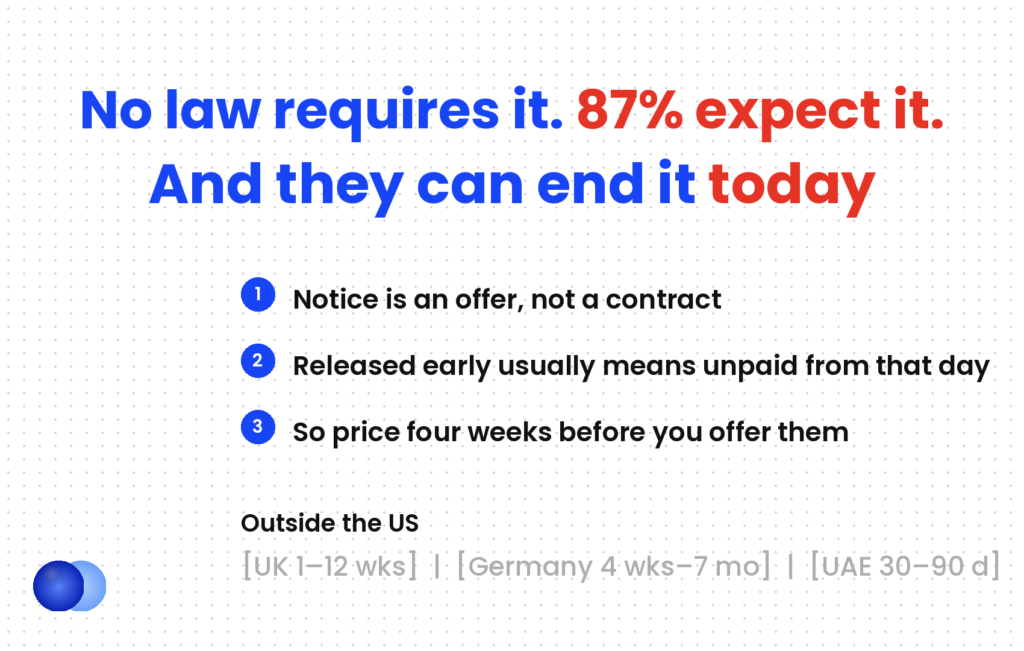
No US federal or state law requires you to give notice. Yet SHRM found 87% of employers expect at least two weeks for a voluntary resignation. A norm with strong social force and no legal force.
Which produces the asymmetry that decides how long yours should be: in an at-will state, your employer can accept your resignation the same day and pay you only through that day. A four-week notice is an offer of two extra weeks you may never be paid for.
This is general information rather than legal advice, and a contract with real money attached is worth a lawyer's time.
How much notice should you give?
Two weeks as the default. Three to four weeks for senior roles, a complex handover, or a real search to replace you. Longer than a month increases the chance of being released early, which in an at-will state usually means unpaid.
| Situation | Notice |
|---|---|
| Standard role, at-will state | 2 weeks |
| Under 3 months in the job | 1 week is defensible |
| Senior or specialist role | 3–4 weeks |
| Sole owner of a system or client relationship | 4 weeks, with documentation |
| Licensed, clinical or security-cleared work | 4–8 weeks — credentialing takes it |
| Contract or non-US role | Whatever the contract says |
Every notice period above assumes US at-will employment. Outside that, notice is usually statutory and binding, which is a different question entirely.
What is the financial risk of a longer notice?
Being released early. An at-will employer can accept your resignation effective immediately, and you are typically paid only through the day you actually worked. A few states require payment through a stated notice period, but most do not.
This is the part worth understanding before you choose a notice period.
You offer, they decide. A resignation letter saying "my last day will be the 30th" is a proposal. The employer can make it today.
Payment usually stops when you do. Under the Fair Labor Standards Act and state wage laws, an employer must pay you for hours worked. It generally does not owe you for hours it declined to let you work.
They cannot withhold what you earned. An employer cannot dock earned wages as a penalty for leaving, whatever a handbook says.
So a four-week notice in a role where early release is plausible is a bet with your own money. If your new start date is fixed and those two extra weeks were funding something, price that risk before offering them.
Confirm the new start date before you resign
Have the new offer in writing, with a start date, and with background checks and references either cleared or clearly understood. Then work backwards. Resigning on the strength of a verbal offer occasionally leaves people with neither job, and an immediate release turns a comfortable transition into an unplanned gap. The order is: signed, then dated, then notice.
Does the law require notice anywhere?
Not in the US for employees, and almost everywhere else. Forty-nine states follow at-will employment, so neither side must give notice. Most other countries set statutory minimums by tenure — the UK runs 1 to 12 weeks, Germany 4 weeks to 7 months, and the UAE 30 to 90 days.
| Country | Statutory employee notice |
|---|---|
| United States | None (at-will, 49 states) |
| United Kingdom | 1 week to 12 weeks by tenure |
| Germany | 4 weeks to 7 months by tenure |
| Poland | 2 weeks to 3 months by tenure |
| India | Typically contractual, 1 to 3 months |
| UAE | 30 to 90 days under the 2021 labour law |
The practical consequence for anyone working across borders: the US convention is unusually weak and unusually short. A candidate resigning from a UK or Gulf role cannot simply give two weeks, and a US employer hiring them needs to expect a start date one to three months out.
If you are in a contractual notice country, read the clause before you do anything else. The number in your contract is the number.
How do you word it?
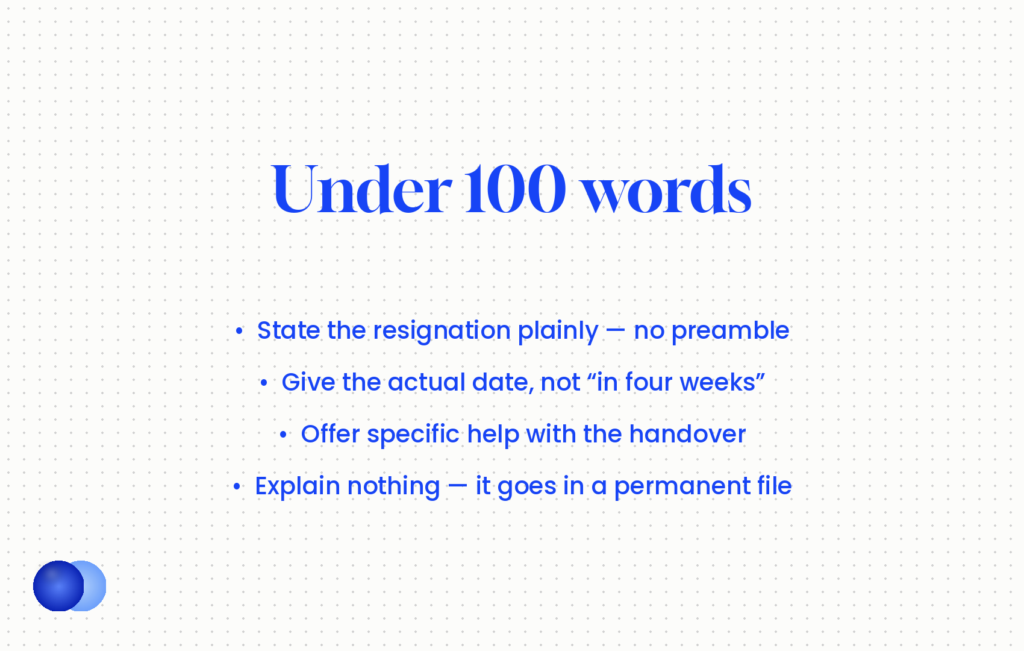
Short, dated, and without justification. State that you are resigning, give your last working day, offer to help with the transition, and thank them in one line. Reasons, grievances and details of the new role all belong out of the letter.
A resignation letter stating your notice period takes under 100 words:
Dear Priya, I'm writing to let you know I'm resigning from my role as Senior Analyst. My last day will be Friday 3 April, which gives us four weeks. I'd like to make the handover as smooth as possible — I'll document the reporting process and can help brief whoever picks it up. Thank you for the last three years. I've learned a great deal here. Best, Sam
Four things it does and one it avoids:
States the resignation plainly. No preamble.
Gives a specific date. Not "in four weeks" — the actual day.
Offers transition help. Concrete where possible.
Thanks them briefly. One line, genuine.
What to leave out
Explains nothing. No reason for leaving, no comparison to the new role, no grievance. A resignation letter is a record that goes in a file, and everything you add can be read later by someone you did not write it for.
Over-explained: "After a lot of soul-searching I've decided to accept an offer elsewhere. It wasn't an easy decision but the new role offers growth opportunities I felt weren't available here, particularly around leadership, which we discussed in my last two reviews without much movement."
Clean: "I'm resigning from my role as Senior Analyst. My last day will be Friday 3 April."
The first is honest and it also puts a complaint in your permanent file, closes a door, and invites a negotiation you have already finished having.
Tell your manager in person or on a call first, then send the letter the same day. A letter arriving cold is the version people remember badly, exactly as when declining an offer after accepting.
Announce it to colleagues before your manager knows. It travels faster than you expect, and a manager who hears it secondhand starts the conversation badly.
What about a counter-offer?
Expect one if you are hard to replace. Treat it as a different decision from the one you already made — the raise is real, and so is the fact that you have now identified yourself as someone who was interviewing.
In practice, two questions cut through it quickly.
Would this money have arrived if you had not resigned? If not, the company was comfortable paying you less until forced, which is information about how the next three years go.
Was compensation actually why you were leaving? If the reason was the manager, the work or the trajectory, a raise changes none of it.
Neither question makes accepting wrong. They make accepting for the money alone the version that usually disappoints. The counter offer letter covers the mechanics on the other side of the same conversation.
What should you do during the notice?
Document, hand over, and stay useful. The reference conversation happens after you leave, and the last two weeks are disproportionately what people remember. Leaving well is cheap; leaving badly follows you in a small industry.
Finally, four things in order of how much they matter later:
1. Write down what only you know. The process nobody documented, the client quirk, the workaround in the legacy system. This is the highest-value thing you can leave behind.
2. Hand over specifically. Named successor where possible, a walkthrough, a document they can follow without you.
3. Keep working. Visible disengagement in the last two weeks is what colleagues remember about your whole tenure.
4. Ask for the reference before you go. A manager is more willing while you are still in the building, and a LinkedIn recommendation requested on your last week is far easier to get than one requested six months later.
There are no state or federal laws that require an employee to give two weeks' notice before resigning.
Frequently asked questions
How much notice should you give when resigning?
Two weeks as the standard in at-will US employment, three to four for senior roles or a complex handover. Outside the US, whatever your contract or national law requires.
Is two weeks' notice legally required?
No. Forty-nine US states follow at-will employment, and no federal or state law requires an employee to give notice. It is a professional norm that 87% of employers expect.
Can my employer end my employment before my last day?
Yes, in an at-will state. They can accept your resignation effective immediately, and you are typically paid only through the day you actually worked.
Can an employer withhold pay if I don't give notice?
No. Under the Fair Labor Standards Act and state wage laws, employers must pay for all hours worked. They cannot dock earned wages as a penalty for leaving.
Should I give more than two weeks?
Only where the handover genuinely needs it. Longer notice increases the chance of early release, which in most at-will states means the extra weeks go unpaid.
What should a resignation letter say?
That you are resigning, your specific last working day, an offer to help with the transition, and one line of thanks. Under 100 words, with no reasons or grievances.
Do notice periods work differently outside the US?
Substantially. The UK sets 1 to 12 weeks by tenure, Germany 4 weeks to 7 months, and the UAE 30 to 90 days. In contractual notice countries, the clause is binding.
Should I accept a counter-offer?
Treat it as a separate decision. Ask whether the money would have arrived without your resignation, and whether pay was actually why you were leaving.



Comments