

Summary
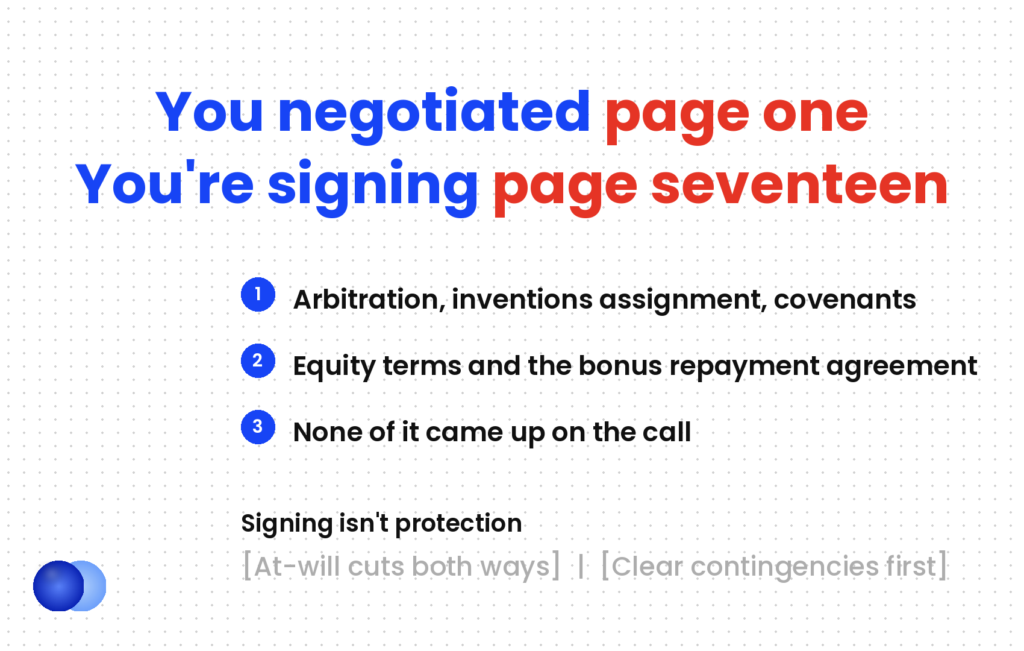
The four pages a recruiter walks you through hold the title, salary and start date. The seventeen pages behind them hold the arbitration agreement, the inventions assignment, the restrictive covenant, the equity terms and the bonus repayment agreement. Almost everything that shapes the next four years sits in the part nobody reads aloud.
Your job offer letter arrives on a Friday and HR wants it back Monday. It runs to four pages, and seventeen more sit behind the paperclip.
A modern job offer letter is a stack of contracts pretending to be a single document. Page one is the headline — title, salary, start date, the things you negotiated. The pages behind it are the at-will acknowledgment, the arbitration agreement, the inventions assignment, the restrictive covenant addendum, the equity terms and the bonus repayment agreement.
Almost everything that will matter over four years is in the second part, and almost none of it came up on the call.
General information rather than legal advice. A contract with real money or real restrictions attached is worth a lawyer's hour.
What is actually in a job offer letter?
Two layers. The headline layer holds the title, compensation, start date, work arrangement and benefits summary. The structural layer holds the at-will clause, contingencies, arbitration, intellectual property assignment, restrictive covenants and any repayment agreement.
| Layer | What it contains | Negotiable? |
|---|---|---|
| Headline | Title, base, bonus target, equity, start date, work arrangement | Yes, and usually already discussed |
| Contingencies | Background check, references, right to work, drug screen | Rarely, but worth understanding |
| At-will clause | Either side can end it at any time | No |
| Arbitration | Disputes go to arbitration, not court | Rarely |
| Inventions assignment | Who owns what you create | Sometimes, and worth trying |
| Restrictive covenants | Non-compete, non-solicit, non-disparagement | Often, by scope |
| Repayment agreements | Signing bonus, relocation, training clawbacks | Yes — see below |
In short, the pattern: the parts you can still change are mostly the ones nobody mentions.
Which clauses matter most?
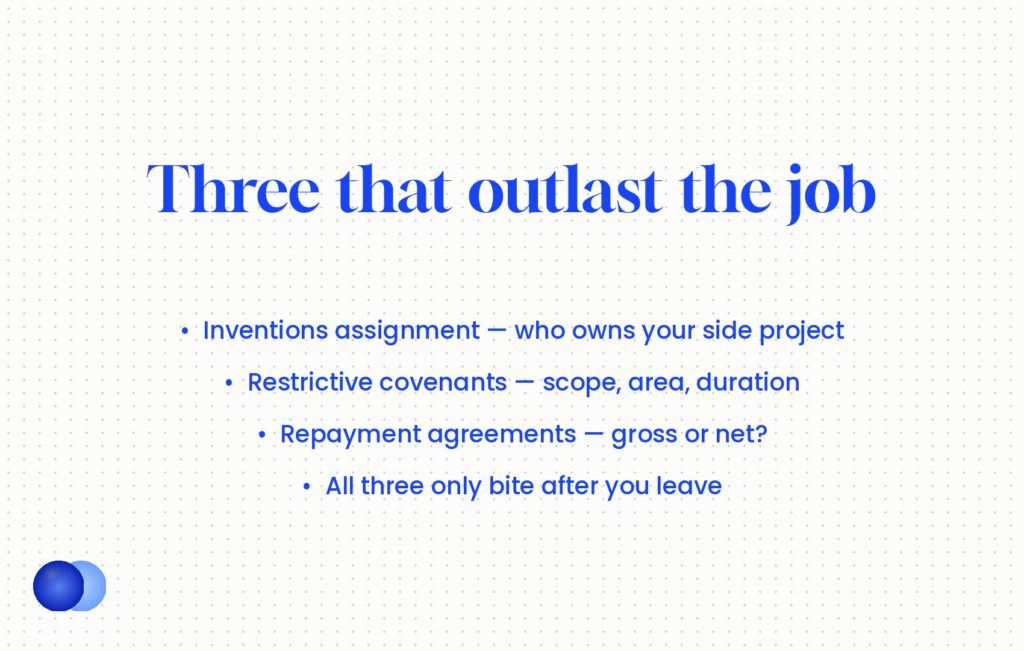
The inventions assignment, the restrictive covenants and any repayment agreement. Those three create obligations that outlast the job itself — they are the ones that follow you after you leave, which is exactly why they are easy to skim.
Three clauses in a job offer letter deserve a careful read:
1. The inventions assignment. This defines who owns what you create. A broad version can claim side projects built on your own time and equipment. Check whether it carves out work that is unrelated to the company's business and developed without its resources — several states require that carve-out, and many agreements include it. If yours does not, ask.
2. Restrictive covenants. Non-compete, non-solicit, non-disparagement. A non-compete should be narrow in scope, geography and duration, and it should only appear at all if the role gives you access to genuine confidential information. Enforceability varies enormously by state, and an overly broad clause is frequently unenforceable — but unenforceable is a thing you find out expensively, after the fact.
3. Repayment agreements. Signing bonus, relocation, training costs. Most specify the gross amount rather than the net you received, which the signing bonus clawback trap covers in detail. This is the most negotiable of the three and the one people most often sign untouched.
Ask for the handbook before you sign, not after
Offer letters frequently reference an employee handbook or separate policy documents, and important terms — termination procedure, PTO accrual and forfeiture, expense rules, the actual bonus mechanics — live there rather than in the letter. Asking for a copy before signing is a completely normal request and occasionally produces the only real surprise in the process. An employer who will not share it before you commit has told you something about how information flows there.
Does signing secure the job?
No. In at-will employment, an employer can rescind after you sign and even after you resign your current role. Your remedy is usually limited to recouping promised relocation costs. That is why the sequence matters: clear every contingency and confirm the start date in writing before you give notice.
Crucially, this turns a paperwork question into a financial one.
Signing is not protection. At-will works both directions, and a signed offer letter with proper at-will language is not a contract for a fixed term.
Contingencies are real. One analysis of offer-letter disputes found 43% involved candidates who failed a background check or reference verification. Until those clear, the offer is conditional.
The safe sequence: signed offer → all contingencies cleared → written start-date confirmation → then resign. Reversing the last two steps is how people end up with no job and no notice period, and your notice period is not something you can take back once given.
A small number of states recognise promissory estoppel where you took an irreversible step — quitting, relocating — in reliance on an offer. That is a lawsuit, not a plan.
What if it does not match what you were told?
Raise it before signing, always. Verbal promises about flexible hours, fast promotion or a bonus do not survive a dispute — the wording on the page decides it. Anything agreed on a call belongs in the letter or in a written amendment attached to it.
Finally, the rule is simple and people break it constantly because raising it feels awkward.
What was said does not govern. If a dispute arises, the signed document decides it, not what anyone remembers from a call.
The fix is one email. "Thanks — before I sign, could we add the six-month review with the defined target we discussed? Happy to sign as soon as that's in."
Nothing about this is unreasonable. An employer who agreed to something verbally and declines to write it down has answered the question of whether they meant it.
Avoidant: Sign it, start the job, and raise the missing signing bonus in month two. The person who promised it has moved teams, nobody has a record, and you are now negotiating from inside rather than outside.
Direct: "The letter doesn't include the 8,000 signing bonus we discussed on Thursday. Could you add it? Everything else looks right and I'm ready to sign."
One sentence, sent before signature, when you still hold the only leverage you will ever have on this document.
Read the appendices, not just the letter. The four pages they walked you through are the part you already agreed. The seventeen behind the paperclip are the part you are actually signing.
Sign the same day out of politeness. Accepted offers close in about 2.8 days on average, so taking two or three days to read properly sits inside the normal range rather than signalling hesitation.
What should you check, line by line?
Eleven items — title, reporting line, base, pay frequency, bonus mechanics, equity terms, start date, work arrangement, benefits eligibility dates, contingencies and the response deadline. Then the three clause families above.
The job offer letter checklist, in the order the terms usually appear:
1. Job title and reporting line. Both, exactly. A title that differs from what you discussed affects your next role, not just this one.
2. Base salary and pay frequency. Monthly, semi-monthly and biweekly are meaningfully different for cash flow.
3. Bonus mechanics. Target percentage, what it depends on, and whether "discretionary" appears. Discretionary means exactly that.
4. Equity. Grant size, vesting schedule, cliff, and the post-termination exercise window. That last one is frequently 90 days and frequently overlooked.
5. Start date. Firm, and workable against your notice period.
6. Work arrangement. Remote, hybrid or on-site, and how many days if hybrid. Written down, not assumed.
The five people skim
7. Benefits eligibility. Not just what, but from when. A 90-day wait on health coverage is a real cost.
8. PTO. Accrual rate, carryover, and what happens to unused days on exit.
9. Contingencies. What must clear, and by when.
10. Response deadline. And whether you can ask for a few more days. You usually can. If another employer is still interviewing you, aligning the two decision dates matters more than the decision itself.
11. Who signs. A letter from someone without authority is a weaker document than it looks.
A modern offer letter is a stack of contracts pretending to be a single document.
If anything in the headline layer still needs to move, do it now rather than after — the counter offer letter covers how, and the same principle governs both: once you have accepted, your leverage is gone.
Frequently asked questions
What should you check in a job offer letter before signing?
Title and reporting line, base and pay frequency, bonus mechanics, equity terms including the exercise window, start date, work arrangement, benefits eligibility dates, PTO rules, contingencies and the response deadline — then the arbitration, inventions and restrictive covenant clauses.
Is a job offer letter a contract?
Usually not, if it contains proper at-will language. Most offer letters explicitly state they are not a contract for a fixed term and that either party may end the relationship at any time.
Can a job offer be rescinded after I sign?
Yes, in at-will employment, and even after you have resigned your current role. Clear every contingency and get a written start-date confirmation before giving notice.
What is an inventions assignment clause?
It defines who owns what you create. A broad version can claim side projects built on your own time and equipment, so check for a carve-out covering work unrelated to the company and developed without its resources.
Are non-compete clauses enforceable?
It varies enormously by state, and overly broad clauses are frequently unenforceable — but establishing that happens expensively and after the fact. Negotiate scope, geography and duration before signing.
What if the offer letter doesn't match what I was told?
Raise it before signing. Verbal promises do not survive a dispute, because the wording on the page decides it. One email asking for the term to be added is entirely normal.
How long can I take to review an offer letter?
Offers that get accepted close in about 2.8 days on average, so two or three days to read properly is well within the normal range. Acknowledge receipt immediately and say when you will respond.
Should I ask for the employee handbook before signing?
Yes. Termination procedure, PTO forfeiture, expense rules and actual bonus mechanics often live there rather than in the letter, and asking is a standard request.



Comments