

Summary
Two numbers in a signing bonus are not what they appear. Employers withhold at a flat 22% supplemental rate, so a $20,000 bonus lands closer to $14,000 after FICA and state tax. And most clawback clauses require repayment of the gross amount, meaning you return money you never had. Both are negotiable, and California changed the rules in January 2026.
Most guides tell you to ask for a signing bonus. Fewer explain the two places the number moves against you.
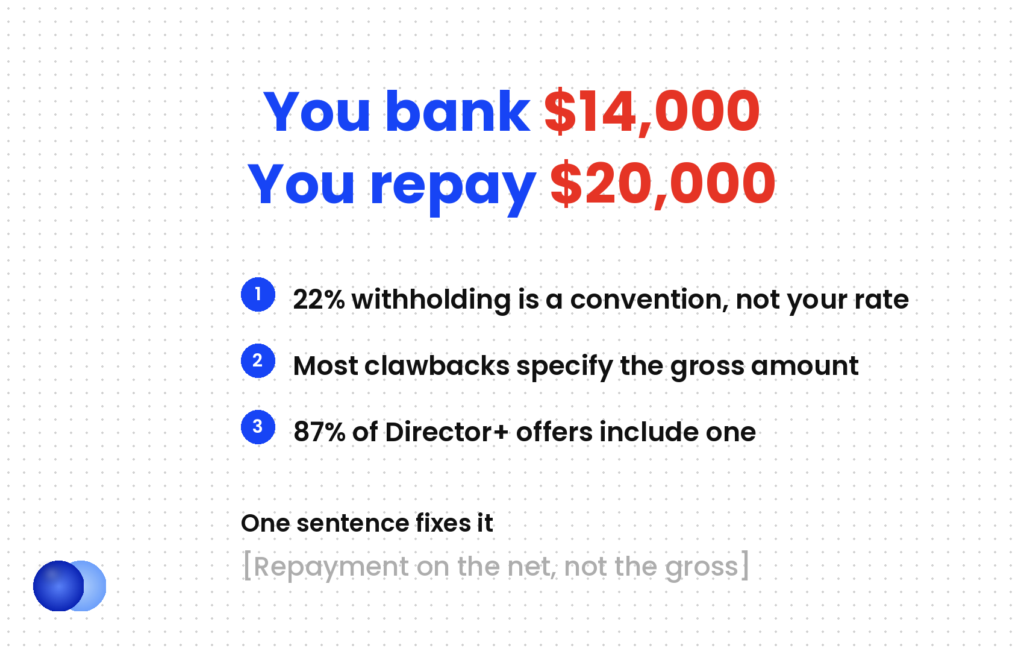
The bonus you receive is smaller than the bonus you negotiated. Employers withhold at a flat 22% supplemental rate, plus FICA and state tax, so a $20,000 bonus commonly lands around $14,000.
The bonus you repay is larger than the bonus you kept. Most clawback clauses specify the gross amount. Leave inside the window and you return $20,000 having banked $14,000.
Both are negotiable. Almost nobody negotiates them.
General information rather than legal or tax advice — a five-figure clawback is worth a CPA's time.
Why is the signing bonus the most negotiable number?
Because it comes from a different budget. Base salary sits inside a rigid internal pay band and affects every future raise and every colleague's relative position. A signing bonus is a one-time cost that changes neither, which makes it far easier for a manager to approve.
In practice, this is the mechanism worth understanding before you ask.
Base raises the band. Paying you more means either stretching the range or creating an inconsistency with the people already in it.
A one-time payment does neither. It comes out of a separate line, needs less internal justification, and disappears after one cycle.
That makes "if base is fixed, could we look at a signing bonus?" the single most productive follow-up in an offer conversation — and why a recruiter saying the offer is final often means the base is fixed, not that every element is locked.
One caveat to hold onto: a signing bonus is patch money, not structure. It fixes year one; base fixes every year after it. Negotiate base first and take the bonus as the bridge when base genuinely caps — the salary negotiation email covers that order.
What is a typical signing bonus?
$2,000 to $10,000 at entry level, $10,000 to $30,000 for mid-level professional roles, and $50,000 or more at executive level, varying widely by industry. As a percentage, 10 to 20% of base is a defensible ask.
| Level | Typical range |
|---|---|
| Entry level | $2,000–$10,000 |
| Mid-level professional | $10,000–$30,000 |
| Senior / specialist | $20,000–$50,000 |
| Executive | $50,000–$200,000+ |
| As a share of base | 10–20% |
Broadly, two ways to arrive at your number, and one is much stronger:
Forgone compensation. Add up what you are leaving behind — unvested equity, an upcoming annual bonus, relocation costs — and ask for that. This is the most defensible anchor because it is arithmetic rather than a preference.
Percentage of base. 10 to 20% of the offered base. Use the lower end when you have nothing specific to cite.
What is the clawback trap?
Most clauses require repayment of the gross bonus rather than the net you received. A $20,000 bonus that reached you as $14,000 becomes a $20,000 debt if you leave inside the window — typically 12 to 24 months, and present in 87% of Director-plus offers.
This is the part that costs real money and the part people sign without reading.
| What happens | The number |
|---|---|
| Negotiated bonus | $20,000 |
| Withheld at 22% federal supplemental | –$4,400 |
| FICA and state (varies) | –$1,600 or more |
| What reaches your account | ~$14,000 |
| What a gross clawback demands back | $20,000 |
The gap is money you never held. You can often recover part of it through the tax system — IRC §1341 provides a credit for repaid income — but that is a filing exercise months later, not cash in the moment.
One sentence in the negotiation fixes it: ask for repayment calculated on the net amount you received rather than the gross.
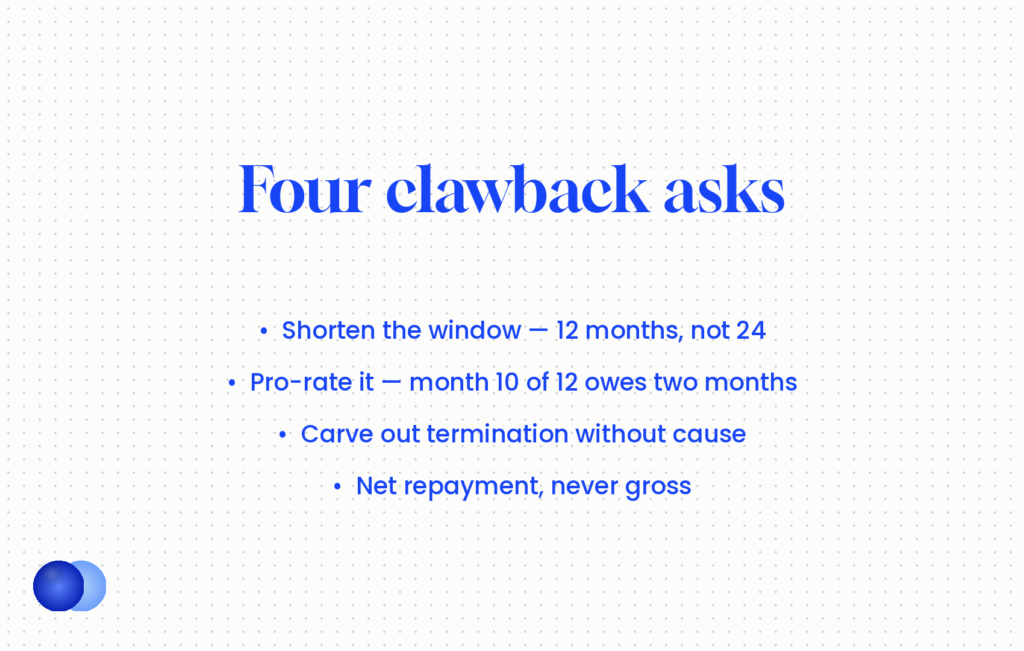
Four clawback asks, all routinely granted
Shorten the window — 12 months instead of 24. Require pro-rated repayment, so leaving at month 10 of 12 means owing two months' worth rather than everything. Carve out termination without cause, so a layoff or restructure does not trigger it. And specify net rather than gross repayment. Frame all four the same way: "I'm committed long-term, so I'm comfortable with a clawback — I'd just want it structured fairly." Companies eager to close accept most of these.
Did the rules change in 2026?
In California, substantially. Assembly Bill 692 makes sign-on bonus clawbacks unenforceable from January 2026 unless specific conditions are met — including that the repayment terms sit in a separate document and that you had at least five business days to consult an attorney before signing.
Notably, this changes what a clause is worth rather than what it says.
California's AB 692 targets "stay-or-pay" arrangements, which is precisely what a signing bonus clawback is. For offers signed after 1 January 2026, a clause that does not meet the stated conditions is void.
New York has moved in a similar direction. The broader point for anyone outside those states: an offer letter is not a court order. If a clawback fires, protect yourself in this order: check the contract's exact language, check your state's law, run the tax treatment, and ask your new employer whether they will cover it — before wiring anything. Clawback language sits with the rest of the terms behind page one, which the clauses in a job offer letter walks through line by line.
How do you ask?
In writing, as part of a complete counter, after the base conversation has concluded. A written request forces a considered response where a verbal one invites a deflection.
Finally, three scripts by situation:
Base still open:
"Based on the range posted and the scope we discussed, I'm targeting 102 to 108. If the base is constrained, I'd also be open to bridging the gap with a signing bonus."
Base declared final:
"I completely understand the base is set. Is there any flexibility on a one-time signing bonus to help bridge the gap? I'm leaving an annual bonus of about 12,000 on the table by starting in April."
Forgone compensation as the anchor:
"Moving now means forfeiting roughly 18,000 in unvested equity and a March bonus. A signing bonus covering that would let me say yes without absorbing the cost of the timing."
The second script does the most work, because it accepts their constraint rather than arguing with it and then names a different budget.
Verbal, mid-call: "Is there maybe a signing bonus or something?"
Written, in the counter email: "To finalise, here's my complete counter: base at 105, plus a signing bonus of 15,000 to offset the unvested equity I'd forfeit by starting in April. Happy to sign as soon as we've settled this."
The written version forces the recruiter to process a specific number and take it somewhere. The verbal one is easy to answer with "I'll see what I can do" and never revisit.
Confirm the payment date, the tax treatment, and the clawback terms before celebrating. First paycheck, 30 days, 90 days and 50/50 splits are all common, and the difference matters if you are timing a move around it.
Accept a verbal promise of a bonus. A one-time payment has no second payroll cycle in which to correct a misunderstanding, which is why the counter offer letter exists — anything not in the written offer is not part of the deal.
What should you check before signing?
Amount, payment date, tax treatment, clawback window, whether repayment is gross or net, whether it is pro-rated, and whether involuntary termination triggers it. All seven belong in the offer letter rather than in an email thread.
Seven items, and the last three are where the money sits:
1. The amount. In figures, in the letter.
2. The payment date. First paycheck, 30 days, 90 days, or split.
3. Tax treatment. Whether the figure is gross or grossed-up.
4. The clawback window. 12 or 24 months, and the exact end date.
Where the money actually sits
5. Gross or net repayment. The single most valuable clause to negotiate.
6. Pro-rated or binary. Binary clauses mean missing the threshold by a day costs the full amount.
7. Involuntary termination. If they lay you off, the clawback should not apply. Get it in writing.
The repayment amount is usually the gross bonus, not the net amount the employee received.
That sentence is the whole article. A signing bonus is worth asking for — it is the most approvable number in an offer, and most people never raise it. Just ask for it with the four structural terms attached, because the difference between a well-drafted clause and a default one is frequently larger than the difference between asking and not asking.
Before any of this is relevant, the offer has to exist — the salary expectations answer covers the conversation that sets the band you are negotiating inside.
Frequently asked questions
What is a typical signing bonus?
$2,000 to $10,000 at entry level, $10,000 to $30,000 mid-level, and $50,000 or more at executive level. As a share of base, 10 to 20% is a defensible ask.
How do I ask for a signing bonus?
In writing, as part of a complete counter, after the base conversation. If the base is declared final, ask specifically whether a one-time signing bonus is possible — "final" usually means the base is fixed rather than every element.
How much tax is taken from a signing bonus?
Employers withhold at a flat 22% federal supplemental rate under IRC §3402(g), plus FICA and state tax. That is a withholding convention rather than your actual rate, so a $20,000 bonus commonly nets around $14,000.
What is a signing bonus clawback?
A clause requiring repayment if you leave within a set window, usually 12 to 24 months. It appears in around 87% of Director-plus offers.
Do I repay the gross or net amount?
Usually the gross, unless you negotiate otherwise. That means returning money you never received, which makes net repayment the single most valuable term to ask for.
Can clawback terms be negotiated?
Yes, and companies eager to close frequently accept. The four standard asks are a shorter window, pro-rated repayment, a carve-out for termination without cause, and net rather than gross repayment.
What happens to the clawback if I'm laid off?
It depends entirely on the wording. Negotiate a carve-out for involuntary termination before signing, because without one a restructure can leave you repaying a bonus for a job you did not choose to leave.
Did signing bonus rules change in 2026?
In California, yes. Assembly Bill 692 makes sign-on clawbacks unenforceable from January 2026 unless conditions are met, including separate documentation and five business days to consult an attorney.



Comments