

Summary
Multiple-offer situations usually fail on timing rather than on judgement. The candidate who asks for an extension keeps the ability to compare; the one who lets the deadline run out loses the option before ever using it. Asking is free, most deadlines move, and the honest version of leverage — a competing offer named without inflation — is the one that works.
Multiple job offers should feel like a good problem. In practice they feel like a deadline, and that is where most of them go wrong.
The timing window is the most common reason multiple-offer situations collapse. Company A wants an answer in five days, Company B is in final rounds, and the candidate who handles the next 48 hours passively loses the ability to compare before ever getting to use it.
The framework is short: buy real time, compare honestly, decide fast.
Should you ask for more time?
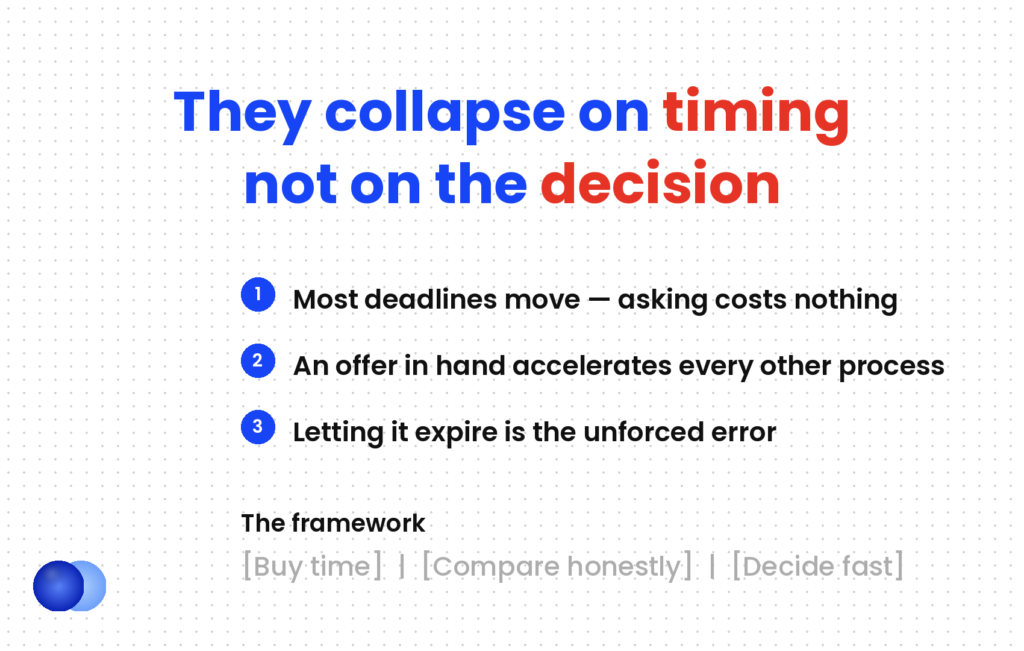
Always. Most offer deadlines move, the company has already invested heavily in reaching this point, and nobody rescinds an offer because a candidate asked for another week. Letting a deadline expire without asking is the single most common unforced error here.
In practice, this is a free ask and most people skip it.
They have invested heavily. Sourcing, screening, four rounds of interviews and a debrief. They are not throwing that away over seven days.
Deadlines are usually soft. Structured programmes in banking and consulting hold firm. Most other employers do not.
The worst case is information. If they refuse, you have learned something about how they operate before joining.
The wording that works names a specific date and a real reason:
"I'm genuinely excited about this and I want to give you a considered yes rather than a rushed one. I have one other process concluding this week — would Thursday work instead of Monday?"
Reasonable asks: one to two weeks on most offers, longer for senior roles or relocations. Avoid asking for thirty-plus days, and never let the date pass in silence.
Use the deadline on the other side too
An offer in hand accelerates every other process you are in. "I've received an offer with a Thursday deadline. I'd much rather finish your process first — is there any way to know where I stand before then?" is a legitimate, honest request that frequently compresses two more weeks of interviews into three days. Most candidates only use a deadline defensively, as something to survive. It works better as something to spend.
How do you use one offer as leverage?
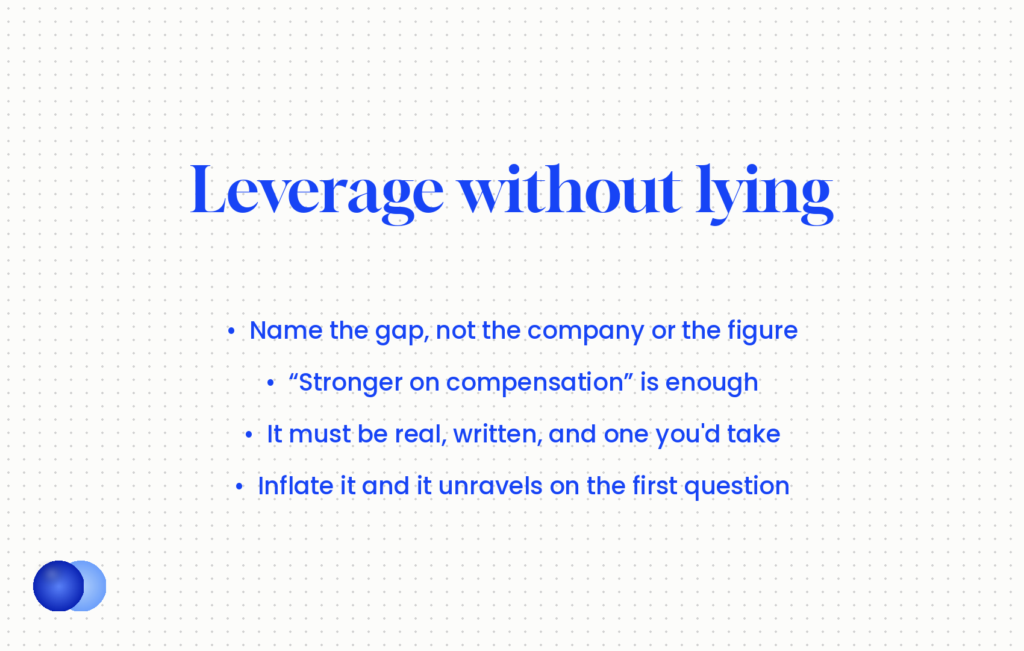
Name the gap, not the company or the exact figure. "I have a competing offer that's stronger on compensation — is there flexibility to get closer to X?" is sufficient. Inflating the number is the failure mode, because it unravels the moment anyone asks for specifics.
Usefully, the honest version is also the effective one, which is not always true in negotiation.
You do not have to name the company. Revealing a lower-prestige name weakens you; revealing a stronger one occasionally invites a comparison you would rather not have.
You do not have to give the exact number. A range is enough.
You do have to be accurate. If they ask for specifics and you have inflated, you have created a problem with no recovery.
Two conditions before using leverage at all. The competing offer must be real and written, not verbal or vague. And it must be one you would genuinely accept — using an offer you would never take reads as a bluff, and experienced recruiters detect it.
If the base will not move, the rest of the package usually will:
| Lever | Typical flexibility |
|---|---|
| Base salary | Constrained by the band |
| Signing bonus | High — a one-time cost outside the ongoing budget |
| Equity | High at startups, moderate elsewhere |
| Start date | High, and genuinely valuable if you want a break |
| Earlier review date | Moderate where formal cycles exist |
| PTO, remote days | Moderate |
| Title | Sometimes, especially at smaller companies |
The salary negotiation email covers the arithmetic of the counter itself, and the signing bonus is usually the most approvable number on that list.
How do you compare them?
On total compensation at realistic payout rather than headline base, then on the things that decide the next two years — scope, manager, trajectory. Compensation is the most visible dimension and rarely the most important over a three-year horizon.
Comparing multiple job offers takes two passes, in order.
Pass one: make the numbers comparable. Base, bonus at realistic payout rather than target, equity valued honestly, signing bonus amortised over the period you would stay, and the cost of benefits including any waiting period. A 6% higher base with a 90-day health coverage gap and no signing bonus is not the better offer it looks like.
What outlasts the number
Pass two: the things that outlast the number. Scope — are you owning something or contributing to it. Manager — the single largest predictor of whether you stay. Trajectory — what does this title let you apply for next. Commute or remote arrangement, over 250 days a year.
One useful exercise: imagine both roles two years out and ask which version of you is more employable. That question frequently answers the whole comparison.
Offer A: $105,000 base, 10% bonus target, no signing bonus, benefits from day 90, same level as your current role, manager you met once.
Offer B: $99,000 base, 10% target, $12,000 signing bonus, benefits from day one, one level up with a function to own, manager you spent an hour with and liked.
A looks like more money. Over year one, B pays more once you count the bonus and the benefits gap — and B changes what you can apply for in 2028.
Decide quickly once you have what you need. The longer a rejection sits, the more it costs the recruiter who championed you internally, and that person has a long memory in a small industry.
Accept verbally and keep interviewing. A verbal acceptance signals intent, and reneging after it is where real reputational damage happens — declining after accepting covers the cost when it is unavoidable.
What if the timing genuinely cannot align?
Take the offer in hand if it is strong on its own merits. The risk of waiting for an offer that may never arrive is usually worse than accepting a good one in front of you — and an offer at final-round stage is not an offer.
This is where multiple job offers cost people the most, usually by over-weighting the possibility.
Company A is firm on Monday. Company B says they cannot accelerate. You now have a real offer and a hypothetical one.
Judge A on its own terms. If it is a good offer, the absence of a comparison does not make it worse.
Discount B heavily. A final-round conversation is not an offer, and the gap between the two is larger than it feels while you are in it.
Take the certainty. Declining a strong offer for a possibility is a bet most people lose, and the downside — no job at all — is much larger than the upside of a slightly better one.
How do you decline the others?
Quickly, by phone or a short email, with no comparison and no elaborate reason. One or two sentences thanking them and confirming the decision. The hiring manager you decline today may be your skip-level in three years.
Declining the other job offers comes down to three rules, all about speed and brevity:
Move fast. Same day you decide. They can now act on it.
Say nothing comparative. "I've accepted another offer that was the right fit for this next step" is complete. Naming the other company or explaining why they lost creates a record and no benefit.
Leave it open. "I'd genuinely welcome the chance to work together in future" is worth writing when it is true, because in most industries it turns out to be.
The candidate who handles timing well preserves the option to compare offers and use leverage; the candidate who lets timing happen passively loses optionality before they ever get to use it.
Finally, a note on where this starts. Multiple offers arrive when several processes run in parallel, which is a function of application volume and timing rather than luck — how many jobs you should apply to covers the arithmetic that produces this position in the first place.
Frequently asked questions
How do you handle multiple job offers at once?
Buy time by asking for an extension, compare on total compensation and trajectory rather than headline base, then decide quickly and decline the others the same day.
Can I ask for more time to decide on a job offer?
Yes, and you almost always should. Most deadlines move, the company has invested heavily in reaching this point, and nobody rescinds because a candidate asked for another week.
How do I use a competing offer as leverage?
Name the gap without naming the company or the exact figure — "I have a competing offer that's stronger on compensation, is there flexibility to get closer to X?" Never inflate it.
Should I tell an employer I have another offer?
Yes, when it is real and written. It is honest, it frequently accelerates their process, and the honesty is itself a professional signal.
What if one company won't extend the deadline?
Judge the offer in hand on its own merits. A final-round conversation is not an offer, and declining a strong offer for a possibility is a bet most people lose.
What can I negotiate if the base salary won't move?
Signing bonus, equity, start date, an earlier review with a defined target, PTO, remote days and sometimes title. The signing bonus is usually the most approvable.
Can I accept verbally and keep interviewing?
No. A verbal acceptance signals intent, and reneging after it is where genuine reputational damage happens. If you are going to withdraw, do it before accepting.
How do I turn down the other offers?
Same day you decide, by phone or short email, with no comparison and no elaborate reason. One or two sentences, and leave the door open where you mean it.



Comments