

Summary
Published estimates range from 32 applications per offer to 200. That gap is not a disagreement about the market — it is the difference between generic applications converting at 2 to 3% and tailored ones converting at 7 to 9%. Once you see that, the weekly number stops being a matter of opinion: pick an interview target, divide by your own conversion rate, and the volume falls out.
The published answers to how many jobs you should apply to are wildly inconsistent. One 2025 study found the average job seeker sends 32 applications before a hire. Aggregated job-board data puts it at 100 to 200 per offer. Career advisors say ten a week; auto-apply tools say a hundred.
That is a six-fold spread, and it looks like nobody knows. But the same datasets contain the resolution, and it is not a compromise between the two camps.
Why do the estimates disagree so much?
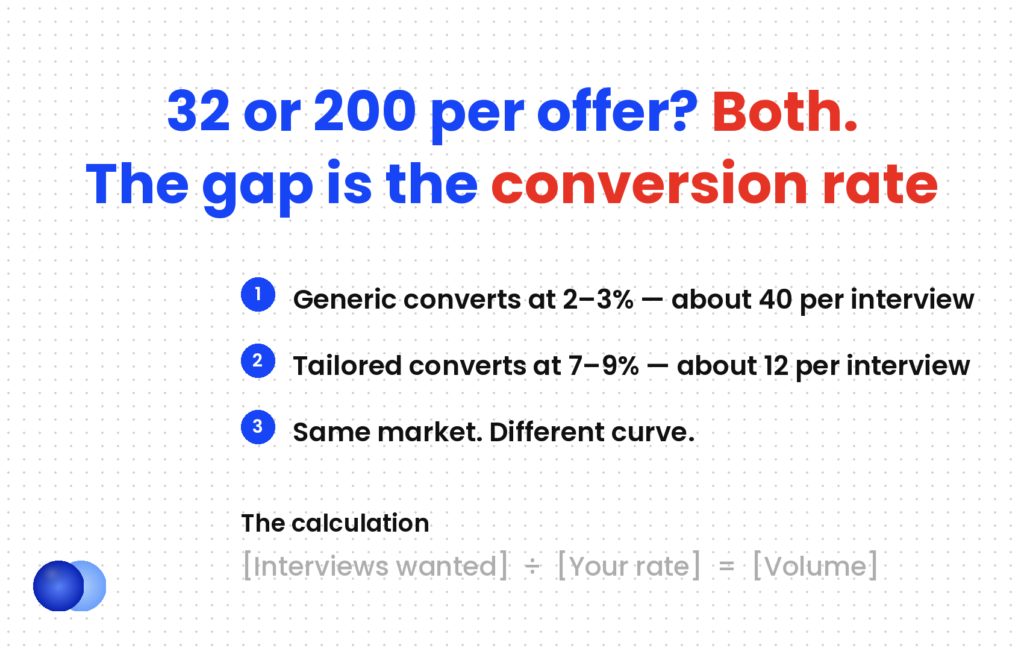
Because they measure different strategies. Generic applications convert to interviews at 2 to 3%, while applications tailored to the job description convert at 7 to 9%. At 2.5% you need roughly 40 applications per interview; at 8% you need about 12. The six-fold spread in advice is the three-fold spread in conversion rate, compounded.
In practice, run the arithmetic and the disagreement dissolves.
| Approach | Interview rate | Applications per interview |
|---|---|---|
| Generic, mass-applied | 2–3% | ~40 |
| Tailored to the posting | 7–9% | ~12 |
Both camps are quoting real numbers from their own populations. The “32 applications” figure comes from targeted job seekers. The “150 to 200” figure comes from the general pool, most of whom are mass-applying.
So the question “how many jobs should I apply to” has no answer in the abstract. It has an answer once you know which curve you are on.
How many jobs should I apply to per week?
Work backwards. Decide how many interviews a week you want, then divide by your conversion rate. Two interviews a week at an 8% tailored rate means about 25 applications; at a 2.5% generic rate it means 80, which almost nobody sustains. Most people land in the 10 to 25 band.
How many jobs you should apply to comes out of a thirty-second calculation that replaces every generic recommendation:
Interviews wanted per week ÷ your interview rate = applications per week.
| Target | At 8% (tailored) | At 2.5% (generic) |
|---|---|---|
| 1 interview/week | ~13 applications | ~40 applications |
| 2 interviews/week | ~25 applications | ~80 applications |
| 3 interviews/week | ~38 applications | ~120 applications |
Now look at the right-hand column. Those volumes are not achievable for most people alongside a job, and attempting them is what collapses quality — which lowers the rate further, which demands more volume. That is the loop to avoid.
Your own ratio is the only number that matters
Track applications sent against interviews received. If your rate sits below 5%, more volume will not fix it — the targeting or the resume is the constraint, and another forty applications at the same rate produce the same silence more expensively. Above 8%, you are converting well and volume genuinely is your lever. That single ratio tells you which problem you actually have, and almost nobody calculates it.
What do the three volume bands look like?
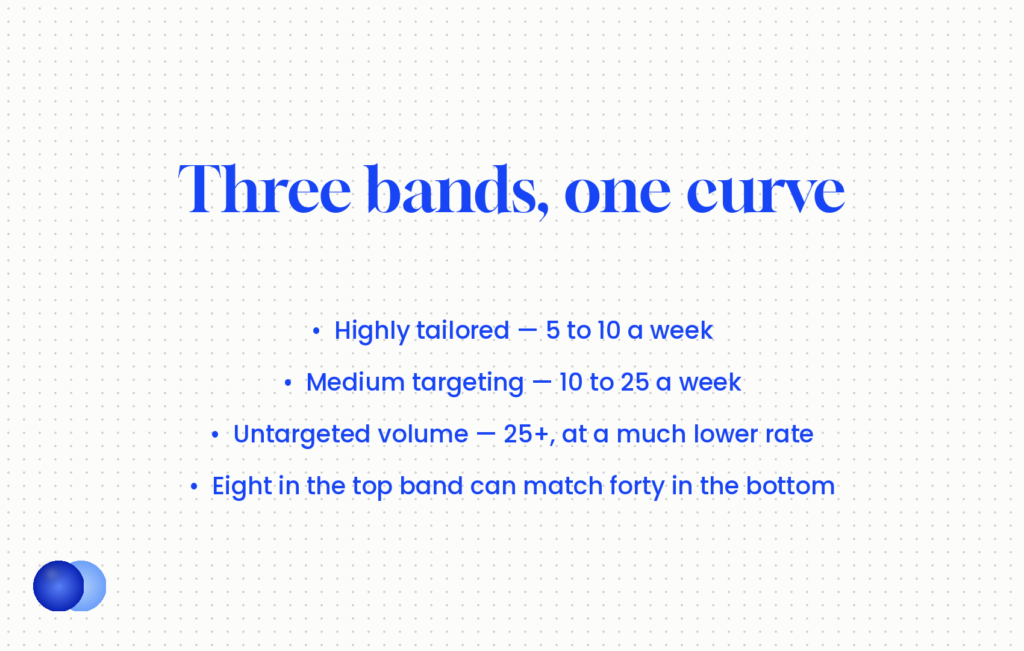
Highly tailored applications work at 5 to 10 per week, medium targeting at 10 to 25, and untargeted volume at 25 or more with a much lower rate per application. Most people do best in the middle band, because past it, added volume costs the targeting that was doing the work.
| Band | Volume | What you do per application | Best for |
|---|---|---|---|
| Highly targeted | 5–10/week | Company research, rewritten summary and bullets, cover letter | Senior, specialised, competitive roles |
| Medium targeting | 10–25/week | Tweaked summary and top bullets, matched keywords | Most job seekers |
| Untargeted volume | 25+/week | Same file everywhere | High-supply standardised roles only |
Eight applications in the top band can produce as many screens as forty in the bottom one. These are not moral positions about effort — they are points on a curve, and past the middle, each additional application costs you the targeting that was generating the conversion.
Role type shifts the curve. Standardised, high-supply roles flatten the targeting premium, so volume is more defensible there. Specialised and senior roles steepen it, because fit is the entire evaluation.
Does tailoring actually pay for itself?
Yes, at modest effort. Tailoring only the summary and top three bullets is reported to lift response rates substantially and takes under 15 minutes once you have a solid base resume. Beyond that threshold, additional customisation produces diminishing returns.
Here both camps are partly right, and the shape of the curve matters.
The first fifteen minutes are worth a lot. Matching the posting’s job title, rewriting the summary, and adjusting your top three bullets moves you from the generic rate toward the tailored one. That is the largest available gain in the whole process.
The next hour is worth much less. Rewriting every bullet, researching the company’s history, composing a bespoke cover letter for a role you are a marginal fit for — these produce real but sharply diminishing returns.
Where the threshold sits
So the honest position is neither “quality over quantity” nor the reverse. It is that a threshold exists, you reach it quickly, and effort past it belongs on the next application.
The threshold is mechanical, not artistic: does the file parse, and does the language match the posting. An AI resume checker run against the specific role answers both in a couple of minutes, and beating AI resume screening covers why the exact job title is the single highest-value change you can make.
Candidate A. 40 generic applications a week. Same resume every time. At 2.5%, that produces one interview a week and about eight hours of submitting.
Candidate B. 15 applications a week, each with a matched title, rewritten summary and three adjusted bullets. Fifteen minutes each. At 8%, that produces 1.2 interviews a week and under four hours.
Fewer applications, half the time, more interviews. The difference is not effort — it is where the effort goes.
Check your fit before applying. If you meet under 70% of the stated requirements, your odds are very low and that application is mostly costing you time you could spend on a better match.
Treat a weekly number as a target to hit regardless of what is available. Some weeks have twelve good matches and some have three. Applying to the three is the correct answer in the second week.
How long does a whole search take?
Most searches run 100 to 200 applications for untargeted seekers and 30 to 100 for targeted ones, over two to four months. Huntr's Q1 2026 data found 48% of successful candidates landed offers within 30 applications, which is consistent with the tailored conversion rate rather than a contradiction of the larger figures.
Naturally, the totals follow directly from the weekly maths, and they are worth seeing before you start.
At the tailored rate, an offer typically arrives somewhere between 30 and 100 applications. At the generic rate, 100 to 200 is normal, and competitive fields like tech, finance and consulting skew higher.
That translates to two to four months of sustained effort for most people — the part worth preparing for rather than discovering. How long to hear back after applying covers the per-application timeline inside that.
One market note for context rather than comfort: US job openings ran around 6.9 million against 5.6 million hires in early 2026, and UK vacancies fell to their lowest level since 2021 with roughly 2.5 unemployed people per vacancy. The inventory exists; the competition for it has risen.
Should you use auto-apply tools?
With care, and knowing who is telling you what. Tools that submit at volume recommend high volume; tools that score fit recommend low volume. Both have commercial interests in their own recommendation, and this article's publisher builds resume tools too.
Finally, worth naming plainly, because the advice landscape here is unusually conflicted.
Search this question and roughly half the results recommending 50 to 100 applications a week come from services that auto-submit applications. Roughly half the results recommending 10 to 15 come from services that score fit and tailor resumes. Each recommendation happens to align with what the publisher sells. We build resume tools, so treat this article the same way.
The way through is to ignore the recommendation and check the mechanism. Automation that speeds up submitting a tailored application is genuinely useful — the fifteen minutes of tailoring is what produces the rate. Automation that submits the same file to a hundred postings moves you onto the 2.5% curve, where the volume it enables is exactly the volume you now need.

Track your application-to-interview ratio. If it's below 5%, your targeting or your resume needs work.
What should you actually do this week?
Calculate your own interview rate from your last twenty applications, pick an interview target, divide, and apply that many with fifteen minutes of tailoring each. If the rate is unknown, start at 15 per week in the middle band and measure.
Four steps to settle how many jobs you should apply to:
1. Calculate your rate. Applications sent, interviews received, from your last twenty. If you have not applied yet, assume 5% and correct after twenty.
2. Pick an interview target. One or two a week is realistic and sufficient.
3. Divide. That is your weekly number, and it is yours rather than a benchmark.
4. Fix the rate before raising the volume. Below 5%, the constraint is upstream — how an ATS works covers what actually filters candidates, and more applications at a broken rate simply produce more silence.
The reframe worth keeping: the question is not how many jobs you should apply to. It is what your conversion rate is, because that number decides the volume for you — and it is the one thing on this page you can actually change.
Frequently asked questions
How many jobs should I apply to per week?
Work backwards from interviews. At a tailored 8% rate, two interviews a week needs about 25 applications; at a generic 2.5% rate it needs 80. Most people land between 10 and 25.
How many applications does it take to get a job?
Between 30 and 100 for targeted applicants and 100 to 200 for untargeted ones. Huntr's Q1 2026 data found 48% of successful candidates landed offers within 30 applications.
Is it better to apply to more jobs or fewer better ones?
Fewer, better-targeted ones convert three to five times better per application. But volume still matters, because most applications end in silence regardless of quality.
Does tailoring a resume actually work?
Yes, and quickly. Tailored applications convert at 7 to 9% against 2 to 3% for generic ones, and most of that gain comes from matching the title, summary and top three bullets — under 15 minutes of work.
What is a good application-to-interview rate?
Above 8% is strong and means volume is your lever. Below 5% means the targeting or the resume is the constraint, and more applications will produce more silence rather than more interviews.
Should I apply if I only meet half the requirements?
Usually not. Below roughly 70% of stated requirements the odds drop sharply, and that time converts better into a closer match.
How long does a job search take in 2026?
Two to four months of sustained effort for most people, which follows directly from the application totals and the per-application response timeline.
Are auto-apply tools worth it?
It depends what they automate. Speeding up the submission of a tailored application preserves your conversion rate; submitting the same file everywhere moves you onto the low-conversion curve where you need far more volume.



Comments