Display Pronouns to Hiring Team: What It Means and What to Pick
Display pronouns to hiring team means recruiters and interviewers can see your pronouns. Learn who sees them, if it is optional and what to choose.

On this pageWhat does display pronouns to hiring team mean?
- What does display pronouns to hiring team mean?
- Who sees your pronouns, and who does not?
- Is the pronouns field optional, and can it affect screening?
- Should you display pronouns to the hiring team?
- How is the pronouns field different from voluntary self-identification?
- Can you change your pronouns after you apply?
- How do you fill out the pronouns field step by step?
- FAQ
- Sources
"Display pronouns to hiring team" is an optional setting on some online job applications. If you turn it on, the recruiters, hiring managers and interviewers who work on your application can see the pronouns you enter, so they can address you correctly. If you leave it off, they do not see them. It is separate from the voluntary EEO questions, which stay out of hiring decisions.
"Display pronouns to hiring team" means the pronouns you type on a job application will show to the people who review and interview you. It is optional. Turn it on if you want interviewers to address you correctly; leave it off if you prefer privacy.
The setting usually sits next to a pronouns field near your name. Some forms show it as a checkbox, others as a dropdown or a short question. Below you will find a quick table, who sees what, the US legal context, and wording you can copy.
Quick answers by situation
| Your situation | What to do | Example entry |
|---|---|---|
| You want interviewers to use your pronouns | Fill in the field and turn the display option on | "she/her" |
| You prefer to keep it private | Leave the field blank or the option off | (blank) |
| You are not sure yet | Leave it off; you can share later in an email or interview | (blank) |
| Your pronouns are not on the list | Pick "self-describe" and type them | "he/they" |
| You go by a different first name too | Add your preferred name in its own field | "Sam (she/her)" |
| You want to change it after you apply | Email your recruiter with the update | "Please note my pronouns are they/them" |
What does display pronouns to hiring team mean?
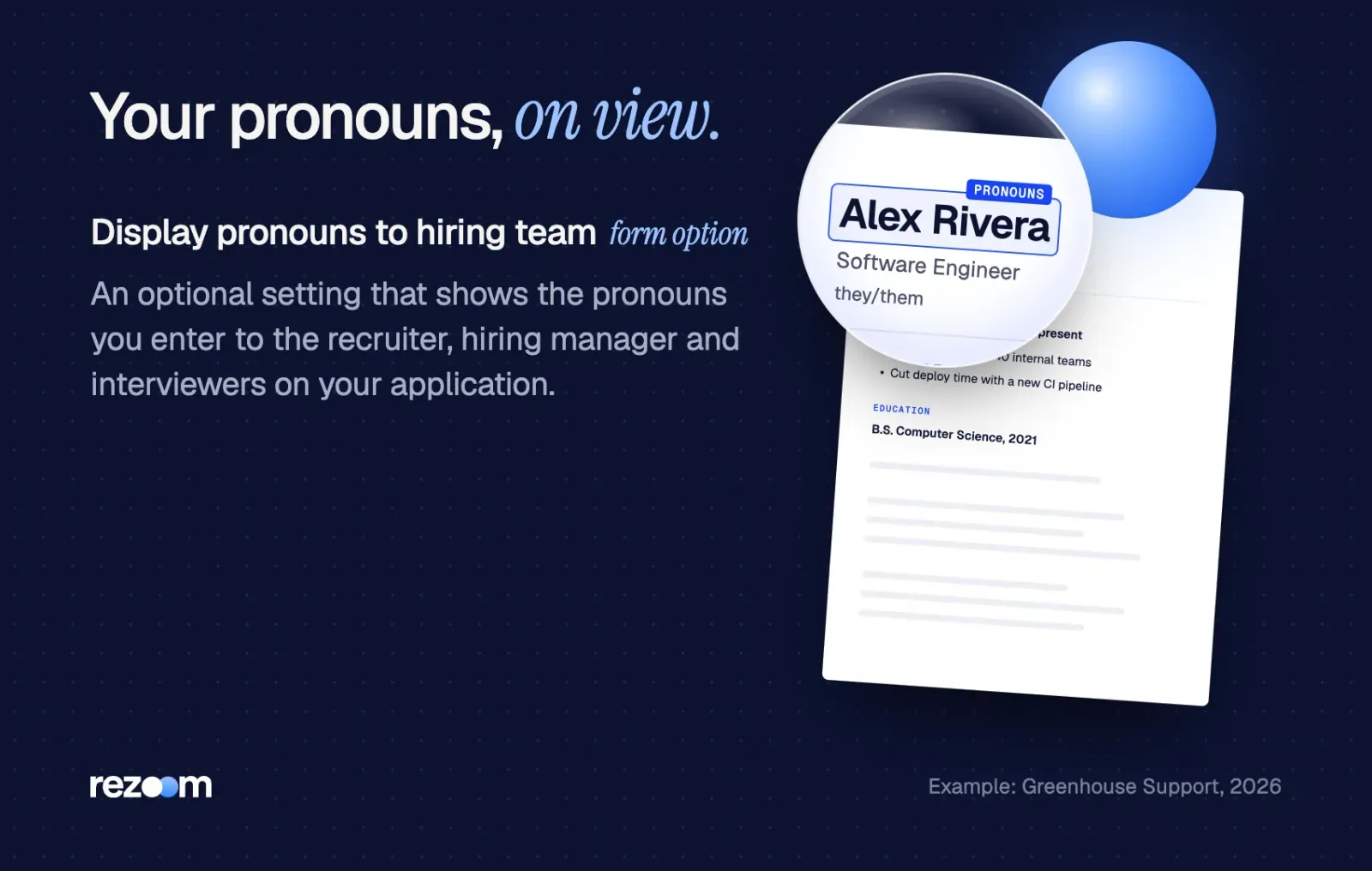
It means the pronouns you enter on the application will appear on your candidate profile for the hiring team. That group usually includes the recruiter, the hiring manager and your interviewers. The option is voluntary. If you skip it, you can still apply, and the team will simply not see any pronouns next to your name.
Most large employers run their hiring through an applicant tracking system (ATS). The ATS turns your application into a candidate profile that the hiring team opens before each step. A pronouns field adds one more line to that profile, right under or beside your name.
How vendors describe the feature
Greenhouse is one ATS that documents a candidate pronouns feature. Its help center says pronouns appear at the top of the candidate's profile, below their name1, and in every interview kit for that candidate. Candidates can choose she/her, he/him, they/them or a self-describe option.
Tribepad, another hiring platform, says candidates pick pronouns from a dropdown so recruiters and hiring managers know how to address them3. In short, the label differs by form, but the purpose stays the same. If you want to see what else an ATS does with your file, read how Greenhouse works behind the scenes.
Some forms ask for pronouns and then ask a second question about sharing them. Others share them as soon as you fill in the field. If the form has no separate display option, treat a filled-in field as visible to the team.
Who sees your pronouns, and who does not?
When you display pronouns to hiring team members, the people with access to your candidate profile see them: recruiters, coordinators, hiring managers and interviewers. Greenhouse limits the field to users with permission to view you. Its help center also says the field stays out of its standard reports, its API and third-party integrations.
Visibility depends on the employer's settings, so no rule fits every form. Still, vendor documentation gives a clear picture of the usual setup.
Only users with permission to view a candidate can view the candidate's pronouns.
Greenhouse Support, Candidate personal pronouns
| Who | Usually sees displayed pronouns? | Why |
|---|---|---|
| Recruiter and coordinator | Yes | They manage your profile and schedule interviews |
| Hiring manager | Yes, unless the employer hides names | They review your profile and scorecards |
| Interviewers | Yes | Pronouns can appear in their interview kit |
| Other employees with no access | No | They cannot open your candidate profile |
| Reports and outside tools | Not in Greenhouse's standard setup | Greenhouse keeps pronouns out of reports and integrations |
Some systems also hide pronouns during blind review. Tribepad says that when anonymous applications are on, the candidate shows as a number and the pronouns will be removed from view3, typically for hiring managers.
Is the pronouns field optional, and can it affect screening?
Yes, the field is optional, and you can apply without it. Under US federal law, Title VII bans sex discrimination in hiring, and the Supreme Court's Bostock ruling held that firing someone for being transgender is sex discrimination. However, a 2025 court ruling vacated parts of EEOC guidance on pronoun use, so some questions remain open.
Greenhouse describes pronouns as a choice. Its overview page says candidates have the option to include their pronouns2 during the interview process. So a blank field should not block your application.
What US federal law says
The EEOC explains that in the 2020 Bostock case, the Supreme Court held that firing individuals because of their sexual orientation or transgender status violates Title VII4. The EEOC also lists hiring among the covered actions. So an employer may not lawfully refuse to hire you because of your gender identity.
What changed in 2025
On May 15, 2025, a federal court in Texas vacated the gender identity portions of the EEOC's harassment guidance5, including the parts on pronouns. The same analysis notes that Bostock still stands. As a result, federal rules on whether employers must use a person's pronouns remain unsettled, and state laws vary.
This article gives general information, not legal advice. If you believe an employer treated you unfairly, the EEOC and your state civil rights agency take complaints.
Should you display pronouns to the hiring team?
Display them if you want interviewers to address you correctly from the first call and you feel comfortable sharing. Leave the option off if you value privacy or want to decide employer by employer. Either choice is valid. Pick the one that matches your goal for this application, not a general rule.
Interest in this topic keeps growing. Pew Research Center reports that 26% of US adults knew someone who goes by gender-neutral pronouns in 20217, up from 18% in 2018. Even so, the choice on your form stays personal.
If you want colleagues to use the right pronouns
Turn the option on and enter your pronouns in the short format most forms expect. That way, the recruiter can brief interviewers before your first call.
she/her he/him they/them he/they Self-describe: xe/xem
If you prefer privacy
Leave the field blank or the display option off. You lose nothing in screening, and you keep the choice for later. Many people share pronouns once they meet the team instead.
If you are not sure
Wait. You can add pronouns in your email signature, your video-call display name, or your first interview introduction. Our guide to pronouns on your resume covers the same decision for your resume header.
Hi, I'm [FIRST NAME], and I use [PRONOUNS]. Thanks for meeting with me about the [JOB TITLE] role.
Should you put pronouns on a resume? It is your choice. See where they go, how to format them, what display pronouns to hiring team means and the research.
Tech and IT applications
Many tech companies use ATS forms that include a pronouns field, so software and IT candidates meet this choice often. Your answer will not replace a strong file, though.
Before you apply, compare your draft with our IT resume examples, and developers can study our software engineer resume examples. Then match your letter to our IT cover letter examples.
Free ATS score, the text the software extracts and your missing keywords. No sign-up.
How is the pronouns field different from voluntary self-identification?
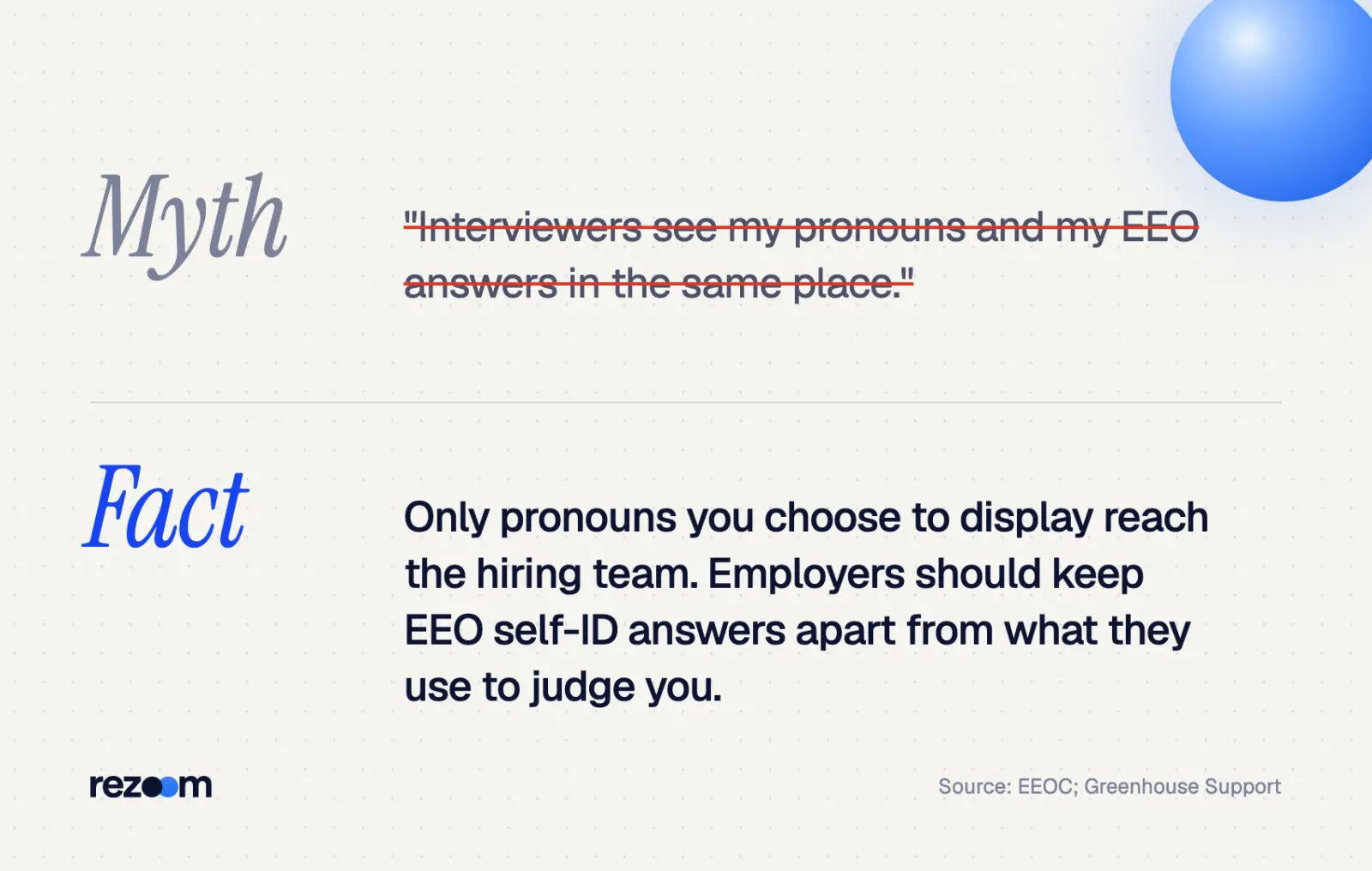
The pronouns field helps people address you, so the hiring team can see it if you allow it. Voluntary self-identification questions ask about sex, race, veteran or disability status for compliance reports. Employers should keep that data separate from the materials used to judge your qualifications, so your interviewers should not see it.
The two often sit on the same form, which causes confusion. However, they serve different goals and follow different rules.
| Pronouns field | Voluntary self-identification (EEO) | |
|---|---|---|
| Purpose | Tell people how to address you | Compliance and applicant-flow reports |
| Who sees it | The hiring team, if you display it | HR or compliance staff, kept apart from your evaluation |
| Required? | No | No |
| Typical options | she/her, he/him, they/them, self-describe | Sex, race and ethnicity, veteran status, disability |
| Affects screening? | Should not | Should not |
The EEOC advises employers who collect race data to use a method that lets them separate the race-related information from the information used to determine if a person is qualified6. Our guide to voluntary self-identification on job applications explains each EEO question and the "decline to answer" option. If you are unsure about the race, veteran or disability questions, see what happens when you decline to self-identify.
Do
- Read each question's label before you answer.
- Use the pronouns field only for how you want people to address you.
- Answer EEO questions only if you want to, or pick "decline to self-identify."
Don’t
- Assume your EEO answers appear to interviewers.
- Put pronouns in the EEO sex question, or sex in the pronouns field.
- Feel pressure to fill in either one to finish the form.
Can you change your pronouns after you apply?
Usually not on the submitted form, but you can tell your recruiter by email at any time. Greenhouse notes that candidates who already gave pronouns are not asked again on later scheduling forms. After you accept an offer, its onboarding tool lets employees edit or remove their pronouns in their own profile.
Most application portals lock your answers after you submit. So the fastest fix is a short note to your recruiter. They can update your profile and brief the interviewers.
Subject: Quick update for my application, [JOB TITLE]
Hi [RECRUITER NAME],
Thanks for scheduling my interview. Please note that I use [PRONOUNS]. I'd appreciate it if you could share that with the interview panel.
Best, [YOUR NAME]
After you join, the employee system often takes over. Greenhouse says new hires and employees can self-select, edit, or remove pronouns2 in their employee profiles, unless the employer restricts that access.
If you also go by a different first name, add it in the preferred name field so your pronouns and name line up. See our guide to your preferred name on a job application for wording.
Yes, you can use a preferred name on a resume. See 4 clean formats, when your legal name is required, and how to match LinkedIn, email and job forms.
What to say if they push back
Most interviews go smoothly. Still, it helps to have calm, short lines ready if someone uses the wrong pronouns or asks about your choice.
- Wrong pronouns once. Correct it briefly and move on: "Just a note, I use they/them."
- Repeated mistakes. Mention it to your recruiter after the interview, not in the middle of an answer.
- A question about why. You do not need to explain. Steer back to the role.
Interviewer: "So, when he joined the team, he would..."
"Quick note, I use she/her. Happy to keep going."
Interviewer: "Sorry about that. Why do you list pronouns, anyway?"
"It just helps people address me. I'd love to hear more about the team's next project."
How do you fill out the pronouns field step by step?
Read the label, decide whether you want to share, enter your pronouns in the short format, and check the display option. Then confirm your preferred name, answer or decline the EEO questions, and review the whole form before you submit. The whole step takes less than a minute.
- Read the labelCheck whether the form has a separate "display" option or shares the field by default.
- Decide your goalShare for correct address, or skip for privacy. Both are fine.
- Enter the short formatType "she/her," "they/them" or your self-described pronouns.
- Set the display optionTurn it on to show the hiring team, or leave it off.
- Review the EEO sectionAnswer or choose "decline to self-identify," then submit.
Before you hit submit, run your resume through our ATS resume checker to see how the system reads your file.
Before you submit the application
Free ATS score and your missing keywords. No sign-up.
Frequently asked questions
What does "display pronouns to hiring team" mean?
It means your pronouns will appear on your candidate profile for the recruiter, hiring manager and interviewers. You choose whether to turn it on.
Is it mandatory to share pronouns on a job application?
No. The field is optional on the forms we reviewed, and you can submit your application with it blank.
Will displaying my pronouns affect my chances?
It should not. Federal law bans sex discrimination in hiring, and the Bostock ruling covers transgender status. If you prefer extra privacy, you can leave the option off.
Do pronouns show up in EEO reports?
In Greenhouse's standard setup, no. Its help center says pronouns stay out of its standard reports, API and integrations. EEO self-identification answers are a separate section.
Can I list more than one set of pronouns?
Yes. Use the self-describe option and type something like "he/they" or "she/they."
What if the hiring team uses the wrong pronouns?
Correct it briefly in the moment. If it keeps happening, tell your recruiter by email.
Sources
We opened and read each page below. The small numbers in the text point here. Pages that carry no publication date show n.d.
- Greenhouse Support2026
Candidate pronouns appear below the name on the profile and in interview kits, only users with permission can view them, and they are kept out of standard reports, the API and integrations
- Greenhouse Support2023
Candidates have the option to include pronouns, and employees can self-select, edit or remove pronouns in their profiles
- Tribepadn.d.
Candidates choose pronouns from a dropdown, and anonymous applications remove pronouns from view
- U.S. Equal Employment Opportunity Commissionn.d.
Bostock v Clayton County (2020) held that firing someone for sexual orientation or transgender status violates Title VII
- Jackson Lewis2025
A federal court vacated the gender identity portions of EEOC harassment guidance on May 15, 2025, while Bostock still stands
- U.S. Equal Employment Opportunity Commissionn.d.
Employers should keep race data for affirmative action apart from the information used to judge qualifications
- Pew Research Center2023
26% of US adults knew someone who goes by gender-neutral pronouns in 2021, up from 18% in 2018
Mohammad has spent more than ten years designing consumer products and leads product at Rezoom, deciding what gets built and what gets left out. His guides cover the whole job search, from resume sections and cover letters to interview answers and career moves.
Goodi, M. (2026, October 29). Display Pronouns to Hiring Team: What It Means and What to Pick. Rezoom. https://rezoom.io/display-pronouns-to-hiring-team/