

Summary
You can use a preferred name on a resume because a resume is not a legal document. Put the name you want recruiters to call you in the header, either alone or next to your legal first name, and use the same name on LinkedIn, your email and your cover letter. Your legal name is required later, for the background check you authorize, Form I-9 and payroll paperwork, so give it when HR asks.
Yes, you can put a preferred name on a resume. A resume is a marketing document, not a legal one, so the header can show the name you want recruiters to use, such as a nickname, an anglicized name, your middle name or a chosen name.
The catch comes later. Background checks, Form I-9 and payroll need your full legal name. If you plan for that handoff, a preferred name on a resume causes no confusion at all.
This guide covers when to use one, four clean formats, where your legal name is required, and how to keep LinkedIn and your email consistent.
Can you use a preferred name on a resume?
Yes. A resume is not a legal document, so you can use the name you go by, such as a nickname, anglicized name, middle name or chosen name. Use it consistently across your resume, cover letter, LinkedIn and email. Provide your legal name when the employer runs a background check and completes hiring forms.
University career centers agree on this point. The University of Vermont Career Center states that "a resume is not a legal document, so it is acceptable to use your preferred name on the resume." It adds that you will need your legal name for background checks, Social Security documents and insurance forms.
The University of Denver's career office gives the same rule: you can use a chosen or preferred name throughout your job search, as long as you provide your legal name when it comes time for a background check.
Common reasons people use a preferred name:
- Nickname. Everyone calls you Mike, not Michael.
- Middle name. You go by your middle name, as in J. Michael Ortiz.
- Anglicized or second name. You use an English name at work, such as Wei "William" Zhang.
- Chosen name. Your legal name does not match the name you live by.
- Legal name change in progress. Marriage, divorce or a court petition has not caught up with every record yet.
Why do job seekers change the name on their resume?
Mostly for clarity and fit: the name recruiters will call you should be the name they read. Some candidates also change it because they worry about bias. A 2023 Greenhouse survey of 1,200 US candidates found almost one-fifth had changed their name on a resume for that reason.
Clarity is the everyday reason. If a recruiter emails "Dear Xiu Ying" and you answer as Suzie, the thread already feels off. The name in your resume header sets what people call you in every interview.
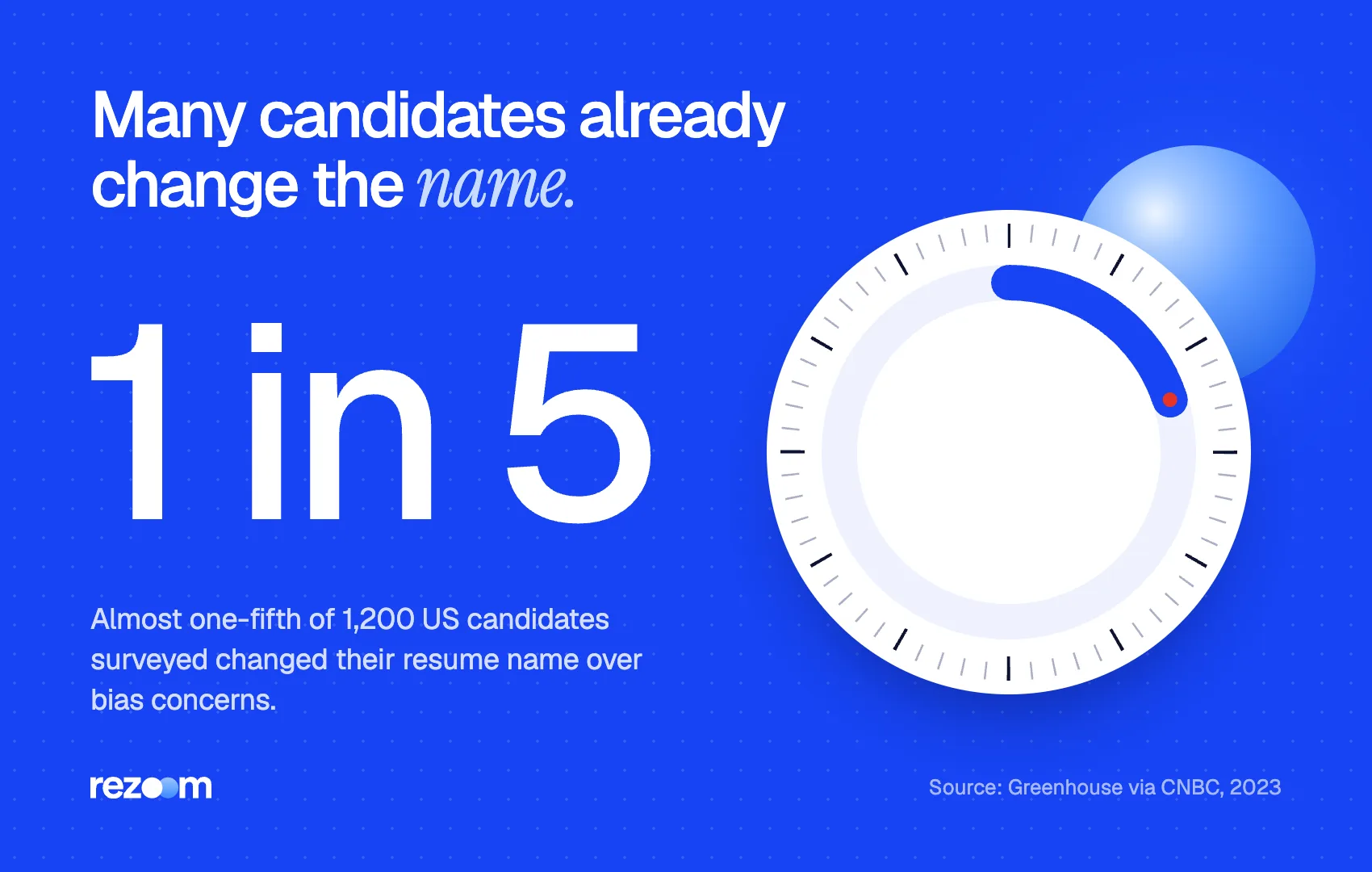
Bias is the other reason, and it is documented. CNBC reported Greenhouse's 2023 Candidate Interview Experience Report, a survey of 1,200 US job candidates. Almost one-fifth had changed their name on a resume to protect themselves against discriminatory hiring. Of those, 45% did so to sound "less ethnic," 42% to sound younger and 22% to sound like a different gender.
Field research backs up the concern. An NBER experiment sent more than 83,000 fictitious applications to 108 of the largest US employers. Applications with distinctively Black names received callbacks 2.1 percentage points less often than those with distinctively white names.
So roughly 1 in 5 candidates in the Greenhouse survey had already made this call. Whether you do is your decision. A preferred name on a resume is legitimate either way, as long as you share your legal name when it is required.
How do you format a preferred name on a resume?
Pick one of four formats: the preferred name alone (Sam Lee), the nickname in quotation marks (Samantha "Sam" Lee), the preferred name in parentheses (Wei (William) Zhang), or a first initial plus middle name (J. Michael Ortiz). Keep it on one line, in plain text, at the top of the page.
All four formats parse cleanly in applicant tracking systems because they are plain text. Choose based on how closely you want the resume to connect to your legal records.
| Format | Example | Best for | Watch out for |
|---|---|---|---|
| Preferred name only | Sam Lee | A name you use everywhere, including LinkedIn | Give the legal name to HR at the offer |
| Nickname in quotes | Samantha "Sam" Lee | Common nicknames recruiters may not guess | Use straight or curly quotes consistently |
| Parentheses | Wei (William) Zhang | Anglicized or second names | Do not add a third name |
| Initial + middle name | J. Michael Ortiz | Going by your middle name | Use the full middle name, not an initial |
Sam Lee Denver, CO | [email protected] | (555) 014-2290 | linkedin.com/in/samlee
Samantha "Sam" Lee Denver, CO | [email protected] | (555) 014-2290
Wei (William) Zhang Seattle, WA | [email protected] | (555) 019-3381
J. Michael Ortiz Austin, TX | [email protected] | (555) 017-4420
Credentials need one extra step. If a license, degree or publication is under a different name, keep your preferred name in the header and note the record name next to the credential. Our guide to licenses on a resume shows where that note fits.
Registered Nurse (RN), Texas Board of Nursing, License #123456 (issued as Ana Maria Gutierrez)
When do you need your legal name instead of a preferred name?
At the offer stage. Employers need your legal name for the background check you authorize in writing, Form I-9 and tax forms such as the W-4. Give it when HR asks. Until then, your preferred name on a resume, cover letter and interviews is fine.
Here is where each name goes in a typical US hiring process:
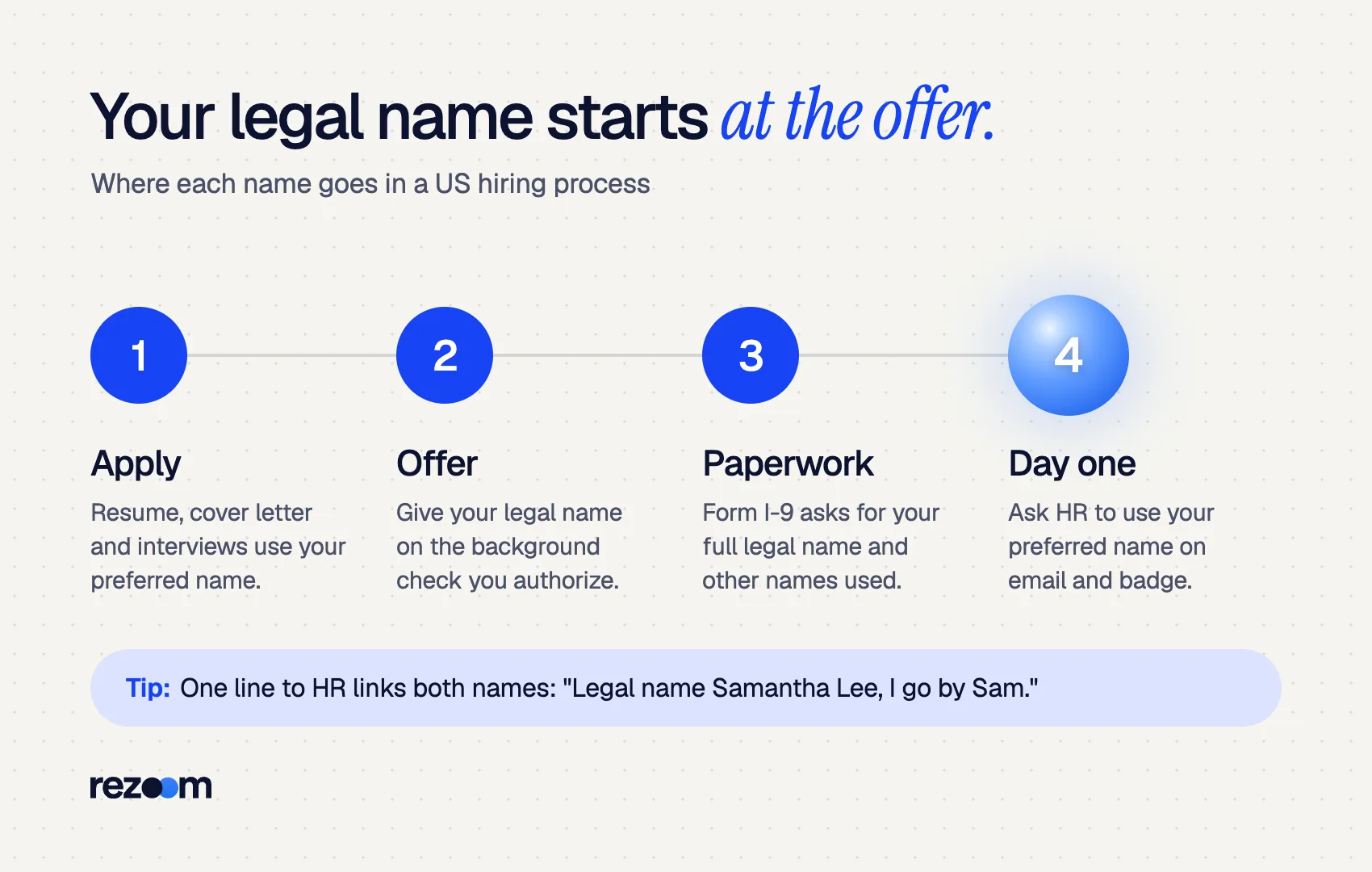
- Application and interviews. Use your preferred name.
- Background check. The FTC notes that employers must get your written permission before running a background check through a reporting company. That consent form asks for your legal name, so screening can match records.
- Form I-9. USCIS says employees must provide their full legal name and other names used, such as a maiden name.
- Payroll. Form W-4 asks whether your name matches your Social Security card. If not, the IRS tells you to contact the SSA so you get credit for your earnings.
Do not hide your legal name at these steps. The University of Denver warns that failing to disclose it during the background check counts as misrepresentation and can be grounds for termination.
Tell HR once, in writing
When the offer arrives, reply with one short line: "For paperwork, my legal name is Samantha Lee. I go by Sam, so please use Sam on my email, badge and directory." That single sentence connects your records and sets your name for day one. The FTC also gives you the right to a copy of your background report and to dispute errors.
How do you keep your name consistent across LinkedIn, email and applications?
Use the same preferred name on your resume header, cover letter signature, LinkedIn profile, email address, file name and online application. When a form has a legal name field and a preferred name field, fill both. Consistency lets recruiters match your documents and find you online.
Recruiters cross-check. They search your name on LinkedIn, open your attachments, and read your email address. If those show three different names, they may think they have the wrong person.
Run a quick consistency check:
- LinkedIn. Your profile name should match the resume header. See our LinkedIn profile optimization guide for the rest of the profile.
- Email. [email protected] supports "Sam Lee." An address built on a name you no longer use does not.
- File name. Name the file Sam-Lee-Resume.pdf. Our resume file name guide has more patterns.
- Cover letter. Sign with the same name you used in the header.
- Application forms. Put your legal name in the legal name field and your preferred name in the preferred name field when one exists.
Use one preferred name on every document and profile do: Fill in both fields when an application asks for legal and preferred names do: Tell HR your legal name at the offer stage
List three names, such as Wei "Will" (William) Zhang Jr. dont: Use a nickname that sounds casual for the role, such as "Bubba" dont: Leave your legal name off the background check or Form I-9
If you also share pronouns, that decision sits right next to your name in the header. Our guide to pronouns on a resume covers when and how.
Should you explain your preferred name in a cover letter or interview?
Usually no. A preferred name on a resume needs no explanation. If your references, transcripts or past employers know you by another name, mention it briefly so the employer can verify you. A single factual sentence is enough, without personal detail.
Explaining is only useful when someone needs to connect records. Two cases come up often:
- References and past employers. If a former manager knew you as Samantha, tell the recruiter when you send your list. Our guide on how to ask someone to be a reference covers the prep.
- Transcripts and degrees. If your diploma shows another name, note it when the employer asks for verification.
In a reference list: "Dana Ruiz, Operations Manager, Brightway Health (knew me as Samantha Lee)"
In an email to a recruiter: "My transcript is under my legal name, Xiu Ying Li. I go by Suzie."
For a transgender or nonbinary job seeker, the University of Denver also notes there is nothing wrong with using your legal name during the search and sharing a chosen name after you are hired. That is a personal choice based on your comfort and safety.
Once the header is settled, the rest of the resume matters more. The Rezoom AI resume builder lets you set your preferred name in the header and keeps it consistent across every tailored version you create.

Frequently asked questions
Is it legal to use a preferred name on a resume?
Yes. A resume is not a legal document, so a preferred name is acceptable. You must still give your legal name for background checks, Form I-9 and tax forms.
Will a background check fail if my resume uses a nickname?
No, as long as you give your legal name on the background check authorization. Screening matches records by legal name and other identifiers, not by the resume header.
Should I put my legal name in parentheses?
Only if it helps a recruiter connect records, such as a credential under that name. Otherwise, one preferred name or the quoted-nickname format (Samantha "Sam" Lee) is cleaner.
Can I use an English name on my resume?
Yes. Many people use an anglicized or second name at work. The Wei (William) Zhang format shows both, or you can use William Zhang alone if that is the name you use professionally.
What name should I use on job application forms?
Use your legal name in any field labeled legal name and your preferred name where the form offers a preferred name field. If there is one name field, use the name on your resume.
Do I need to tell my employer my preferred name after I am hired?
Yes, tell HR so your email, badge and directory listing use it. Payroll and tax records will still use your legal name.



Comments