Preferred Name in Parentheses on a Resume: 4 Formats That Work
Should your preferred name in parentheses go on your resume? See 4 header formats, quotes vs parentheses, and where your legal name is still required.

On this pageDo you put a preferred name in parentheses on a resume?
- Do you put a preferred name in parentheses on a resume?
- What are the four ways to write a preferred name on a resume?
- Should you use your legal or preferred name on a resume?
- Do you have to put your legal name on a resume?
- How do you keep your name the same on LinkedIn, email and applications?
- What if a recruiter or form pushes back on your name?
- FAQ
- Sources
Yes, you can put a preferred name in parentheses on a resume, as in "Katherine (Kate) Ruiz." Quotes work too, and so does the preferred name alone. The resume is not a legal document, so your legal name only has to appear later, on the I-9, tax forms and background check. Pick one format and use the same name on LinkedIn, email and the application.
Yes, a preferred name in parentheses is a standard, safe way to write your resume header: "Katherine (Kate) Ruiz." It shows your legal name and the name you answer to in one line. Quotes and the preferred name alone also work.
This guide covers the formatting question only. It shows the four header formats, when each one fits, and where your legal name still has to appear. The running example is Kate Ruiz, a fourth-grade teacher whose legal first name is Katherine.
Quick answers by situation
| Your situation | What to put in the header | Example line |
|---|---|---|
| You go by a short form of your name | Legal first name, preferred name in parentheses | Katherine (Kate) Ruiz |
| You like how quotes look in your layout | Legal first name, preferred name in quotes | Katherine "Kate" Ruiz |
| You have used your nickname for years | Preferred name only | Kate Ruiz |
| You go by your middle name | First initial, then the middle name | K. Leigh Ruiz |
| Your license or degree uses your legal name | Show both names | Katherine (Kate) Ruiz |
| You go by your legal first name | Legal name only | Katherine Ruiz |
Do you put a preferred name in parentheses on a resume?
You can, and most career advisers call it the cleanest option. Write your legal first name, then the preferred name in parentheses, then your last name: "Katherine (Kate) Ruiz." Recruiters see both names, so the resume matches your ID later and still tells them what to call you.
Resume writers back this format. In a National Résumé Writers' Association roundup, Cathy Lanzalaco says your legal name with the nickname in parenthesis1 is "easy and perfectly acceptable." UC Irvine's career center gives the same advice and tells students to list your preferred name in parenthesis2.
The reason is simple. A resume is a marketing document, not a legal one. So you choose the name on it, as our main guide to the preferred name on a resume explains.
What it looks like on Kate's resume
KATHERINE (KATE) RUIZ
Fourth-Grade Teacher | Tucson, AZ | kate.ruiz@email.com | (520) 555-0147
Taught 26 fourth graders in a Title I school, 2021 to now.
Raised class reading scores with small-group guided reading.
Notice that the email uses "kate," not "katherine." That small match helps the recruiter connect the two names at a glance.
What are the four ways to write a preferred name on a resume?
The four common formats are: legal name with the preferred name in parentheses, legal name with the preferred name in quotes, the preferred name alone, and a first initial followed by the preferred name. All four are acceptable. Pick the one that matches how you want recruiters to address you.
Each format sends a slightly different signal. Here is how they compare for Kate.
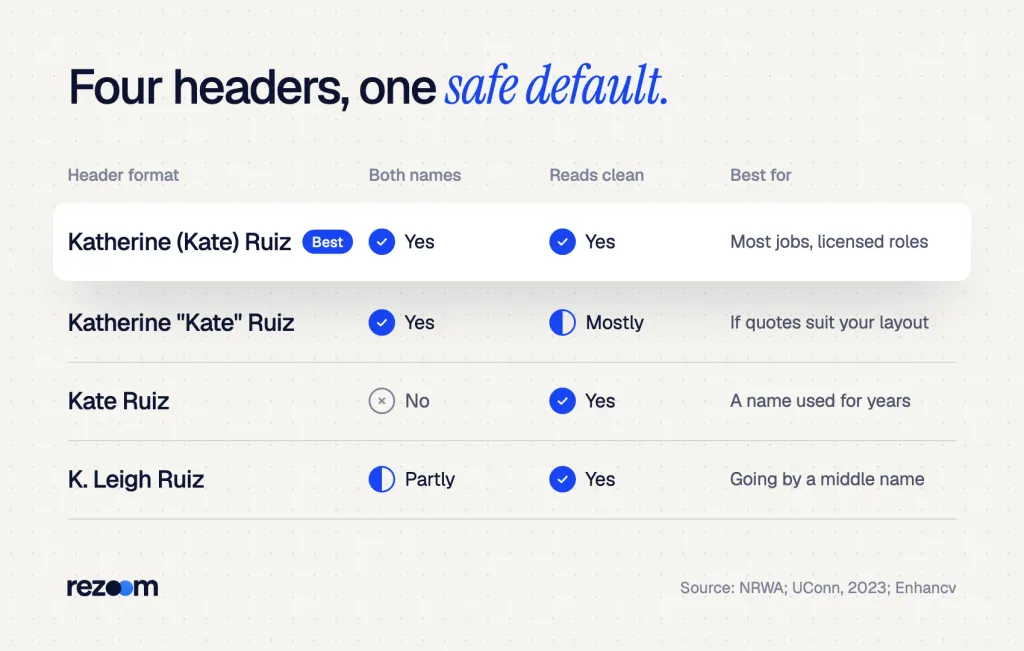
| Format | Header line | Shows both names | Best for |
|---|---|---|---|
| Parentheses | Katherine (Kate) Ruiz | Yes | Most jobs, including schools and roles with licenses |
| Quotes | Katherine "Kate" Ruiz | Yes | Same uses, if quotes look cleaner in your layout |
| Preferred only | Kate Ruiz | No | Private-sector jobs and a name you have used for years |
| First initial | K. Leigh Ruiz | Partly | A legal first name you never use, such as going by a middle name |
Parentheses vs quotes
Both are fine. Enhancv's guide says you can use quotation marks or parentheses, "whichever looks cleaner with your layout."4 In the NRWA roundup, Tammeca Riley also calls quotes "another widely used strategy."
But parentheses have one edge. Quotes around a name can read like a stage name or a joke nickname to some readers. Parentheses read as a plain note, so they are the safer default if you are unsure.
Preferred name only
Enhancv says the preferred name alone works best for private-sector jobs where resumes aren't tied to formal ID checks4. So if you have gone by "Kate" for your whole career, "Kate Ruiz" is fine. Your legal name will still go on the application form.
First initial plus preferred name
UConn's career center suggests a first initial with the preferred name after it3, as in "K. Leigh Ruiz." This fits people who go by a middle name. Then the reader sees which name you use without your unused first name in full.
KATHERINE (KATE) RUIZ KATHERINE "KATE" RUIZ KATE RUIZ K. LEIGH RUIZ (if she went by her middle name, Leigh)
Write "Katherine (Kate) Ruiz," not "Katherine Ruiz (Kate)." When the preferred name sits next to the first name, readers see it as a first name. At the end, it can look like a typo or a second person.
Should you use your legal or preferred name on a resume?
Use the name you want people to call you. If that is not your legal name, a preferred name in parentheses keeps both visible. Show your legal name too when your credentials, such as a teaching license or degree, are issued in that name, so the employer can match them.
Most hiring teams do not need your legal name at the resume stage. Enhancv puts it this way: employers only need your legal name later in the hiring process4 for HR or verification. UConn agrees that a résumé is not a legal document, so a preferred name is acceptable.
When to show both names
Enhancv advises showing both names when your degrees or certifications use your legal name. That rule fits teachers well. A district will check your license, so "Katherine (Kate) Ruiz" helps HR link the license to the resume.
If you apply for school jobs, our education resume examples show how a clear header and credentials section look on one page. You can also see how Kate's format fits a full page in our teacher resume example.
Teacher resume example
A full teacher resume you can copy, with room for your preferred name in the header.
When the preferred name alone is enough
Use only "Kate Ruiz" if that is the name on your work history, references and LinkedIn. Paul Bennett, in the NRWA roundup, says to use the nickname consistently everywhere people can find you online. If every record says "Kate," the resume should too.
Yes, you can use a preferred name on a resume. See 4 clean formats, when your legal name is required, and how to match LinkedIn, email and job forms.
Do you have to put your legal name on a resume?
No. Your legal name is required on the Form I-9, tax and payroll forms, and the background check, not on the resume. USCIS asks for your full legal name in I-9 Section 1, which you fill out after you accept the offer. The application form may also have a legal name field.
The legal name requirement starts after the offer. USCIS says Section 1 of the I-9 asks for your full legal name5. It also says you complete it no later than your first day, any time after you accept the job offer.
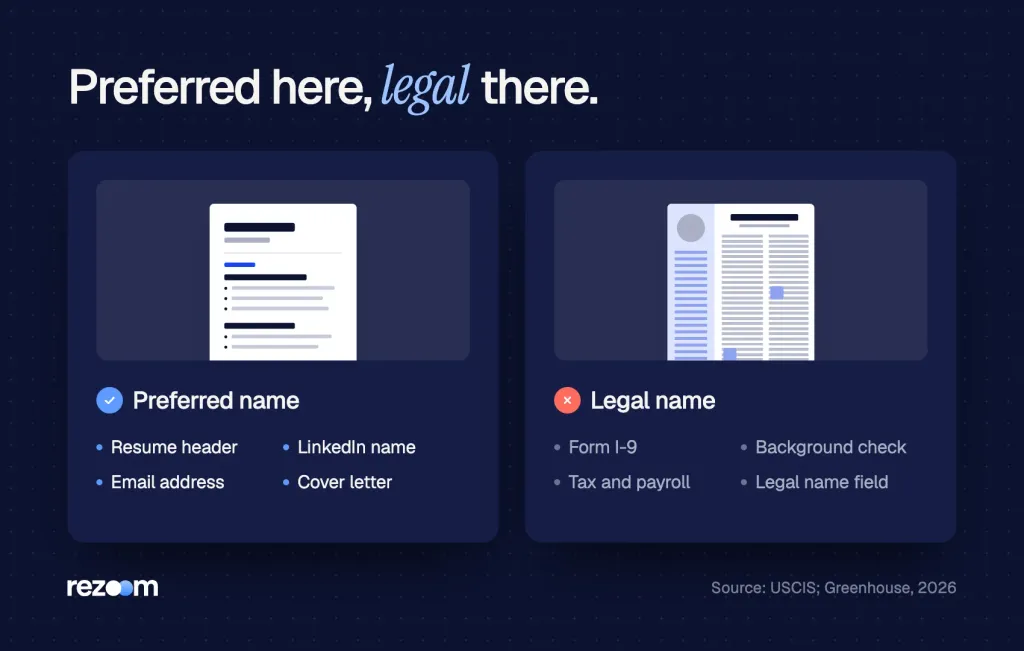
LawLogix, an I-9 software company, notes that HR may still use your preferred name for directories and email. But the I-9 itself must carry the legal name from a government-issued document6.
Background checks use your legal name
Greenhouse, a major applicant tracking system, says this plainly in its help center.
Any documents or processes of legal significance, like a background check, will use the candidate's legal name.
Greenhouse Support
So a nickname on your resume does not confuse the background check. The screening firm works from the legal name you give on the consent form, not from your resume header. Teachers usually go through a check before they start, so expect this step.
What the ATS does with your name
Most applicant tracking systems store a legal name and a preferred name. Workday's admin guide says it uses the legal name for the preferred name8 unless you set a different one. Greenhouse calls its field a candidate preferred first name7 and makes it optional by default.
Resume parsers also handle nickname marks. The open-source tool python-nameparser reads a name in quotes, or in parentheses with no other marker, as a nickname9. We could not confirm how each commercial ATS parser treats these marks, because vendors do not publish that detail.
So check the name fields after the system fills them in. Our guide on how Workday parses resumes shows what to look for.
Job application name fields
The form usually splits names into legal first name, legal last name and a "preferred" or "known as" box. Put your legal names in the legal fields and "Kate" in the preferred box. Our guide to the known as name on a job application decodes each label, and our preferred name on a job application guide covers what happens after you submit.
Legal first name: [FIRST NAME ON YOUR ID]
Legal last name: [LAST NAME ON YOUR ID]
Preferred first name: [THE NAME IN YOUR PARENTHESES, OR BLANK]
Resume header: [LEGAL FIRST] ([PREFERRED]) [LAST]
Email: [preferred].[last]@email.com
Greenhouse also notes that LinkedIn Apply Connect and Indeed Apply do not currently support preferred names7. If you apply that way, your resume header is the main place a recruiter sees "Kate."
Do
- Put your legal name in the legal name fields on the form.
- Put one preferred first name in the preferred or known as box.
- Keep the preferred name in parentheses right after your legal first name.
- Use your legal name on the I-9 and background check consent.
Don’t
- Put a nickname in the legal name field.
- Use quotes and parentheses together, as in Katherine ("Kate").
- List your nickname under "other names used" on a background check.
- Switch formats between your resume, cover letter and LinkedIn.
Free ATS score, the text the software extracts and your missing keywords. No sign-up.
How do you keep your name the same on LinkedIn, email and applications?
Use one preferred name everywhere a recruiter can see you: the resume header, email address and signature, LinkedIn, the cover letter sign-off and the application's preferred name box. Keep your legal name for forms that ask for it. One consistent name helps a recruiter match your file to your profile.
Cheryl Minnick of the University of Montana, quoted by the NRWA, advises using the nickname harmoniously across resume, social, and email1. UC Irvine adds a related point: keep your given name on the resume if it matches the email address you list.
Put "Kate Ruiz" in your LinkedIn name. Then add "Katherine" in the "Additional name" field, which you reach from Settings, under Name, location, and industry.
A Guideflow walkthrough says this field helps people with maiden names, nicknames, or alternative professional names10 get found. Our guide to putting LinkedIn on your resume shows how to list the URL.
Resume header: KATHERINE (KATE) RUIZ Email: kate.ruiz@email.com LinkedIn name: Kate Ruiz | Additional name: Katherine Cover letter sign-off: Kate Ruiz Application: Legal first name Katherine | Preferred first name Kate
Cover letter sign-off
Sign your cover letter with the name you want them to use, "Kate Ruiz." You do not need parentheses there, because the resume already shows the legal name. Our education cover letter examples show clean openings and sign-offs for school jobs.
Set your name format in one master resume, then copy it to every version you send. Switching between "Kate" and "Katherine (Kate)" across applications to one district can look like two different people in the same ATS.
What if a recruiter or form pushes back on your name?
Explain it in one sentence: your legal name is Katherine, and you go by Kate. If a portal rejects parentheses in a name field, enter your legal name there and use the preferred name box. Don't change your resume header to suit one form.
Some portals reject spaces, accents or symbols in name fields. If you hit an error message, our guide to the preferred full name / display name is invalid error covers the fixes.
- Choose one formatPick parentheses, quotes, the preferred name alone or a first initial, and stick with it.
- Match your emailUse the preferred name in your email address and signature if you can.
- Fill legal fields exactlyType your legal first and last names as they appear on your ID.
- Add the preferred name in its boxEnter one first name, with no quotes or parentheses, in the preferred field.
- Confirm after the offerAsk HR which name will show on your badge, email and class roster.
What to say if they push back
- "Your license says Katherine, but you wrote Kate." Say Katherine is your legal name and you go by Kate.
- "Which name should we use on your badge?" Give the preferred name, and confirm payroll uses the legal one.
- "Why are there parentheses in your name?" Say it shows the name you go by next to your legal name.
HR: "Your background check came back under Katherine Ruiz. Is that right?"
"Yes. Katherine is my legal name, and I go by Kate."
HR: "Should the school email say Kate?"
"Yes, please. Payroll and the I-9 can stay under Katherine Ruiz."
What goes in the known as name on job application forms? Learn the two meanings, what to enter, when to leave it blank and how it ties to background checks.
Final check before you send
Before you send your resume
If you want a header that lays this out for you, our AI resume builder lets you set your name once and keeps it the same on every version. For more ideas on the rest of a teaching resume, see our list of skills on a resume for a teacher.
Free plan, no card.
Frequently asked questions
Do you put a preferred name in parentheses on a resume?
Yes. Write your legal first name, then the preferred name in parentheses, then your last name, as in "Katherine (Kate) Ruiz." Career centers and resume writers call it an acceptable, clear format.
Should I use quotes or parentheses for a nickname on a resume?
Either works. Parentheses read as a plain note, so they are the safer default. Quotes are fine if they look cleaner in your layout.
Should I use my legal or preferred name on a resume?
Use the name you want people to call you. Show both names if your license or degree uses your legal name.
Do you have to put your legal name on a resume?
No. Your legal name goes on the I-9, tax forms and background check after the offer. The application form may also ask for it in a legal name field.
How do I write my preferred call name on a CV?
Put it in the header next to your legal first name, as in "Katherine (Kate) Ruiz," or use the preferred name alone. Use the same name on LinkedIn and your email.
How do you put a nickname on a resume?
Place the nickname in parentheses or quotes between your first and last name. Only use a nickname you would want on a work badge.
Will a nickname on my resume cause problems with a background check?
No. Background checks use the legal name you give on the consent form. Greenhouse says processes of legal significance use the candidate's legal name.
Sources
We opened and read each page below. The small numbers in the text point here. Pages that carry no publication date show n.d.
- National Résumé Writers' Associationn.d.
Resume writers say a legal name with the preferred name in parenthesis is easy and perfectly acceptable, and quotes are another widely used option
- UC Irvine Division of Career Pathways2018
Students with a preferred name can list it in parenthesis and keep the given name if it matches their email
- UConn Center for Career Readiness2023
A resume is not a legal document, so a preferred name is acceptable, shown with a first initial or in quotes
- Enhancvn.d.
Employers need the legal name only later in hiring, and quotes or parentheses both work
- U.S. Citizenship and Immigration Servicesn.d.
Form I-9 Section 1 asks for the full legal name and is completed after the job offer is accepted and by the first day of work
- LawLogix2022
The I-9 must carry the legal name from a government-issued document, while HR may use a preferred name for directories
- Greenhouse Support2026
The preferred first name field is optional by default, background checks use the legal name, and LinkedIn Apply Connect and Indeed Apply do not support preferred names
- Workday Administrator Guiden.d.
Workday uses the legal name as the preferred name unless a different preferred name is set
- python-nameparser documentationn.d.
The open-source parser reads a quoted name, or a parenthesized clause with no marker, as a nickname
- Guideflown.d.
LinkedIn's Additional name field helps people with maiden names, nicknames or alternative professional names get found
Mohammad has spent more than ten years designing consumer products and leads product at Rezoom, deciding what gets built and what gets left out. His guides cover the whole job search, from resume sections and cover letters to interview answers and career moves.
Goodi, M. (2026, October 31). Preferred Name in Parentheses on a Resume: 4 Formats That Work. Rezoom. https://rezoom.io/preferred-name-in-parentheses-on-resume/