Known As Name on Job Application: What It Means and What to Write
What goes in the known as name on job application forms? Learn the two meanings, what to enter, when to leave it blank and how it ties to background checks.

On this pageWhat does the known as name on job application forms mean?
- What does the known as name on job application forms mean?
- What should you put in the "Known as" field?
- When should you leave the known as name blank?
- What do "also known as" and "other names used" mean?
- How do you show your preferred call name on a CV or resume?
- What if the form or recruiter pushes back on your name?
- FAQ
- Sources
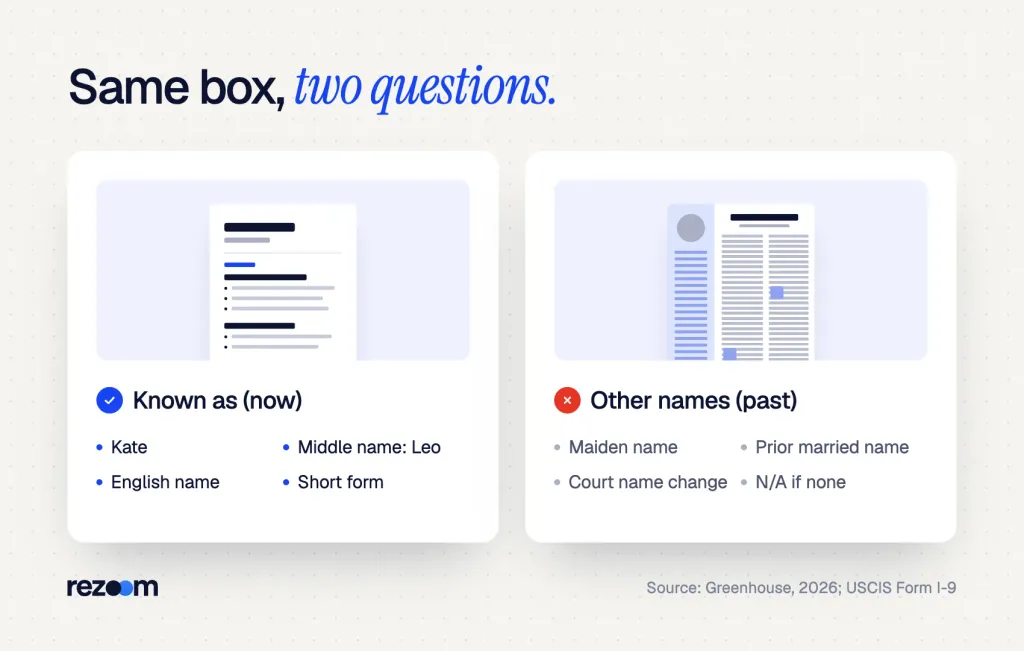
A "Known as" field on a job application asks for one of two things. Usually it means the first name you go by day to day, such as a nickname, a middle name or an English name. On background check and I-9 sections, "also known as" or "other names used" means past legal names, such as a maiden name. Fill in the one the form asks for and leave the other blank or write N/A.
The known as name on job application forms is the name people call you, such as "Kate" for Katherine or "Leo" for a middle name. Fill it in only if it differs from your legal first name. If the field says "other names used," list past legal names instead.
Two labels look alike but ask very different questions. So read the words around the box before you type. This guide shows what each version means, what to enter, and when a blank or "N/A" is the right answer.
Quick answers by situation
| Your situation | What to put in "Known as" | Example line |
|---|---|---|
| You use a short form of your name | The short form only | Kate (legal name Katherine) |
| You go by your middle name | Your middle name | Leo (legal name James Leo Park) |
| You use an English or local name | The name coworkers will use | Jenny (legal name Xiaoying Chen) |
| You go by your legal first name | Leave it blank | (blank) |
| The form says "other names used" | Past legal names, or N/A | Smith (maiden name) |
| The name would embarrass you at work | Use your legal first name | (blank) |
What does the known as name on job application forms mean?
On most applications, "Known as" means your preferred or called name: the first name you want recruiters, managers and name tags to use. It does not replace your legal name, which still goes in the first and last name fields for payroll, tax forms and background checks. Leave it blank if you go by your legal first name.
Hiring software keeps two names on file. Workday's admin guide says it plainly: "By default, Workday uses the legal name for the preferred name1 unless you specify a different preferred name." So a blank "Known as" box just means the system calls you by your legal first name.
Greenhouse works the same way, as our explainer on how Greenhouse ATS works shows. Its support page says the candidate preferred first name field2 is optional by default, and recruiters see it on your profile and scorecards. But anything with legal weight, such as a background check, still uses your legal name.
The labels you will see
Employers use many words for the same box. This table decodes the common ones.
| Field label | What it asks for | What to enter |
|---|---|---|
| Known as / Preferred name | The first name you go by | Nickname, middle name or English name |
| Preferred first name | Same as above | One first name, no quotes |
| Also known as (AKA) | Often past names, sometimes nicknames | Read the section title to decide |
| Other names used | Past legal names | Maiden or prior married names, or N/A |
| Other last names used (I-9) | Past legal last names only | Former last names, or N/A |
If the box sits next to "Legal first name," it wants your called name. If it sits in a background check or "previous names" section, it wants past legal names. That one clue answers most of the confusion.
What should you put in the "Known as" field?
Put the single first name you want people to use at work, written the way you want to see it on an email or name tag. Common answers are a short form (Kate), a middle name (Leo), an English or local name (Jenny) or a spelling you prefer. Skip quotes, titles and last names.
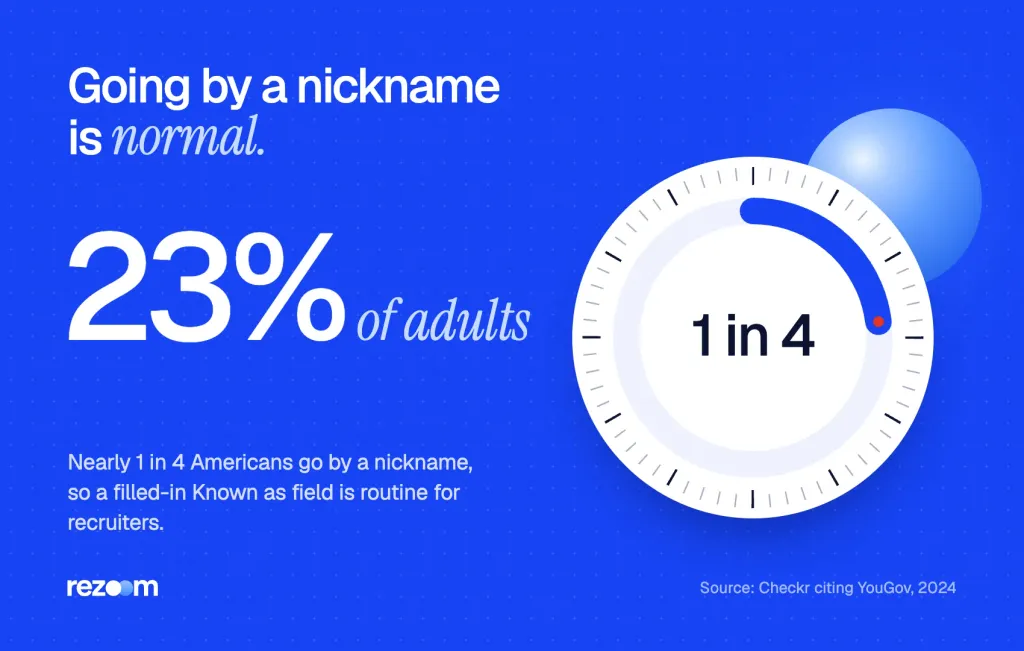
Checkr, citing a YouGov poll, says nearly 1 in 4 Americans go by a nickname7. So recruiters see this field filled in all the time. It is a routine request, not a red flag.
Career centers agree that you control the name you use day to day. York College's career services page puts it this way.
The name on your resume does not necessarily need to be your legal name.
York College (CUNY) Career Services
Common entries by situation
Legal name: Katherine Ann Morris | Known as: Kate Legal name: James Leo Park | Known as: Leo Legal name: Xiaoying Chen | Known as: Jenny Legal name: Oluwaseun Adeyemi | Known as: Seun
Each entry is one first name. It is also a name you would answer to on the first day. That test matters more than how formal the name sounds.
Fill-in-the-blank template
Legal first name: [FIRST NAME ON YOUR ID]
Middle name: [MIDDLE NAME, OR LEAVE BLANK]
Legal last name: [LAST NAME ON YOUR ID]
Known as: [THE ONE FIRST NAME COWORKERS SHOULD USE, OR LEAVE BLANK]
Other last names used: [FORMER LEGAL LAST NAMES, OR N/A]
Use the same called name on your resume, email signature and LinkedIn. If the form says "Kate" but your resume says "Katherine," a recruiter may think they have two people. Consistency also helps when someone searches for you in the system.
When should you leave the known as name blank?
Leave it blank when you go by your legal first name, when the only difference is a last name, or when the field is optional and you have no strong preference. Don't use it for a joke nickname, a gamer tag or a name you would not want on a badge. A blank box simply tells the system to use your legal first name.
A blank field never hurts you. Greenhouse notes that some apply buttons skip the field entirely, because LinkedIn Apply Connect and Indeed Apply do not currently support preferred names2. So the recruiter may never see a preferred name you set on those sites.
Do
- Enter one first name you answer to every day.
- Match the spelling on your resume and email.
- Leave it blank if you use your legal first name.
- Add your called name later in HR if the form skipped it.
Don’t
- Put a last name here; most employers allow first names only.
- Use quotes, emoji or a title such as "Dr."
- Enter a slang nickname you would not want on a badge.
- Confuse it with "other names used" in the background check section.
Last names are a different case
Preferred-name policies often cover first names only. NewYork-Presbyterian's HR help page says a last name "can only be changed with a legal name change"3. If you want a different last name at work, ask HR after you get the offer.
For the bigger picture on how employers handle your called name, read our guide to using a preferred name on a job application.
Preferred name on job application forms means the name you go by. See what to type for a nickname, middle name or chosen name, and where your legal name goes.
What do "also known as" and "other names used" mean?
In a background check, I-9 or "previous names" section, "also known as" and "other names used" mean past legal names: a maiden name, a prior married name or a name you changed in court. Employers list them so screeners can find records filed under those names. If you have never had another legal name, write N/A.
This is the second meaning, and it has nothing to do with nicknames. The Form I-9 (edition 01/20/25) has a box labeled "Other Last Names Used (if any)"4. Its instructions ask you to "Provide all other last names used, if any (e.g., maiden name)"5 and to enter N/A if you have none.
USCIS once labeled this box "Maiden Name." LawLogix explains it changed to other names in 20136 and later narrowed to last names, partly to protect privacy.
Why background checks ask for past names
Screeners search records by name. Checkr calls it "a common myth"7 that vendors search aliases by default. And it notes that court records rarely list every name a person has used.
The employer's screening firm also needs a solid match before it reports anything. Employer group ASE says a consumer reporting agency "cannot provide information unless it can be matched specifically to the subject"8. So listing your past legal names helps the right records attach to you, and the wrong ones stay off.
Former name after marriage: Other last names used: Smith Two prior married names: Other last names used: Smith, Lopez Legal name change in court: Other names used: Daniel Reyes Never had another legal name: Other last names used: N/A
Questions an employer can and cannot ask
Some states limit how employers ask about past names. A Michigan Department of Civil Rights guide lists "Have you ever worked for this company under a different name?"9 as lawful. The same guide lists a plain "Applicant's maiden name" question as an unlawful pre-employment inquiry.
After an offer, the I-9 and the background check consent form are where past names belong.
Don't list "Kate" under other names used on a background check form. That section is for names on legal records. A nickname there can slow the search without adding anything useful.
Free ATS score, the text the software extracts and your missing keywords. No sign-up.
How do you show your preferred call name on a CV or resume?
Put your called name in the resume header with your legal name, as in "Katherine (Kate) Morris," or use the called name alone. Keep that name the same on the application's "Known as" field, your email signature and LinkedIn. Use your full legal name only where the form asks for it.
Resume writers back the parentheses format. In a National Résumé Writers' Association roundup, Cathy Lanzalaco calls a legal name with the preferred name in parentheses11 "perfectly acceptable." Our guide to the preferred name on a resume covers the name itself, and our resume header guide covers the contact line under it.
A retail header example
Retail jobs are a good test, because your called name often ends up on a name tag. If you apply for store roles, our retail resume examples show how strong headers and bullets look on the page.
JIAWEN "JENNY" LIU
Cashier | Columbus, OH | jenny.liu@email.com | (614) 555-0182
Cashier, Corner Market, Columbus, OH | Mar 2024 to now
Processed 180+ transactions a shift with a balanced drawer.
Known to regulars as Jenny; top 5 in store for loyalty sign-ups.
For a full page built the same way, open our retail cashier resume example and copy its header and bullet style.
Retail cashier resume example
A full cashier resume you can adapt with your called name in the header.
Check that the software reads your name
Some applicant tracking systems pull the name from the top of your file. If the header uses odd symbols, the parser can split it badly. Run your file through our free ATS resume checker before you apply to see which name the system picks up.
Your cover letter can sign off with the same called name. Our retail cover letter examples show clean sign-offs and openings for store roles.
What if the form or recruiter pushes back on your name?
If the form rejects your called name, enter your legal name and add the called name later in HR or onboarding. If a recruiter asks about the difference, explain it in one sentence. Many systems allow a preferred first name only, so a last-name change waits for a legal name change.
Some portals reject spaces, accents or parentheses in name fields. If you see a red error message, our guide to the preferred full name / display name is invalid error walks through the fixes.
- Read the field labelDecide if the box wants a called name or past legal names before you type.
- Enter legal names firstFill the legal first and last name fields exactly as on your ID.
- Add one called namePut a single first name in "Known as," with no quotes or titles.
- List past names only where askedUse the I-9 and background check sections for maiden or prior names, or write N/A.
- Confirm after the offerAsk HR which name will show on your badge, email and schedule.
What to say if they push back
- "Your resume says Jenny but your ID says Jiawen." Say Jiawen is your legal name and Jenny is the name you use at work.
- "Why is the Known as field blank?" Say you go by your legal first name.
- "Did you work here under another name?" Give the former legal name so they can find your file.
Recruiter: "The background check came back under Jiawen Liu. Who is Jenny?"
"That's me. Jiawen is my legal name, and I go by Jenny at work."
Recruiter: "Should we use Jenny on your badge and email?"
"Yes, please. My payroll and tax forms can stay under Jiawen Liu."
Yes, you can use a preferred name on a resume. See 4 clean formats, when your legal name is required, and how to match LinkedIn, email and job forms.
Final check before you submit
Before you submit the application
Free ATS score and your missing keywords. No sign-up.
Frequently asked questions
What does "known as" mean on a job application?
The known as name on job application forms usually means the first name you go by, such as a nickname or middle name. Your legal name still goes in the legal name fields. Leave "Known as" blank if you use your legal first name.
What does "known as first name" mean on an application?
It asks for the first name you want people to call you at work. Enter one name, such as "Kate" or "Leo," with no quotes or last name.
Should I put my maiden name in the known as field?
No. A maiden name is a past legal name, so it belongs under "other names used" or "other last names used" on the I-9 or background check form. "Known as" is for the name you go by now.
What is a local name on a job application?
A local name is the name you use where you live and work, such as an English name used alongside a name from another language. Put it in "Known as" if coworkers will use it.
How do I say my preferred call name on a CV?
Write your legal first name with the called name in parentheses or quotes, as in "Katherine (Kate) Morris." Or use the called name alone and give your legal name on the application form.
Does a nickname affect my background check?
No. Background checks use your legal name and past legal names. Greenhouse and NewYork-Presbyterian both say the legal name drives background checks.
Sources
We opened and read each page below. The small numbers in the text point here. Pages that carry no publication date show n.d.
- Workday Administrator Guiden.d.
Workday uses the legal name as the preferred name unless the worker specifies a different preferred name
- Greenhouse Support2026
The candidate preferred first name field is optional by default, background checks use the legal name, and LinkedIn Apply Connect and Indeed Apply do not support preferred names
- NewYork-Presbyterian HR Connectn.d.
Preferred names appear on the directory, email and badge, while payroll, background checks and the I-9 use the legal name; last names change only with a legal name change
- U.S. Citizenship and Immigration Services, Form I-92025
The Form I-9 edition 01/20/25 has a Section 1 field labeled Other Last Names Used (if any)
- U.S. Citizenship and Immigration Services, Form I-9 Instructions2019
The I-9 instructions ask workers to provide all other last names used, such as a maiden name, or enter N/A
- LawLogix2022
The I-9 field once labeled Maiden Name changed to Other Names Used in 2013 and later to other last names only
- Checkr2024
Screening providers do not search aliases by default, and nearly 1 in 4 Americans go by a nickname according to YouGov
- ASE2022
A consumer reporting agency cannot report information unless it matches the subject, so applicants should give full names and other names used
- Michigan Department of Civil Rights, via Central Michigan Universityn.d.
Asking whether an applicant worked for the company under a different name is lawful, while asking for a maiden name is not
- York College (CUNY) Career Servicesn.d.
The name on a resume does not need to be the legal name, and a nickname can go in parentheses
- National Résumé Writers' Association2022
Resume writers say a legal name with the preferred name in parentheses is perfectly acceptable
Mohammad has spent more than ten years designing consumer products and leads product at Rezoom, deciding what gets built and what gets left out. His guides cover the whole job search, from resume sections and cover letters to interview answers and career moves.
Goodi, M. (2026, October 30). Known As Name on Job Application: What It Means and What to Write. Rezoom. https://rezoom.io/known-as-name-on-job-application/