I Do Not Wish to Self Identify: What It Means and Who Sees It
What I do not wish to self identify means on race, veteran and disability forms, who sees your answer, why it can't count against you and the 2026 changes.

On this pageWhat does "I do not wish to self identify" mean?
- What does "I do not wish to self identify" mean?
- Can choosing "I decline to self-identify" hurt your application?
- How is declining different on the race, veteran and disability forms?
- What do employers do with your answer?
- Should you answer or decline?
- What if a recruiter or form pushes you to answer?
- FAQ
- Sources
Choosing "I do not wish to self identify" means you decline to share your race, sex, veteran or disability status on a voluntary form. It does not withdraw your application. Federal rules say declining cannot lead to adverse treatment, and employers keep these answers apart from the file recruiters read. In 2026 the federal disability form was retired, but veteran questions remain.
"I do not wish to self identify" means you decline to share your race, sex, veteran or disability status on a voluntary form. Your application still counts. Federal rules bar employers from treating you worse for it.
The option goes by many names, such as "I decline to self-identify" or "I do not want to answer." So this page explains what each version means, who sees it and when answering helps you.
Our main guide to voluntary self-identification on job applications covers why the forms exist. This one is narrower: it covers the decline box itself.
Quick answers by situation
| Your situation | What to do | Example line |
|---|---|---|
| You want privacy on race or sex | Pick the decline option | "I do not wish to self-identify" |
| You are a protected veteran | Consider answering, since it can help outreach | "I identify as one or more protected veteran classifications" |
| You are a veteran but want privacy | Decline on the form, list service on your resume | "I do not wish to answer" |
| You have a disability and need an accommodation | Ask HR directly, not on the form | "I'd like to request an accommodation for the interview" |
| The form has no decline option | Email HR before you submit | "Can I leave the voluntary section blank?" |
| You changed your mind after applying | Ask HR to update your record | "Please update my voluntary self-ID answer" |
Quick note: this page explains how the forms work. It is not legal advice.
What does "I do not wish to self identify" mean?
It means you choose not to share a protected trait, such as race, ethnicity, sex, protected veteran status or disability, on a voluntary form. The employer records "no response" for that item. Your application moves forward the same way, because the form is separate from the questions used to judge your skills.
Each version of the phrase means the same thing. "Declines to self identify" is simply how the choice appears in the employer's records. So if you see that line next to your name later, it only means you skipped the question.
Where you see the option
- EEO race and sex questions: These sit at the end of many online applications, often under "Voluntary Self-Identification."
- Veteran status questions: Federal contractors ask these under VEVRAA, the Vietnam Era Veterans' Readjustment Assistance Act.
- Disability questions: Until September 2026, federal contractors used Form CC-305. Some employers still ask a version of it.
- Post-offer forms: Some employers ask again after the offer, during onboarding.
Is a blank answer the same as declining?
Not always. A blank field can look like an error, and some systems block you from moving on. But the decline box tells the employer you made a choice, so pick it instead of skipping.
Can choosing "I decline to self-identify" hurt your application?
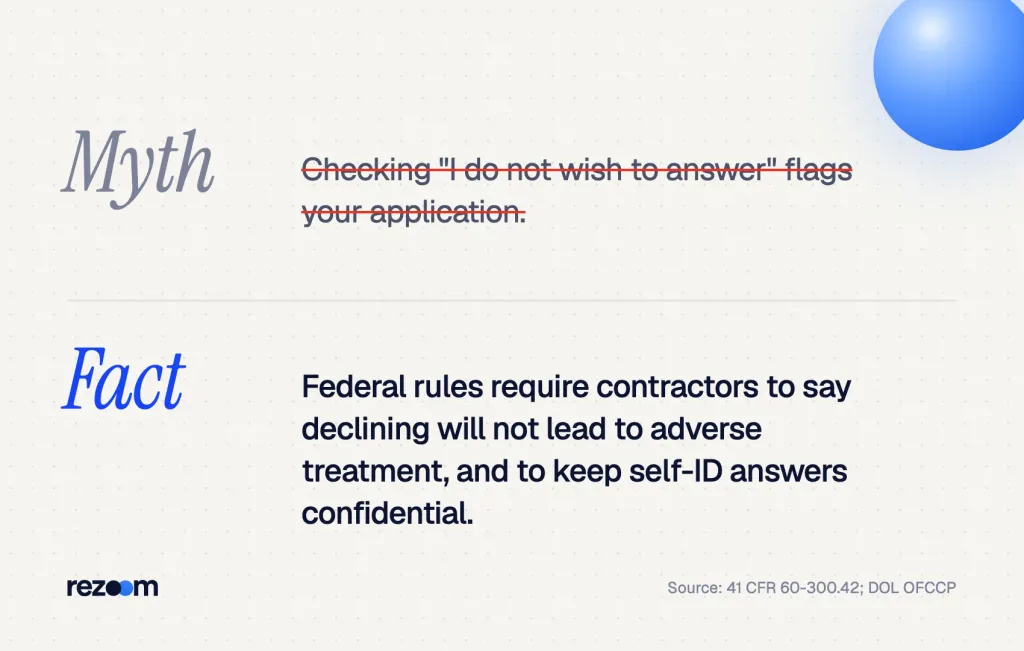
No, it should not. Federal rules require contractors to say the questions are voluntary and that declining will not lead to adverse treatment. The EEOC also tells employers to keep race data apart from the information used to judge applicants. So recruiters who screen you should not see the answer at all.
The rules keep your answer away from the people who decide. The VEVRAA rule says the invitation must state that declining "will not subject the applicant to any adverse treatment"8. It also says the employer must keep what you share private.
Any answer you give will be kept private and will not be used against you in any way.
U.S. Department of Labor, OFCCP sample VEVRAA self-identification form
Who actually sees the answer?
The old CC-305 disability form said it plainly: "No one who makes hiring decisions will see it."6 Most applicant systems store the voluntary section in a separate data file that HR or compliance staff use for reports. If a hiring manager sees a race answer, something has gone wrong.
The EEOC has long pushed the same idea. It points employers to "tear-off" sheets9 so race data stays separate from the facts used to judge whether you qualify. It adds that asking for race by phone could probably never be justified.
Voluntary questions belong in a separate section, not in a phone screen or an interview. If a recruiter asks your race or disability status out loud, you can say you prefer to answer only on the voluntary form. Then note the date and name.
How is declining different on the race, veteran and disability forms?
Declining means the same thing on all three, but the rules behind each form now differ. Veteran questions are still required for federal contractors under VEVRAA. The federal disability form CC-305 was retired in September 2026. Race and sex questions now depend on the employer, because the contractor race and sex rules were rescinded.
The rules changed a lot between 2025 and 2026. So the same decline box can sit on top of three very different legal duties. The table sums up where each form stands as of October 2026.
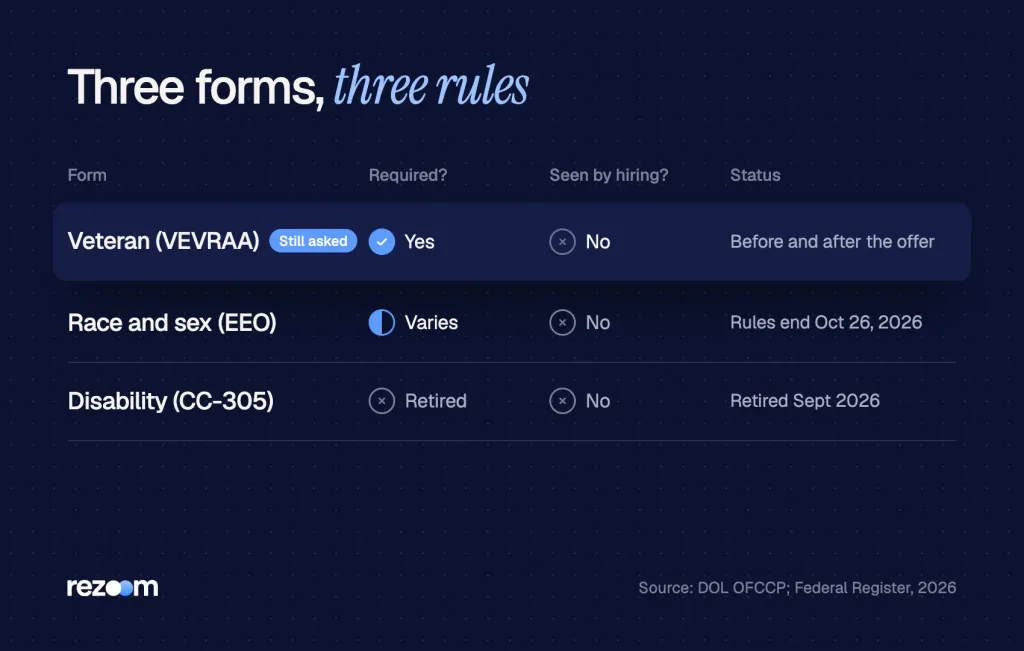
| Form | Still required for federal contractors? | What declining means |
|---|---|---|
| Race, ethnicity and sex (EEO) | No. The contractor rules end October 26, 2026 | The employer leaves you out of its counts or marks "not disclosed" |
| Protected veteran (VEVRAA) | Yes, before and after the offer | The employer can't count you toward its veteran outreach data |
| Disability (CC-305) | No. The form was retired in September 2026 | Your choice stays private, and accommodation rights don't change |
Race and sex questions
Executive Order 14173, issued on January 21, 2025, revoked Executive Order 112461, the order behind contractor race and sex affirmative action. In August 2026 the Labor Department published a final rule that rescinds its regulations, effective October 26, 20262. But many private employers still ask these questions, because the EEO-1 report still exists for now.
Protected veteran questions
This is where "protected veteran declines to self identify" matters most. Federal contractors must invite you to self-identify before any job offer and again after it8. The form lists four groups: disabled veterans, recently separated veterans (within three years of discharge), active duty wartime or campaign badge veterans and Armed Forces service medal veterans.
The DOL sample form says the purpose is "to help us measure the effectiveness of our outreach and recruitment efforts of veterans."7 A 2026 rule raised the contract size that triggers VEVRAA to $200,000 from $150,0004, but it left the self-ID invitation alone.
Disability questions
The Section 503 final rule drops the rule that made firms ask about disability3. It also drops the data checks and the 7% hiring goal. The DOL says the form is discontinued, effective September 21, 20265. But the duty not to treat you unfairly, and the duty to make fair changes for you at work, both stay.
So if you still see a disability question, the employer chose to keep asking. For the full disability decision, read our guide on how to answer the disability question on a job application.
Disability question on a job application example: see how the form looks, the three answers you can pick, who sees them and how to ask for accommodations.
What do employers do with your answer?
Employers turn the answers into totals for reports and outreach reviews. Federal contractors use veteran data to judge their outreach. Employers with 100 or more workers have filed race and sex counts on the EEO-1 report, which the EEOC proposed to end in July 2026. Employers may not use the answers to decide who gets hired.
Your single answer becomes one tally in a count. Then a compliance team uses the totals to check whether its outreach reaches veterans or other groups. If you decline, you simply drop out of that count.
The EEO-1 report is under review
In July 2026 the EEOC proposed to remove the EEO-1 through EEO-6 reports10. The proposal calls the reports inconsistent with equal employment law. Still, law firm Jackson Lewis notes that existing reporting requirements remain in effect11 until a final rule arrives.
After you're hired
Once you are an employee, the rules change slightly. DirectEmployers notes that if an employee declines race or ethnicity, the employer may use employment records, personal knowledge, or visual identification12 for the EEO-1. That applies to the payroll count, not to the hiring choice.
Why federal contractors ask most
Federal contractors face the most rules, so they ask more voluntary questions than most employers. If you apply to defense, IT or public agency roles, expect veteran questions on almost every form. Our government resume examples show how candidates in this field present their background on the resume itself.
Applying to an agency or a contractor that writes long, detailed postings? Then start from our federal resume examples, which list hours, grades and duties the way federal reviewers expect.
Federal resume example
A federal resume with hours, grade levels and detailed duties for agency and contractor roles.
Free ATS score, the text the software extracts and your missing keywords. No sign-up.
Should you answer or decline?
Answer if you are comfortable and you want to help the employer measure its outreach, especially as a protected veteran. Decline if you want privacy; it carries no penalty. If you need an accommodation, ask HR directly, because the self-ID form is not a request. Your resume, not this form, decides your interview.
There is no wrong choice here. But a simple rule helps: answer when the data serves a goal you care about, and decline when privacy matters more.
- Read the form's purpose lineCheck whether it says veteran, disability or race and sex, and whether it says voluntary.
- Decide per questionYou can answer one question and decline another on the same form.
- Pick the decline box, not a blankThe decline option records a choice, while a blank can look like an error.
- Put job-relevant facts on your resumeMilitary service, clearances and skills belong in your work history, not only on a voluntary form.
- Save a screenshotKeep a copy of what you chose in case you need to ask HR to update it later.
Scripts by situation
Veteran status: I do not wish to answer.
Resume: U.S. Army, Logistics Specialist, 2018 to 2022.
Cover letter: "My four years in Army logistics taught me to run inventory for 300 soldiers."
The point of that script: your service still reaches the reader through your resume and letter. Our government cover letter examples show how to frame military work for public sector roles.
Subject: Voluntary self-identification question for [JOB TITLE], requisition [NUMBER]
Hi [NAME],
The voluntary section of the [JOB TITLE] application does not offer a decline option for [QUESTION].
Could you tell me how to submit without answering, or add "I do not wish to answer"?
Thank you,
[YOUR NAME]
"I'm looking forward to the interview on [DATE]."
"I'd like to request one accommodation: [EXTRA TIME / CAPTIONS / A STEP-FREE ROOM]."
"Who should I send the details to?"
Do and don't on the voluntary section
Do
- Pick the decline box when you want privacy.
- Answer one question and decline another if you prefer.
- List military service and skills on your resume.
- Ask HR in writing if a form forces an answer.
Don’t
- Leave a required field blank and hope it passes.
- Treat the disability form as an accommodation request.
- Answer out loud if a recruiter asks your race in a phone screen.
- Assume declining will get you rejected.
Voluntary EEO forms are for reporting, so they rarely carry your preferred name. If you want recruiters to use a different name, use the profile fields instead. Our guide on using a preferred name on a job application shows where it goes.
What if a recruiter or form pushes you to answer?
Most voluntary forms include a decline option, so a forced answer is often a setup error. Email HR, ask how to submit without answering and keep a copy. If someone asks your race, disability or veteran status in an interview, steer back to your skills and offer to complete the voluntary form instead.
A pushy question is rare, but it happens. So prepare a calm, short reply ahead of time.
What to say if they push back
- "Why didn't you fill in the diversity section?" Say it is voluntary, then return to your skills.
- "Are you a veteran? It helps our numbers." Share it if you want, or say the voluntary form covers it.
- "Do you have a disability we should know about?" Say you'll raise any accommodation needs with HR.
Recruiter: "I noticed you skipped the self-ID questions. Any reason?"
"I chose not to answer the voluntary section. I'm happy to talk about my project work."
Recruiter: "No problem, it's just for our reporting."
"Thanks. Should I send my references to you or to the hiring manager?"
Before you submit
Before you submit the voluntary section
Your resume does the real work in the screen. Run it through a free ATS resume checker to see how the system reads your titles, dates and skills.
Voluntary self-identification on job applications: what the race, sex, veteran and disability questions mean, who sees them and if you should answer.
Free ATS score and your missing keywords. No sign-up.
Frequently asked questions
What does "declines to self identify" mean?
It means you chose not to share a trait such as race, sex, veteran or disability status on a voluntary form. The employer records "no response" for that question.
Does "I do not wish to self identify" hurt my chances?
It should not. Federal rules say declining cannot lead to adverse treatment, and employers keep these answers apart from the hiring file.
Should a protected veteran decline to self-identify?
You can. But answering helps the employer measure its veteran outreach, and the answer stays confidential, so many veterans choose to share it.
Do employers still use the CC-305 disability form?
Not as a federal rule. The DOL retired it in September 2026, but some employers still ask a voluntary disability question.
What does self identify mean on a job application?
It means you describe yourself, such as your race, sex, veteran or disability status, instead of the employer guessing. It is always voluntary.
Can I change my answer after I apply?
Usually yes. Ask HR or the recruiting team to update your voluntary self-identification record.
Sources
We opened and read each page below. The small numbers in the text point here. Pages that carry no publication date show n.d.
- U.S. Department of Labor, OFCCP2026
Executive Order 14173, issued January 21, 2025, revoked Executive Order 11246, while Section 503 and VEVRAA remain in effect
- Federal Register, OFCCP final rule2026
The Executive Order 11246 implementing regulations are rescinded effective October 26, 2026
- Federal Register, OFCCP final rule2026
The Section 503 rule rescinds the disability inquiry requirement, data analysis and 7% utilization goal but keeps nondiscrimination and accommodation duties
- Federal Register, OFCCP final rule2026
The VEVRAA rule raises the coverage threshold from $150,000 to $200,000
- U.S. Department of Labor, OFCCP2026
The disability self-identification form is discontinued effective September 21, 2026
- U.S. Department of Labor, OFCCP2023
Form CC-305 offered an "I do not want to answer" option and said no one who makes hiring decisions will see the answer
- U.S. Department of Labor, OFCCPn.d.
The sample VEVRAA form lists four protected veteran groups and says answers are private and will not be used against you
- Cornell Legal Information Institute, 41 CFR 60-300.42n.d.
Contractors must invite veteran self-identification before and after the offer and say declining will not lead to adverse treatment
- U.S. Equal Employment Opportunity Commissionn.d.
The EEOC points employers to tear-off sheets that keep race data separate from qualification review
- U.S. Equal Employment Opportunity Commission2026
The EEOC proposed in July 2026 to remove the EEO-1 through EEO-6 reporting requirements
- Jackson Lewis2026
Existing EEO-1 reporting requirements remain in effect until the EEOC issues a final rule
- DirectEmployers Association2020
If an employee declines, the employer may use records, personal knowledge or visual identification for the EEO-1
Mohammad has spent more than ten years designing consumer products and leads product at Rezoom, deciding what gets built and what gets left out. His guides cover the whole job search, from resume sections and cover letters to interview answers and career moves.
Goodi, M. (2026, October 29). I Do Not Wish to Self Identify: What It Means and Who Sees It. Rezoom. https://rezoom.io/i-do-not-wish-to-self-identify/