Do You Capitalize Latin Honors? Cum Laude Rules for Your Resume
Do you capitalize Latin honors? No. Write cum laude, magna cum laude and summa cum laude in lowercase. See the italics, comma and resume rules with examples.

On this pageDo you capitalize Latin honors on a resume or in a sentence?
- Do you capitalize Latin honors on a resume or in a sentence?
- Should cum laude be in italics?
- How do you write cum laude correctly on a resume line?
- Where does summa cum laude go on a resume?
- What GPA do you need for cum laude, magna and summa?
- How do Latin honors work outside the US?
- How do you check your Latin honors line before you send it?
- FAQ
- Sources
You don't capitalize Latin honors in running text or on a resume line. Write cum laude, magna cum laude and summa cum laude in lowercase, and capitalize only the first word of a sentence or a title-case heading. AP and Chicago set them in plain roman type, but many law and career guides use italics. Either is fine on a resume if you stay consistent and spell each word right.
No, you don't capitalize Latin honors in a sentence or on a resume line. Write cum laude, magna cum laude and summa cum laude in lowercase. Capitalize them only at the start of a sentence or inside a title-case heading.
The harder questions are italics, commas and where the honor sits. Style guides split on italics, so this guide shows what each one says. Then it gives you correct lines to copy for your Education section.
Quick answers by situation
| Your situation | What to do | Example line |
|---|---|---|
| Honor on the degree line of a resume | Lowercase, after a comma | BA in History, magna cum laude |
| Honor in a cover letter sentence | Lowercase, no italics needed | I graduated summa cum laude in May. |
| Honor starts a sentence | Capitalize only the first word | Cum laude graduates get a gold cord. |
| Honor in a title-case heading | Capitalize each main word | Graduating Magna Cum Laude |
| Law or academic resume | Lowercase italics are standard | JD, cum laude, May 2026 |
| Honor not final yet | Wait, or show GPA instead | GPA: 3.82 |
Do you capitalize Latin honors on a resume or in a sentence?
No. Latin honors are ordinary lowercase phrases, like "with distinction" in English. AP and Chicago both keep them lowercase, and university style guides agree. The only time you capitalize Latin honors is when the phrase opens a sentence or sits in a heading set in title case. On a resume line, keep all three words lowercase.
The Grammar Girl site put the rule in one line. In its guide to degree names, Heather Saunders writes: "When including Latin honors in the degree name, set them lowercase."1 She cites both the AP Stylebook and the Chicago Manual of Style.
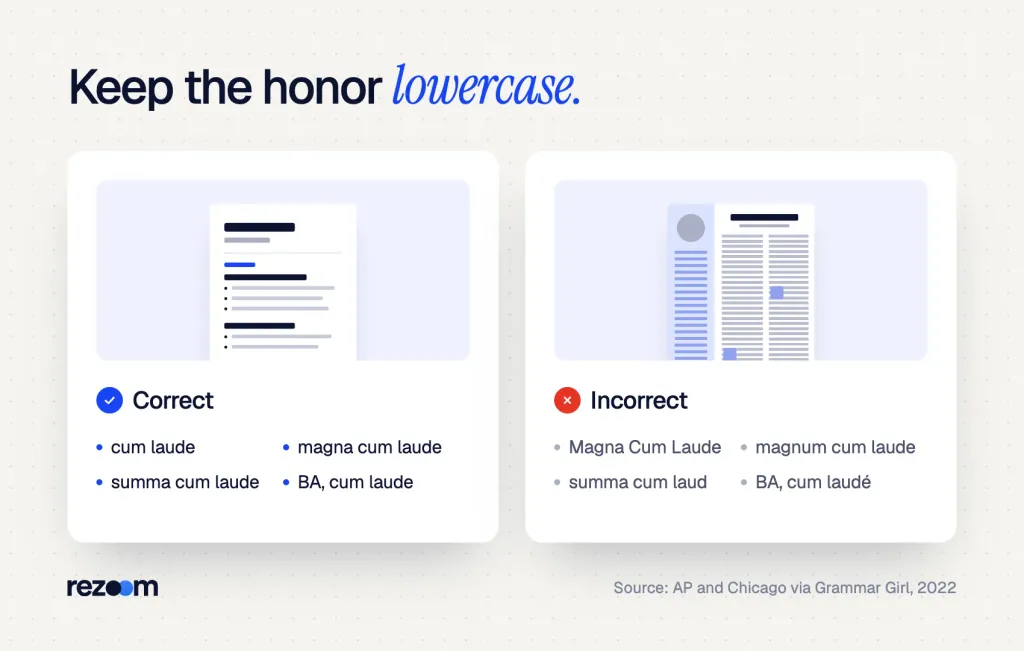
University style guides say the same. The University of Oregon's style column calls the honors "always lowercase, not italicized"2. The University of Alabama follows AP and also prints them in lowercase. Merriam-Webster lists cum laude in lowercase8 as two words meaning "with distinction."
Why capitals look wrong
If you capitalize Latin honors, they look like a proper noun, such as a school or a named award. But cum laude is a description, not a name. So "Magna Cum Laude" in the middle of a line reads like an award title, and editors will mark it.
Your degree name follows a similar logic. You can write "Bachelor of Arts" in capitals as a formal degree name, yet the honor next to it stays lowercase. Our guide on how to list education on your resume covers the rest of that line.
When capitals are correct
- Start of a sentence. "Summa cum laude graduates sit in the front row." Only the first word takes a capital.
- Title-case headings. A section title such as "Graduating Magna Cum Laude" can capitalize each main word.
- All-caps design. If your resume sets every degree line in caps, the honor can follow. But most resumes don't, so keep it lowercase.
Should cum laude be in italics?
It depends on the style you follow. AP and Chicago set cum laude in plain roman type, because the phrase is now standard English. Many law schools and resume guides italicize it as a foreign phrase. On a resume, either choice is fine if you use it the same way every time. In a cover letter or bio, plain type is the safer pick.
This is where the guides really split. Saunders notes that "The AP Stylebook and CMOS (7.55) are in agreement"1 that the terms should not be italicized. Notre Dame's style roundup agrees: "Honors, including cum laude, magna cum laude and summa cum laude, are not italicized."3
The Alabama guide adds "Do not italicize"4 to all three honors. Hamilton College's entry for magna cum laude says just "no italics."5
The guides that use italics
Resume advice often goes the other way. Harvard Law School's public interest office tells students to italicize all three.
Because they are Latin phrases, magna, summa, and cum laude should always appear in italicized, lowercase letters.
Harvard Law School, OPIA resume layout guidance
The University of Alaska Fairbanks style guide also says the honors "should be italicized."6 Resume sites such as Zety9 and TopResume10 say the same. Still, none of them tell you to capitalize Latin honors.
Which style guide says what
| Source | Capitals | Italics |
|---|---|---|
| AP Stylebook (via Grammar Girl) | Lowercase | No |
| Chicago Manual of Style 7.55 (via Grammar Girl) | Lowercase | No |
| Notre Dame, Alabama, Hamilton, Oregon | Lowercase | No |
| Harvard Law School OPIA | Lowercase | Yes |
| University of Alaska Fairbanks | Lowercase | Yes |
| APA Style | No specific rule found | No specific rule found |
We could not open the Chicago entry itself, because it sits behind a paywall. So the Chicago row relies on Grammar Girl's citation of section 7.55.
We also found no APA Style rule on Latin honors. If your school or employer has a house style, that style wins.
Use italics if you apply to law firms, clerkships or academic jobs, because their resume guides expect them. Use plain type for most other jobs and in any sentence you write. Then check that every honor on the page looks the same.
How do you write cum laude correctly on a resume line?
Put the honor right after the degree and major, set off with a comma: "Bachelor of Science in Biology, cum laude." Spell all words in full, keep them lowercase and add no accent marks. Write "magna," not "magnum," and "laude," not "laud." Copy the exact honor your school awarded, because swapping in an English phrase changes what you claim.
First comes the degree, then the major, then the honor. After that come the school, city and date, in whatever order your Education section already uses.
Correct lines to copy
Bachelor of Arts in English, summa cum laude BS in Mechanical Engineering, magna cum laude BA in Psychology, cum laude, May 2026 Juris Doctor, cum laude, May 2025
Harvard Law's own example drops the comma and puts the honor between the degree and major: "B.S. magna cum laude in Physics." That pattern works too. So pick one pattern and use it for every degree you list.
Common mistakes to fix
Wrong: BA in History, Magna Cum Laude | Fix: BA in History, magna cum laude Wrong: BS in Biology, magnum cum laude | Fix: BS in Biology, magna cum laude Wrong: BA in Art, summa cum laud | Fix: BA in Art, summa cum laude Wrong: BA, cum laudé | Fix: BA, cum laude (no accent marks) Wrong: BA, graduated with honors (cum laude) | Fix: BA, cum laude
Zety warns readers not to swap between phrases like "graduated with honors" and cum laude. Use the exact wording your school gives you. That also keeps your resume in line with your transcript if an employer checks it.
Do
- Keep cum laude, magna and summa in lowercase.
- Spell every word in full, with no abbreviations.
- Copy the honor exactly as your diploma shows it.
- Use the same italics choice for every honor.
Don’t
- Capitalize the honor mid-line to make it stand out.
- Add accents or quotation marks around the phrase.
- Write "magnum," "laud" or "summa cum laude honors."
- Bold the honor; bold the degree or school instead.
Where does summa cum laude go on a resume?
Put summa cum laude on the same line as the degree it belongs to, or on the line right under it, in your Education section. A separate honors section only makes sense if you have several awards. Recent graduates keep Education near the top, so the honor shows up early. More experienced readers can move Education lower and keep the honor.
Zety says noting the honor in Education is enough for most people. TopResume calls honors "one of the last things you drop"10 as you gain experience.
If you have more than one degree, each honor stays with its own degree. That matters for anyone with two majors, as our guide on how to list a double major on your resume shows. For the wider placement choices, read our full guide on how to list Latin honors on a resume.
How to list Latin honors on resume: italics, lowercase, placement, and GPA rules, plus real school cutoffs and copy-ready examples for every situation.
A full Education section
JORDAN LEE
Columbus, OH | jordan.lee@email.com | (614) 555-0147
Bachelor of Science in Biology, summa cum laude | The Ohio State University | May 2026
Senior thesis: Gene expression in drought-stressed maize
Dean's List, 6 semesters
Harvard Law notes that Dean's List can look redundant next to Latin honors. So if space is tight, cut Dean's List first. A thesis line can stay, and our guide to listing a thesis on your resume shows the format.
Templates for new grads
Our student resume examples show where honors land on real one-page layouts. For a full page you can copy, open the college student resume example and swap in your degree line.
College student resume example
A one-page student resume with a clean Education section where your Latin honor fits on the degree line.
Fill-in-the-blank template
[DEGREE] in [MAJOR], [cum laude / magna cum laude / summa cum laude]
[SCHOOL NAME], [CITY, STATE] | [MONTH YEAR]
GPA: [X.XX] (optional; leave it off if the honor already says enough)
You can build the whole page faster with Rezoom's AI resume builder. It drops your degree, honor and dates into a clean layout, and then you check the lowercase and italics by eye.
Free ATS score, the text the software extracts and your missing keywords. No sign-up.
What GPA do you need for cum laude, magna and summa?
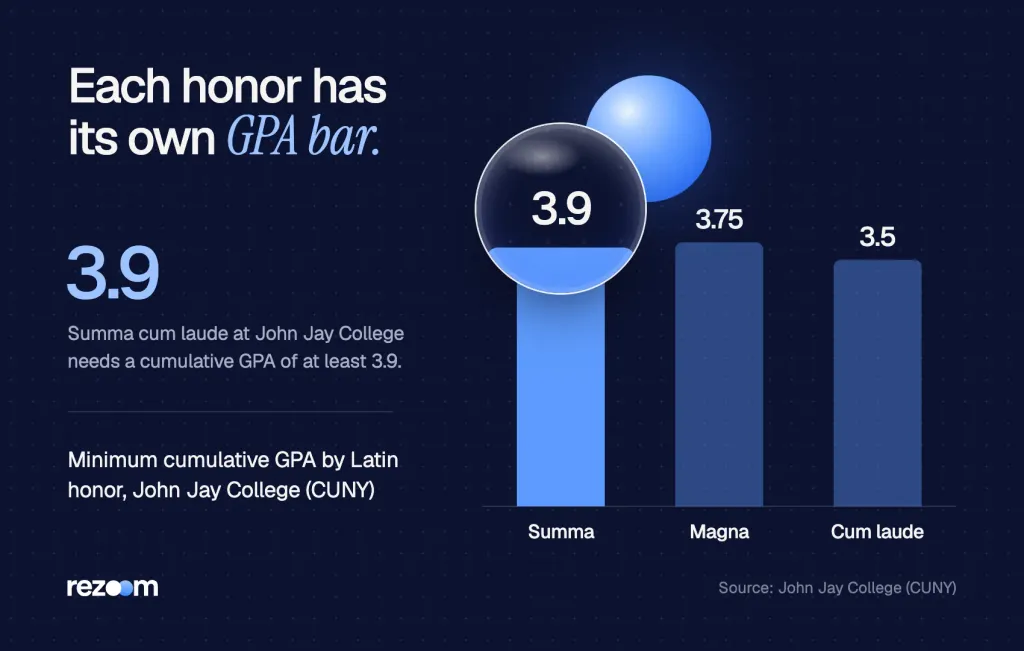
Each school sets its own rules, so there is no national cutoff. Some use fixed GPAs, such as 3.5, 3.75 and 3.9 at John Jay College. Others rank students, such as the top 5, 8 and 12 percent bands at Vanderbilt. Check your registrar's page before you list an honor, and list it only once the school confirms it.
John Jay College (CUNY) uses a cumulative GPA of at least 3.511 for cum laude, 3.75 for magna and 3.9 for summa.
UConn sets minimums of 3.0, 3.4 and 3.712 plus a class-rank test. Yet its May 2025 table for Business shows real cutoffs of 3.819, 3.89 and 3.969. So the minimum on paper can sit far below the bar students actually clear.
Rank-based schools
Vanderbilt ties honors to rank. Summa goes to students at or above the top 5 percent13 of recent graduates, magna to the next 8 percent and cum laude to the next 12 percent. For 2026–27, its Arts and Science cutoffs are 3.990, 3.961 and 3.908.
| School | Cum laude | Magna cum laude | Summa cum laude |
|---|---|---|---|
| John Jay College (CUNY) | GPA 3.5+ | GPA 3.75+ | GPA 3.9+ |
| UConn (minimums) | 3.0 + 75th pct rank | 3.4 + 85th pct rank | 3.7 + 95th pct rank |
| Vanderbilt | Next 12% | Next 8% | Top 5% |
| University of Oregon | Top 10% | Top 5% | Not listed in the source |
Should you add the GPA too?
Because thresholds differ, a recruiter can't read your GPA from the honor alone. But Harvard Law says a high GPA is often self-evident when you graduated magna cum laude.
If the employer asks for GPA, add it on the same line. Our guide on whether to put your GPA on your resume gives the cutoff most recruiters expect.
GPA on resume rules: list it at 3.0+ as a student or recent grad, where it goes, how to write it, weighted vs unweighted, LinkedIn, and when to take it off.
Many schools confirm Latin honors only after final grades post. If you apply before graduation, list your GPA and expected date instead. Then add the honor once your transcript shows it.
How do Latin honors work outside the US?
Latin honors are mostly a US system. UK universities use degree classes instead, such as first-class honours or a 2:1, and you write those in the local form. If you studied abroad, list the honor in your school's own terms. Add a short US equivalent only if a recruiter would not know it.
The UK uses bands, not Latin phrases. Prospects lists first-class honours at 70% and above14 and a 2:1 at 60% to 70%. So a UK grad writes "BA (Hons) History, First-Class Honours," not "summa cum laude."
Other countries use Latin terms with their own scales. We could not confirm one rule for all of them, so copy the wording on your diploma. If you add a US note, keep it short, as in "(top 5% of class)," and only if your school publishes that rank.
What to say if they push back
- "Is magna cum laude the top honor?" Say no: summa is the top, then magna, then cum laude.
- "What GPA did that take at your school?" Give your school's cutoff, or your own GPA.
- "Why is the honor in italics?" Say you followed the law school or academic format, which sets Latin phrases in italics.
Recruiter: "Your resume says magna cum laude. What does that mean at your school?"
"At my school it takes a 3.75 GPA or higher. Mine was 3.86."
Recruiter: "Why didn't you put Dean's List too?"
"The Latin honor covers it, so I used the space for my thesis."
The same lowercase rule applies in a cover letter. Our student cover letter examples show how to mention an honor in one plain sentence.
How do you check your Latin honors line before you send it?
Read the degree line against your diploma or transcript. Confirm the honor is lowercase, spelled in full and set the same way everywhere. Then check that the comma pattern matches your other degrees. A two-minute check catches the capital letters and typos that make an honor look careless.
- Find the official wordingOpen your diploma, transcript or registrar page and copy the honor exactly.
- Set it in lowercaseWrite cum laude, magna cum laude or summa cum laude with no capitals mid-line.
- Pick italics or romanUse italics for law and academic resumes, plain type for most others.
- Place it on the degree linePut it after the major, set off with a comma.
- Check every mentionMatch the style in your resume, cover letter and LinkedIn.
Before you send your resume
Free plan, no card.
Frequently asked questions
Do you capitalize Latin honors?
No. You don't capitalize Latin honors in running text or on a resume line. Capitalize only the first word of a sentence or each main word in a title-case heading.
Is summa cum laude capitalized on a resume?
No. Write "summa cum laude" in lowercase after your degree, as in "BA in English, summa cum laude." Capitals mid-line look like an award name.
How do you write cum laude?
Write it as two lowercase words with no accents: cum laude. Put it after your degree and major, set off with a comma.
Should magna cum laude be italicized?
AP and Chicago say no. Harvard Law and many resume guides say yes. Pick one and use it the same way for every honor.
Do you put a comma before cum laude?
Usually yes, as in "Bachelor of Arts in History, cum laude." Some law resumes skip the comma and write "BS magna cum laude in Physics."
Which Latin honor is the highest?
Summa cum laude is the highest, then magna cum laude, then cum laude. Each school sets its own GPA or rank cutoff.
Sources
We opened and read each page below. The small numbers in the text point here. Pages that carry no publication date show n.d.
- Quick and Dirty Tips (Grammar Girl)2022
Latin honors in a degree name are set lowercase, and the AP Stylebook and Chicago Manual of Style 7.55 agree they are not italicized
- University of Oregon Communications2023
Latin honors are always lowercase and not italicized; cum laude is the top 10 percent and magna cum laude the top 5 percent
- Notre Dame NDWorks2023
Cum laude, magna cum laude and summa cum laude are not italicized
- University of Alabama Strategic Communicationsn.d.
The AP-based guide says not to italicize cum laude, magna cum laude or summa cum laude
- Hamilton College Editorial Style Guiden.d.
Magna cum laude takes no italics
- University of Alaska Fairbanksn.d.
Cum laude, magna cum laude and summa cum laude should be italicized
- Harvard Law School OPIAn.d.
Latin honors should appear in italicized lowercase letters, and Dean's List may look redundant next to them
- Merriam-Webstern.d.
Cum laude is a lowercase two-word phrase meaning with distinction
- Zetyn.d.
Latin honors go in lowercase italics, usually in the Education section, using the exact wording on the diploma
- TopResumen.d.
Honors are one of the last education details to drop from a resume
- John Jay College (CUNY)n.d.
Cum laude needs a 3.5 GPA, magna cum laude 3.75 and summa cum laude 3.9
- UConn Office of the Registrar2025
Minimums are 3.0, 3.4 and 3.7 plus class rank, while May 2025 Business cutoffs were 3.819, 3.89 and 3.969
- Vanderbilt University Registrar2026
Summa goes to the top 5 percent, magna to the next 8 percent and cum laude to the next 12 percent, with 2026–27 Arts and Science cutoffs of 3.990, 3.961 and 3.908
- Prospects2026
UK first-class honours means 70% and above and a 2:1 means 60% to 70%
Mohammad has spent more than ten years designing consumer products and leads product at Rezoom, deciding what gets built and what gets left out. His guides cover the whole job search, from resume sections and cover letters to interview answers and career moves.
Goodi, M. (2026, October 31). Do You Capitalize Latin Honors? Cum Laude Rules for Your Resume. Rezoom. https://rezoom.io/do-you-capitalize-latin-honors/