Thesis on a Resume: Where to List It and How to Make It Readable
Thesis on a resume: list it under your degree in one line, as a research project with bullets, or as a publication. See honors, senior and master's examples.

On this pageShould you put your thesis on a resume?
List a thesis on a resume when its topic, methods or skills connect to the job you want. Put it as one line under the degree in your Education section, or move it to Experience or Research with bullets when it was a major independent project. Give the title, the year and one plain-language result, and translate academic jargon into words the recruiter and ATS can match.
Put your thesis on a resume as one line under the degree in Education, with the title and year, when its topic, methods or skills connect to the job. Give it bullets in Experience or Research only if it was a major independent project.
If the thesis was a major independent project, it can earn more space. Move it to Experience or Research and add bullets that show the methods, tools and results. That turns a line about school into evidence of skills an employer is hiring for.
Most guides stop there. This one also covers the step that decides whether a recruiter understands the entry at all: translating a long academic title into words that match the job posting.
Should you put your thesis on a resume?
Yes, if it is relevant to the role or shows skills the job needs, such as research, data analysis or long-form writing. It matters most for recent graduates, research roles and academic jobs. Leave it off, or cut it to one line, when you have stronger work experience or the topic has no link to the position.
Run three quick checks before you add it:
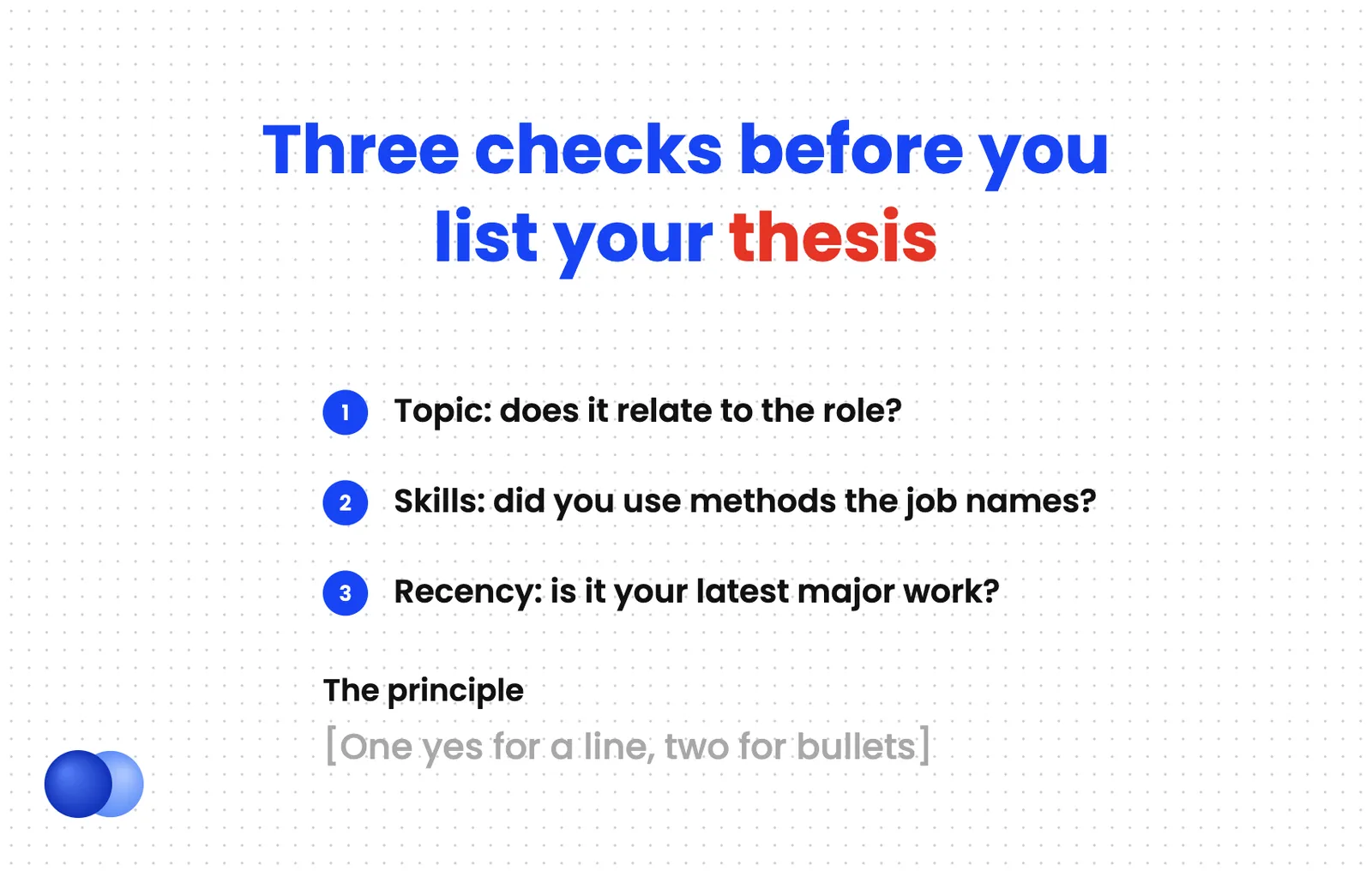
- Topic match. Does the subject relate to the industry or role?
- Skills match. Did you use methods, tools or skills the posting names?
- Recency. Did you finish it within the last few years, or is it your most recent major work?
One yes is enough for a line in Education. Two or three yes answers justify bullets. Pitzer College's career office gives the same logic: list the title in Education especially if the topic aligns with the roles you want1, and move it to Experience if it involved significant independent work. You can see where it sits in our student resume examples.
The skills case is strong. NACE's Job Outlook 2026 Spring Update2 lists problem-solving, communication and analytical skills among the attributes employers want. A thesis is often your best single proof of all three. NACE also stresses that employers want examples, not lists of skills.
Where does a thesis go on a resume?
Put a thesis on a resume as one line under the matching degree in Education by default. Move it to a Research or Experience section with bullets when it was large, independent and relevant. PhD candidates and research applicants can give it a dedicated Thesis or Dissertation section near the top.
The right section depends on your degree level and the job. If you finished the thesis but not the degree, use the wording for an incomplete degree on a resume.
| Your situation | Best placement | How much detail |
|---|---|---|
| Undergrad honors or senior thesis, unrelated job | Education, under degree | Title and year only |
| Undergrad thesis, related job | Education or Experience | Title plus 1–2 bullets |
| Master's thesis, industry role | Experience or Projects | Title plus 2–3 result bullets |
| Master's or PhD, research or academic role | Research section | Title, advisor, methods, outputs |
| PhD, industry role | Thesis section near top | Plain-language title plus 2–3 bullets |
| Thesis in progress | Education, under degree | Title marked "in progress" or expected date |
Graduate career guides reflect this split. Carnegie Mellon's engineering resume guide gives PhD students a separate Thesis section with "Verb + Context + Result" bullets3, while master's students use an Academic Projects section. Harvard Law School suggests a "Thesis" subsection under the relevant degree4 when the topic fits your career interests. If you graduated with honors, note that you don't capitalize Latin honors.
If your thesis sits inside a larger body of research, our guide on how to put research experience on a resume explains how to build that section. For the base Education format, see how to list education on your resume.
How do you format a thesis on a resume?
Write "Thesis:" followed by the title in quotation marks or italics, then the year. Indent it under the degree it belongs to. When you need more detail, add your advisor's name and one or two bullets that start with an action verb and end with a result, such as a finding, a dataset size or a presentation.
Keep the entry short and consistent with the rest of the page. Pick one style for the title, either quotation marks or italics, and use it everywhere. Both parse cleanly in applicant tracking systems. This college graduate resume example shows a research line under the degree.
College graduate resume example
Education first, with a short research line under the degree.
EDUCATION
University of Wisconsin–Madison, Madison, WI
Bachelor of Science in Economics, May 2026
Senior Thesis: "Minimum Wage Changes and Teen Employment in Midwest Counties" (Advisor: Dr. Jane Ruiz)
Built a 12-year county panel dataset in Stata and ran difference-in-differences models
Northeastern University, Boston, MA
Master of Science in Data Science, Expected May 2027
Thesis (in progress): "Forecasting Hospital Bed Demand with Gradient-Boosted Models"
Add the advisor only when the name helps, such as in academic hiring or a field where the advisor is known. Otherwise it takes space without adding evidence.
If your thesis earned honors, put that on the same line or the degree line. Our guide on Latin honors on a resume shows the standard wording. Thesis prizes can also go in an awards section; see today's guide on awards on a resume.
How do you list an honors or senior thesis on a resume?
Write "Honors Thesis:" or "Senior Thesis:" under the degree, then the title in quotation marks and the year. Add the honors level, such as "with High Honors," on the same line if your program awarded one. Add one bullet only if the thesis matches the job.
How do you put a master's thesis on a resume?
List the thesis under your master's degree as "Thesis:" plus the title and year. If it is your strongest research, also add a Research Experience entry with 2 to 3 bullets on the methods, data and result, written in the job posting's words.
Use the label your program used, so the entry matches your transcript. For example: Honors Thesis: "Remote Work and Retention in Small Firms," 2026, with High Honors. A recruiter reads the label, the topic and the result in one glance, which is all a one-line entry needs to do.
How do you rewrite a thesis title so recruiters understand it?
Keep the official title in Education, then write the bullets in the job posting's words. Name the methods and tools you used, such as Python, surveys or lab work, and end each bullet with a result. Recruiters skim fast, so the bullets explain the work, not the title.
Academic titles are written for a committee, not a hiring manager. A Ladders eye-tracking study found recruiters spend about 7.4 seconds on an initial resume scan5. A 20-word title with a colon and two subtitles will not survive that.
A three-step rewrite
Use a three-step rewrite:
- Keep the official title in Education, unchanged, so it matches your transcript.
- Lead the bullets with the job's words. If the posting says "customer churn," say that, even if your thesis said "attrition hazard."
- Name the methods and tools. Python, R, Stata, interviews, surveys and lab techniques are keywords recruiters search for.
EXPERIENCE
Graduate Thesis Researcher | Arizona State University, Tempe, AZ | Aug 2024 – May 2026
Thesis: "Survival Modeling of Subscriber Attrition in Streaming Platforms"
Predicted customer churn for 40,000 subscribers using survival models in Python
Identified 3 usage signals that flagged churn risk 60 days earlier than the baseline
Presented findings to a 30-person faculty and industry panel
The title stays academic, but every bullet speaks the language of a data analyst posting. That is the gap most thesis entries leave open. For more on writing results-first lines, see our guide to projects on a resume.
Paste the job posting next to your thesis abstract and highlight every shared skill or tool. Those overlaps become your bullet openings. If you find fewer than two, keep the thesis to one line in Education and spend the space on experience that matches better.
Free ATS score, the text the software extracts and your missing keywords. No sign-up.
What mistakes should you avoid with a thesis on a resume?
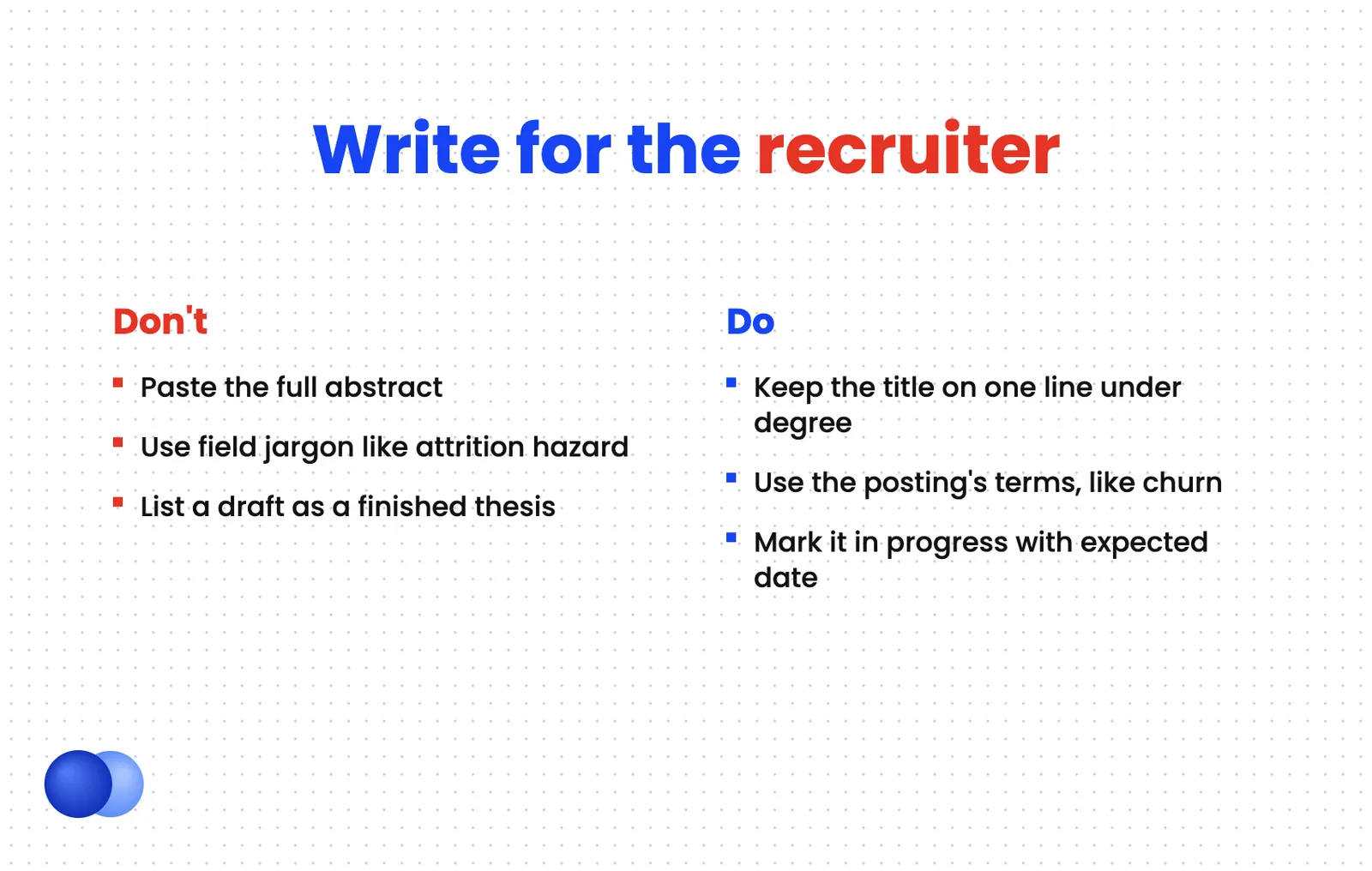
Avoid pasting a long abstract, using undefined jargon, listing a thesis you cannot discuss in depth, and repeating the same thesis in three sections. Do not call a capstone or term paper a thesis, and do not hide an unfinished thesis. Mark it as in progress with an expected date instead.
Do
- Keep the official title on one line under the degree
Don’t
- Paste the abstract or a paragraph-long summary
- Translate jargon into the job posting's terms in bullets
- Assume a recruiter knows your field's acronyms
- Mark an unfinished thesis "in progress" with an expected date
- Present a draft as a completed thesis
- Use the label your program used: thesis, capstone or dissertation
- Call a seminar paper a thesis
- Link a published version from your publications section
- List the same thesis in Education, Research and Projects
Interviewers often ask candidates to explain their thesis in a minute. Prepare a short version that states the question, the method and the result in plain terms. A one-line version fits in a letter too, as these student cover letter examples show.
Should a published thesis go under publications?
If your thesis led to a journal article, conference paper or poster, list that output in a Publications or Presentations section using a standard citation style. Keep the thesis itself in Education. That way each section shows a different achievement and you avoid repeating the same item.
A thesis and the paper it produced are two separate accomplishments. The thesis shows you completed a degree requirement. The publication shows peer review or a public presentation.
Our guide on how to list publications on a resume covers citation formats. Graduate applicants can also see today's guide on an MBA on a resume for degree-line conventions that apply to professional programs.
Once the entry is written, run your draft through the Rezoom ATS resume checker to confirm the thesis line parses under the right degree and the posting's keywords appear.
How to put research experience on a resume: where it goes for grad school vs industry, what each entry needs, bullet formulas and 3 examples to copy.
Frequently asked questions
Should I put my undergraduate thesis on my resume?
Yes, if the topic or methods relate to the job or you have little work experience. Give it one line under your degree, and add bullets only if it shows skills the posting asks for.
Do you put the thesis title in quotes or italics?
Either works. Pick one style and use it consistently across your resume.
How do I list a thesis that is not finished?
Add it under your degree with "in progress" or an expected completion date. Describe only work you have already done.
Should I include my thesis advisor on my resume?
Include the advisor for academic and research roles, where the name can carry weight. For most industry roles it is optional.
Is a thesis the same as a dissertation on a resume?
They are listed the same way. Use the term your program used, usually thesis for bachelor's and master's degrees and dissertation for doctorates.
When should I remove my thesis from my resume?
Cut it to one line once you have a few years of relevant work, and remove it when space is tight unless the role is research-based or the topic matches the job.
Where do you put an honors thesis on a resume?
Under the matching degree in your Education section. Write "Honors Thesis:" with the title and year, and move it to a Research section only if it was a large project tied to the job.
Should I put my master's thesis on my resume?
Yes, if it relates to the job or shows skills the posting asks for. Add it as one line under the degree, or as a project with 2 to 3 bullets if it was a major piece of work.
How do you write a thesis title on a resume?
Write "Thesis:" then the title in quotation marks or italics, then the year, on one line under the degree. Use the official title, and explain it in plain words in a bullet if it is long or full of jargon.
Sources
We opened and read each page below. The small numbers in the text point here. Pages that carry no publication date show n.d.
- Pitzer College Career Services2026 (acce
Include a senior thesis title in Education when the topic aligns with
- National Association of Colleges and Employers2026
Job Outlook 2026 Spring Update: employers seek problem-solving, communication and analytical skills,
- Carnegie Mellon University Career and Professional Development Center2018
PhD resumes use a separate Thesis section with "Verb + Context +
- Harvard Law School, Office of Public Interest Advising2026 (acce
Add a "Thesis" subsection under the degree with the title in italics
- HR Dive (reporting Ladders eye-tracking study)2018
Recruiters spend an average of 7.4 seconds on an initial resume scan
Mohammad has spent more than ten years designing consumer products and leads product at Rezoom, deciding what gets built and what gets left out. His guides cover the whole job search, from resume sections and cover letters to interview answers and career moves.
Goodi, M. (2026, November 18). Thesis on a Resume: Where to List It and How to Make It Readable. Rezoom. https://rezoom.io/thesis-on-resume/