

Summary
To list publications on a resume, add a "Publications" or "Selected Publications" section, use one citation style your field recognizes (APA, MLA or Chicago), list entries newest first, and bold your own name. Mark unfinished work by status: "in press" once accepted, "submitted" or "under review" before that, and never name a journal as if it accepted a paper it has not. Industry resumes show three to five relevant items; academic CVs show everything.
Create a section called "Publications" or "Selected Publications," pick one citation style, list the newest work first and bold your own name. Then label anything unfinished by its exact status, such as "in press" or "under review."
That is the short answer to how to list publications on resume. The details decide whether a hiring manager trusts the section. Most guides show one tidy APA entry and stop. They skip the harder questions: what to do when you are fifth of twelve authors, how "submitted" differs from "in press," and when a resume should become a CV.
This guide covers all three styles, every publication status and a clear rule for choosing a resume or a CV.
Should publications go in a separate section or elsewhere on your resume?
Use a separate section when you have three or more relevant publications or you apply for research, science, policy or writing roles. With one or two items, fold them into an experience bullet or the education entry. Academic, faculty and postdoc applications need a full CV instead.
Where the section goes depends on the job, not just your publication count. Use this decision table.
| Your situation | Where publications go | How many to show |
|---|---|---|
| Academic job, postdoc, fellowship, grant | Full CV, "Publications" section | All of them |
| Industry research or science role | Resume, "Selected Publications," near the end | Three to five most relevant |
| One or two papers, any role | Bullet under the related job or research experience | One or two |
| Student with a thesis or undergraduate paper | Under the education entry | One |
| Writer, journalist, marketer | "Selected Writing" or "Bylines" section | Three to five best clips |
| Unrelated field, older papers | Leave them off or add one line under "Additional" | Zero to one |
Pitt Career Central recommends adding publications to a "Relevant Experience" or "Academic Experience" section when you have limited experience, and creating a dedicated section once you have substantial work.
For industry roles, less is more. In ASBMB Today, career advisor Nicole Matrone advises scientists to "avoid CV-style listing and choose first-authored publications or highlight those that are most relevant to the job." That article also suggests placing a "Selected publications and conference proceedings" section last on an industry resume.
Not sure which document you need? Our explainer on what CV stands for breaks down the difference.
How do you format publications on a resume in APA, MLA and Chicago style?
Use the style your field already uses. Psychology, education and many sciences use APA. Humanities fields use MLA. History and some social sciences use Chicago. The core pieces are the same in every style: authors, year, title, journal, volume, issue, pages and a DOI link. Apply one style to every entry.
Here is the same article in all three styles. Swap in your details and keep the punctuation exactly as shown.
APA 7: Nguyen, T., Garcia, M. R., & Okafor, D. (2025). Remote monitoring and readmission rates in rural hospitals. Journal of Rural Care Studies, 41(2), 210–224. https://doi.org/10.5555/jrcs.2025.0142
MLA 9: Nguyen, Tran, et al. "Remote Monitoring and Readmission Rates in Rural Hospitals." Journal of Rural Care Studies, vol. 41, no. 2, 2025, pp. 210–24.
Chicago 18 (bibliography): Nguyen, Tran, Maria R. Garcia, and David Okafor. "Remote Monitoring and Readmission Rates in Rural Hospitals." Journal of Rural Care Studies 41, no. 2 (2025): 210–24. https://doi.org/10.5555/jrcs.2025.0142
Notice three differences. APA uses initials and puts the year right after the authors. MLA uses full first names and cuts to "et al." at three or more authors. Chicago also uses full names but keeps up to six authors.
In the MLA line, Garcia's name disappears behind "et al." The next section shows how to fix that on a resume.
DOIs belong in URL form. The University of Portland's Chicago 18 guide notes that DOIs should now be formatted as a URL, such as https://doi.org/10.1086/718629, and that the older "doi:" prefix is deprecated.
If your field has its own style, such as AMA in medicine or IEEE in engineering, use that instead. Consistency matters more than which style you pick.
How do you list publications with multiple authors on a resume?
List authors in the published order and bold your own name so a reader finds it in one glance. APA lists up to 20 authors, MLA shortens three or more to "et al.," and Chicago 18 lists up to six. On a resume, never let "et al." hide your name; show authors through your position instead.
The official rules differ sharply:
- APA 7: List all authors up to 20. With 21 or more, list the first 19, an ellipsis, then the final author, per Purdue OWL.
- MLA 9: With three or more authors, list only the first author followed by "et al.," per Purdue OWL's MLA guide.
- Chicago 18: List up to six authors. With more than six, list the first three and "et al.," per the University of Portland guide. Older guides still show the Chicago 17 rule, so check which edition they follow.
Here is the problem those rules create. If you are the fourth of eight authors, a strict MLA or Chicago entry drops your name entirely. A hiring manager then sees a paper with no visible link to you.
On a resume, adapt the style. List authors through your own position, bold your name, then add "et al." On a CV, follow your field's full convention, because academic readers expect it.
Resume version (you are 4th of 8): Chen, L., Patel, R., Osei, K., Garcia, M. R., et al. (2026). Machine learning triage in emergency departments. Emergency Care Informatics, 9(4), 112–125.
Add your contribution when it helps: Chen, L., Patel, R., Osei, K., Garcia, M. R., et al. (2026). Machine learning triage in emergency departments. Emergency Care Informatics, 9(4), 112–125. (Built the data pipeline and validation model.)
The contribution note is optional. It works well on industry resumes, where a manager cares more about what you did than where your name appears.
How do you list in-press, submitted and under-review publications?
Label each item by its real status. "In press" means accepted, so you name the journal. "Submitted" or "under review" means not accepted, so APA omits the journal name. "In preparation" belongs on a CV only when a draft exists. Update the entry every time the status changes.
Status labels are where resumes most often overstate. A journal name next to a submitted paper can look like an acceptance. Use this ladder:
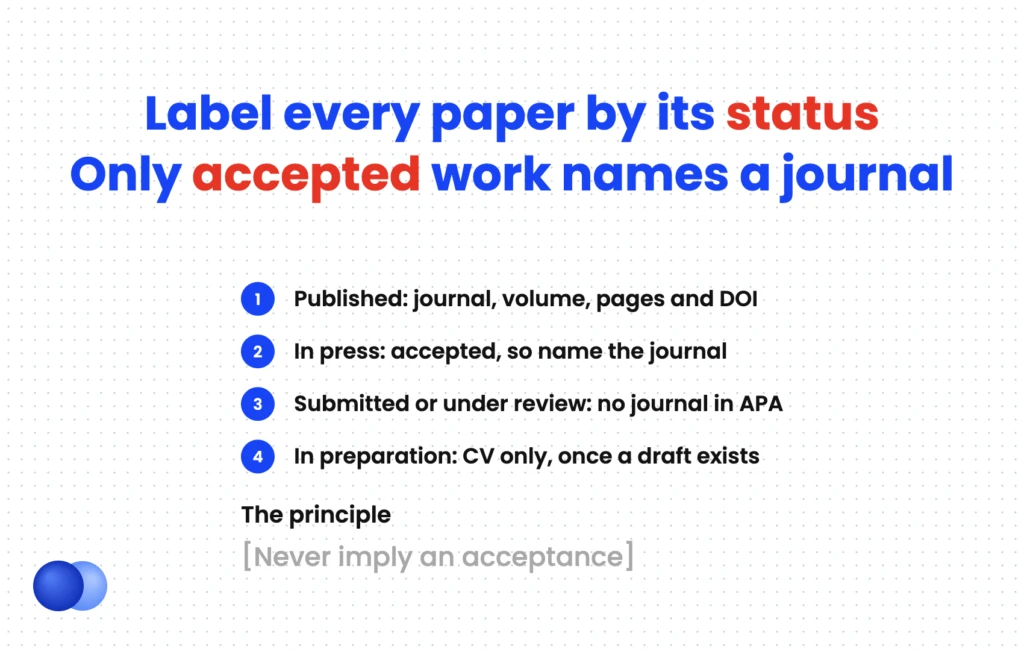
| Status | What it means | Name the journal? | APA example ending |
|---|---|---|---|
| Published | Final version out, has volume and pages | Yes | Journal, 41(2), 210–224. DOI |
| Online ahead of print | Published online, no issue yet | Yes | Journal. Advance online publication. DOI |
| In press | Accepted, not yet published | Yes | (in press). Title. Journal. |
| Submitted / under review | Sent to a journal, no decision | No (APA) | Title [Manuscript submitted for publication]. |
| In preparation | Draft in progress | No | Title [Manuscript in preparation]. |
| Preprint | Posted publicly before peer review | Server name | Title [Preprint]. Server. DOI |
The APA rule on submitted work is explicit. The University of Melbourne's APA 7 guide says: "Do not list the name of the journal to which was submitted." Once accepted, James Cook University's APA guide shows the in-press format: author, "(in press)," title, then the journal name.
Some career centers take a looser approach on resumes. Pitt Career Central shows a submitted paper with the journal name and "(Submitted, March 2024)." That is acceptable on an industry resume if the status is unmistakable. Never drop the status label.
Treat in-press claims like a reference check
Before an interview, have your acceptance email ready. Research hiring managers sometimes ask when a paper will appear or who the handling editor was. A precise answer builds trust. A vague one makes the whole section look padded.
What publications should you include, and what should you leave off?
Include peer-reviewed articles, books, chapters, conference papers, and relevant reports or articles that show expertise the job needs. Leave off unrelated work, very old papers on an industry resume, and anything you only helped proofread. For non-academic writing, a "Selected Writing" section with the outlet and date works better than a formal citation.
Relevance beats volume on a resume. A data science manager wants the paper where you built the model, not the one where you ran a survey in a different field. Our guide on how far back a resume should go applies here too: older work earns space only when it is still relevant.
Non-academic writing counts. Marketers, policy analysts and journalists can list bylines, white papers and reports. Keep the format simple: title, outlet, date and a link.
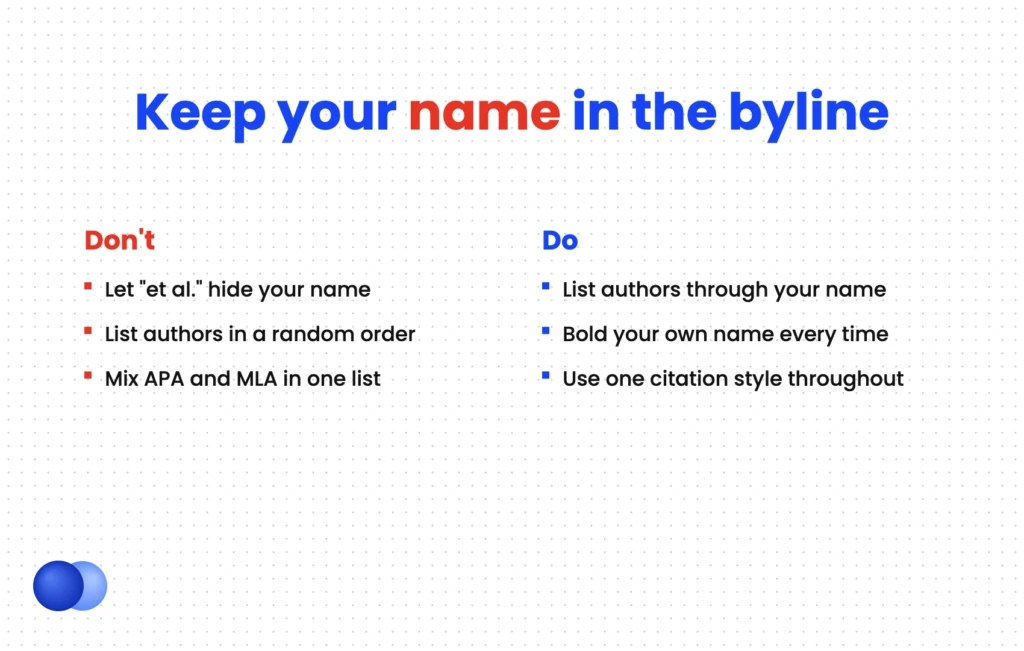
Bold your own name in every entry
Let "et al." hide your name do: Label status as in press, submitted or under review dont: Name a journal that has not accepted the paper do: Use one citation style for every entry dont: Mix APA dates with MLA author names do: List newest work first dont: Pad the list with unrelated or proofread-only work do: Add a DOI link so readers can verify dont: Paste long raw URLs that break the line
How do you make a publications section ATS-friendly?
Use a plain section heading such as "Publications," keep a single-column layout, and write each citation as normal text rather than a table. Put your key skills and methods in your experience bullets too, because a citation title alone may not match the keywords in the posting.
Applicant tracking systems read text, and a publications section is mostly text. That helps. Problems come from layout choices: citations inside tables, text boxes, or two-column templates. Our guide to how ATS works explains why simple structure parses best.
Italics and bold are fine. A plain ATS-friendly resume template keeps both readable.
Also remember that paper titles rarely contain job-posting keywords. A title like "Readmission rates in rural hospitals" does not say "Python" or "logistic regression." Echo those skills in your experience section so both the software and the recruiter connect your research to the job. Our resume keywords guide shows how.
Once the section is ready, run the whole resume through the Rezoom ATS resume checker to confirm the citations parse cleanly and the keywords land.
Publications often sit alongside other academic sections. If you have them, see our sibling guides on how to list Latin honors on resume and how to list languages on resume.

Frequently asked questions
Should I put publications on my resume?
Yes, if they relate to the job or show skills the role needs. For unrelated roles, one line or none is usually better than a full section.
How many publications should I list on a resume?
Three to five relevant items is a practical range for an industry resume. Academic CVs list every publication.
Do I bold my name in a publications list?
Yes. Bolding your name is standard practice on resumes and CVs, and it helps readers find your role in multi-author work.
Can I list a paper that is under review?
Yes, if you label it clearly as "submitted" or "under review." In APA style, leave out the journal name until the paper is accepted.
What does "in press" mean on a resume?
It means a journal has accepted the paper but has not published it yet. You can name the journal and replace "in press" with full details once it appears.
Should I use APA or MLA on my resume?
Use the style your field uses. APA is common in social and health sciences, MLA in humanities, and Chicago in history. Apply one style to every entry.
Can I include blog posts or articles as publications?
Yes, for writing, marketing, communications or policy roles. Label the section "Selected Writing" and list the title, outlet, date and a link.



Comments