

Summary
To list Latin honors on a resume, add the honor in lowercase italics right after your degree, separated by a comma: "B.A. in Economics, magna cum laude." Keep it in the education section, list only honors your school has officially conferred, and add your GPA only if it helps. Cutoffs differ by school, from top-2% rankings to fixed GPA floors, so never translate your honor into a GPA you did not earn.
Put the honor right after your degree, in lowercase italics, separated by a comma: Bachelor of Arts in History, cum laude. That one line covers most of how to list Latin honors on resume. The rest comes down to three choices: where the line goes, whether a GPA goes with it, and when to drop it.
Most guides stop at the italics rule. This one also covers what your honor actually means at your school, how to handle honors that are not final yet, and what to do with English-language versions like "with distinction."
How do you list Latin honors on a resume?
Write the honor in lowercase italics directly after your degree, separated by a comma, such as "B.S. in Biology, summa cum laude." Place it in the education section, on the same line as the degree or on the line below. Use your school's exact honor wording and list only honors that appear on your transcript or diploma.
The standard format has four parts: degree, major, comma, honor. Style guides agree on lowercase and italics. Boston University's College of Communication tells students to write all Latin honors "lowercase and in italics".
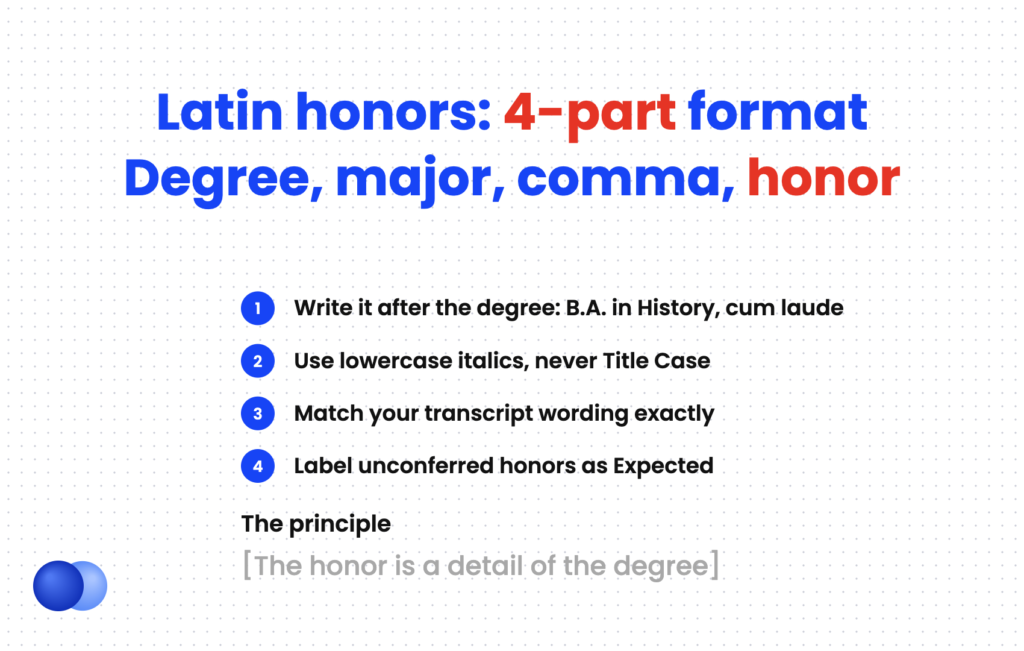
Italics mark the words as a Latin phrase. Lowercase keeps the line calm, so the honor reads as a detail of your degree rather than a separate title. Your diploma may print "Summa Cum Laude" in capitals. That is a ceremonial style, not a resume rule.
University of Maryland, College Park | College Park, MD
Bachelor of Science in Finance, magna cum laude | May 2026
If the degree line is already long, move the honor to its own line. Label it "Honors:" so a recruiter scanning the section catches it.
University of Massachusetts Amherst | Amherst, MA
Bachelor of Science in Mechanical Engineering | May 2026
Honors: summa cum laude (GPA: 3.96/4.00)
Both formats read well in applicant tracking systems because they use plain text. Italics are cosmetic, so the words themselves carry the meaning. If you want a full walkthrough of the section around this line, see our guide on how to list education on your resume.
Should Latin honors be italicized and capitalized?
Yes to italics, no to capitals. Write cum laude, magna cum laude, and summa cum laude in lowercase italics inside a sentence or degree line. If your school awards the honor in English, such as "with distinction," skip the italics and match the school's wording. Be consistent across your resume, cover letter, and LinkedIn.
Here is the quick reference for each honor and its English equivalent.
| Honor | Resume format | Literal meaning | Typical tier |
|---|---|---|---|
| cum laude | cum laude | with praise | Lowest of the three |
| magna cum laude | magna cum laude | with great praise | Middle |
| summa cum laude | summa cum laude | with highest praise | Highest |
| English equivalent | with distinction / with honors | varies by school | Varies |
Two edge cases come up often. First, some programs award English-language honors, like "with distinction" or "with highest honors." Use the wording on your transcript and keep it in regular type.
Second, some schools stack honors. UMass Amherst notes that Commonwealth Honors College students can earn dual distinctions, such as "B.A., magna cum laude, Commonwealth Honors College Scholar with greatest distinction". List both, in the order your transcript uses.
Where should Latin honors go on your resume?
Latin honors belong in the education section, next to or directly under the degree they came with. Use a separate Honors and Awards section only if you have three or more academic distinctions. Recent graduates can also mention the honor once in the resume summary if it is their strongest credential.
The education section is the default home because the honor describes the degree. A recruiter reading your degree line sees the honor at the same moment.
A separate "Honors and Awards" section makes sense when you have several items. Examples include Latin honors, Phi Beta Kappa, departmental honors, and a named scholarship. Grouping them avoids a crowded degree line. If you also earned semester honors, our sibling guide on how to put Dean's List on your resume shows how to combine the two without repeating yourself.
Honors and Awards
- summa cum laude, University of California San Diego, 2026
- Phi Beta Kappa, 2026
- Provost Honors, 6 quarters
- Departmental Honors in Cognitive Science, 2026
A summary mention works for new graduates with little work history. One phrase is enough: "Summa cum laude economics graduate with two finance internships." Our guide to the resume summary shows how to build that opening line.
What GPA do you need for cum laude, magna cum laude, and summa cum laude?
There is no national standard. Some schools award Latin honors to a fixed percentage of each graduating class, while others set GPA cutoffs by college. The same honor can require a 3.72 at one school and a 3.89 at another, so describe your honor as your school defines it.
Many career sites print a single GPA chart. Real registrar policies show why that chart can mislead. Here are four current examples, each from the school's own registrar or policy page.

| School | How honors are awarded | Cum laude | Magna cum laude | Summa cum laude |
|---|---|---|---|---|
| UC San Diego | Top 14% of graduates by GPA | Next 8% (3.887+ in 2025–26) | Next 4% (3.956+) | Top 2% (3.991+) |
| University of Maryland | Top 10% of each college | Next 5%, plus any 3.900+ | Next 3% | Top 2% |
| UMass Amherst | Top 25% of each college | Top 25% | Top 10% | Top 5% |
| UT Dallas | GPA cutoffs set by school | 3.581–3.790 | 3.787–3.919 | 3.935–3.991 |
The details matter. UC San Diego calculates GPA to three decimal places without rounding and requires 72 quarter-units at UC campuses. The University of Maryland requires at least 60 credits at UMD and a minimum 3.300 GPA.
UMass Amherst shows how much colleges differ inside one school. Its 2026–27 cutoffs run from 3.718 for cum laude in Engineering to 3.890 for cum laude in Nursing. UT Dallas sets a 3.40 floor and requires 45 graded UT Dallas credit hours.
What this means for your resume: the honor already signals "top of the class." You do not need to explain the cutoff. You also should not claim a GPA range you read on a generic chart.
Should you include your GPA with Latin honors?
Include GPA when the employer asks for it, when it is 3.5 or higher, or when you are applying to graduate school, law, or academia. Otherwise the honor alone signals strong grades. Always list the exact GPA from your transcript, with the scale, such as 3.82/4.00.
Employers care less about GPA than they did a few years ago. NACE's Job Outlook 2026 found that 42% of employers screen candidates by GPA, down from 73% in 2019. That still leaves plenty of employers who filter on it, mostly for entry-level roles.
A simple rule works. If a job posting or application form asks for GPA, include it. If it does not, the honor usually does the work. For a deeper decision guide, read our sibling post, should I put GPA on my resume.
Match the application form to the resume
Many online applications ask for GPA in a separate field. Whatever number you enter there must match your resume and your transcript exactly, to the same decimal place. Employers can check these details against your transcript, and a mismatch looks careless even when it is a rounding slip.
Can you list Latin honors before graduation?
Only as "expected" or "anticipated" honors, and only if you currently meet your school's threshold. Many schools base commencement honors on grades before the final term, and final honors can change. Once your degree is conferred, update the line to the official honor on your transcript.
Commencement honors are often provisional. UT Dallas says plainly that walking with a specific honor "does not indicate your final Latin honor". The University of Maryland lists honors in commencement materials as tentative until all final grades are in.
Timing adds another wrinkle. UC San Diego notes that honors appear on transcripts and diplomas once degree paperwork is finalized, which can take up to 12 weeks after the term ends. If you apply in that window, "expected" is the honest label.
University of Texas at Dallas | Richardson, TX
Bachelor of Science in Computer Science | Expected May 2027
Expected Honors: magna cum laude (current GPA: 3.85/4.00)
Pair this with a clear graduation date. Our sibling guide on how to list an expected graduation date on your resume covers the exact wording.
When should you remove Latin honors from your resume?
Keep Latin honors for as long as the education section sits near the top, usually your first three to five years after graduation. Once work results outweigh academic ones, the degree moves down and the honor can stay as a short phrase or go. Keep it longer if you work in law, academia, or research.
Your resume should lead with your strongest evidence. For new graduates, that is often the degree and the honor. After a few years of measurable work results, experience takes over.
You do not have to delete the honor in one step. First, move education below experience. Then trim the honor to the degree line with no GPA. Our guide on how far back a resume should go explains the same trimming logic for older jobs.
Some fields value academic honors longer. Law firms, universities, and research labs often read the education section closely at every career stage. Keep the honor there.
Write the honor in lowercase italics after the degree: magna cum laude do: Use the exact wording on your transcript, including English honors like "with distinction" do: Label provisional honors as "Expected" until your degree is conferred do: Add GPA with its scale, such as 3.82/4.00, when you include it
Capitalize it as a title, such as "Magna Cum Laude Graduate" dont: Translate an honor into a GPA or class rank your school never stated dont: Confuse Latin honors with Dean's List or departmental honors dont: List an honor you expected but did not receive after final grades

Once your education section is in place, build the rest of the page in the Rezoom AI resume builder, which formats honors and degree lines consistently for you.
Frequently asked questions
Is cum laude capitalized on a resume?
No. Write cum laude, magna cum laude, and summa cum laude in lowercase italics. Capitals are common on diplomas, but they are a ceremonial style, not a resume convention.
Does magna cum laude look good on a resume?
Yes. It signals that you finished near the top of your class, often within the top 10 percent, depending on the school. It is most valuable in the first few years after graduation.
Is cum laude worth putting on a resume?
Yes, if you earned it. Cum laude is still a school-certified academic honor, and it costs only a few words on your degree line.
What is the difference between Latin honors and honors college?
Latin honors are based on your final GPA or class rank. Honors college is a program you join, with its own courses and requirements. You can earn both and list both, as UMass Amherst's dual distinctions show.
Can I put Latin honors on my resume if my school doesn't use Latin terms?
Use your school's English wording, such as "with distinction" or "with highest honors." Do not convert it to Latin, since your resume should match your transcript word for word.
Should I list Latin honors from a master's degree?
Latin honors are mainly an undergraduate award. If yours did, list the honor on that degree line in the same lowercase italic format. If your program uses "with distinction," use that phrase instead.



Comments