

Summary
To list an expected graduation date on a resume, write the degree, school and location, then "Expected May 2027" (month and year only) on the same line or directly below. Use the date from your degree audit, not a guess. If your timeline is uncertain, use a term such as "Expected Fall 2027" or "Degree in progress," and update the line whenever the date changes. Replace "Expected" with the real month and year once you graduate.
To list your expected graduation date on a resume, write your degree, school and location, then add "Expected May 2027" with the month and year only. That single word, "Expected," tells a recruiter you are still enrolled and when you can start full time.
Knowing how to list expected graduation date on resume matters most when you apply for internships, co-ops and entry-level roles. Employers plan start dates around your calendar. NACE's Spring 2026 update found employers planned to hire 5.6% more Class of 2026 graduates, so many of those offers go to people who have not finished school yet.
Most guides stop at one clean example. Real timelines are messier: you might graduate in December, switch to part-time, add a semester or finish a master's while working. This guide gives a copy-ready line for each case.
How do you write an expected graduation date on a resume?
Put the date in your education section, next to or directly below the degree. Use "Expected" plus the month and year, such as "Expected May 2027." Skip the exact day and the start date. Keep the date format identical to the one you use in your experience section so the resume reads consistently.
The standard entry has four parts: degree, school, location and date. Cornell Career Services recommends placing the date below the degree and school, using "Expected Graduation" or "Anticipated Graduation," and listing only the month and year.
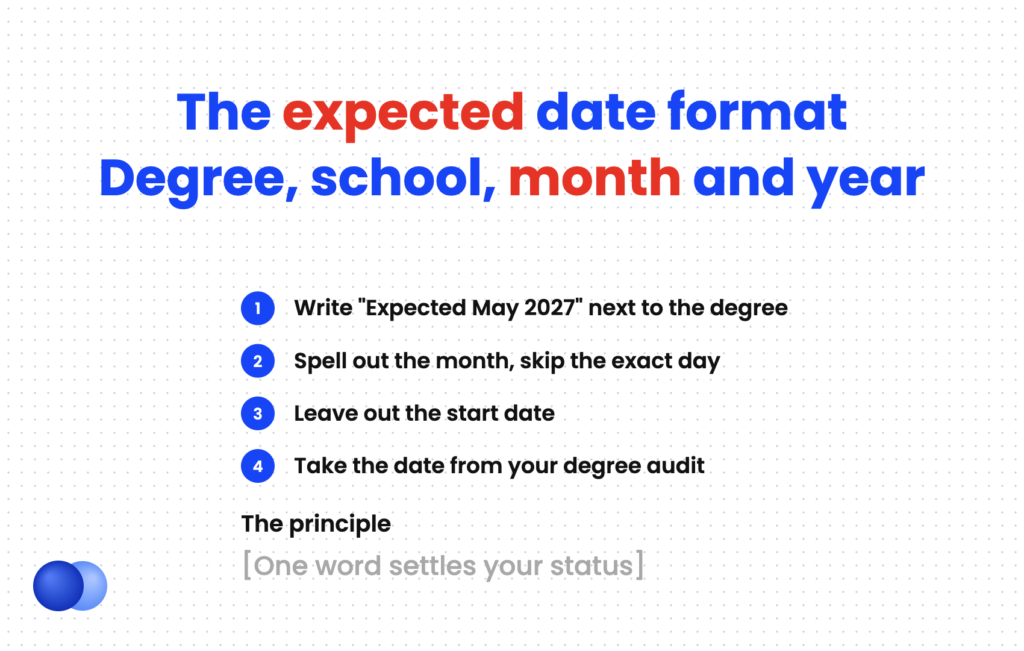
Month names beat numbers. "05/2027" can be misread, while "May 2027" cannot. The Simplify guide makes the same point: month names reduce ambiguity between US and international date formats.
Bachelor of Science in Accounting | Expected May 2027
University of Georgia, Athens, GA
GPA: 3.6/4.0 | Relevant Coursework: Auditing, Federal Taxation, Cost Accounting
Leave out the start date. A range such as "Aug 2023 – May 2027" adds nothing a recruiter needs. It also crowds the line. The Indeed guide likewise advises omitting start dates from the education section.
For the full structure of the section, see our guide on how to list education on your resume.
Should you write "Expected" or just the future date?
Both styles exist. Harvard's resume guide shows student entries with a plain "May 2027" and no "Expected" label. Inside a campus recruiting system, that works because every reader knows the candidates are students.
Outside that context, a bare future date is less clear. A recruiter skimming quickly may not do the math on the year. A label also protects you in background checks, because nobody can say you implied a finished degree.
Here are the labels that work, from most to least common:
| Label | Best use | Example |
|---|---|---|
| Expected May 2027 | Default for any degree in progress | B.A. in Economics, Expected May 2027 |
| Anticipated May 2027 | Same meaning, slightly more formal | MBA, Anticipated May 2027 |
| Expected Fall 2027 | Month not confirmed yet | B.S. in Nursing, Expected Fall 2027 |
| Degree in progress | No firm term at all | B.S. in Biology (degree in progress) |
| Graduating May 2027 | Final semester, date locked in | B.F.A. in Design, Graduating May 2027 |
| May 2027 (no label) | Campus-only recruiting systems | Harvard-style student template |
Pick one label and use it everywhere, including your LinkedIn education entry and applications.
Where does the expected graduation date go on your resume?
Put it in the education section, on the degree line or directly below it. While you are still in school, place education near the top, above work experience. After a few years of full-time work, education moves below experience, and the "Expected" label disappears once you graduate.
Current students lead with education because the degree is their strongest qualification. That order flips once you have relevant full-time experience. Our guide to writing a resume with no experience shows how to build the rest of a student resume around it.
You can also mention the date in one other place. A resume summary line such as "Finance student (Expected May 2027) seeking a summer 2026 analyst internship" helps when the date affects availability. Keep the education entry as the main source of truth.
Match the date to the job’s start date
Read the posting for words like "must have completed degree by start date." If your expected date falls after the role begins, say so in the cover letter and name your real availability. Hiding the mismatch only moves the problem to the offer stage.
How do you calculate your expected graduation date?
Use your degree audit or advising report, not the four-year default. Count your remaining credits, divide by the credits you realistically take each term, and name the final term. If you cannot confirm the month, list the season and year, then update it as soon as your advisor confirms.
Many guides tell you to assume four years for a bachelor's degree. That assumption fails for transfer students, co-op students, part-time students and anyone who changed majors.
Do the math instead:
- Pull your degree audit from the registrar portal.
- Note the credits you still need, including any capstone or thesis.
- Divide by the credits you plan to take each term.
- Map that to your school's commencement months, usually May, August or December.
If the result is "somewhere in 2027," use "Expected Fall 2027" or "Expected 2027–2028" only as a last resort. Simplify suggests using the season until the month is confirmed, then updating. That matches what recruiters need: a realistic window, not false precision.
How do you list an expected graduation date in special situations?
The core format never changes: degree, school, "Expected" plus month and year. What changes is the context line. Delayed students update the date, working students add "part-time," graduate students list the in-progress degree first, and transfer students list only the school awarding the degree.
These are the eight situations we see most. Each line is ready to paste and edit.
1. Standard senior: B.S. in Computer Science | Expected May 2027
2. December graduate: B.A. in Communications | Expected December 2026
3. Delayed by a semester: B.S. in Mechanical Engineering | Expected December 2027
4. Part-time while working: B.S. in Business Administration (part-time) | Expected August 2028
5. Graduate degree in progress: Master of Public Health | Expected May 2027, then your finished bachelor's below it with its real date
6. Transfer student: B.A. in Psychology, Rutgers University | Expected May 2027 (list the prior community college only if it adds an associate degree)
7. Associate to bachelor's: B.S. in Nursing | Expected May 2028, then A.S. in Nursing, May 2025
8. Month not confirmed: B.S. in Data Science | Expected Spring 2027
A few notes on the harder cases:
Delayed graduation. Change the date before you apply again. You do not need to explain the delay on the resume. If an interviewer asks, give a short, factual reason such as a co-op term, a medical leave or a switch in majors.
Paused or stopped studies. "Expected" implies you are enrolled now. If you are not, use the format in our sibling guide on how to list an unfinished degree on resume instead.
Two majors or a minor. Keep one expected date for the whole degree. See how to list a double major on resume and how to put a minor on resume for the degree line itself.
What mistakes should you avoid with an expected graduation date?
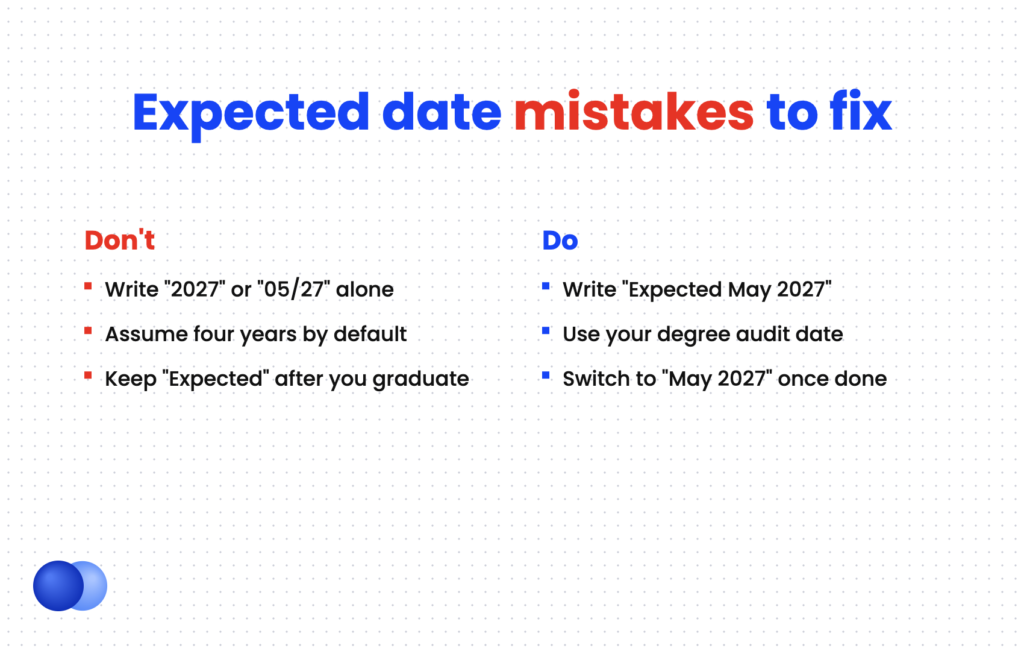
The most common mistakes are dropping the "Expected" label, listing only a year, keeping an old date after a delay, and forgetting to update the entry after commencement. Each one creates doubt about your status or availability, which is exactly what the date is supposed to settle.
Write "Expected May 2027" with the month spelled out
Write "2027" alone or "05/27" do: Pull the date from your degree audit dont: Assume four years because that is the default do: Update the date the moment your timeline shifts dont: Leave a date you already know you will miss do: Switch to "May 2027" after you graduate dont: Keep "Expected" on a finished degree for months do: Use the same label on LinkedIn and in applications dont: Say "Expected" on the resume and "Graduated" on the form
The last point causes more trouble than people expect. Application forms often ask for a graduation date in a separate field. If that field says one thing and your resume says another, the recruiter has to guess which is true.
Should you include GPA and honors next to the expected date?
Only when they help. A strong GPA or dean's list can sit on the same line or one line below the date. Employers lean on GPA less than they used to, so relevant coursework, projects and internships often earn the space more. Keep the entry to two or three lines.
GPA screening is fading. NACE's Job Outlook 2026 data shows 42% of employers screen candidates by GPA, down from 73% in 2019. Meanwhile, 70% report using skills-based hiring practices.
That shift changes what belongs next to your expected date. Our sibling guide on whether you should put GPA on your resume covers the GPA cutoff in detail. For honors, see how to put dean's list on resume.
When you have little room, choose skills-rich details. "Relevant Coursework: SQL, Econometrics, Tableau" gives a recruiter more to match than a 3.4 GPA. Pair it with an internship entry and the education section does real work.
If you want a clean student layout with the education block already in the right place, start with the Rezoom AI resume builder and edit the expected date field directly.

Frequently asked questions
Is it okay to put an expected graduation date on a resume?
Yes. It is the standard way to show a degree in progress. Recruiters expect it on student and new-grad resumes, and leaving it out makes your status unclear.
Should I write "Expected" or "Anticipated"?
Either works, and they mean the same thing. "Expected" is more common and shorter. Choose one and use it consistently.
What if my expected graduation date changes?
Update your resume, LinkedIn and any saved applications before you apply again. You do not need to explain the change on the resume itself.
Do I include the day of graduation?
No. Month and year are enough. Adding a specific day clutters the line and gives the reader nothing useful.
Can I apply for full-time jobs before I graduate?
Yes. Many employers hire seniors months before commencement. Make sure your expected date works with the role's start date, and mention availability in your cover letter if timing is tight.
What do I change after I graduate?
Remove "Expected" and keep the real month and year, such as "May 2027." After a few years of work experience, move education below your experience section.



Comments