

Summary
To put a minor on your resume, list it in the education section directly after your major, labeled "Minor in [Subject]," either on the same line or on the line below. Include it only when it matches the job, fills a gap your major leaves, or adds a skill the posting names. Keep the word "Minor" explicit so ATS parsers file it correctly. Drop it once you have several years of relevant work experience.
Put your minor in the education section, right after your major, and label it plainly: "Minor in Psychology." That is the whole mechanic of how to put a minor on resume. The harder part is deciding whether the minor deserves the space at all.
A relevant minor can explain why a biology graduate is applying to a data role, or why a marketing hire can write in Spanish. An irrelevant one is just a line a recruiter skims past. This guide gives you the exact formats, a quick relevance test, and the point in your career when the minor should quietly disappear.
Where does a minor go on a resume?
A minor belongs in the education section, directly under or beside your major, inside the same degree entry. It never gets its own section. Students and recent graduates place education near the top of the resume; experienced candidates place it after work experience, so the minor moves with it.
Your minor is part of your degree, so it lives inside the degree entry. The UC San Diego Career Center's resume guide shows the degree line first ("Bachelor of [Arts or Science] in [Major]") and lists "Minor/s" among the optional bullet points underneath it.
Where the whole education section sits depends on your experience:
- Students and new grads: education goes near the top, below your header and summary. See our guide on resume formats for freshers.
- Professionals with relevant experience: education goes after work history. The minor follows it there.
- Career changers: education can move up if the minor is your main link to the new field.
For the rest of the entry (school, dates, honors), use our full guide to listing education on your resume.
How do you format a minor on a resume?
Use one of two formats. Same line: "Bachelor of Science in Nursing, Minor in Psychology." Separate line: degree and major on line one, "Minor: Psychology" or "Minor in Psychology" on line two. Both are correct. Pick one and keep it consistent across every degree entry on the page.
Both formats appear in university career guides. Syracuse University's Newhouse career office uses the stacked version in its 2026 resume guide: "Bachelor of Science: Public Relations" on one line and "Minor: Spanish" on the next.
The same-line version saves a line of vertical space. The stacked version makes the minor easier to spot, and it gives you room to add a short note about relevant coursework.
University of Michigan, Ann Arbor, MI | May 2026
Bachelor of Science in Nursing, Minor in Psychology
GPA: 3.7/4.0
Syracuse University, Syracuse, NY | May 2027
Bachelor of Science in Public Relations
Minor: Spanish (professional working proficiency)
Relevant coursework: Spanish for Media, Latin American Business Culture
Whichever format you choose, write out the subject exactly as your transcript does. "Minor in Computer Science" beats "CS minor," because a recruiter or a keyword search may look for the full term.
Should you put a minor on your resume?
Put a minor on your resume when it passes at least one test: it matches the job, it fills a skill gap your major leaves, or it adds a keyword the posting names. If it passes none, leave it off. A space-saving cut is better than a line that makes the reader ask why it is there.
Most guides say "include it if relevant" and stop. Here is a sharper test. Ask three questions about your minor:
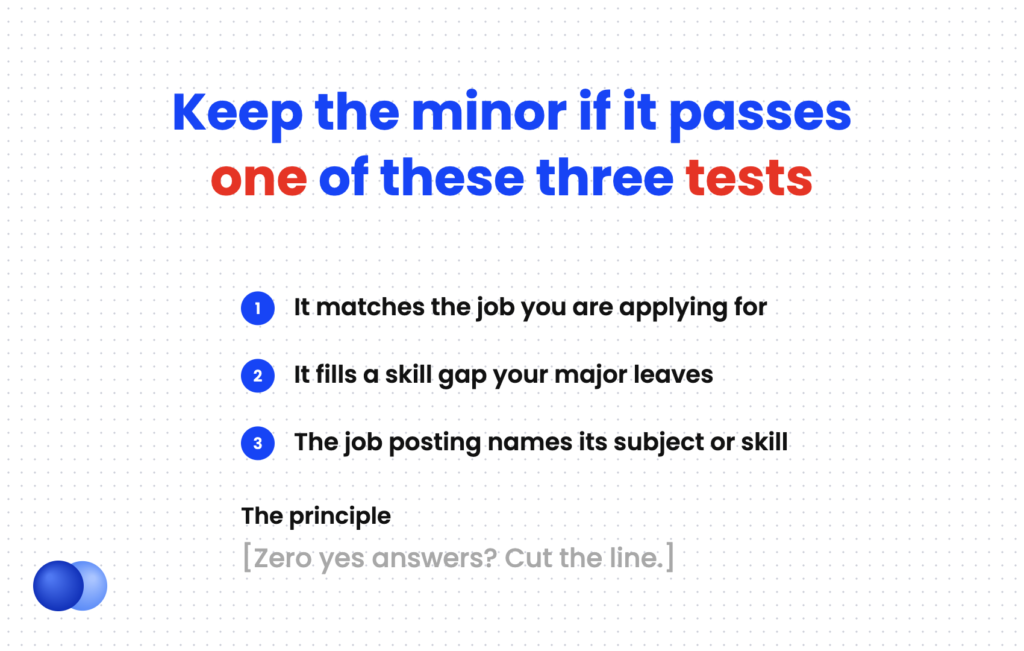
- Does it match the job? A finance minor on an accounting application is an obvious yes.
- Does it fill a gap? An English major applying for a data analyst role needs proof of quantitative skill. A statistics minor provides it.
- Does the posting name it? If the job ad lists "Spanish" or "Python," and your minor delivers that skill, it earns its line.
One "yes" is enough. Three "no" answers mean you should cut it.
This matters because employers increasingly hire on demonstrated skills. In NACE's Job Outlook 2026 Spring Update, a survey of 185 employers, more than half said they want to see 10 or more skills on a candidate's resume. A minor is one of the few places where education signals a specific, named skill.
| Situation | Include the minor? | Why |
|---|---|---|
| Minor directly matches the job (Finance minor, financial analyst role) | Yes, same line or stacked | It reinforces your fit instantly |
| Minor fills a gap (Statistics minor, English major, data role) | Yes, and mention it in your summary | It explains a pivot the major alone cannot |
| Minor is a language the job uses | Yes, and add the language to your skills section | It proves a skill recruiters search for |
| Minor is unrelated (Art History minor, sales role) | Usually no | It costs space without adding evidence |
| Minor is unfinished | Only if you completed most of it; label it clearly | Never imply you earned it |
| You have 5+ years of relevant experience | Usually no | Your work history now does the proving |
How do you get ATS software to read your minor correctly?
Write the word "Minor" in front of the subject, keep the degree entry in plain text, and avoid putting education in a table, text box, or header. Resume parsers store majors and minors in separate fields, so a clear label helps the software file your minor under the right one.
Applicant tracking systems turn your resume into structured data. Textkernel's resume parser, for example, stores Majors and Minors as separate fields inside each education record, according to its Parse API documentation. A parser has to decide which subject belongs in which field. Clear labels make that decision easy.
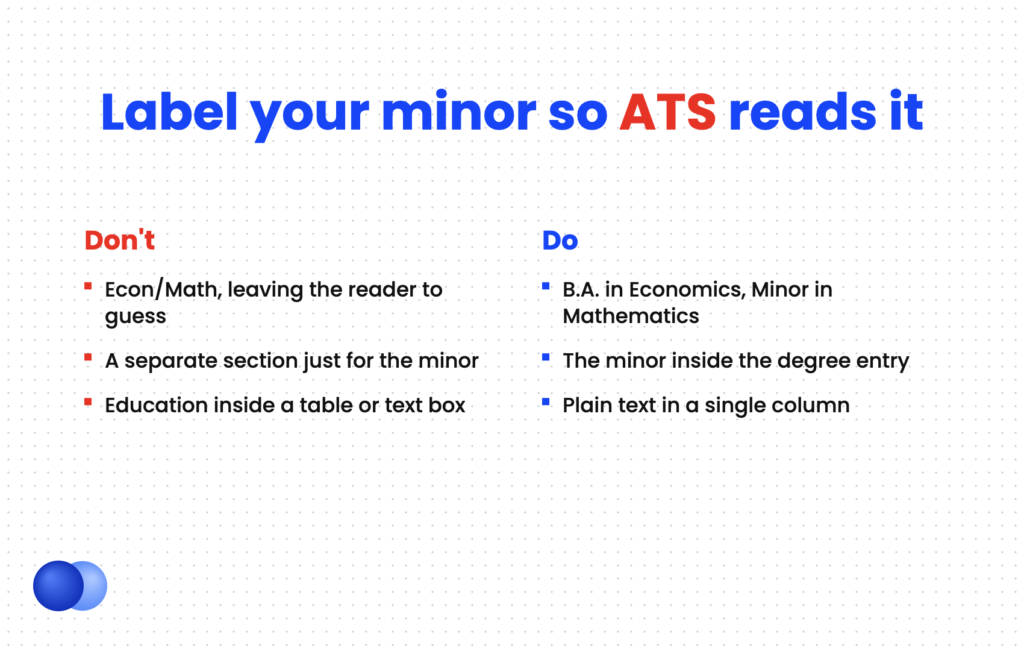
That is why "Economics / Math" is risky. Is math a second major or a minor? The parser has to guess, and so does the recruiter. "B.A. in Economics, Minor in Mathematics" removes the guesswork. For a deeper look at how parsing works, read how ATS software works.
Write "Minor in Statistics" or "Minor: Statistics" with the word Minor spelled out. do: Use the exact subject name from your transcript. do: Keep the education entry as plain text in a single column. do: Repeat a job-relevant minor's skill in your skills section or summary.
Write "Econ/Math" and leave the reader to guess which is the minor. dont: Give the minor its own resume section. dont: List a minor you did not finish without saying so. dont: Put your education in a text box, table, or page header.
How do you list more than one minor?
List multiple minors on one line, joined with "and" or a comma: "Minors in Spanish and Economics." Put the most job-relevant minor first. If only one of your minors fits the role, list that one alone. You are not obligated to list every credential you earned.
- Two relevant minors: "Bachelor of Arts in Political Science, Minors in Economics and Spanish"
- One relevant, one not: list only the relevant one. Your transcript still has both.
- Three or more minors: list the one or two that fit this job. A long list reads as unfocused.
If you also have a second major, the rules change. See our guide on how to list a double major on resume for the order of majors, minors, and dual degrees.
What if your minor is unfinished or still in progress?
If you are still enrolled, list the minor with your expected graduation date; the minor is part of the degree in progress. If you left school or dropped the minor, list it only when you completed most of the coursework, and describe it as coursework rather than a minor.
Current students can list a minor as normal. The degree entry already carries your graduation date, so the minor inherits that timeline. For date wording, see how to list an expected graduation date on resume.
If you stopped before finishing, do not write "Minor in Psychology." A background check or degree verification can expose the gap. Instead, write "Coursework in Psychology (15 credits)" or "Completed 5 of 6 courses toward Psychology minor." If the whole degree is unfinished, follow our guide on how to list an unfinished degree on resume.
Arizona State University, Tempe, AZ | 2021 – 2025
Bachelor of Science in Marketing
Completed 15 credits toward Minor in Data Analytics: SQL, Business Statistics, Data Visualization
How do you make a relevant minor stand out beyond the education section?
Mention the minor in your resume summary when it explains your fit, turn its skills into entries in your skills section, and cite a minor project in a bullet if it produced a real result. That way the minor still registers with readers who never reach your education section.
If your minor is your strongest link to the role, surface it earlier.
In your summary. One clause is enough: "Journalism graduate with a minor in Data Science and two newsroom internships building interactive charts." See our resume summary guide for structure.
In your skills section. A Spanish minor becomes "Spanish (professional working proficiency)." A computer science minor becomes "Python, SQL." Recruiters search these terms directly. Our guide to resume keywords explains how to mirror the posting.
In a project bullet. If your minor included a capstone, treat it like experience: "Built a regression model predicting campus housing demand for a Statistics minor capstone; presented to the housing office."
Match the minor to the job ad, not your transcript
Before you submit, search the job posting for your minor's subject and its core skills. If the ad says "bilingual Spanish," write "Minor in Spanish" in education and "Spanish (bilingual)" in skills. You get two matches from one credential. Rezoom's AI resume builder can compare your education section against the posting and flag which minor skills to pull forward.
When should you take a minor off your resume?
Remove a minor once you have several years of relevant work experience, when you need the line for stronger content, or when the minor no longer matches the kind of jobs you target. Keep it longer if it is a language, a technical skill, or the main credential behind a career change.
A minor carries the most weight early in a career. Once you have three to five years of work that proves the same skills, the minor adds little. It can go.
Keep it longer in three cases:
- It is a language. Spanish, Mandarin, or ASL stays useful for decades. Also list it in your languages section; see how to list languages on resume.
- It is technical and your job title does not show it. A computer science minor still helps a product marketer apply for technical roles.
- You are changing careers. The minor may be your only formal credential in the new field. Lead with it in your summary, not just your education section.
Frequently asked questions
Should I put my minor on my resume if it is not related to the job?
Usually not. An unrelated minor takes space without adding evidence. Keep it only if it shows a transferable skill the job values, such as writing, a language, or data analysis.
Do you write "Minor in" or "Minor:" on a resume?
Both are correct. "Minor in Psychology" reads naturally on the same line as your degree, and "Minor: Psychology" works well on its own line. Choose one style and use it consistently.
Does a minor go before or after the major on a resume?
After. Your major is the core of the degree, so it comes first. The minor follows, either after a comma on the same line or on the next line.
Can I list a minor if I have not graduated yet?
Yes. If you are enrolled and on track, list the minor as part of your degree in progress, with your expected graduation date on the degree entry.
Should I list my minor on LinkedIn too?
Yes, if it is relevant. LinkedIn's education entry has a field of study box, where you can add the minor after your major. Keep the wording identical to your resume.
Do employers care about minors?
They care when the minor proves a skill the job needs. A statistics minor for an analyst role, or a language minor for a client-facing role, gives a recruiter concrete evidence. An unrelated minor rarely changes a hiring decision.



Comments