

Summary
List relevant coursework as a short line under your degree in the Education section, naming three to six upper-level courses by their full titles, not course numbers. Pick only courses whose skills or keywords appear in the job posting. Use a detailed format with one or two bullets only when a course is your strongest evidence. Remove coursework once you have about a year or more of relevant work experience.
To list relevant coursework on a resume, add one line under your degree in the Education section: "Relevant Coursework:" followed by three to six course titles that match the job posting. That is the whole answer for most students and recent graduates.
The harder part is choosing. A coursework line only helps when each course proves a skill the employer asked for. This guide gives you a simple selection test, three formats with copy-ready examples, and a clear rule for when to delete the section.
When should you list relevant coursework on a resume?
List relevant coursework when you are a student, a recent graduate, or a career changer with limited experience in the target field. It works best when the job asks for specific technical knowledge you learned in class. Skip it if you have a year or more of related work experience or the role does not rely on academic skills.
Coursework is a substitute for experience. It fills the gap when you can't yet point to a job that proves a skill.
That gap matters more than it used to. NACE reports that 70% of employers now use skills-based hiring, while the share screening candidates by GPA fell from 73% in 2019 to 42% in 2026. Employers want evidence of skills, and a well-chosen course list is one piece of that evidence.
List relevant coursework if one of these fits you:
- You are in school or graduated within the last year or two.
- You are writing a resume with no experience in the field.
- You completed a certificate or graduate program to change careers.
- The posting names technical knowledge, such as statistics, accounting standards, or pharmacology, that you studied formally.
Skip it for roles where academic content carries little weight, such as many retail or hospitality jobs. Your space is better spent on work history and transferable skills.
Where does relevant coursework go on a resume?
Put relevant coursework inside your Education section, directly under the degree line. Use a separate "Relevant Coursework" section only when courses are your main qualification and you plan to add bullets. Never scatter courses across your Skills or Experience sections without context.
The default spot is the Education section. Harvard's career office lists relevant coursework as part of the Education entry, and most university guides agree. For the full Education layout, see our guide on how to list education on your resume.
Place the line after your degree, school, and graduation date. If you include honors or GPA, those usually sit on the lines above it. Our guide on whether to put GPA on your resume covers that call. If you graduated with distinction, how to list Latin honors on a resume shows where that line belongs.
A standalone section makes sense in one case: your courses are your strongest material and you want to describe what you did in them. Then place the section right after Education, above any unrelated jobs.
How many courses should you list, and which ones?
List three to six courses. MIT's career office suggests up to five or six, kept to about two lines. Choose upper-level courses whose titles or content match keywords in the job posting. Leave out introductory classes, general education requirements, and anything the employer would assume from your degree.
MIT's career office advises listing up to five or six relevant courses, ideally in about two lines. Fewer is fine. Three sharp matches beat eight generic ones.
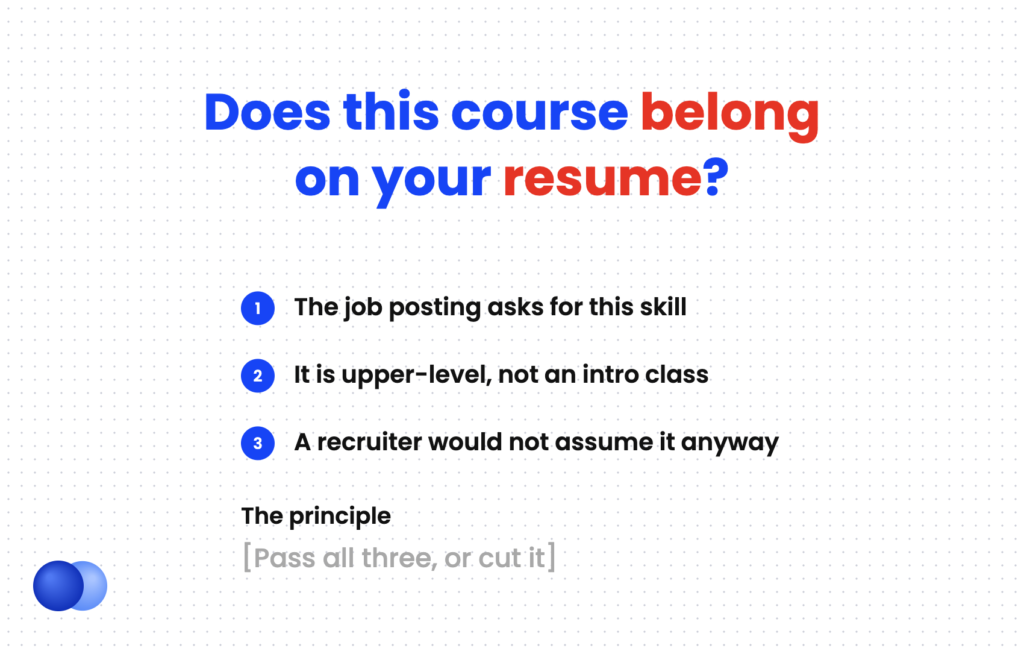
Use this three-question test for every course before it earns a spot:
- Does the posting ask for it? The course title or content matches a skill or keyword in the job description.
- Is it beyond the basics? It is upper-level, graduate-level, or a specialized elective, not "Intro to" anything.
- Would a recruiter assume it anyway? A finance major does not need to list Principles of Accounting.
A course that passes all three belongs on the page. This matters because NACE found that more than 80% of employers highlight key skills in their job descriptions. The posting tells you which courses to pick. Our resume keywords guide shows how to pull those terms out.
Rewrite cryptic course titles
Use the course title, never the number. As the University of Vermont career center puts it, course numbers mean nothing outside the university. If an official title is vague, such as "Special Topics III," add a short clarifier: "Special Topics: Machine Learning for Healthcare." Keep it honest and close to the transcript.
What formats work best for relevant coursework?
Use one of three formats. A single comma-separated line fits most resumes. A grouped or two-column list works when you have courses in distinct areas. A detailed format with one or two bullets per course works when a class produced real output, such as an analysis, model, or report, that proves a job skill.
Pick the format by how much weight the courses carry. Recruiters in The Ladders eye-tracking study spent an average of 7.4 seconds on an initial resume scan, so the lighter format is usually the better choice.
| Format | Best for | Space used | What it signals |
|---|---|---|---|
| Single line | Most students and recent grads | 1–2 lines | "I have the academic base" |
| Grouped by area | Double majors, interdisciplinary roles | 2–3 lines | Breadth across two skill sets |
| Detailed with bullets | Little or no experience; course is key proof | 3–5 lines per course | "I have applied this skill" |
B.S. in Economics | University of Michigan | May 2026
Relevant Coursework: Econometrics, Applied Data Analysis in R, Behavioral Economics, Financial Markets and Institutions
B.A. in Psychology, Minor in Computer Science | Arizona State University | Dec 2025
Relevant Coursework:
Research: Research Methods, Advanced Statistics, Cognitive Psychology
Technical: Data Structures, Database Systems, Human-Computer Interaction
The grouped format pairs well with a minor or a double major, since it shows how both fields support the role.
How do you turn a course into proof of skills?
Give a course bullets only when it produced something concrete. Start each bullet with an action verb, name the tool or method, and state the result or scope. One or two bullets per course is enough. If the work was substantial, list it as a project instead of a course.
A course title tells a recruiter what you studied. A bullet tells them what you can do. MIT recommends bullets that start with an action verb, name the subject, and end with the result of the work.
That approach fits the skills employers rank highest. In NACE's Job Outlook 2025 survey, nearly 90% of employers looked for problem-solving and nearly 80% for teamwork on college students' resumes. A course bullet can show both.
Relevant Coursework Database Systems | Georgia State University | Spring 2026 - Designed a normalized PostgreSQL schema for a 12-table library system and wrote 30+ SQL queries for reporting - Led a team of 3 to present query optimization results to a panel of faculty reviewers
Marketing Analytics | Georgia State University | Fall 2025 - Built a customer segmentation model in Excel from 5,000 survey responses and recommended two target segments
Only include numbers that are true for your work. If a course centered on one big deliverable, such as a capstone app or a semester-long study, it often reads better as a project. See our sibling guide on how to list projects on a resume. Lab or thesis work belongs in a research entry instead, covered in how to put research experience on a resume.
What mistakes make a relevant coursework section hurt you?
The common mistakes are listing too many courses, using course numbers, including introductory or unrelated classes, and keeping coursework after you have real experience. Each one wastes space and signals weak judgment. A short, tailored line that mirrors the posting reads as focused and confident.
A bloated relevant coursework list looks like filler. Recruiters read it as a sign you had little else to show.
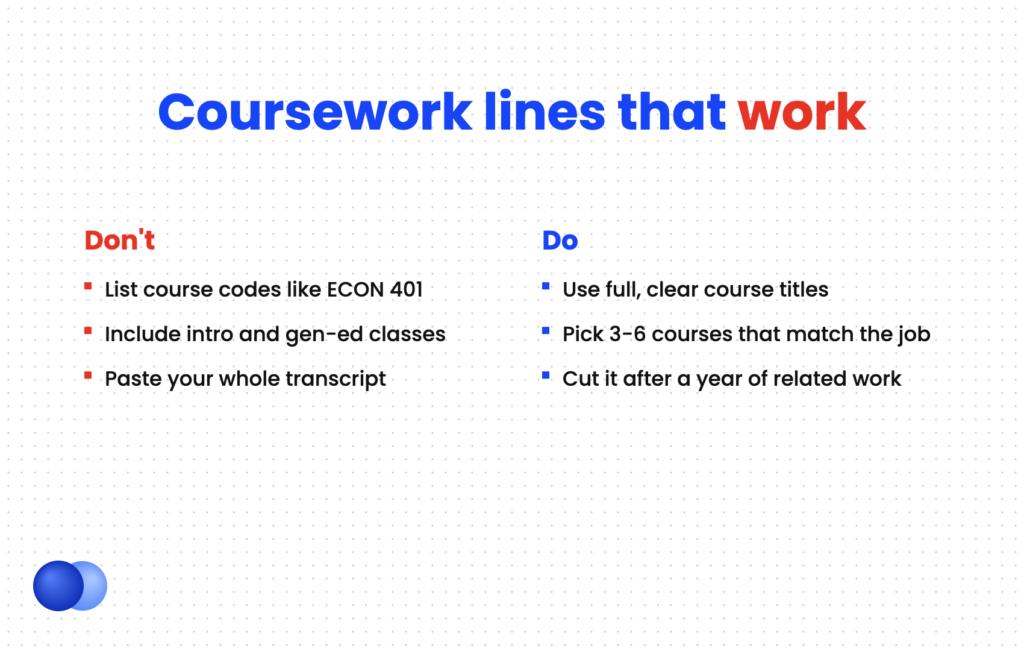
Use full course titles recruiters outside your school understand do: Match three to six courses to keywords in the job posting do: Update the list for each application type do: Use the exact skill terms from the posting when they match the course
List course codes like "ECON 401" or "CS 3510" dont: Include intro, general education, or unrelated electives dont: Paste your whole transcript to fill space dont: Keep coursework after a year or more of related work
Also check that the line survives an applicant tracking system. Plain text under a standard "Education" heading parses reliably. Tables and text boxes are riskier. Before you apply, run the file through an ATS check to confirm your courses and keywords come through.
When should you remove coursework from your resume?
Remove coursework once you have about a year or more of work experience related to the target role, or when it pushes your resume past one page. Keep it longer only if you are changing careers and the courses are your most direct proof of the new field's skills.
Coursework is a bridge, not a permanent section. Once a job, internship, or freelance role proves the same skill, the course adds nothing new. If none of those exist yet, see what belongs on a college student resume with no internship.
Apply these cut-off rules:
- After your first related role: Replace courses with the job bullets that prove the same skills.
- After a relevant internship: Keep only courses the internship did not cover. Move the proof into your internship bullets instead.
- When space is tight: Coursework is the first line to cut from a one-page resume.
- When changing careers: Keep new-field courses until you have paid experience in that field. Our career change resume guide explains how to frame them.
If you want help deciding what stays, Rezoom's AI resume builder can tailor your Education section to each job description.

Frequently asked questions
Should I put relevant coursework on my resume?
Yes, if you are a student, recent graduate, or career changer and the courses match the job. No, if you have a year or more of related work experience that already proves those skills.
How many courses should I list on a resume?
List three to six. MIT's career office suggests up to five or six courses kept to about two lines, so the section stays scannable.
Should I use course numbers or course names?
Use course names. Course numbers mean nothing to employers outside your school, and names carry the keywords an ATS and a recruiter look for.
Can I list coursework I am currently taking?
Yes. List in-progress courses the same way as completed ones. If you want to be explicit, add "(in progress)" after the title.
Does relevant coursework go under Education or Skills?
Put it under Education, directly below your degree. If a course taught a specific tool, such as SQL or Tableau, also add that tool to your Skills section.
Do employers care about coursework?
They care about skills. NACE reports that 70% of employers use skills-based hiring, so coursework helps when it shows a skill the posting asks for.



Comments