

Summary
Put research experience in a dedicated "Research Experience" section when you are applying to graduate school, medical school, or research roles. For industry jobs, list it under Experience or Projects and translate the methods into business skills. Each entry needs your title, the lab or organization, the principal investigator, dates, and two to four bullets that name the method, the scale, and the outcome.
To put research experience on a resume, list it like a job: your title, the lab or organization, the principal investigator, the location, and the dates, followed by two to four results-focused bullets. Where it goes depends on your goal. Academic and medical applications get a dedicated "Research Experience" section, while industry resumes fold it into Experience or Projects.
The second decision matters more than most guides admit. The same lab work can read as rigorous to a faculty committee and as jargon to a hiring manager. So the job is not just listing research. It is translating it for the reader in front of you.
Below you will find a placement rule for each career goal, an entry template, a bullet formula, and examples for lab, social science, and class research.
Where should research experience go on a resume?
Use a dedicated "Research Experience" section, placed right after Education, when applying to graduate programs, medical school, or research jobs. For industry roles, list research under Experience if it was paid or substantial, or under Projects if it was a class or independent study. Put the strongest, most relevant section first.
Mercer University's career center frames placement by career goal. It recommends "Research Experience" for graduate school and academic paths and "Projects" for industry roles. It also suggests "Professional Experience" when the research was funded or client-facing (Mercer University).
Binghamton University adds a volume rule. Create a separate section when you have multiple research experiences, and fold a single experience into another section (Binghamton University).
| Your goal | Section | Placement | Emphasis |
|---|---|---|---|
| PhD or master's program | Research Experience | Right after Education | Methods, question, contribution |
| Medical, PA, or dental school | Research Experience | After Education and clinical work | Hypothesis, your role, presentations |
| Industry research or R&D job | Experience | Top of the page | Techniques, tools, outcomes |
| Non-research industry job | Experience or Projects | By relevance | Data, project management, communication |
| Class or capstone research | Projects | Below Experience | Scope, tools, deliverable |
If you are a student, your research may sit close to your Education section anyway. Our guide on how to list education on your resume shows how the two sections fit together.
What should a research experience entry include?
Each research experience entry needs your title, the lab name, the institution or employer, the principal investigator or faculty advisor, the location, and month-and-year dates. Then add two to four bullets. On a one-page industry resume, the PI line is optional. On academic applications, include it.
Binghamton's checklist covers the core fields: project name, organization, your title, dates and location, lab name, and faculty advisor or principal investigator (Binghamton University).
Use a title that matches your real role:
- Undergraduate Research Assistant if you joined a faculty lab.
- Research Intern or REU Participant for a summer program. National Science Foundation REU Sites place a cohort of students on projects around a theme, so name the site (NSF).
- Independent Researcher or Honors Thesis for self-directed work.
- Research Volunteer if the role was unpaid and informal.
Paid or not, it still counts. The Council on Undergraduate Research defines undergraduate research as an inquiry that makes "an original intellectual or creative contribution to the discipline" (Council on Undergraduate Research, via Kent State). A pay stub is not part of that test.
Undergraduate Research Assistant | Lee Lab, Department of Molecular Biology
University of Wisconsin–Madison, Madison, WI | Sept 2024 – Present
PI: Dr. Hannah Lee, PhD
- Ran qPCR and Western blot assays on 60+ tissue samples to measure inflammatory gene expression in a mouse model of colitis
- Built an R pipeline to clean and plot assay data, cutting weekly analysis time from about 6 hours to 2
- Presented findings as a poster at the 2026 Undergraduate Research Symposium
How do you write research experience bullets?
Write each bullet as action verb, method, scale, and outcome. Name the technique or tool, say how many samples, participants, or sources you handled, and end with what the work produced or informed. Keep one idea per bullet and describe only the parts you personally did.
Binghamton's formula is "Action verb → What you did → How you did it → Why it mattered/Outcome" (Binghamton University). It works because each part answers a question a reviewer has.
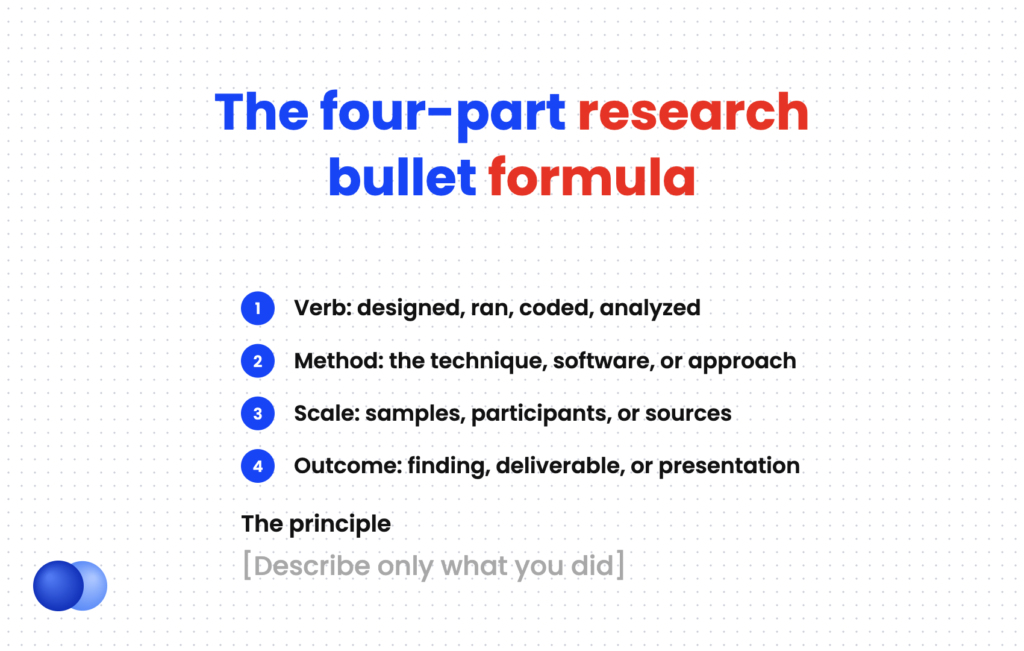
- Verb: designed, ran, coded, analyzed, recruited, synthesized.
- Method: the technique, software, or approach, such as "logistic regression in Stata."
- Scale: samples, participants, interviews, or sources.
- Outcome: a finding, a deliverable, a time saving, or a presentation.
Research outcomes are not always numbers. "Findings informed the lab's 2026 grant renewal" is a real outcome. "Identified three themes in patient feedback" is too.
Scale is the easiest number to add honestly. You almost always know how many samples you ran or interviews you coded.
Coded 45 semi-structured interviews in NVivo to identify barriers to telehealth use do: Assisted a postdoc with cell culture and maintained 12 cell lines on a weekly schedule do: List the PI and lab so reviewers can place your work
Conducted groundbreaking research on cancer treatment dont: Responsible for various lab duties as needed dont: Claim the lab's published result as your own finding
How do you translate research experience for industry jobs?
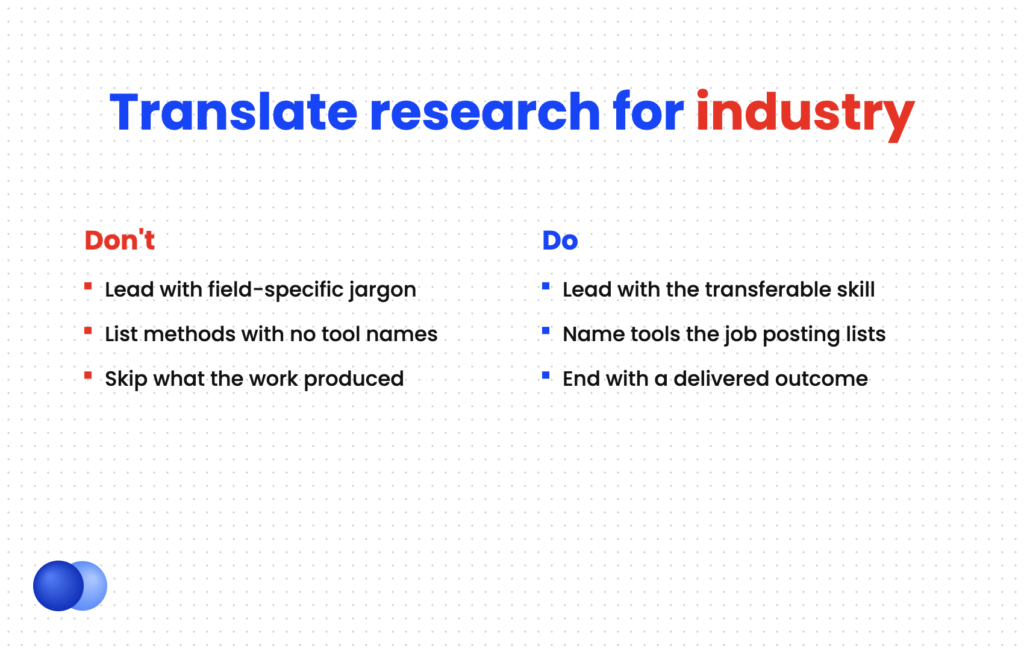
For industry jobs, lead each bullet with the transferable skill and tool, then mention the research context. Replace field-specific jargon with plain terms, name software and data methods that appear in the job posting, and stress outcomes like analysis delivered, deadlines met, and findings presented to non-specialists.
Employers look for exactly what research builds. In NACE's Job Outlook 2025 survey, nearly 90% of employers said they seek problem-solving ability on college students' resumes. More than two-thirds look for analytical and quantitative skills (NACE).
Listing those skills is not enough, though. NACE's president put it plainly in 2026: "It is not enough for candidates to simply list their skills: Employers want to see examples" (NACE). A research bullet is that example.
Binghamton gives the same advice for industry resumes. Prioritize skills such as project management, data analytics, and collaboration over detailed methodology (Binghamton University).
Here is the same work written twice:
- Academic version: "Quantified microglial activation via Iba1 immunohistochemistry in hippocampal sections."
- Industry version: "Analyzed 300+ microscopy images with ImageJ and Python, producing weekly data summaries for a 6-person team."
Match the tools to the posting. If a data analyst job lists SQL, Python, and Tableau, put those words in your research bullets where they are true. Our guide to the best skills to put on a resume covers how to mirror a job description without stuffing.
Research Assistant | Center for Health Policy Research
Arizona State University, Tempe, AZ | Jan 2025 – May 2026
- Cleaned and analyzed a 4,000-respondent survey dataset in Python (pandas) to compare insurance coverage across counties
- Built Tableau dashboards used by two faculty investigators to brief a county health department
- Wrote a 12-page summary of findings for a non-technical audience, reviewed and adopted by the project lead
Where do publications, posters, and presentations go?
Mention a poster or talk in one bullet under the related research experience entry. When you have two or more publications or presentations, move them into their own "Publications" or "Presentations" section in standard citation format. Keep the research entry focused on your role and methods, not the citation.
A single presentation reads well as a bullet, like the symposium line in the lab example above. Once the list grows, a separate section is cleaner and lets committees scan authorship quickly.
For citation style, author order, and how to list papers under review, see our full guide on how to list publications on a resume.
Ask your PI to review your bullets
Before you send a research-heavy resume, ask your PI or supervising postdoc to read your entry. They can confirm your role is described accurately and flag anything that is unpublished or confidential. They are also likely writing your recommendation letter, so matching descriptions help both documents.
How do you list class projects, ongoing research, or unfinished results?
Class research, capstones, and theses count as research experience when you designed or ran the inquiry yourself. List ongoing work with "Present" as the end date and describe the methods and progress so far. If a study produced no significant result, describe what you built, tested, and learned instead.
Class and capstone research usually fits best under Projects. It is covered in our sibling guide on how to list projects on a resume. If the research was simply part of a course, a line under relevant coursework may be enough.
Ongoing projects are normal in research. Write "Sept 2025 – Present" and phrase bullets in present tense: "Developing a survey instrument to measure…" Do not predict results you do not have yet.
Null or incomplete results still show skill. "Designed and piloted a 20-item survey with 35 participants; results informed a revised instrument for the fall cohort" describes real work and a real outcome.
If you also spent time in a clinic observing physicians, list that separately. Our guide on how to put shadowing on a resume covers that format.
When your entries are drafted, run the finished resume through the Rezoom ATS resume checker to confirm the research section parses cleanly and matches the posting's keywords.

Frequently asked questions
Should research experience go before work experience?
Yes, when you are applying to graduate school, medical school, or research roles, or when the research is more relevant than your jobs. For unrelated industry roles, put your most relevant experience first, whichever it is.
Does unpaid research count as experience on a resume?
Yes. Unpaid lab work, volunteer research, and thesis projects all count. Label your title accurately, for example "Research Volunteer," rather than implying a paid position.
Should I include research experience for a job that is not in research?
Usually, yes, especially early in your career. Rewrite the bullets around the data, tools, and communication skills the job asks for, and cut the field-specific jargon.
Should I list the principal investigator's name?
Include the PI for academic, medical, and research job applications, because reviewers know labs by their PI. On a one-page industry resume, you can drop the PI line to save space.
How far back should research experience go?
Keep undergraduate research on your resume while you are a student and for your first few years after graduating. After that, keep it only if it relates to the job, as with any older experience.
Is research experience the same as a project?
Not quite. Research investigates a question and produces new knowledge, while a project builds a deliverable. A class assignment with a research component can fit either section, so choose the one that fits your target role.



Comments