Tomás Iglesias Research Assistant II, Clinical and Behavioural Research New Haven, 06511, United States [email protected] · (203) 555-0142
11 September 2026
Dr. Adaeze Okonkwo Principal Investigator Community Health Outcomes Lab Hartford, United States
Application for Research Assistant II, Community Health Outcomes Lab
Dear Dr. Okonkwo,
I am applying for the Research Assistant II post in the Community Health Outcomes Lab. I run participant recruitment, informed consent, structured interviewing and full REDCap data capture without supervision, and analyse in R; my CITI Biomedical training is current to 2027, so I can be added to an active protocol in my first week.
For the last four years I have coordinated two federally funded studies at the Connecticut Center for Community Health Research. I recruited and enrolled all 312 participants in a longitudinal cohort against a 14-month target and we still hold 91% retention at the twelve-month visit. I rebuilt the REDCap branching logic after the first year, which took our field query rate from 6.1% to 1.4%, and I wrote the two IRB amendments that opened the study to a second clinical site, both approved without revisions.
I read your 2025 paper on adherence in the Hartford cohort and noticed you shifted to text-based contact between visits. That is close to what worked for us, and the part I would most want to work on is the follow-up window, since that is where our own attrition concentrated. I am comfortable working inside federal reporting requirements and have been through two continuing reviews and one site activation.
I am available from January and can provide the retention analysis script and data dictionary as a work sample. Thank you for your time.
Sincerely, Tomás Iglesias, M.P.H., CCRP
Summary
A research assistant cover letter names the methods you can run without supervision, shows you have read the laboratory's own work, and states your human subjects training. This guide gives you a full adaptable letter, what changes between a bench post and a clinical coordination post, and the openings that get a strong application read to the end.
Research Assistant cover letter examples by experience level
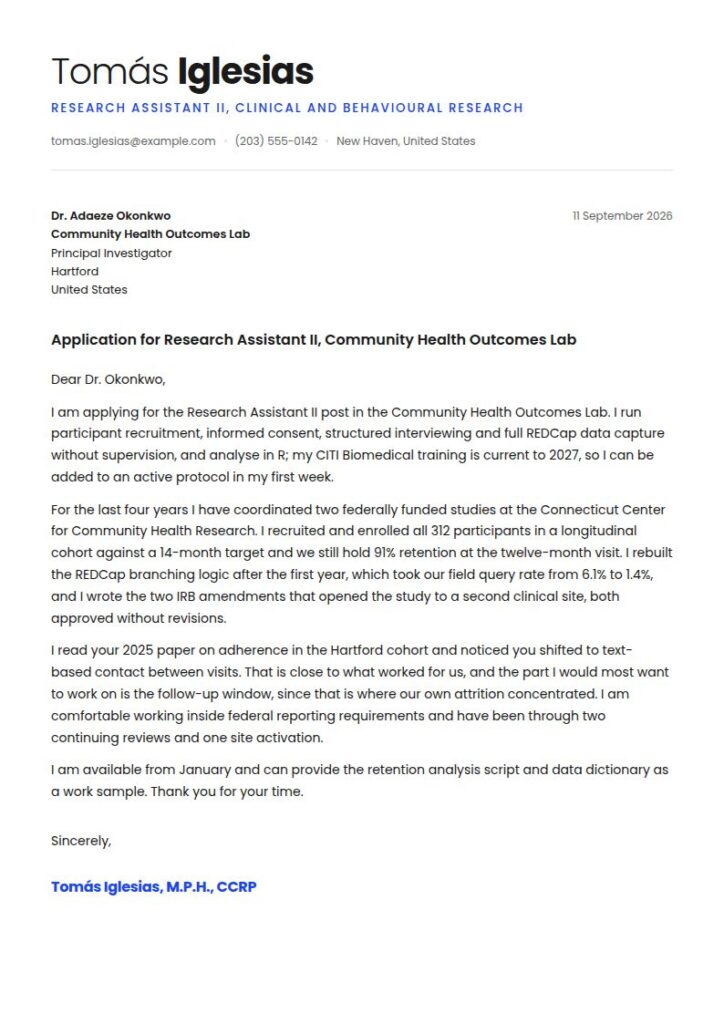
A research assistant cover letter is a one-page letter telling a principal investigator which methods you can run without supervision, proving you have read their actual work, and saying whether your human subjects training is current.
It is the one document where you can show you understand the science. A resume lists technique; a letter can say why this laboratory and not the eleven others advertising the same title.
Guide to a research assistant cover letter
This guide and the corresponding research assistant cover letter example will cover:
- How to structure the letter, paragraph by paragraph
- Why one named paper of theirs belongs in the letter
- How to write about method without turning the letter into a list
- Bench, clinical, social and market research, and how the letter changes
- The openings that get an application read to the end
How to write a research assistant cover letter
| Paragraph | Its job | Length |
|---|---|---|
| Opening | The post, the methods you run, your training status | 2 to 3 sentences |
| Evidence | One study, one method, one volume figure, one outcome | 4 to 5 sentences |
| Fit | Something specific about their research, named | 3 to 4 sentences |
| Close | Availability, work sample, thank you | 2 sentences |
Read one of their papers and say so in a sentence
The commonest failure in these letters is that they could have been sent to any laboratory, and principal investigators notice immediately.
Find one recent paper from the group, read the methods section, and write one accurate sentence about it. Not praise, a methods observation: "I read your 2025 paper on adherence in the community cohort and noticed you moved to text-based follow-up between visits, which is the approach I used to hold 91% retention on our own cohort."
That sentence proves you read it, shows you can read a methods section, connects their problem to your experience, and cannot be reused in the next letter.
A research assistant cover letter example you can adapt
Dear Dr. Okonkwo,
I am applying for the Research Assistant II post in the Community Health Outcomes Lab. I run participant recruitment, informed consent, structured interviewing and full REDCap data capture without supervision, and analyse in R; my CITI Biomedical training is current to 2027, so I can be added to an active protocol in my first week.
For the last four years I have coordinated two federally funded studies at the Connecticut Center for Community Health Research. I recruited and enrolled all 312 participants in a longitudinal cohort against a 14-month target and we still hold 91% retention at the twelve-month visit. I rebuilt the REDCap branching logic after the first year, which took our field query rate from 6.1% to 1.4%, and I wrote the two IRB amendments that opened the study to a second clinical site, both approved without revisions.
I read your 2025 paper on adherence in the Hartford cohort and noticed you shifted to text-based contact between visits. That is close to what worked for us, and the part I would most want to work on is the follow-up window, since that is where our own attrition concentrated. I am comfortable working inside federal reporting requirements and have been through two continuing reviews and one site activation.
I am available from January and can provide the retention analysis script and data dictionary as a work sample. Thank you for your time.
Sincerely, Tomás Iglesias, M.P.H., CCRP
Openings that work
| Instead of | Use |
|---|---|
| I am passionate about scientific research and eager to learn | I run recruitment, consent, structured interviewing and full REDCap capture without supervision |
| I am writing to express my interest in the research assistant position | I am applying for the Research Assistant II post in the Community Health Outcomes Lab |
| I have strong attention to detail and excellent organisational skills | I rebuilt our REDCap branching logic and cut the field query rate from 6.1% to 1.4% |
| I would be a valuable addition to your team | I read your 2025 adherence paper and noticed you moved to text-based follow-up between visits |
Writing about method without writing a list
The resume carries the list. The letter carries one method, followed all the way to a result.
| Kind of evidence | What it looks like in a sentence |
|---|---|
| Volume | Ran 340 ELISA plates to protocol, 3% repeat rate |
| Retention | Held 91% twelve-month retention across a 312-participant cohort |
| Data quality | Cut the field query rate from 6.1% to 1.4% by rebuilding branching logic |
| Regulatory | Wrote 2 IRB amendments and 4 continuing reviews, all approved unrevised |
| Reproducibility | Wrote the R pipeline behind four published analyses, version controlled in Git |
| People | Trained 21 incoming assistants; 6 have since moved into coordinator posts |
One of those, expanded into four sentences, is the middle of the letter.
Four different jobs share this title
Say in the first line which kind of research you do, because bench, clinical coordination, social and behavioural, and market or policy research barely overlap. For a bench post, lead with technique and volume. For a clinical coordination post, lead with regulatory and participant-facing work and name your Good Clinical Practice training. For a social science post, lead with instrument design, interviewing and analysis software. Name the funder of your previous work.
Do not claim a technique you have watched rather than performed, because it comes out in week one. Do not write a paragraph of admiration for the field; write one accurate sentence about one paper. Do not send an academic template for a staff post. Do not describe yourself as detail-oriented, which every letter in the folder does. Do not name or describe an individual study participant.
The post exists because an award started, so write like you know that
University research and development spending reached $117.7 billion in fiscal year 2024, an increase of $8.9 billion or 8.1% on the previous year, with the federal government funding 55% of it (National Center for Science and Engineering Statistics, NSF, February 2026).
That is why these posts appear suddenly, close suddenly, and are so often fixed term. Social science research assistants held 38,400 jobs in 2025, with a median annual wage of $61,990 and 5% projected growth through 2035 (BLS Occupational Outlook Handbook, May 2025 wage data and 2025-35 projections).
So name the funding mechanism of your previous work, which says you have worked inside federal reporting requirements, and state your availability as a date. A principal investigator with an award starting in January is reading for exactly that.
Human subjects training belongs in the first paragraph
Say the track and the currency, not the acronym alone. NIH requires all key personnel involved in the design or conduct of NIH-funded human subjects research to complete protection of human subjects education (NIH Guide notice NOT-OD-00-039), and most institutions meet that through the Collaborative Institutional Training Initiative, whose Human Subjects Research series runs a Biomedical track and a Social-Behavioural-Educational track (CITI Program, 2026).
A candidate whose training is current joins the protocol in week one. One who has to complete it adds weeks to a study already behind. That is worth a clause in your opening paragraph.
Length, format and sending it
One page, four paragraphs, 250 to 400 words. PDF unless the portal says otherwise, named for yourself and the post: tomas-iglesias-research-assistant-cover-letter.pdf.
Address the principal investigator by name; they are named on the advertisement, the laboratory website and the papers. "Dear Hiring Manager" on an otherwise specific application reads as a letter sent to twelve laboratories.
Use the same figures as your resume. Our research assistant resume example is written with the numbers used here.
Key takeaways
- Name the methods you run unsupervised in the first paragraph.
- Say your training track and its currency in the same breath.
- Follow one method through to a number with a time frame.
- Read one of their papers and write one accurate methods sentence about it.
- Say which of the four research contexts you work in.
- Name the funder of your previous work and give an availability date.
- Address the principal investigator by name; keep it to one page.
Write your research assistant cover letter in 10 minutes.
Research assistant cover letter questions, answered
How long should a research assistant cover letter be?
One page, four paragraphs, 250 to 400 words. Principal investigators read these between other work, and length does not read as effort. A formal academic application asking for a research statement is a different document.
Do I need a cover letter for a university research post?
Attach one wherever there is a field for it. The portal collects the same structured fields from everyone. The letter is the only place you can say which methods you own, which track your training is in, and that you have read the group's work.
What do I write with no research experience?
Write your coursework method as method: the practical units with their techniques and run counts, the statistics course with its software and dataset, the independent study with its research question. Then complete CITI human subjects training before you apply, which many institutions allow, and say so. A candidate who arrives already cleared is easier to hire.
Should I mention a specific paper of theirs?
Yes, one, and read the methods section rather than the abstract. One accurate sentence about how they did something beats a paragraph about how important the field is, and it is the only part of the letter that cannot be copied into the next application.
How do I explain a fixed-term research post that ended?
Say the award ended. These posts are funded by lines in grants, and university research and development spending is 55% federally funded (NCSES, NSF, February 2026), so fixed terms are normal and everyone reading your letter knows it. "The R01 closed in June and I stayed through close-out" is a complete explanation.