Associate Systems Engineer Ingrid Solheim-Park ASEP
Associate Systems Engineer, Guidance and Control
[email protected] | (256) 555-0118 | Huntsville, United States
Profile
Associate systems engineer with two years on a tactical guidance program and an ASEP certification from INCOSE. Maintained a 1,400-line requirements baseline in DOORS Next, wrote 210 verification requirements and their methods, and ran the requirements verification traceability matrix through two subsystem test campaigns. Active DoD Secret clearance and US citizen. BS in Aerospace Engineering from an ABET-accredited program.
Work Experience
07/2016 - 06/2018, Associate Systems Engineer, Guidance and Control, Trellis Defense Systems, Huntsville, United States
- Maintained a 1,400-line system requirements baseline in IBM DOORS Next for a tactical guidance subsystem, processing 190 change requests across two years.
- Wrote 210 verification requirements with their verification methods, 84 percent by test and the remainder by analysis, demonstration or inspection.
- Ran the requirements verification traceability matrix through two subsystem test campaigns, tracking 412 verification events to closure.
- Drafted two external interface control documents under the subsystem lead and took the minutes for the biweekly interface working group.
- Produced DoDAF OV-1 and SV-1 views for an internal architecture description review.
05/2015 - 08/2015, Systems Engineering Intern, Trellis Defense Systems, Huntsville, United States
- Built a requirements import and consistency check script that cut a manual baseline audit from three days to four hours.
- Supported a trade study on seeker alternatives, scoring four candidates against six weighted criteria.
Education
08/2012 - 05/2016, Bachelor of Science, Aerospace Engineering, Iowa State University, Ames, United States
EAC/ABET-accredited program. Senior capstone: a small launch vehicle avionics architecture, including the stakeholder needs analysis, 96 system requirements and the verification plan.
Skills
Requirements writing and decomposition, 75
IBM DOORS and DOORS Next, 80
Requirements verification traceability matrix, 75
Interface control documents, 60
SysML and Cameo Systems Modeler, 55
MATLAB and Simulink, 70
DoDAF 2.02 viewpoints, 55
Languages
English, native
Norwegian, native
Korean, intermediate
Certificates
03/2017, Associate Systems Engineering Professional (ASEP), INCOSE
Knowledge exam against the INCOSE Systems Engineering Handbook. No experience requirement at this tier.
10/2016, DoD Secret Clearance, Defense Counterintelligence and Security Agency
Active. US citizen. Enrolled in continuous vetting.
Summary
Systems engineer is two different jobs sharing one title. This guide covers both: the INCOSE lifecycle discipline of requirements, interfaces and verification, and the IT infrastructure role. It gives you three adaptable summaries, the artifact list that proves which one you do, INCOSE certification tiers, and current Bureau of Labor Statistics pay and outlook.
Systems Engineer resume examples by experience level
A systems engineer resume is a one to two page document, and before you write a word of it you have to settle which systems engineer you are, because the title covers two unrelated professions.
One is systems engineering in the INCOSE sense: the discipline that turns a stakeholder need into a set of verified requirements, allocates them across subsystems, controls the interfaces between those subsystems, and proves at the end that the thing built is both the thing specified and the thing wanted. It lives in aerospace, defense, automotive, medical devices and large infrastructure, and it is governed by ISO/IEC/IEEE 15288:2023, the standard the INCOSE Systems Engineering Handbook is written against (INCOSE, accessed September 2026).
The other is IT infrastructure work: servers, virtualization, identity, networks, patching, automation and uptime. In job postings that role is often titled systems engineer, sometimes interchangeably with systems administrator or infrastructure engineer.
The two share no tools, no certifications and no hiring managers. A resume that hedges between them fails both. This page leads with the lifecycle role, because that is the one filed under engineering, and gives the IT role its own section below.
Resume guide for a systems engineer resume
This guide and the corresponding systems engineer resume example will cover:
- How to write a systems engineer resume, section by section
- Which of the two systems engineer jobs the reader thinks they are hiring for
- Three adaptable summaries: associate, practicing and chief systems engineer
- The lifecycle phase and artifact block that proves what you actually did
- What INCOSE certification tiers are worth, and what clearance does to an offer
- What the job market looks like and what you can expect to earn
How to write a systems engineer resume
Six sections: contact header, summary, clearance and certification, program experience, education, and technical skills. One page for the first five years, two once you have owned requirements baselines on named programs.
Clearance and certification sit above experience on a defense resume, for the same reason licensure sits above experience on a civil resume. They are gates. A recruiter filling a cleared position screens for them before reading anything else.
| Section | What it is answering | Where it goes |
|---|---|---|
| Clearance and citizenship | Can this person be badged onto the program at all? | Header or first block |
| Certification | Is the systems engineering training formal or self-taught? | With clearance, under the summary |
| Program experience | Which lifecycle phases, which artifacts, which subsystems? | Reverse chronological, program lines inside each job |
Say which lifecycle phases you have actually worked, not just the program name
The V-model is the shape every systems engineering reader has in their head. The left leg runs from stakeholder needs through system requirements, architecture and subsystem design. The bottom is build. The right leg runs back up through unit test, subsystem verification, system verification and finally validation against the original need.
Most applicants have worked a segment of that V, not all of it, and the segment matters. An engineer who has only written requirements has never had to live with one that turned out to be unverifiable. An engineer who has only run verification has never negotiated an interface.
Write the segment: "Owned system requirements and the subsystem allocation for the payload controller from SRR through CDR, then ran the verification cross-reference matrix through system-level qualification." That sentence tells the reader more than the program name does.
Run the finished file through the free Rezoom ATS resume checker before you submit. Defense primes and every federal agency parse applications into a system before a human opens one.
Choosing the best resume format for a systems engineer resume
Reverse chronological. Two pages is normal once you have programs to list, and on federal and prime contractor postings a longer file is tolerated in a way it is not in commercial hiring.
Functional formats fail here because program experience is read as a sequence of increasing scope: component, then subsystem, then system of systems. A format that hides the order hides the progression.
If you are applying through USAJOBS, build that as a separate federal resume with hours per week and supervisor details, and never send it to a commercial employer.
Include your contact information
| ✅ Right | ❌ Wrong |
|---|---|
| Ingrid Solheim-Park, CSEP | Ingrid Solheim-Park |
| Systems Engineer, Guidance and Control | Engineering professional |
| Active DoD Secret clearance, US citizen | Clearable |
| (256) 555-0118, [email protected], Huntsville, AL | (256) 555-0118, [email protected] |
Write clearance in three parts: level, granting agency, and whether it is currently active. "Active DoD Secret, investigation closed 2024, enrolled in continuous vetting" is a complete answer. "Secret clearance" is not, because a lapsed clearance and an active one are different hiring problems. Name the domain, never the program, contract number or customer if any of those are controlled.
Make use of a summary
Four lines: which systems engineering you do, the domain, the lifecycle phases you have owned, and one number describing scale.
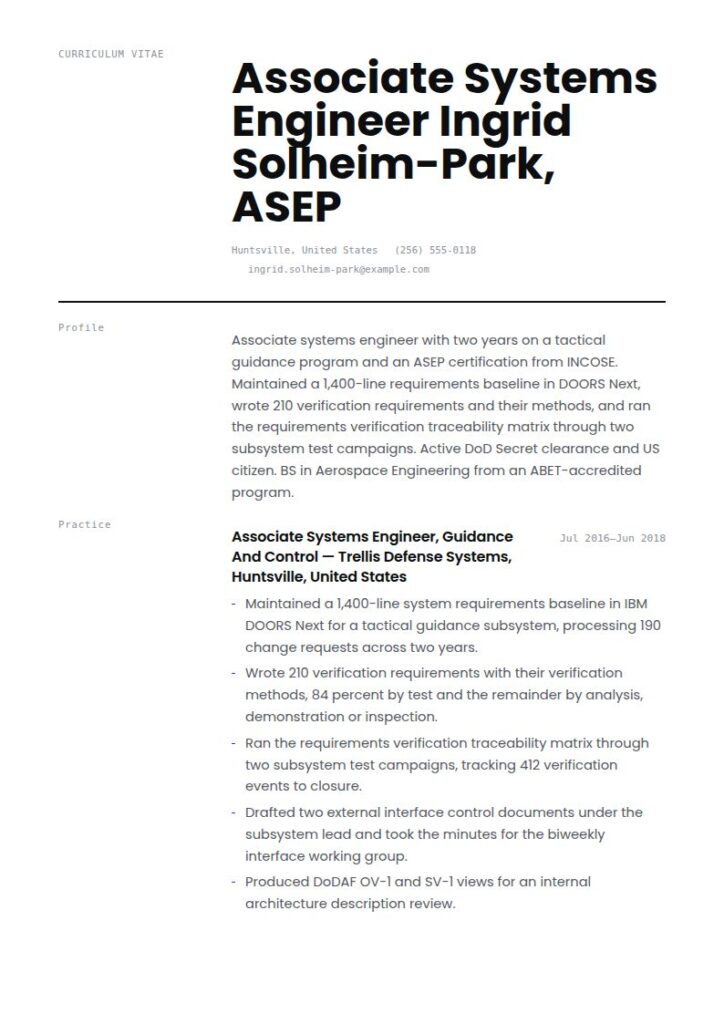
Associate systems engineer with two years on a tactical guidance program and an ASEP certification from INCOSE. Maintained a 1,400-line requirements baseline in DOORS Next, wrote 210 verification requirements and their methods, and ran the requirements verification traceability matrix through two subsystem test campaigns. Active DoD Secret clearance and US citizen. BS in Aerospace Engineering from an ABET-accredited program.
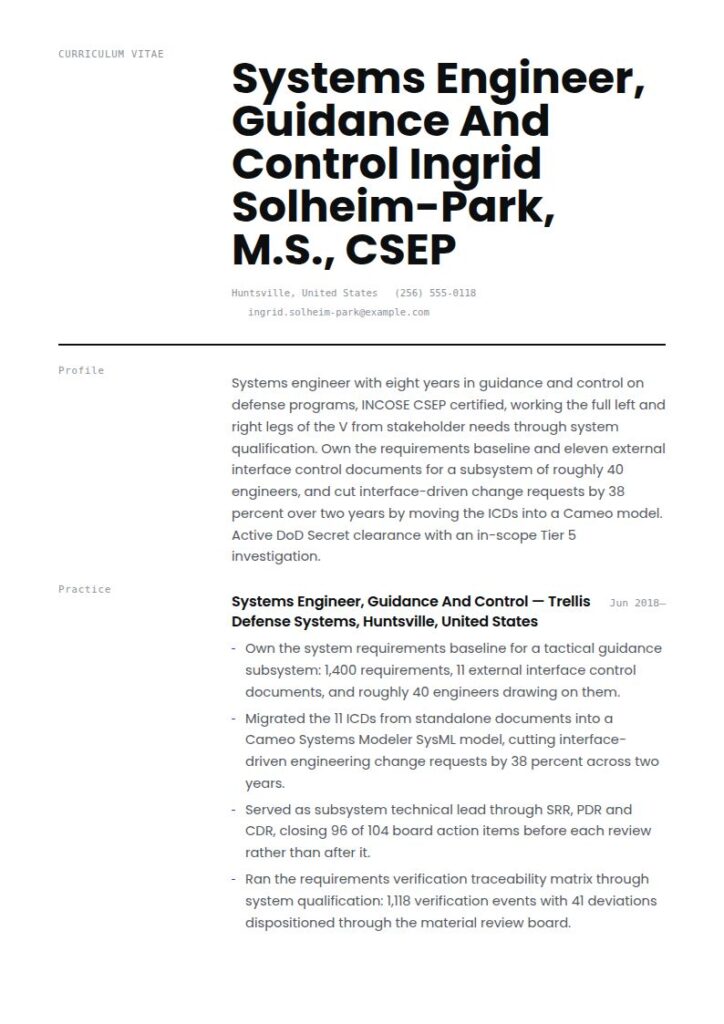
Systems engineer with eight years in guidance and control on defense programs, INCOSE CSEP certified, working the full left and right legs of the V from stakeholder needs through system qualification. Own the requirements baseline and eleven external interface control documents for a subsystem of roughly 40 engineers, and cut interface-driven change requests by 38 percent over two years by moving the ICDs into a Cameo model. Active DoD Secret clearance with an in-scope Tier 5 investigation.
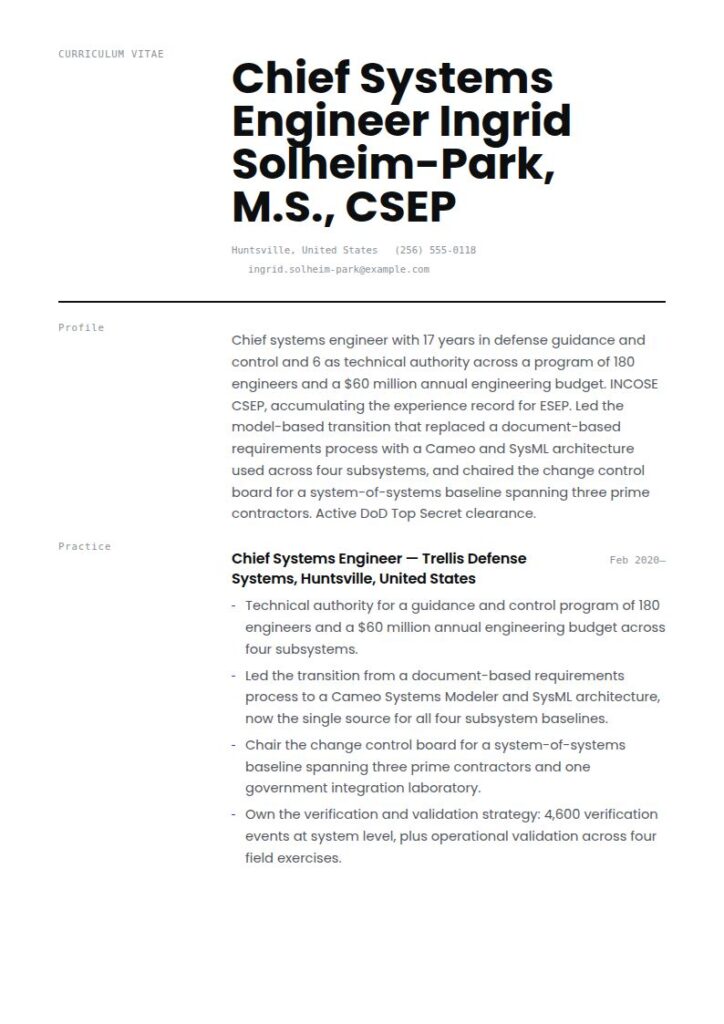
Chief systems engineer with 17 years in defense guidance and control and 6 as technical authority across a program of 180 engineers and a $60 million annual engineering budget. INCOSE CSEP, accumulating the experience record for ESEP. Led the model-based transition that replaced a document-based requirements process with a Cameo and SysML architecture used across four subsystems, and chaired the change control board for a system-of-systems baseline spanning three prime contractors. Active DoD Top Secret clearance.
Right vs wrong: the same systems engineer summary, twice
| ✅ Right | ❌ Wrong |
|---|---|
| Systems engineer with eight years in guidance and control on defense programs, INCOSE CSEP certified. | Versatile systems engineer with a strong technical background across many domains. |
| Own the requirements baseline and eleven external interface control documents for a subsystem of roughly 40 engineers. | Responsible for requirements management and system integration activities. |
| Cut interface-driven change requests by 38 percent over two years by moving the ICDs into a Cameo model. | Improved engineering processes and collaborated cross-functionally with stakeholders. |
The right column belongs to someone who has held an interface and been blamed for it. The left column could be a project manager, a test engineer or an IT administrator, and the reader cannot tell which.
Outline your program experience
Employer, site, dates and title first. Then program lines, not duty lines. A program line carries four things: the domain, the scale, the lifecycle phases you worked, and the artifact you personally owned.
| Instead of | Use |
|---|---|
| Responsible for systems engineering activities on a defense program | Owned the system requirements baseline for a tactical guidance subsystem, 1,400 requirements across 11 external interfaces |
| Managed requirements | Decomposed 312 system requirements to subsystem level and wrote verification methods for all of them, 84 percent by test |
| Used SysML and MBSE tools | Migrated 11 interface control documents from Word to a Cameo SysML model, cutting interface change requests by 38 percent |
| Supported integration and test | Ran the requirements verification traceability matrix through system qualification: 1,118 verification events, 41 deviations dispositioned |
| Created architecture documentation | Produced DoDAF OV-1, OV-5b, SV-1 and SV-6 views for the program architecture description submitted at Milestone B |
Systems Engineer, Guidance and Control, Trellis Defense Systems, Huntsville, AL, June 2018 to Present
Own the system requirements baseline for a tactical guidance subsystem: 1,400 requirements, 11 external interface control documents, and a team of roughly 40 engineers drawing on them.
Migrated the 11 ICDs from standalone documents into a Cameo Systems Modeler SysML model, which cut interface-driven engineering change requests by 38 percent across two years.
Ran the requirements verification traceability matrix through system qualification: 1,118 verification events with 41 deviations dispositioned through the material review board.
Produced DoDAF OV-1, OV-5b, SV-1 and SV-6 views for the architecture description submitted at Milestone B, and chair the biweekly interface working group with two subcontractors and one government furnished equipment supplier.
Place yourself on the V and name the artifacts you owned
This is the section that separates two systems engineering resumes with identical program names, and it is the one almost nobody writes deliberately.
Systems engineering has no license and no stamp. The profession is a set of artifacts, and the resume's job is to say which of them carried your name. Answer three questions: which lifecycle phases, which artifacts, at what level of the system hierarchy.
| Artifact | What owning it proves | How to write it |
|---|---|---|
| System requirements specification | You can write a requirement that is verifiable, not just agreeable | Give the count and the level: system, subsystem or component |
| Functional and physical architecture | You can allocate, not just describe | Name the decomposition and how many elements it covered |
| Interface control documents | You have negotiated across an organizational boundary | Give the ICD count and who sat on the other side |
| Requirements verification traceability matrix | You have been made to close the loop | Give verification events and the method split: test, analysis, demonstration, inspection |
Verification and validation are not synonyms, and the resume is where people give themselves away
Verification asks whether the system was built to the specification. Validation asks whether the specification was the right one, measured against the stakeholder need it came from. The left leg of the V produces the specifications; the right leg verifies against them; validation closes the loop back to the top of the left leg.
A resume that says "responsible for V&V" without distinguishing them reads, to an experienced systems engineer, as someone who has worked test but not systems engineering.
Write them separately. "Wrote the verification plan for 1,118 verification events and supported operational validation across four field exercises" says you have worked both legs and know they are different.
Then the certification tier, because INCOSE publishes a public ladder and hiring managers read it as one.
| INCOSE tier | Knowledge requirement | Experience requirement | References |
|---|---|---|---|
| ASEP, Associate Systems Engineering Professional | Multiple-choice knowledge exam on the INCOSE Systems Engineering Handbook, or Academic Equivalency | None | None |
| CSEP, Certified Systems Engineering Professional | Same exam or Academic Equivalency | Minimum 5 years of systems engineering experience, documented as at least 60 months of direct experience including at least 12 months in 3 experience areas | One or more, covering the documented experience |
| ESEP, Expert Systems Engineering Professional | Not directly measured | Minimum 25 years, or 20 if already CSEP, plus at least 5 years of professional development credit | Three or more, covering at least 10 years of experience |
Source: INCOSE certification program requirements, accessed September 2026. CSEP certification is valid for three years (INCOSE, accessed September 2026).
The ladder is useful because above the first rung it is experience-gated rather than exam-gated. ASEP says you learned the vocabulary. CSEP says a named reference confirmed five years of it. ESEP is a small population and an oral interview, and functions as a senior credential rather than a hiring filter.
On defense programs, add the architecture framework you produce in. DoDAF 2.02 organizes an architecture description into eight viewpoints: All (AV), Capability (CV), Data and Information (DIV), Operational (OV), Project (PV), Services (SvcV), Systems (SV) and Standards (StdV), each holding numbered models (DoD Chief Information Officer, DoDAF 2.02, accessed September 2026). Naming the views you produced, OV-1, SV-6 and so on, beats writing "DoDAF experience", because anyone who has built an SV-6 knows what it costs.
State clearance level, granting agency and whether it is currently active, plus citizenship. Name the lifecycle phases by their review gates: SRR, PDR, CDR, TRR, qualification. Give requirement counts and interface counts. Separate verification from validation. Name the specific DoDAF views and the specific SysML diagrams you produced. Say which requirements database and which modeling tool, by product name and version family.
Do not name a controlled program, contract number or customer; write the domain instead. Do not write "V&V" as one undifferentiated blob. Do not claim ownership of a baseline you only had read access to. Do not list DoDAF, MBSE and SysML as bare keywords with no artifact behind them. Do not put the IT infrastructure keywords on the same resume as the lifecycle engineering keywords in the hope of catching both, because it reads as neither.
The other systems engineer: IT infrastructure and systems administration
If you administer servers, virtualization, identity and networks, you are in the second occupation and almost none of the advice above applies. Your equivalent of the requirements baseline is the estate: what you run, how much of it, and what you are measured on. Write it as numbers.
| Instead of | Use |
|---|---|
| Managed servers and virtual infrastructure | Administer 340 virtual machines across 18 VMware ESXi hosts and 2 sites, 1.2 PB of attached storage |
| Responsible for system uptime | Held 99.95 percent availability on a 24/7 tier-one estate across 14 months, against a 99.9 percent internal target |
| Automated routine tasks | Replaced manual patching with Ansible playbooks covering 610 endpoints, taking the monthly patch window from 9 hours to 2 |
The certifications are a different ladder: Red Hat RHCSA and RHCE, Microsoft Azure Administrator Associate, AWS Solutions Architect, CompTIA Server+ and Security+, VMware VCP, Cisco CCNA. INCOSE certification means nothing on this resume, and RHCE means nothing on the other one.
The Bureau of Labor Statistics tracks this occupation separately as network and computer systems administrators, with a median annual wage of $99,130 in May 2025 and employment projected to fall 4 percent from 323,600 in 2025 to 310,400 in 2035, with about 13,400 openings a year coming almost entirely from replacement rather than growth (BLS Occupational Outlook Handbook, May 2025 wage data and 2025-35 projections).
If you want the infrastructure page rather than this one, the Network administrator resume and network engineer resume guides are written for that work.
Build a snapshot of your key skills
Twelve to sixteen entries in four groups: lifecycle processes, modeling and requirements tools, domain, and the program controls your employer runs. Keep them all on one side of the two-occupation line.
Lifecycle processes: Requirements elicitation and decomposition, Interface management, Functional and physical architecture, Verification planning, Validation against operational need, Trade studies, Technical performance measures, Risk and opportunity management
Modeling and requirements tools: Cameo Systems Modeler, SysML, IBM DOORS and DOORS Next, Jama Connect, MATLAB and Simulink, Innoslate
Frameworks and standards: ISO/IEC/IEEE 15288, INCOSE Systems Engineering Handbook, DoDAF 2.02 viewpoints, MIL-STD-881 work breakdown structures, EIA-649 configuration management
Program environment: Configuration and change control boards, Material review boards, Earned value management, Milestone A through C reviews, Subcontractor technical oversight
List your education and certifications
Degree first with the accreditation, then clearance, then certifications in the order a reader in this field weighs them.
Active DoD Secret clearance, US citizen. Tier 5 investigation closed 2024, enrolled in continuous vetting.
Certified Systems Engineering Professional (CSEP), INCOSE, 2021, renewed 2024. Associate Systems Engineering Professional (ASEP), INCOSE, 2017.
Master of Science, Systems Engineering, The University of Alabama in Huntsville, Huntsville, AL, 2020
Bachelor of Science, Aerospace Engineering, Iowa State University, Ames, IA, 2016. EAC/ABET-accredited program.
Additional training: DAU ENG 101 and ENG 202 Systems Engineering, Defense Acquisition University (2022). Cameo Systems Modeler advanced modeling, Dassault Systemes (2023).
Choose the right layout and design
Single column, 10 or 11 point body type, clear section headings, no photograph and no graphics. Defense primes run applicant tracking systems and federal agencies run USAJOBS, and both break on multi-column layouts, text boxes and header images.
Put clearance in plain text near the top, because cleared-role recruiters search on those words. A clearance rendered inside a graphic or a sidebar is one the search will not find.
Systems engineer job market and outlook
The Bureau of Labor Statistics publishes no standalone occupation called systems engineer, which is worth knowing when you research pay. The work sits inside three BLS occupations depending on which systems engineer you are.
| Occupation | Employment 2025 | Projected 2035 | Change 2025-35 | Annual openings | Median annual wage, May 2025 |
|---|---|---|---|---|---|
| Aerospace engineers | 68,700 | 74,400 | +8% | ~3,800 | $134,960 |
| Industrial engineers | 365,100 | 410,600 | +12% | ~23,100 | $102,440 |
| Network and computer systems administrators | 323,600 | 310,400 | -4% | ~13,400 | $99,130 |
Source: U.S. Bureau of Labor Statistics, Occupational Outlook Handbook, May 2025 wage data and 2025-35 employment projections.
Clearance is the supply constraint, not the skill
Aerospace engineering employment is concentrated in places where clearance is a condition of entry: aerospace product and parts manufacturing holds 38 percent of the occupation, engineering services 16 percent, the federal government 15 percent, navigational and control instruments manufacturing 8 percent, and research and development another 8 percent (BLS Occupational Outlook Handbook, May 2025).
BLS states the requirement plainly: "Aerospace engineers who work on projects that are related to national defense may need a security clearance. Some types and levels of clearance require U.S. citizenship" (BLS Occupational Outlook Handbook, May 2025).
That is why an active clearance changes an offer more than an extra year of experience does. A cleared candidate can start on the program; an uncleared one has to be sponsored, investigated and adjudicated first, and the employer carries that cost and that delay. Put the level, the agency, the investigation date and the citizenship line in the header, and never let it be inferred.
Where the aerospace jobs sit:
| Industry | Share of employment | Median annual wage (May 2025) |
|---|---|---|
| Aerospace product and parts manufacturing | 38% | $137,030 |
| Engineering services | 16% | $132,440 |
| Federal government, excluding postal service | 15% | $142,630 |
| Navigational, measuring and control instruments manufacturing | 8% | $126,740 |
| Research and development in the physical, engineering and life sciences | 8% | $149,260 |
Source: U.S. Bureau of Labor Statistics, Occupational Outlook Handbook, May 2025.
What salary you can expect as a systems engineer
There is no single number, because there is no single occupation. The three BLS occupations that absorb systems engineering work had May 2025 median annual wages of $134,960 for aerospace engineers, $102,440 for industrial engineers and $99,130 for network and computer systems administrators (BLS Occupational Outlook Handbook, May 2025).
The spread inside each is wide. Aerospace engineers ran from under $86,700 at the tenth percentile to over $205,890 at the ninetieth; industrial engineers from under $74,370 to over $159,860; network and computer systems administrators from under $62,640 to over $155,050 (BLS, May 2025).
Three things move a lifecycle offer inside that range. Clearance is the largest, because it removes a months-long delay from the employer's start date. Domain is second: the federal government paid aerospace engineers a median of $142,630 and research and development $149,260, both above the 38 percent of the occupation in aerospace manufacturing at $137,030 (BLS, May 2025). Third is whether you owned a baseline or contributed to one, which is what the artifact block exists to make visible.
Key takeaways for a systems engineer resume
- Decide which systems engineer you are and write one resume, not a hybrid.
- Put clearance level, granting agency, investigation status and citizenship in the header as plain text.
- Name the lifecycle phases by their review gates, and say which segment of the V you worked.
- List the artifacts you owned: requirements baseline, ICDs, architecture views, the verification matrix.
- Keep verification and validation separate; conflating them is the tell.
- Give the INCOSE tier by name, because the ladder is public and readers know what each rung costs.
- Name specific DoDAF views and SysML diagrams rather than the acronyms alone.
Build your systems engineer resume in 15 minutes.
Related engineering resume examples
- Civil engineer resume
- Electrical engineer resume
- Mechanical engineer resume
- Chemical engineer resume
- Process engineer resume
- Structural engineer resume
- Project engineer resume
- Facility engineer resume
- Research engineer resume
- Health and safety engineer resume
- Technician resume
- Engineering resume
Pair it with a matching systems engineer cover letter.
Systems engineer resume questions, answered
How long should a systems engineer resume be?
Two pages is normal once you have programs to list, and defense employers expect it. One page for the first three to five years. If you are applying through USAJOBS, build a separate federal resume with hours per week and supervisor details, and do not send that version to a commercial employer.
Do I need INCOSE certification to get hired as a systems engineer?
No. It is rarely a posted requirement, and plenty of senior systems engineers hold none. It matters most at two moments: entering the field from an adjacent discipline, where ASEP shows you learned the vocabulary deliberately, and moving between employers, where CSEP is an externally verified claim about five years of experience rather than a self-description. CSEP requires at least 60 months of direct systems engineering experience with references covering it, and is valid for three years (INCOSE, accessed September 2026).
How do I write about a classified program?
Describe the domain, the scale and the artifacts, never the program, customer or contract. "A tactical guidance program" plus requirement counts, interface counts and review gates tells a hiring manager what they need. If you are unsure whether a detail is releasable, leave it out; your security officer is the authority.
Should I list a clearance I no longer hold?
Yes, with the dates. "DoD Secret, active 2019 to 2023, currently inactive" is useful, because reinstating a recently lapsed clearance is usually faster than a new investigation. Writing "Secret clearance" with no dates when it has lapsed reads as concealment once the recruiter checks.
What is the difference between a systems engineer and a systems administrator?
They are different professions that share a word. A systems engineer in the INCOSE sense works the lifecycle of a system being built: requirements, architecture, interfaces, verification and validation, under ISO/IEC/IEEE 15288. A systems administrator operates and maintains an existing IT estate. Postings titled systems engineer appear in both fields, so read the requirements list rather than the title: DOORS and SysML mean one occupation, Active Directory and VMware mean the other.
What do I put on a systems engineer resume with no program experience?
Capstone or thesis work written as a program: the stakeholder need, the requirements you wrote and how many, the architecture, the trade study and its criteria, and how you verified the result. Then ASEP, since it needs no experience, and the tools you can genuinely operate. A candidate who can write a verifiable requirement and build a traceability matrix is useful from week one.