Agricultural Engineer, Machine Systems Bethany Kolstad EIT
Agricultural Engineer I, Machine Systems
[email protected] | (515) 555-0136 | Ames, United States
Profile
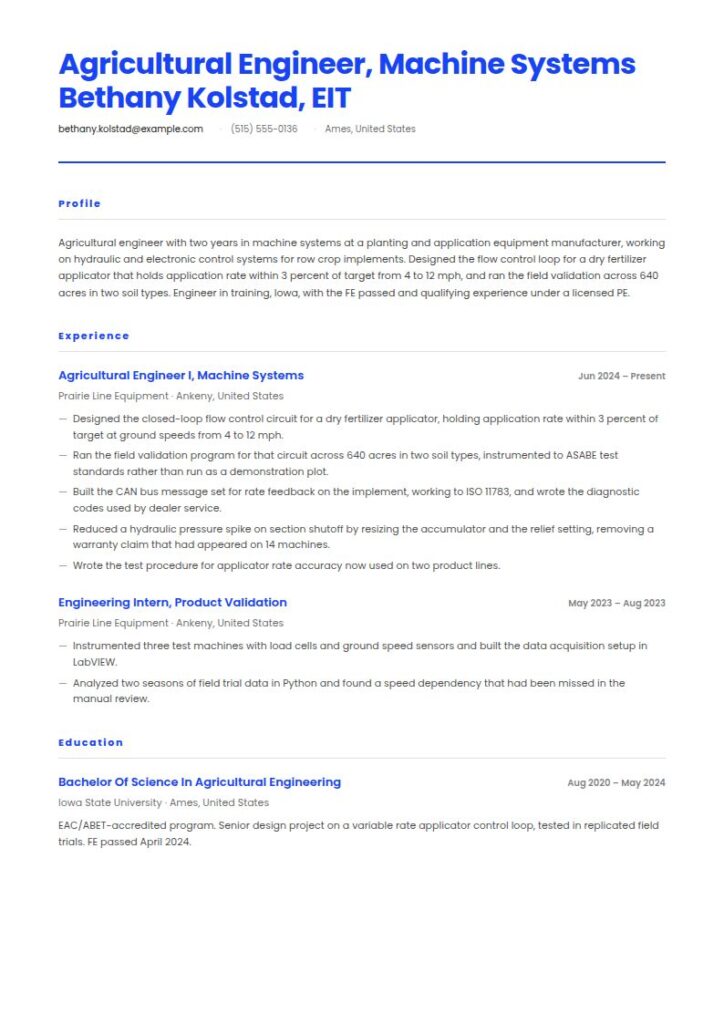
Agricultural engineer with two years in machine systems at a planting and application equipment manufacturer, working on hydraulic and electronic control systems for row crop implements. Designed the flow control loop for a dry fertilizer applicator that holds application rate within 3 percent of target from 4 to 12 mph, and ran the field validation across 640 acres in two soil types. Engineer in training, Iowa, with the FE passed and qualifying experience under a licensed PE.
Work Experience
06/2024 - Present, Agricultural Engineer I, Machine Systems, Prairie Line Equipment, Ankeny, United States
- Designed the closed-loop flow control circuit for a dry fertilizer applicator, holding application rate within 3 percent of target at ground speeds from 4 to 12 mph.
- Ran the field validation program for that circuit across 640 acres in two soil types, instrumented to ASABE test standards rather than run as a demonstration plot.
- Built the CAN bus message set for rate feedback on the implement, working to ISO 11783, and wrote the diagnostic codes used by dealer service.
- Reduced a hydraulic pressure spike on section shutoff by resizing the accumulator and the relief setting, removing a warranty claim that had appeared on 14 machines.
- Wrote the test procedure for applicator rate accuracy now used on two product lines.
05/2023 - 08/2023, Engineering Intern, Product Validation, Prairie Line Equipment, Ankeny, United States
- Instrumented three test machines with load cells and ground speed sensors and built the data acquisition setup in LabVIEW.
- Analyzed two seasons of field trial data in Python and found a speed dependency that had been missed in the manual review.
Education
08/2020 - 05/2024, Bachelor of Science, Agricultural Engineering, Iowa State University, Ames, United States
EAC/ABET-accredited program. Senior design project on a variable rate applicator control loop, tested in replicated field trials. FE passed April 2024.
Skills
Hydraulic circuit design, 70
Closed-loop control system design, 65
CAN bus and ISO 11783 implement communication, 70
Instrumented field testing and data acquisition, 75
SolidWorks, 75
Python for field data analysis, 70
MATLAB and Simulink, 60
Languages
English, native
Certificates
06/2024, Engineer in Training, Iowa, Iowa Engineering and Land Surveying Examining Board, EIT-11642
FE passed April 2024. Qualifying experience from June 2024 under a licensed professional engineer.
Summary
Agricultural engineering is one of the smallest engineering occupations in the United States, which changes how the resume has to be written. It needs to satisfy an agricultural engineering manager and still be legible to a mechanical, civil or controls one. This guide gives you three adaptable versions and current Bureau of Labor Statistics pay and outlook.
Agricultural Engineer resume examples by experience level
An agricultural engineer resume is a one to two page document that has to do something unusual: satisfy an agricultural engineering manager and remain completely legible to a mechanical, civil, environmental or controls one.
That is because of a fact worth saying plainly at the start. There were 1,500 agricultural engineer jobs in the United States in 2025, with about 100 openings projected each year over the decade (BLS Occupational Outlook Handbook, 2025-35 projections). It is one of the smallest engineering occupations the federal government counts. Most people with an agricultural or biosystems engineering degree are not in a job titled agricultural engineer, and most of the jobs they do were posted by somebody who does not use that title either.
This is not a discouraging fact. It is a formatting instruction.
Resume guide for an agricultural engineer resume
This guide and the corresponding agricultural engineer resume example will cover:
- How to write an agricultural engineer resume, section by section
- Why the page has to work for adjacent hiring managers too
- Three adaptable summaries: early career, practicing engineer and lead
- The six areas the work actually covers, and how to name yours
- Where the licensure route matters and where it does not
- What the job market looks like and what you can expect to earn
How to write an agricultural engineer resume
Six sections: contact header, summary, experience, technical and domain skills, education, and licensure or certifications. One page for your first five years, two once you have a project record and a license.
The structure is conventional. What is different is the vocabulary discipline: every line has to carry its own translation, because the reader may not share your terms.
| Section | What it is answering | Where it goes |
|---|---|---|
| Summary | Which of the six areas, which industry, which systems | Top, four lines |
| Experience | What did they design or build, at what scale, measured how | Reverse chronological, one result per bullet |
| Technical skills | Which engineering skills survive outside agriculture | Grouped, with the general term first |
| Education | ABET-accredited degree, and what the degree is called | Spell out the discipline, do not abbreviate to ABE |
Write the engineering noun first and the agricultural noun second
"Designed a variable rate applicator control system" is read by an agricultural engineering manager as domain work and by a controls engineering manager as nothing at all, because the first four words are agricultural.
"Designed a closed-loop flow control system for a variable rate applicator, CAN bus to ISO 11783, holding application rate within 3 percent of target at speeds from 4 to 12 mph" is read by both. The engineering content is now in front: closed loop, flow control, CAN bus, a tolerance and an operating range. The agriculture is context rather than the whole sentence.
Do that to every bullet. The domain stays; it just stops being the only thing the reader can see.
Run the finished file through the free Rezoom ATS resume checker before you send it. Equipment manufacturers, food processors and federal agencies all parse applications before a human opens one.
Choosing the best resume format for an agricultural engineer resume
Reverse chronological. In a small occupation continuity matters more than usual, because a reader who does not know your employers is relying on the shape of the career to tell them what you are.
One page early on, two once you have a project record. Resist the functional format: when your job titles do not match the job you are applying for, the instinct is to hide the timeline behind a skills grouping. It reads as evasion, and it removes exactly the information a reader in a small field uses to place you.
Include your contact information
| ✅ Right | ❌ Wrong |
|---|---|
| Bethany Kolstad, PE | Bethany Kolstad |
| Agricultural Engineer, Machine Systems and Precision Agriculture | Agricultural Engineering Professional |
| Iowa PE #E-24817, Agricultural and Biological Engineering | Licensed engineer |
| (515) 555-0136, [email protected], Ames, IA | (515) 555-0136, [email protected] |
The subtitle line is doing real work. "Agricultural Engineer" alone tells a reader almost nothing. "Machine Systems and Precision Agriculture" or "Irrigation and Water Resources" or "Food and Bioprocess Engineering" places you in about a second.
Make use of a summary
Four lines: which of the six areas you work in, the industry, the systems you have designed, and one result with a number.
Agricultural engineer with two years in machine systems at a planting and application equipment manufacturer, working on hydraulic and electronic control systems for row crop implements. Designed the flow control loop for a dry fertilizer applicator that holds application rate within 3 percent of target from 4 to 12 mph, and ran the field validation across 640 acres in two soil types. Engineer in training, Iowa, with the FE passed and qualifying experience under a licensed PE.
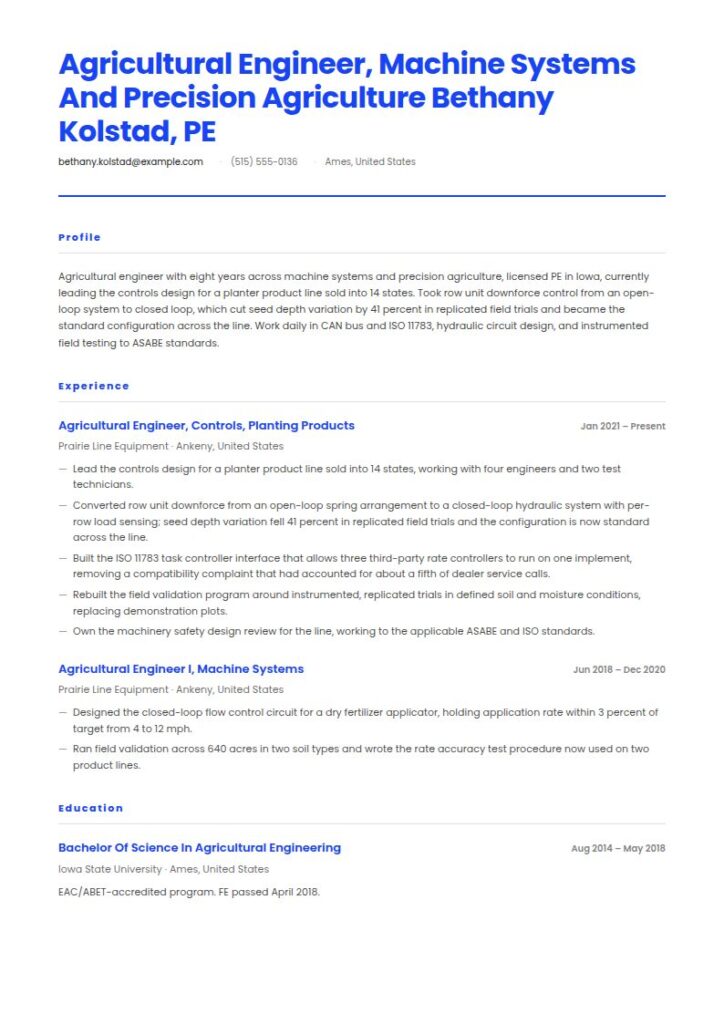
Agricultural engineer with eight years across machine systems and precision agriculture, licensed PE in Iowa, currently leading the controls design for a planter product line sold into 14 states. Took row unit downforce control from an open-loop system to closed loop, which cut seed depth variation by 41 percent in replicated field trials and became the standard configuration across the line. Work daily in CAN bus and ISO 11783, hydraulic circuit design, and instrumented field testing to ASABE standards.
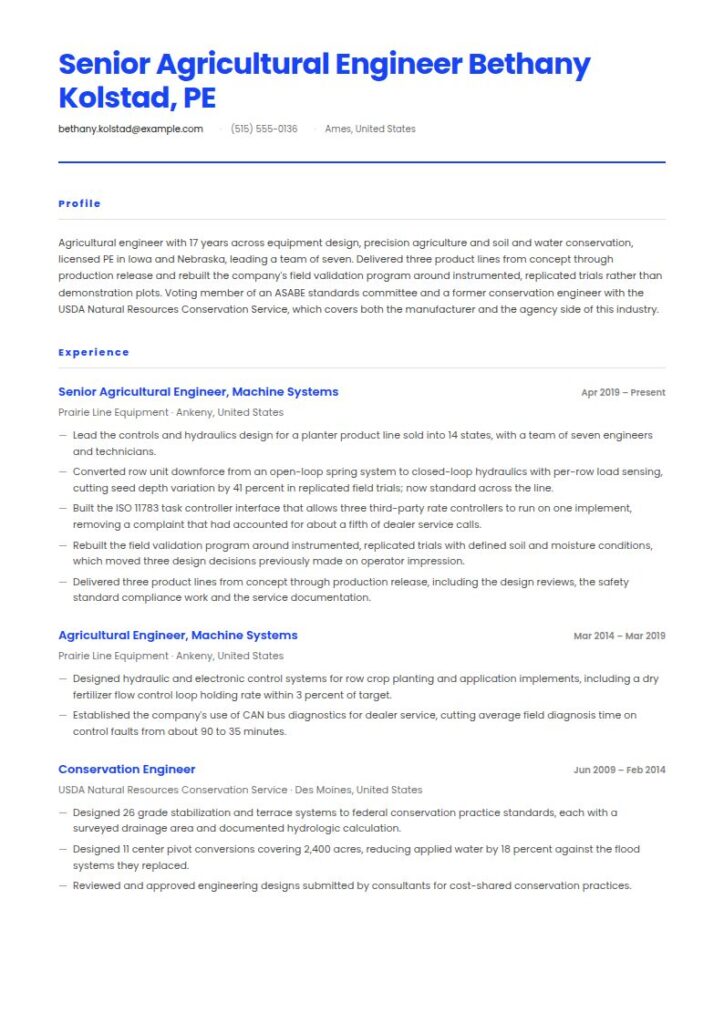
Agricultural engineer with 17 years across equipment design, precision agriculture and soil and water conservation, licensed PE in Iowa and Nebraska, leading a team of seven. Delivered three product lines from concept through production release and rebuilt the company's field validation program around instrumented, replicated trials rather than demonstration plots. Voting member of an ASABE standards committee and a former conservation engineer with the USDA Natural Resources Conservation Service, which covers both the manufacturer and the agency side of this industry.
Right vs wrong: the same agricultural engineer summary, twice
| ✅ Right | ❌ Wrong |
|---|---|
| Leading the controls design for a planter product line sold into 14 states. | Experienced in agricultural equipment design and development. |
| Took row unit downforce control from open loop to closed loop. | Improved planter performance through innovative engineering solutions. |
| Cut seed depth variation by 41 percent in replicated field trials. | Achieved significant improvements in planting accuracy. |
| CAN bus and ISO 11783, hydraulic circuit design, instrumented field testing. | Proficient in a variety of engineering tools and agricultural technologies. |
The right column is readable by a mechanical engineering manager who has never set foot on a farm. That is the test.
Outline your agricultural engineering experience
Employer, location, dates. Then three to five bullets, each with an engineering noun in front and a number in it.
| Instead of | Use |
|---|---|
| Designed agricultural equipment | Designed the hydraulic circuit and closed-loop flow control for a dry fertilizer applicator, holding rate within 3 percent of target |
| Worked on precision agriculture technology | Built the ISO 11783 task controller interface that let three third-party rate controllers run on one implement |
| Conducted field testing | Ran replicated field trials across 640 acres and two soil types, instrumented to ASABE test standards |
| Helped with irrigation projects | Designed 11 center pivot conversions covering 2,400 acres, cutting applied water by 18 percent against the prior flood systems |
| Worked on conservation practice | Designed 26 grade stabilization and terrace systems to federal practice standards, each with a surveyed drainage area and hydrologic calculation |
Senior Agricultural Engineer, Machine Systems, Prairie Line Equipment, Ankeny, IA, April 2019 to Present
Lead the controls and hydraulics design for a planter product line sold into 14 states, working with a team of seven engineers and technicians.
Converted row unit downforce control from an open-loop spring system to a closed-loop hydraulic system with load sensing, which cut seed depth variation by 41 percent in replicated field trials and is now standard across the line.
Built the ISO 11783 task controller interface that allows three third-party rate controllers to run on one implement, removing a compatibility complaint that had accounted for about a fifth of dealer service calls on the product.
Rebuilt the field validation program around instrumented, replicated trials with defined soil types and moisture conditions, replacing demonstration plots; the change moved three design decisions that had previously been made on operator impression.
Write for the adjacent hiring manager, not only the agricultural one
This is the section that does not appear on any other engineering resume guide, because no other engineering occupation is this small.
With roughly 1,500 people in the occupation and about 100 openings a year (BLS Occupational Outlook Handbook, 2025-35 projections), waiting for a job posted as "agricultural engineer" is a poor strategy. The work exists in far larger numbers under other titles: product engineer, machine systems engineer, controls engineer, application engineer, water resources engineer, process engineer, project engineer. Your resume has to be readable by whoever is hiring for those.
Six areas of work, and the adjacent title each one sits next to:
| Area of work | What it is | Who else hires for it |
|---|---|---|
| Machinery and equipment design | Implements, harvesters, hydraulics, drivetrains, structures | Mechanical and product engineering managers |
| Precision agriculture | Sensors, controllers, CAN bus, data, guidance and rate control | Controls, embedded and systems engineering managers |
| Irrigation and water management | Pumps, pipelines, pivots, scheduling, water measurement | Civil and water resources engineering managers |
| Soil and water conservation | Terraces, waterways, structures, erosion and drainage | Civil and environmental engineering managers, agency staff |
| Food and bioprocess engineering | Thermal processing, drying, separation, handling, sanitation | Process and packaging engineering managers |
| Livestock housing and environment | Ventilation, thermal environment, manure handling, air quality | Mechanical, HVAC and environmental engineering managers |
Pick the one you work in, put it in your header subtitle, then write every bullet so the adjacent manager in the right-hand column could assign you work on the strength of it. The Bureau of Labor Statistics describes the occupation as solving problems "concerning power supplies, machine efficiency, the use of structures and facilities, pollution and environmental issues, and the storage and processing of agricultural products" (BLS Occupational Outlook Handbook, May 2025). Every one of those is somebody else's job title somewhere.
Where the jobs are, in an occupation of 1,500
Agricultural engineering employment is spread across five kinds of employer, and the shares are unusual for an engineering occupation. Professional, scientific and technical services holds 27 percent at a median of $98,710; the federal government 21 percent at $101,480; colleges, universities and professional schools 17 percent at $86,970; manufacturing 11 percent at $96,290; and state government 7 percent at $103,230 (BLS Occupational Outlook Handbook, May 2025).
Nearly half the occupation works for a government or a university, which means federal and state application processes, formal position descriptions and structured resumes matter far more here than in most engineering fields. An applicant who sends a private-sector resume to an agency is usually screened out before a human reads it.
The 11 percent in manufacturing is the equipment industry, and those employers post under product, machine systems and controls titles far more often than under agricultural engineer.
Build a snapshot of your key skills
Twelve to sixteen entries in three groups: the transferable engineering skills first, the domain-specific ones second, and the tools third. That order is deliberate.
Engineering: Hydraulic circuit design, Closed-loop control system design, Mechanism and structural design, Instrumented test design and replicated trials, Failure mode and effects analysis, Design for manufacture
Domain: Precision agriculture and rate control, ISO 11783 and CAN bus implement communication, Machine guidance and section control, Soil and water conservation practice design, Irrigation system design and water measurement, ASABE standards
Tools: SolidWorks, MATLAB and Simulink, LabVIEW and instrumented data acquisition, Python for field data analysis, AutoCAD Civil 3D, GIS for field and watershed mapping
List your education and certifications
Degree, spelled out. Then licensure. Then standards and professional work.
Licensed Professional Engineer, Iowa, #E-24817, Agricultural and Biological Engineering, 2018. Comity license in Nebraska.
Master of Science, Agricultural and Biosystems Engineering, Iowa State University, Ames, IA, 2011
Bachelor of Science, Agricultural Engineering, Iowa State University, Ames, IA, 2009. EAC/ABET-accredited program.
Professional: Voting member, ASABE standards committee on machinery systems, since 2021. Fundamentals of Engineering passed October 2009.
The PE route exists here, and the exam is offered once a year
NCEES offers a PE Agricultural and Biological Engineering exam. It is computer-based, 85 questions, with 8.5 hours of exam time inside a 9.5-hour appointment, and it is administered once a year (NCEES, accessed September 2026). The next administration listed at the time of writing is 28 October 2026.
Once a year is the fact to plan around. Miss the date and you wait twelve months, which is a very different calculation from the civil or mechanical disciplines where the exam runs year-round.
The license matters most on the conservation, irrigation and structures side, where you are sealing designs for a public agency or a landowner, and least in equipment manufacturing, where industrial exemptions usually apply. Either way, put the whole sequence on the page: the FE date, the engineer in training number, the start of qualifying experience, and the discipline of the PE exam you took or intend to take. It costs four lines and it removes the reader's uncertainty.
Choose the right layout and design
Single column, plain type at 11 point, clear headings, no photograph. Equipment manufacturers, food processors and federal agencies all parse these into a system first, and two columns, text boxes and graphics are where that parsing breaks. Keep a second version for federal applications: agency postings are written against a position description with specific qualification statements, and the resume that answers those statements in their own words is the one that survives the screen.
Put the engineering noun before the agricultural noun in every bullet. Name which of the six areas you work in, in the header subtitle. Spell out the degree title rather than abbreviating it. Give every result a number and a method, since replicated trials and demonstration plots are not the same evidence. Name the standards you have worked to, including ASABE and ISO numbers. Keep a separate federal version if you are applying to an agency.
Do not assume the reader knows what ISO 11783 is; add three words of translation. Do not use a functional format to hide unfamiliar job titles, because in a small field the timeline is how a reader places you. Do not write "agricultural equipment" when you mean a planter, a pivot, a pasteurizer or a ventilation system. Do not leave the licensure sequence implicit. Do not describe an individual farm, cooperative or client by name.
Agricultural engineer job market and outlook
A very small occupation, growing faster than the average for all occupations in percentage terms while adding almost nothing in absolute numbers.
| Measure | Value |
|---|---|
| Agricultural engineer jobs, 2025 | 1,500 |
| Projected employment, 2035 | 1,600 |
| Projected change, 2025-35 | +7% (+100) |
| Projected annual openings | ~100 |
| Typical entry-level education | Bachelor's degree |
| Median annual wage, May 2025 | $98,590 |
Source: U.S. Bureau of Labor Statistics, Occupational Outlook Handbook, May 2025 wage data and 2025-35 employment projections.
Where the jobs sit:
| Industry | Share of employment | Median annual wage (May 2025) |
|---|---|---|
| Professional, scientific and technical services | 27% | $98,710 |
| Federal government, excluding postal service | 21% | $101,480 |
| Colleges, universities and professional schools | 17% | $86,970 |
| Manufacturing | 11% | $96,290 |
| State government, excluding education and hospitals | 7% | $103,230 |
Source: U.S. Bureau of Labor Statistics, Occupational Outlook Handbook, May 2025.
The demand story sits underneath the job titles rather than in them. Precision agriculture has moved from novelty to normal equipment: guidance autosteering was used by 52 percent of midsize and 70 percent of large-scale crop-producing farms in 2023, and yield monitors, yield maps and soil maps by 68 percent of large-scale crop farms (USDA Economic Research Service, America's Farms and Ranches at a Glance, December 2024). Somebody engineers all of that, and most of them are employed by manufacturers under product and controls titles rather than by anyone counting agricultural engineers.
What salary you can expect as an agricultural engineer
The median annual wage for agricultural engineers was $98,590 in May 2025, or $47.40 an hour. The lowest 10 percent earned less than $68,060 and the highest 10 percent more than $166,460 (BLS Occupational Outlook Handbook, May 2025).
That is a wide band for an occupation of 1,500 people, and the spread is mostly about employer type rather than seniority. State government sat highest at a $103,230 median and the federal government at $101,480, while colleges and universities sat lowest at $86,970 (BLS Occupational Outlook Handbook, May 2025).
Two things move a resume inside that band. The first is the license, worth most on the conservation, irrigation and structures side where you are sealing work. The second is the engineering skill you can demonstrate outside agriculture, because that determines how many employers can bid for you. An engineer whose resume reads only to agricultural employers is competing in a market of 1,500 jobs. The same engineer, written properly, is competing in several much larger ones.
Key takeaways for an agricultural engineer resume
- Say which of the six areas you work in, in the header subtitle.
- Put the engineering noun before the agricultural noun in every bullet.
- Write so a mechanical, civil, controls or process manager can assign you work.
- Give every result a number and say how it was measured.
- Name the standards, including ASABE and ISO numbers, with three words of translation.
- Put the full licensure sequence on the page; the PE exam here runs once a year.
- Keep a separate federal version, because nearly half the occupation works for a government or a university.
Build your agricultural engineer resume in 15 minutes.
Related engineering resume examples
- Civil engineer resume
- Mechanical engineer resume
- Electrical engineer resume
- Chemical engineer resume
- Project engineer resume
- Systems engineer resume
- Facility engineer resume
- Research engineer resume
- Health and safety engineer resume
- CNC machinist resume
- Technician resume
- Engineering resume
Pair it with a matching agricultural engineer cover letter.
Agricultural engineer resume questions, answered
How long should an agricultural engineer resume be?
One page for your first five years, two once you have a project record and a license. Federal applications are the exception; agency resumes are routinely longer because they have to answer each qualification statement in the position description directly.
Is agricultural engineering a dead end because the occupation is so small?
No, but the job title is a poor search term. There were 1,500 agricultural engineer jobs in 2025 with about 100 openings a year (BLS Occupational Outlook Handbook, 2025-35 projections), while the work itself is spread across equipment manufacturing, food processing, water resources, environmental consulting and federal agencies under other titles. Search by the work rather than the title, and write the resume so those employers can read it.
Do I need a PE license as an agricultural engineer?
It depends entirely on the side you work on. Conservation, irrigation, drainage and agricultural structures work is often sealed, so the license is close to required. Equipment manufacturing usually falls under an industrial exemption and the license is a credential rather than a requirement. NCEES offers a PE Agricultural and Biological Engineering exam, computer-based, 85 questions, administered once a year (NCEES, accessed September 2026), so the planning matters.
What does ASABE do, and does membership belong on the resume?
ASABE is the American Society of Agricultural and Biological Engineers, founded in 1907, with members in more than 100 countries. It is accredited by ANSI and describes itself as the leading national producer of standards for agricultural systems, coordinating the US position in fifteen distinct areas of international standards development (ASABE, accessed September 2026). Plain membership is worth one line. Committee work is worth more, because standards participation is checkable and rare.
What belongs on an agricultural engineer resume with no experience?
Your senior design project written as a job, with the system, the constraints, the testing method and the result. Any farm, shop or equipment dealership work, described in engineering terms: hydraulics, diagnostics, fabrication, machine setup. Internships and research assistantships with the instrumentation named. And the FE result with a date, since it is the first step of a sequence a reader will be tracking.
Should I include field or farm work on a professional engineering resume?
Yes, described in engineering language. Someone who has operated, set up and repaired the machine they are now designing has domain knowledge equipment manufacturers value highly and cannot train quickly. Write it as troubleshooting, calibration, hydraulics and mechanical work, with what it taught you about how the machine actually fails.