Project Engineer, EPC Capital Projects Rafael Costa-Nunes EIT
Project Engineer, Capital Projects
[email protected] | (713) 555-0164 | Houston, United States
Profile
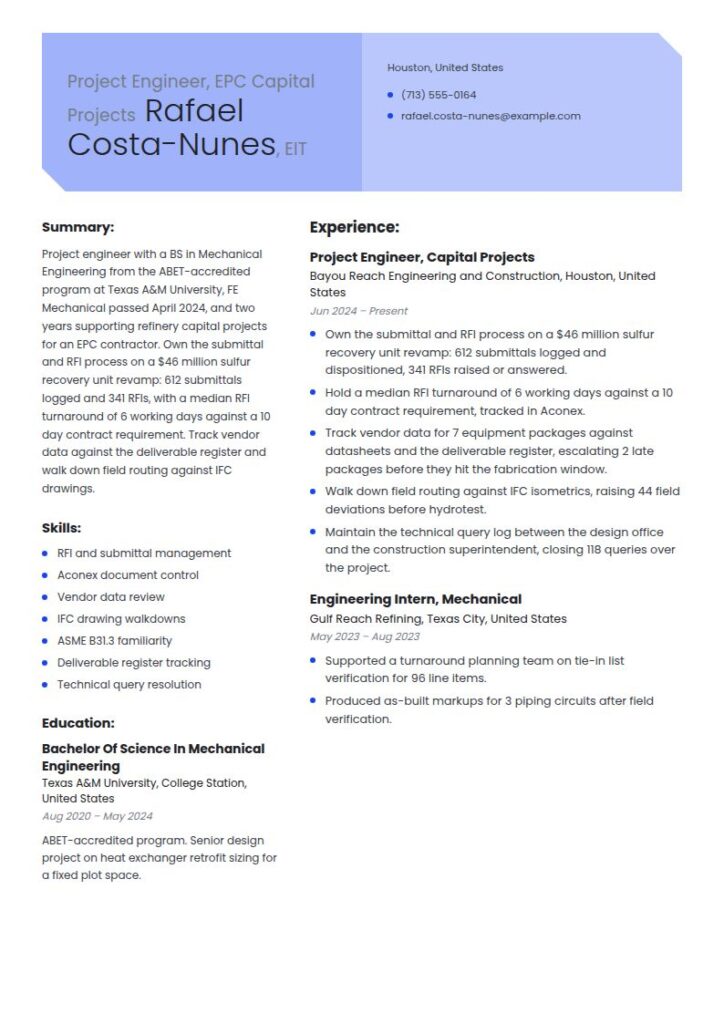
Project engineer with a BS in Mechanical Engineering from the ABET-accredited program at Texas A&M University, FE Mechanical passed April 2024, and two years supporting refinery capital projects for an EPC contractor. Own the submittal and RFI process on a $46 million sulfur recovery unit revamp: 612 submittals logged and 341 RFIs, with a median RFI turnaround of 6 working days against a 10 day contract requirement. Track vendor data against the deliverable register and walk down field routing against IFC drawings.
Work Experience
06/2024 - Present, Project Engineer, Capital Projects, Bayou Reach Engineering and Construction, Houston, United States
- Own the submittal and RFI process on a $46 million sulfur recovery unit revamp: 612 submittals logged and dispositioned, 341 RFIs raised or answered.
- Hold a median RFI turnaround of 6 working days against a 10 day contract requirement, tracked in Aconex.
- Track vendor data for 7 equipment packages against datasheets and the deliverable register, escalating 2 late packages before they hit the fabrication window.
- Walk down field routing against IFC isometrics, raising 44 field deviations before hydrotest.
- Maintain the technical query log between the design office and the construction superintendent, closing 118 queries over the project.
05/2023 - 08/2023, Engineering Intern, Mechanical, Gulf Reach Refining, Texas City, United States
- Supported a turnaround planning team on tie-in list verification for 96 line items.
- Produced as-built markups for 3 piping circuits after field verification.
Education
08/2020 - 05/2024, Bachelor of Science, Mechanical Engineering, Texas A&M University, College Station, United States
ABET-accredited program. Senior design project on heat exchanger retrofit sizing for a fixed plot space.
Skills
RFI and submittal management, 80
Aconex document control, 75
Vendor data review, 65
IFC drawing walkdowns, 70
ASME B31.3 familiarity, 55
Deliverable register tracking, 75
Technical query resolution, 70
Languages
English, native
Portuguese, native
Spanish, proficient
Certificates
06/2024, Engineer in Training, Texas, Texas Board of Professional Engineers and Land Surveyors, EIT-77318
FE Mechanical passed April 2024. Qualifying experience accruing under a licensed PE.
06/2024, TWIC Card, Transportation Security Administration
Current through 2029.
08/2024, OSHA 30 Construction, OSHA Training Institute
Summary
A project engineer resume is a one to two page document showing that you own the technical scope inside a project while someone else owns cost, schedule and contract. This guide gives you three adaptable versions, the RFI and submittal record that proves the work, and current Bureau of Labor Statistics pay for the occupations the title sits inside.
Project Engineer resume examples by experience level
A project engineer resume is a one to two page document proving that you own the technical scope inside a project, and that you know where that ownership stops.
That boundary is the whole job. A project engineer is accountable for whether the thing being built is technically correct: the design intent, the specifications, the drawings, the RFIs, the submittals, the field engineering and the code compliance. A project manager is accountable for whether it lands on cost, on schedule and inside the contract. The two roles work on the same project, often sit at the same desk, and are hired for different things.
Resumes that blur it fail twice. Written as a project manager resume, it invites comparison with candidates who have carried a real profit and loss. Written as a design resume, it loses the delivery record that made the title worth having.
Resume guide for a project engineer resume
This guide and the corresponding project engineer resume example will cover:
- How to write a project engineer resume, section by section
- The technical-scope boundary, and how to write experience that sits on the right side of it
- Three adaptable summaries: field project engineer, project engineer and lead project engineer
- How to write the RFI, submittal and field change record so it reads as engineering
- Where the title is used, what the market looks like, and what you can expect to earn
How to write a project engineer resume
Six sections: contact header, summary, credentials, project experience, technical scope and systems, and education. One page for the first five years, two once you are carrying multi-discipline scope.
The header line is doing more work here than in most occupations, because "project engineer" means different things in construction, EPC, manufacturing and energy. Say which one you are in the first line, and give the project type immediately after it.
| Section | What it is answering | Where it goes |
|---|---|---|
| Credentials | ABET degree, FE or PE status, and any discipline certifications | Directly under the summary |
| Project experience | What scope was technically yours, at what size, and what did you resolve? | Reverse chronological, project lines with value and delivery method |
| Technical scope and systems | Which disciplines, codes and document systems have you worked in? | Grouped block, name the systems |
| Education | Degree, discipline, accreditation | Bottom, with the accreditation named |
Say which industry’s project engineer you are, in the first line
The title travels across four industries that use it differently. In construction it sits under a project manager on a general contractor's team and lives in submittals, RFIs and field coordination. In EPC work it owns a discipline or a unit inside an engineering, procurement and construction contract. In manufacturing it runs capital projects, new product introduction and line installs. In energy it runs turnarounds, tie-ins and brownfield modifications.
A recruiter screening for one of those will not translate the others for you. "Project Engineer, EPC, refinery and petrochemical capital projects" costs one line and routes the file correctly.
Then keep the industry's own vocabulary in the bullets. Construction reads RFIs, submittals and punch lists. EPC reads deliverable registers, IFC drawings and vendor data. Manufacturing reads installation qualification, commissioning and takt. Using the wrong dialect reads as someone describing a job they have not done.
Run the finished file through the free Rezoom ATS resume checker before you send it. Contractors, EPC firms and manufacturers all parse applications into a system before a hiring engineer opens one.
Choosing the best resume format for a project engineer resume
Reverse chronological, one to two pages. Project engineering careers are read as a sequence of projects, and the sequence is the argument: larger scope, more disciplines, more autonomy on technical decisions.
Inside each employer, list projects rather than duties. A project line carries the name or type, the installed value, the delivery method or contract form, and the part of the technical scope that was yours. A reader who cannot tell which scope was yours will assume it was the smallest plausible one.
Include your contact information
| ✅ Right | ❌ Wrong |
|---|---|
| Rafael Costa-Nunes, PE | Rafael Costa-Nunes |
| Project Engineer, EPC, Refinery and Petrochemical Capital Projects | Project professional and engineering leader |
| PE, Texas #PE-141902. TWIC card current. | Licensed engineer, safety trained |
| (713) 555-0164, [email protected], Houston, TX | (713) 555-0164, [email protected] |
Site access credentials belong in the header in this field. A current TWIC card, a site safety council card or an active clearance removes a real onboarding delay, and the person reading knows exactly what it saves them.
Make use of a summary
Four lines: industry, credential position, the size and type of scope you own technically, and one number that shows a technical problem you resolved.
Project engineer with a BS in Mechanical Engineering from the ABET-accredited program at Texas A&M University, FE Mechanical passed April 2024, and two years supporting refinery capital projects for an EPC contractor. Own the submittal and RFI process on a $46 million sulfur recovery unit revamp: 612 submittals logged and 341 RFIs, with a median RFI turnaround of 6 working days against a 10 day contract requirement. Track vendor data against the deliverable register and walk down field routing against IFC drawings.
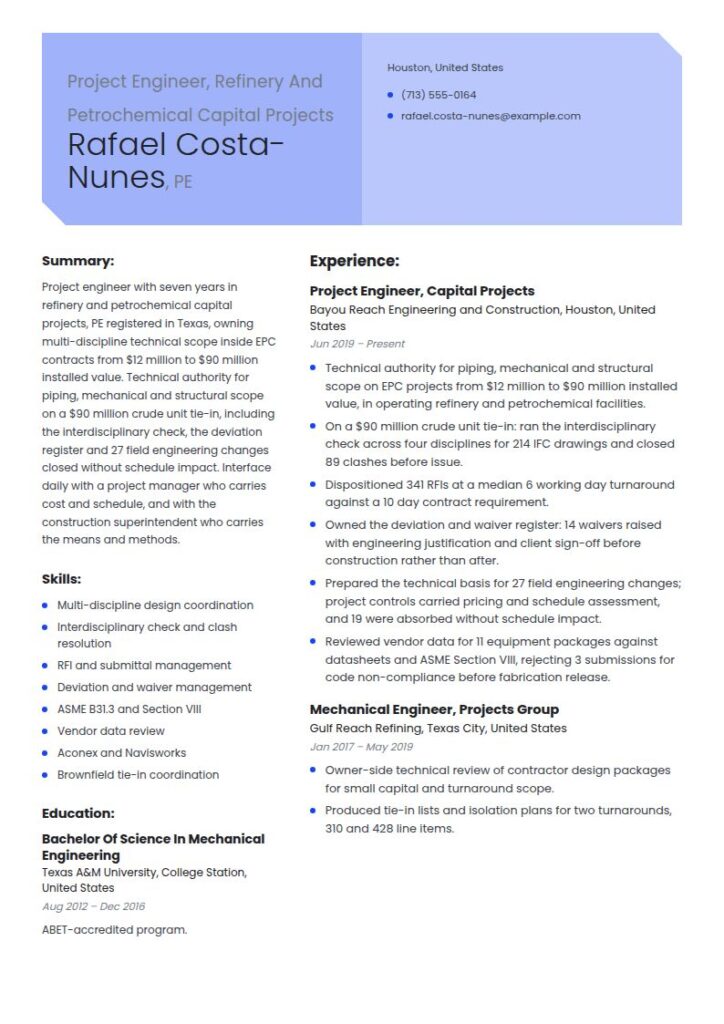
Project engineer with seven years in refinery and petrochemical capital projects, PE registered in Texas, owning multi-discipline technical scope inside EPC contracts from $12 million to $90 million installed value. Technical authority for piping, mechanical and structural scope on a $90 million crude unit tie-in, including the interdisciplinary check, the deviation register and 27 field engineering changes closed without schedule impact. Interface daily with a project manager who carries cost and schedule, and with the construction superintendent who carries the means and methods.
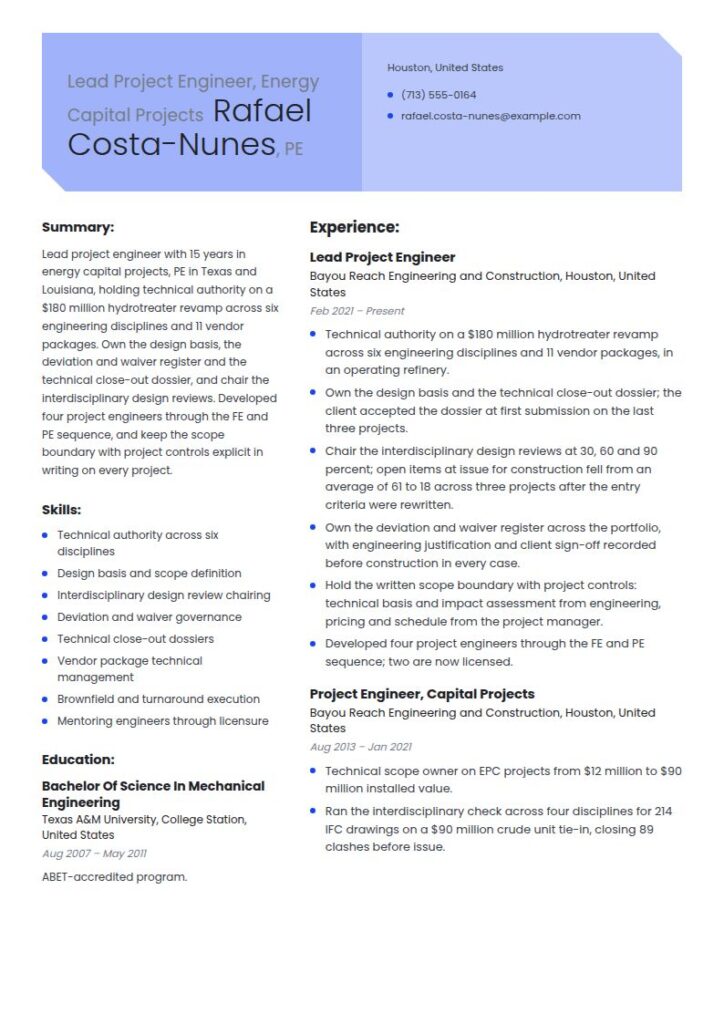
Lead project engineer with 15 years in energy capital projects, PE in Texas and Louisiana, holding technical authority on a $180 million hydrotreater revamp across six engineering disciplines and 11 vendor packages. Own the design basis, the deviation and waiver register and the technical close-out dossier, and chair the interdisciplinary design reviews. Developed four project engineers through the FE and PE sequence, and keep the scope boundary with project controls explicit in writing on every project.
Right vs wrong: the same project engineer summary, twice
| ✅ Right | ❌ Wrong |
|---|---|
| Technical authority for piping, mechanical and structural scope on a $90 million crude unit tie-in. | Managed a $90 million project from initiation through closeout. |
| 612 submittals logged and 341 RFIs, median turnaround 6 working days against a 10 day requirement. | Handled project documentation and communication with stakeholders. |
| Closed 27 field engineering changes without schedule impact. | Delivered projects on time and within budget. |
The right column describes engineering. The left column describes a project manager, and a hiring engineer reading it will either doubt the claim or route the file to a job you did not apply for.
Outline your project experience
Employer, city, dates, title. Then project lines. Inside each one, the technical scope that was yours and the numbers that come with it.
| Instead of | Use |
|---|---|
| Managed project documentation | Logged and dispositioned 612 submittals and 341 RFIs on a $46 million unit revamp, median RFI turnaround 6 working days |
| Coordinated with multiple disciplines | Ran the interdisciplinary check across piping, civil, electrical and instrumentation for 214 IFC drawings, closing 89 clashes before issue |
| Assisted with change orders | Prepared the technical basis for 27 field engineering changes; project controls priced them, 19 were absorbed without schedule impact |
| Supported construction | Walked down 3.1 miles of process piping against IFC isometrics, raising 44 field deviations before hydrotest |
| Worked with vendors | Reviewed vendor data for 11 equipment packages against datasheets, rejecting 3 submissions for code non-compliance to ASME Section VIII |
| Ensured quality and compliance | Owned the deviation and waiver register; 14 waivers raised, all with engineering justification and client sign-off before construction |
Project Engineer, Capital Projects, Bayou Reach Engineering and Construction, Houston, TX, June 2019 to Present
Technical authority for piping, mechanical and structural scope on EPC projects from $12 million to $90 million installed value, in operating refinery and petrochemical facilities.
On a $90 million crude unit tie-in: ran the interdisciplinary check across four disciplines for 214 IFC drawings, closed 89 clashes before issue, and dispositioned 341 RFIs at a median 6 working day turnaround against a 10 day contract requirement.
Owned the deviation and waiver register, raising 14 waivers with engineering justification and client sign-off before construction rather than after.
Prepared the technical basis for 27 field engineering changes; project controls carried the pricing and the schedule assessment, and 19 were absorbed without schedule impact.
Reviewed vendor data for 11 equipment packages against datasheets and ASME Section VIII, rejecting 3 submissions for code non-compliance before fabrication release.
Own the technical scope: where the project engineer role stops and the project manager's begins
This is the section that decides whether your resume reads as a project engineer or as a project manager who did not get the title. Write it as a boundary, because that is how the role is actually defined.
A project engineer owns whether the work is technically right. A project manager owns whether it lands on cost, on schedule and inside the contract. In the built environment, the project engineer's day is documents, shop drawings, RFIs and quality logs, field oversight and code compliance, and coordination between the designers and the trades, while the project manager carries budgets and cost reports, change orders, buyout and forecasting, the master schedule, procurement and the client relationship (Certis Solutions, AEC industry guidance, accessed September 2026).
| Deliverable | Project engineer owns | Project manager owns |
|---|---|---|
| RFI | Writing or answering the technical question, and the resolution | Whether the answer has a cost or time consequence |
| Submittal | Reviewing conformance to the specification and design intent | The procurement and delivery date behind it |
| Change | The engineering basis for the change and its technical impact | Pricing it, negotiating it, and the contract position |
| Schedule | Technical sequencing and constructability input | The master schedule, float and the completion date |
| Quality | Inspection and test plans, code compliance, the deviation register | Whether the client accepts the work contractually |
Three of those documents carry most of the evidence, so define them the way the industry does. An RFI is a formal written request to clarify plans, drawings, specifications or agreements, raised when documents contradict each other, lack detail, or meet a field condition they did not anticipate. A submittal is the package sent for review before installation: shop drawings, product data, samples and test documentation, confirming what will actually be built against what was specified. Large projects routinely run 500 or more individual submittals (Fieldwire, accessed September 2026). A change order is the contractual instrument that follows, and it is the one you supply the engineering basis for rather than own.
Then write your bullets on the correct side of that line. "Priced and negotiated 27 change orders" is a project manager claim. "Prepared the technical basis for 27 field engineering changes; project controls carried the pricing" is a project engineer claim, and it is a stronger one, because it shows you know the difference.
Name your industry's version of the role in the first line. Count RFIs, submittals, drawings and deviations, with turnaround times. Say which disciplines you carried technical scope for. Attribute cost and schedule work to the people who own it. Put site access credentials in the header.
Do not claim budget ownership or profit and loss you did not carry; the interview question after it is specific. Do not write "managed the project" when you owned the technical scope inside it. Do not use construction vocabulary for an EPC job or the reverse. Do not describe yourself as a project manager in a resume applying for project engineer posts. Do not leave the number of disciplines you coordinate off the page.
Build a snapshot of your key skills
Twelve to sixteen entries in four groups: technical scope, project documents and systems, codes and standards, and field. The documents group is the one that distinguishes the role, so name the systems rather than describing them.
Technical scope: Multi-discipline design coordination, Interdisciplinary check, Constructability review, Design basis and scope definition, Deviation and waiver management, Vendor data review
Project documents and systems: RFI and submittal management, Deliverable registers, Procore, Aconex, SharePoint document control, Primavera P6 for technical sequencing input, Navisworks clash detection
Codes and standards: ASME B31.3, ASME Section VIII, API 650 and API 570, NFPA 70, OSHA 1910 process safety management awareness
Field: Walkdowns against IFC drawings, Punch list and close-out, Hydrotest and reinstatement packages, Turnaround tie-in coordination, Contractor technical query resolution
List your education and certifications
Degree with the accreditation, then licensure, then certifications. This is also where the PE and PMP question gets answered, and a project engineer resume should answer it deliberately.
BS Mechanical Engineering, ABET-accredited, Texas A&M University, College Station, TX, 2016
Licensure: PE, Texas #PE-141902, 2021. FE Mechanical passed April 2015. Comity registration in Louisiana through an NCEES Record.
Certifications: OSHA 30 Construction (2024). TWIC card, current through 2029. API 570 Piping Inspector coursework completed 2023. H2S and confined space entry, current.
PE or PMP: the two credentials answer different questions
The PE route runs through a bachelor's degree from an EAC/ABET-accredited program, the FE exam, four years of acceptable, progressive and verifiable experience, and the PE exam, administered through the 69 state and territory boards that make up NCEES (NCEES, accessed September 2026).
The PMP route asks for three years of project management experience with a bachelor's degree, four with an associate's or five with a high school diploma, plus 35 hours of project management training, and PMI reports more than 1.7 million PMP holders worldwide (PMI, accessed September 2026).
For a project engineer, the PE is the credential that matches the job description, because the thing you are accountable for is technical correctness. The PMP is the credential that signals you are heading for the project manager seat. Holding both is common in EPC and construction, but if you are applying for project engineer posts and only one is on the page, the PE is the one that reads as evidence rather than ambition.
Choose the right layout and design
Single column, one or two pages, plain type at 11 point, no photograph. Contractor and EPC portals are frequently older than the ones in office hiring, and a two-column template with graphics arrives as run-together text.
Keep project lines visually distinct from duty bullets: project name or type, value, delivery method, then the scope that was yours. A reader scanning for size and complexity should be able to get it from the left edge of the page.
Project engineer job market and outlook
There is no separate federal occupation called project engineer, which is worth knowing before you plan a search. The title sits inside several occupations depending on industry, and the openings are counted under those.
| Occupation the title sits inside | Jobs, 2025 | Projected change, 2025-35 | Projected annual openings | Median annual wage, May 2025 |
|---|---|---|---|---|
| Construction managers | 609,100 | +9% (+55,200) | ~49,700 | $114,990 |
| Civil engineers | 380,600 | +6% (+24,500) | ~22,700 | $100,840 |
| Industrial engineers | 365,100 | +12% (+45,400) | ~23,100 | $102,440 |
| Mechanical engineers | 298,500 | +11% (+33,500) | ~17,800 | $104,110 |
| Architectural and engineering managers | 220,900 | +6% (+12,200) | ~14,900 | $171,270 |
Source: U.S. Bureau of Labor Statistics, Occupational Outlook Handbook, May 2025 wage data and 2025-35 employment projections.
The adjacent management track pays more than the engineering track
Architectural and engineering managers had a median annual wage of $171,270 in May 2025, against $104,110 for mechanical engineers, $102,440 for industrial engineers and $100,840 for civil engineers, while construction managers sat at $114,990 with a top decile above $189,440 (BLS Occupational Outlook Handbook, May 2025).
That gap explains the pressure on project engineers to write project manager resumes. It is worth resisting for the specific application in front of you, because the two roles are screened by different readers with different questions, and a hybrid file usually loses both.
The practical answer is two documents from one record. A project engineer version leads with technical scope, disciplines carried, RFIs and submittals, and the PE. A project manager version leads with contract value, cost performance, schedule recovery and the PMP. Send whichever the posting names, and never blend them.
What salary you can expect as a project engineer
Because no single federal wage series covers the title, read the range off the occupation your work sits inside. Civil engineers had a median of $100,840, industrial engineers $102,440 and mechanical engineers $104,110 as of May 2025, while construction managers, whose work overlaps the construction-side project engineer role, had a median of $114,990 with the lowest 10 percent under $69,690 and the highest 10 percent above $189,440 (BLS Occupational Outlook Handbook, May 2025).
Three things move a project engineer's number inside those ranges, and all three are resume-visible. The first is the PE license, which changes what you can sign and therefore what scope can be assigned to you. The second is the number of disciplines you carry technical scope for, because a single-discipline project engineer and a multi-discipline one are different jobs at the same title. The third is whether your projects are executed in operating facilities: turnaround, tie-in and brownfield work carries a premium over greenfield because the technical risk is higher and the window is fixed.
Put those three on the page explicitly. Everything else at offer time is a negotiation about which of the three the employer believes.
Key takeaways for a project engineer resume
- Write the boundary: you own the technical scope, project controls owns cost and schedule.
- Name your industry's version of the title in the first line, and use its vocabulary.
- Count RFIs, submittals, drawings and deviations, with turnaround times against the requirement.
- Say how many disciplines you carry technical scope for.
- Attribute pricing and negotiation to project controls; it makes your own claims credible.
- Lead with the PE, not the PMP, when applying for project engineer posts.
- Put site access credentials in the header, because they remove a real onboarding delay.
Build your project engineer resume in 15 minutes.
Related engineering resume examples
- Civil engineer resume
- Structural engineer resume
- Mechanical engineer resume
- Electrical engineer resume
- Chemical engineer resume
- Process engineer resume
- Systems engineer resume
- Facility engineer resume
- Health and safety engineer resume
- Research engineer resume
- Technician resume
- Engineering sector resume
Pair it with a matching project engineer cover letter.
Project engineer resume questions, answered
What is the difference between a project engineer and a project manager?
Ownership. A project engineer owns the technical scope: design intent, specifications, drawings, RFIs, submittals, field engineering and code compliance. A project manager owns cost, schedule and contract: budgets and cost reports, change order pricing and negotiation, the master schedule, procurement and the client relationship (Certis Solutions, AEC industry guidance, accessed September 2026). They work the same project from different accountabilities, and they are hired against different questions.
Should I put change orders on a project engineer resume?
Yes, on the engineering side of them. Write that you prepared the technical basis for a change and what its technical impact was, and attribute the pricing and negotiation to project controls or the project manager. Claiming to have priced and negotiated change orders on a project engineer resume invites a question you may not want to answer in detail.
Do I need a PE license to be a project engineer?
Not usually, but it changes your ceiling. The PE route runs through an EAC/ABET-accredited degree, the FE exam, four years of verifiable experience and the PE exam (NCEES, accessed September 2026), and in EPC, energy and civil work it decides what scope can be assigned to you. In manufacturing project engineering it is far less common and rarely required.
PE or PMP for a project engineer?
The PE if you are staying on the technical side, the PMP if you are moving toward the project manager seat. PMI requires three years of project management experience with a bachelor's degree plus 35 hours of training and reports more than 1.7 million PMP holders worldwide (PMI, accessed September 2026), which makes it a strong signal of intent but a weaker signal of technical authority.
How do I write a project engineer resume with no experience?
Use the numbers you already have. A co-op or internship that logged submittals, chased vendor data, walked down drawings or sat in coordination meetings produced countable work: documents handled, drawings checked, disciplines involved, turnaround achieved. Add the FE exam date, the codes you have worked to, and any site credentials. An entry-level project engineer is hired to be reliable with documents and honest about what they do not know.
What salary should I expect as a project engineer?
Read it off the occupation your work sits inside, since there is no separate federal series for the title. Civil engineers had a median of $100,840, industrial engineers $102,440 and mechanical engineers $104,110 as of May 2025, while construction managers, whose role overlaps the construction-side version, had a median of $114,990 (BLS Occupational Outlook Handbook, May 2025). Licensure, the number of disciplines you carry and whether the work is in operating facilities move you inside those ranges.