Rafael Costa-Nunes Project Engineer, PE Houston, 77002, United States [email protected] · (713) 555-0164
11 September 2026
Ms. Annika Lindqvist Capital Projects Sabine Gulf Petrochemical Port Arthur, United States
Application for Project Engineer, Olefins Expansion, Sabine Gulf Petrochemical
Dear Ms. Lindqvist,
I am applying for the Project Engineer post on your olefins expansion. I am a PE registered in Texas with seven years on refinery and petrochemical capital projects, carrying technical scope for piping, mechanical and structural work inside EPC contracts from $12 million to $90 million installed value.
On a $90 million crude unit tie-in last year the interdisciplinary check was happening too late, so clashes were arriving as field deviations instead of drawing comments. I moved the check forward to the 60 percent review and ran it across all four disciplines on 214 drawings, which closed 89 clashes before issue for construction. What was left in the field was small: 44 deviations raised during walkdown, all resolved before hydrotest, and 341 RFIs dispositioned at a median 6 working days against the 10 day contract requirement. Project controls priced the 27 field engineering changes that followed and 19 were absorbed without schedule impact, but the technical basis for each one came from my desk.
Your expansion sits inside an operating facility, which is the work I want. Brownfield tie-ins are where the technical risk actually lives, and the deviation and waiver register is the document I would want to own from day one rather than inherit at 60 percent.
My TWIC card is current through 2029, I hold OSHA 30 Construction, and I can give four weeks' notice. Thank you for your time.
Sincerely, Rafael Costa-Nunes, PE
Summary
A project engineer cover letter is a one-page letter claiming the technical scope you owned inside a project, and leaving cost, schedule and contract to the people who carried them. This guide gives you a full adaptable letter, the boundary language that makes the claim credible, and what changes between construction, EPC, manufacturing and energy.
Project Engineer cover letter examples by experience level
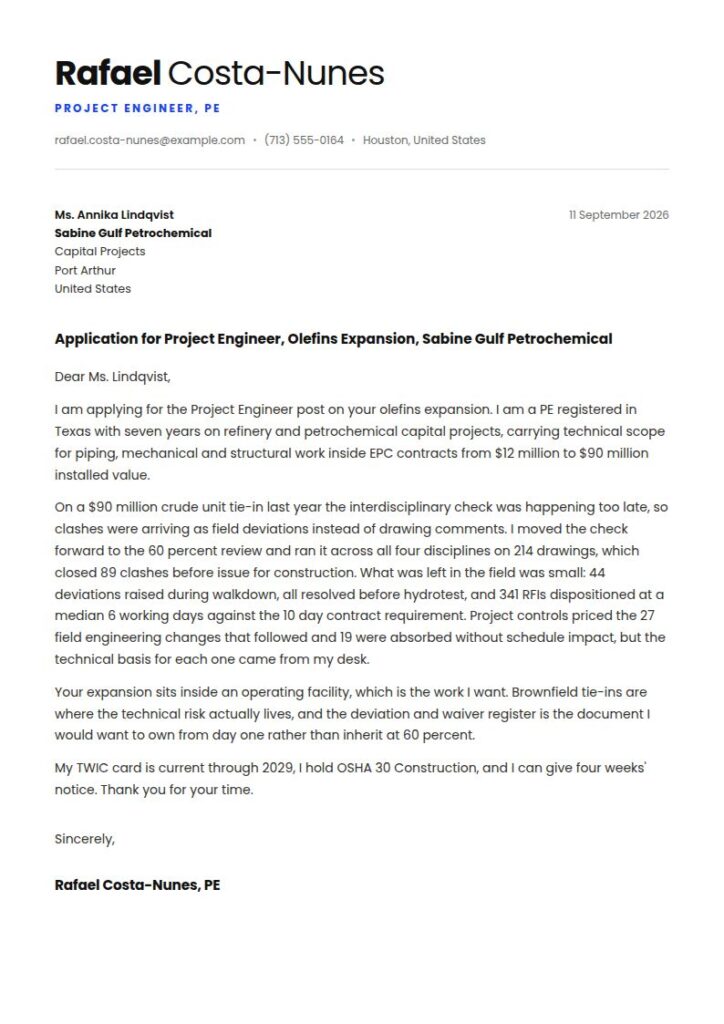
A project engineer cover letter is a one-page letter saying what technical scope you owned, how you resolved a technical problem inside a live project, and why this employer's work is the kind you want to own next.
The failure mode is specific to this title. Project engineers write project manager letters, because the project manager language is the language everyone hears on site all day. A hiring engineer reading "delivered the project on time and under budget" from a project engineer is not impressed; they are wondering which of those claims was actually yours.
Guide to a project engineer cover letter
This guide and the corresponding project engineer cover letter example will cover:
- How to structure the letter, paragraph by paragraph
- The boundary language that keeps the letter on the engineering side
- How to pick the technical problem the letter is built on
- What changes between construction, EPC, manufacturing and energy
- Openings that work, and openings that close a file
How to write a project engineer cover letter
| Paragraph | Its job | Length |
|---|---|---|
| One | The role, your industry, licensure, and the scope you own technically | 2 to 3 sentences |
| Two | One technical problem, what you changed, and what it did | 4 to 6 sentences |
| Three | Something specific about this project or facility, and the scope you want | 3 sentences |
| Four | Site credentials, availability and the close | 2 sentences |
Four paragraphs, 300 to 400 words. Anything longer is the resume again.
A project engineer cover letter example you can adapt
Dear Ms. Lindqvist,
I am applying for the Project Engineer post on your olefins expansion. I am a PE registered in Texas with seven years on refinery and petrochemical capital projects, carrying technical scope for piping, mechanical and structural work inside EPC contracts from $12 million to $90 million installed value.
On a $90 million crude unit tie-in last year the interdisciplinary check was happening too late, so clashes were arriving as field deviations instead of drawing comments. I moved the check forward to the 60 percent review and ran it across all four disciplines on 214 drawings, which closed 89 clashes before issue for construction. What was left in the field was small: 44 deviations raised during walkdown, all resolved before hydrotest, and 341 RFIs dispositioned at a median 6 working days against the 10 day contract requirement. Project controls priced the 27 field engineering changes that followed and 19 were absorbed without schedule impact, but the technical basis for each one came from my desk.
Your expansion sits inside an operating facility, which is the work I want. Brownfield tie-ins are where the technical risk actually lives, and the deviation and waiver register is the document I would want to own from day one rather than inherit at 60 percent.
My TWIC card is current through 2029, I hold OSHA 30 Construction, and I can give four weeks' notice. Thank you for your time.
Sincerely, Rafael Costa-Nunes, PE
The boundary language that makes the claim credible
Every sentence in a project engineer letter should be answerable to the question "was that actually yours". The way to get there is to name the other roles explicitly rather than write around them.
In the built environment the project engineer carries the documents, the design intent, RFIs, submittals, quality logs, field oversight and code compliance, while the project manager carries budgets and cost reports, change order pricing, buyout, the master schedule, procurement and the client relationship (Certis Solutions, AEC industry guidance, accessed September 2026).
| Instead of | Use |
|---|---|
| Delivered the project on time and under budget | Closed 89 clashes before issue for construction and dispositioned 341 RFIs at a median 6 working days |
| Managed change orders on a $90 million project | Prepared the technical basis for 27 field engineering changes; project controls carried the pricing |
| Led the project team | Chaired the interdisciplinary design review across four disciplines on 214 drawings |
| Ensured quality standards were met | Owned the deviation and waiver register: 14 waivers, each with engineering justification and client sign-off before construction |
Naming the project manager's scope does not shrink your letter. It is the sentence that makes a hiring engineer believe the rest of it.
Use the industry’s own document vocabulary
An RFI is a formal written request to clarify plans, drawings, specifications or agreements, raised when the documents contradict each other, lack detail, or meet a field condition nobody anticipated. A submittal is what goes for review before installation: shop drawings, product data, samples and test documentation. Large projects routinely carry 500 or more individual submittals (Fieldwire, accessed September 2026).
That vocabulary is construction's. EPC work says deliverable register, IFC drawings, vendor data and technical query. Manufacturing says installation qualification, commissioning and line acceptance. Energy says tie-in list, isolation plan and turnaround window.
Use the reader's dialect. A letter written in the wrong one reads as a description of a job the writer has heard about rather than done, which is exactly the impression a project engineer letter cannot afford.
Picking the technical problem
One problem, told in four sentences: what was going wrong, what you diagnosed, what you changed, what the numbers did afterwards.
Pick it for closeness of match rather than size. A $12 million brownfield tie-in with a hard shutdown window is a better story for a turnaround employer than a $200 million greenfield build, because the constraint is the same one they live with.
There is no federal wage series for this title, and that matters to how you write
The Bureau of Labor Statistics does not publish a separate occupation for project engineers. The work is counted inside other occupations: civil engineers at a median of $100,840, industrial engineers at $102,440 and mechanical engineers at $104,110 as of May 2025, with construction managers, whose role overlaps the construction-side version, at $114,990 and architectural and engineering managers at $171,270 (BLS Occupational Outlook Handbook, May 2025).
Those occupations are also where the openings are counted. Construction managers alone are projected to see about 49,700 openings a year and 9 percent growth over the decade to 2035, against 12 percent growth for industrial engineers and 6 percent for civil engineers (BLS Occupational Outlook Handbook, 2025-35 projections).
The practical consequence for the letter is that the reader is not matching you to a standard job description. They are matching you to a scope that exists on one project at one facility. Spend the third paragraph on that scope, and the first on the discipline vocabulary that gets you into the right pile.
Openings that work
| ✅ Right | ❌ Wrong |
|---|---|
| I am a PE registered in Texas with seven years on refinery and petrochemical capital projects, applying for the Project Engineer post on your olefins expansion. | I am writing to express my interest in the project engineer opportunity at your company. |
| Carrying technical scope for piping, mechanical and structural work inside EPC contracts from $12 million to $90 million installed value. | I have managed numerous large-scale projects from inception to completion. |
| Your expansion sits inside an operating facility, which is the work I want. | I am confident I would be a valuable addition to your team. |
| My TWIC card is current through 2029 and I can give four weeks' notice. | I look forward to the opportunity to discuss my qualifications further. |
What changes by industry
Construction. Lead with submittals, RFIs, shop drawing review and field coordination. Name the contract form and the delivery method. Site credentials in the close.
EPC. Lead with discipline scope, the deliverable register, vendor data and the interdisciplinary check. Name the contract value and whether it was greenfield or brownfield.
Manufacturing. Lead with capital project installs, line moves, commissioning and qualification. Name the downtime window you worked inside.
Energy. Lead with turnaround and tie-in scope, the shutdown window, and the operating facility constraints. Say plainly that you want brownfield work if you do.
Claim technical scope and name who carried cost and schedule. Tell one technical problem with the diagnosis in it. Use the reader's document vocabulary. Name the facility or project you are applying to and what you want to own on it. Put site credentials and notice period in the close.
Do not write "on time and under budget" unless you personally carried the budget. Do not call yourself a project manager in a project engineer application. Do not describe your leadership style; describe a technical decision. Do not use construction vocabulary for an EPC role. Do not run past one page.
Key takeaways for a project engineer cover letter
- Claim the technical scope, and name the roles that carried cost, schedule and contract.
- Say which industry's project engineer you are in the first line.
- Build the letter on one technical problem, with the diagnosis included.
- Count documents: RFIs, submittals, drawings, deviations, with turnaround against the requirement.
- Lead with the PE when the post is a project engineer post.
- Name the facility or project and the scope you want to own on it.
- Close with site credentials, availability and notice period.
Build your project engineer cover letter in minutes, and pair it with the project engineer resume guide.
Project engineer cover letter questions, answered
How long should a project engineer cover letter be?
One page, 300 to 400 words, four paragraphs. The reader is usually an engineering manager between meetings, and the second page is where the restating starts.
Should the letter mention the project manager at all?
Yes, and it strengthens it. Saying that project controls priced the changes while the technical basis came from you is the clearest evidence available that you understand the role you are applying for. Candidates who cannot draw that line are the ones the interview is designed to find.
Do I lead with the PE or the PMP?
The PE for project engineer posts. It matches what the role is accountable for, which is technical correctness. Mention a PMP in one clause if you hold it, but leading with it signals that you want the project manager seat, and a hiring engineer will read it that way.
What if my project engineer title covered cost and schedule too?
Say so explicitly, with the numbers, because small firms genuinely combine the roles. Write it as "carried technical scope and the project budget on projects to $8 million", rather than blending the two into vague delivery language. Precision about a combined role reads as competence; vagueness reads as inflation.
How do I write this letter with no project engineering experience?
Use a co-op, internship or graduate rotation and write it in documents. Submittals chased, drawings checked, vendor data tracked, walkdowns attended, disciplines involved, turnaround achieved. Add the FE date, the codes you have worked to and any site credentials, then say which part of the scope you want to learn to own.