Fiona Brannigan Senior Structural Engineer, PE, SE Seattle, 98107, United States [email protected] · (206) 555-0118
11 September 2026
Mr. Emeka Okonjo Healthcare Studio Northwater Structural Seattle, United States
Application for Senior Structural Engineer, Northwater Structural
Dear Mr. Okonjo,
I am applying for the Senior Structural Engineer post on your healthcare team. I hold a Washington SE and professional engineering licenses in Washington, Oregon, Idaho and Alaska, and I have been engineer of record on 60 buildings, including Risk Category IV work in Seismic Design Categories D and E.
The project closest to what your team does is a 42,000 square foot emergency operations center. It is Risk Category IV, so the seismic importance factor was 1.50 and the drift limits and nonstructural anchorage requirements drove far more of the design than the gravity system did. I selected a special steel concentrically braced frame on a mat foundation, ran the ETABS model myself, sealed the calculation package and 38 structural sheets, and carried it through construction administration including 340 submittals. It was permitted under IBC 2021 with ASCE 7-16, and the building official accepted the alternate anchorage approach we proposed for the generator skids.
I have read the three hospital projects on your site and I noticed two of them are phased renovations rather than new build. That is the part I would most want to work on. I spent a year on a 1924 unreinforced masonry assessment under ASCE 41 and designed a retrofit that let the tenants stay in occupancy through construction, which the owner had been told was not possible, and phased work in an operating building is the same problem with higher stakes.
My licenses are current, my NCEES Record is up to date for comity applications, and I can start at six weeks' notice. Thank you for your time.
Sincerely, Fiona Brannigan, PE, SE
Summary
A structural engineer cover letter names one building, its structural system, the code edition it was designed to, and whether you sealed it. This guide gives you a full adaptable letter, the openings that work, and what changes when you are writing to a design firm, an owner or a forensic practice.
Structural Engineer cover letter examples by experience level
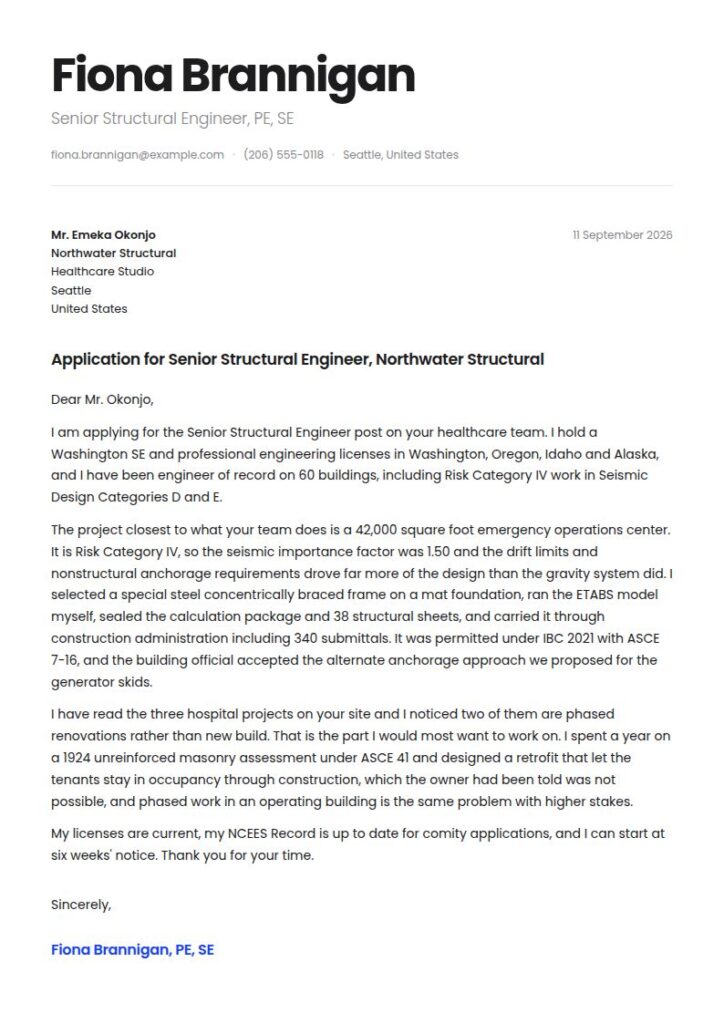
A structural engineer cover letter is a one-page letter that names one building, its structural system, the code edition it was designed to, and whether your seal was on it.
Principals read these while they are chasing work. They have a proposal due, a building type they want more of, and a seal coverage problem somewhere in the office. A letter that speaks to those three things is unusual enough to be remembered.
Guide to a structural engineer cover letter
This guide and the corresponding structural engineer cover letter example will cover:
- How to structure the letter, paragraph by paragraph
- Why one building beats a summary of your whole portfolio
- How to write licensure so a reader knows what you can sign
- What changes when you write to an owner or a forensic practice
- The openings that get a strong file read twice
How to write a structural engineer cover letter
| Paragraph | Its job | Length |
|---|---|---|
| Opening | The post, your licensure, and the building type you bring | 2 to 3 sentences |
| Evidence | One building: type, system, size, code, seismic category, your role | 4 to 6 sentences |
| Fit | Something specific about the firm's work, and what you would take on | 3 to 4 sentences |
| Close | Licensure states, availability, thank you | 2 sentences |
Say what you can seal, and where
Every structural firm has a seal coverage map in someone's head: which states, which building types, which people. Your letter should tell them where you fit on it in one sentence.
"I hold a Washington SE and PEs in Washington, Oregon, Idaho and Alaska, and I have been engineer of record on Risk Category IV work" answers the question that the resume takes a paragraph to reach.
If you are not licensed yet, say the sequence instead: the FE date, when qualifying experience started, and which structural exam components are scheduled. A firm planning two years ahead treats that as useful information rather than as a gap.
A structural engineer cover letter example you can adapt
Dear Mr. Okonjo,
I am applying for the Senior Structural Engineer post on your healthcare team. I hold a Washington SE and professional engineering licenses in Washington, Oregon, Idaho and Alaska, and I have been engineer of record on 60 buildings, including Risk Category IV work in Seismic Design Categories D and E.
The project closest to what your team does is a 42,000 square foot emergency operations center. It is Risk Category IV, so the seismic importance factor was 1.50 and the drift limits and nonstructural anchorage requirements drove far more of the design than the gravity system did. I selected a special steel concentrically braced frame on a mat foundation, ran the ETABS model myself, sealed the calculation package and 38 structural sheets, and carried it through construction administration including 340 submittals. It was permitted under IBC 2021 with ASCE 7-16, and the building official accepted the alternate anchorage approach we proposed for the generator skids.
I have read the three hospital projects on your site and I noticed two of them are phased renovations rather than new build. That is the part I would most want to work on. I spent a year on a 1924 unreinforced masonry assessment under ASCE 41 and designed a retrofit that let the tenants stay in occupancy through construction, which the owner had been told was not possible, and phased work in an operating building is the same problem with higher stakes.
My licenses are current, my NCEES Record is up to date for comity applications, and I can start at six weeks' notice. Thank you for your time.
Sincerely, Fiona Brannigan, PE, SE
Openings that work
| Instead of | Use |
|---|---|
| I am a dedicated structural engineer seeking a challenging role | I am applying for the Senior Structural Engineer post on your healthcare team |
| I have extensive experience in structural design | I hold a Washington SE and PEs in four states, engineer of record on 60 buildings |
| I have worked on a wide variety of projects | Risk Category IV work in Seismic Design Categories D and E |
| I am familiar with current building codes | Permitted under IBC 2021 with ASCE 7-16, including an accepted alternate anchorage approach |
What counts as evidence
| Kind of evidence | What it looks like in a sentence |
|---|---|
| Building type and system | 6-story Type III-A residential, wood over a two-level concrete podium |
| Code and edition | Designed to IBC 2021 with ASCE 7-16, ACI 318-19 and NDS 2018 |
| Seismic and wind | Risk Category IV, importance factor 1.50, Seismic Design Category D |
| Your role | Sealed the calculation package and 38 structural sheets |
| Construction | Carried it through construction administration and 340 submittals |
| A hard problem solved | Retrofit that kept tenants in occupancy through construction |
The last row is the one that gets remembered. Every structural engineer has designed buildings. Far fewer can point to a constraint everyone else thought was fatal and say what they did about it.
Writing to a design firm, an owner or a forensic practice
Read the firm's project pages and name a real project type they do, then match it with the closest thing you have done. Give one building in full: type, system, size, code edition, seismic design category and your role. State licensure and comity plainly, including your NCEES Record if you hold one. For an owner or agency, write about review, criteria and consultant management instead of production. For a forensic practice, write about what failed, how you established it, and whether you have testified.
Do not paste your project list into the letter; that is the resume's job. Do not say "seismic experience" without a category attached. Do not claim engineer of record on work you produced under another engineer's seal. Do not send a design-firm letter to a forensic practice, since they buy completely different evidence. Do not write to a firm without naming something they have actually built.
The occupation you are counted in, and what it pays
There is no separate federal occupation for structural engineers. The Bureau of Labor Statistics counts them within civil engineers, which had 380,600 jobs in 2025, a projected 6 percent growth to 405,100 by 2035 and about 22,700 openings a year, at a median annual wage of $100,840 (BLS Occupational Outlook Handbook, May 2025 wages and 2025-35 projections).
Engineering services holds 51 percent of that occupation at a $100,620 median, while local government sits at $113,640 and the federal government at $117,790 (BLS Occupational Outlook Handbook, May 2025).
Structural building practice sits overwhelmingly in that first row, which is why the letter's job is to make a consulting principal want to bill you to a client. Name the building type they are chasing and the code you designed it to, and you have answered the only question that pays for itself.
Length, format and sending it
One page, four paragraphs, 250 to 400 words. PDF unless the portal says otherwise, named for yourself and the post: fiona-brannigan-structural-engineer-cover-letter.pdf.
Address a person. Firm leadership is on the website, and a letter addressed to a hiring committee tells a principal that the same letter went to nine firms.
Use the same figures as your resume so the two agree. Our structural engineer resume example is written with the numbers used here, and the Rezoom ATS resume checker will tell you whether the pair parses cleanly.
Key takeaways
- Open with the post, your licensure and the building type you bring.
- Spend the middle paragraph on one building, described completely.
- Give the code edition, not just the code.
- Attach a seismic design category and a risk category to any seismic claim.
- Say whether you sealed it or worked under someone else's seal.
- Name a real project the firm has built.
- Close with licensure states, comity and availability.
Write your structural engineer cover letter in 10 minutes.
Structural engineer cover letter questions, answered
How long should a structural engineer cover letter be?
One page, four paragraphs, 250 to 400 words. A principal reads these between a proposal deadline and a site visit, and a second page is almost always a restatement of the resume.
What do I write if I am not licensed yet?
Write the sequence. When you passed the FE, when your qualifying experience started and under whom, and which structural exam components you have taken or scheduled. The NCEES structural exam is taken as two components, Vertical Forces and Lateral Forces, and both must be passed (NCEES, accessed September 2026), so naming the one you have cleared is concrete information rather than an excuse.
Should I mention the SE license if I am applying out of state?
Yes, and explain what it is. NCSEA sorts jurisdictions into full practice restriction, partial practice restriction and title restriction (NCSEA, accessed September 2026), and a reader in a state with no SE may not know which of those your license came from. One clause fixes it.
How do I write about a project I only worked on part of?
Say which part. "I designed the gravity framing and the podium transfer, under the engineer of record" is a stronger sentence than an unattributed project name, because it is specific and because it is verifiable. A principal who has been in the business for twenty years can tell the difference immediately.
Do I need a cover letter when the firm asks only for a resume and project list?
Attach one anyway if there is a field for it. The project list says what the firm did. The letter is the only place you say what you did, which building type you want more of, and what you noticed about their work.