Lianne Beauchamp CNC Machinist, Setup and Operation Grand Rapids, 49503, United States [email protected] · (616) 555-0137
11 September 2026
Mr. Erik Halvorsen Machine Shop Lakeshore Aerospace Machining Holland, United States
Application for CNC Machinist, Second Shift, Lakeshore Aerospace Machining
Dear Mr. Halvorsen,
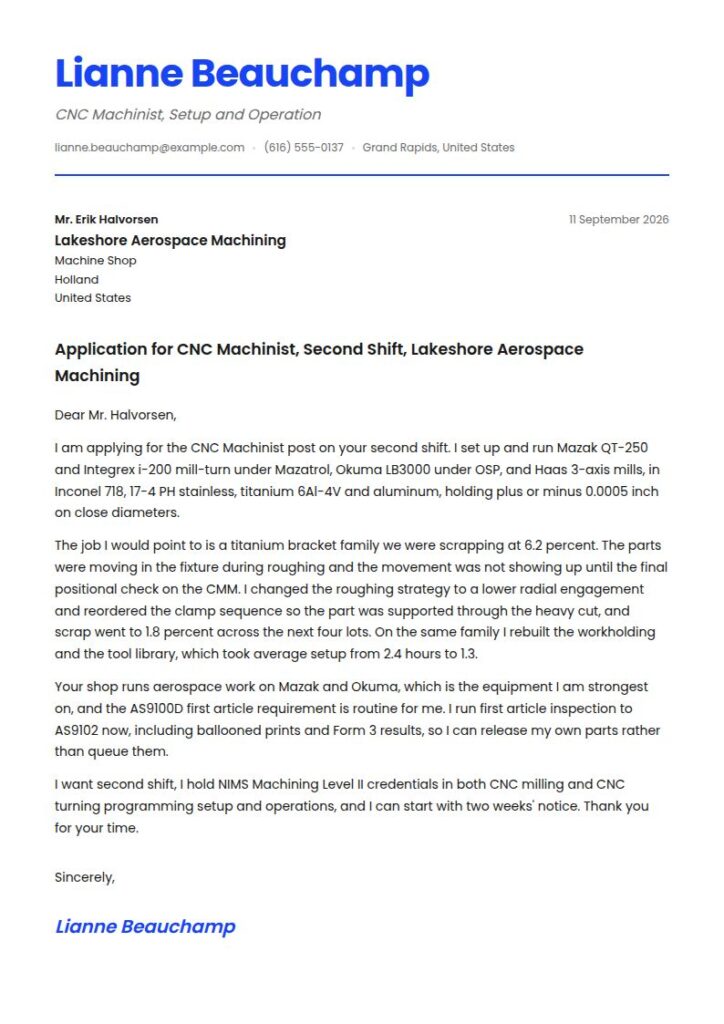
I am applying for the CNC Machinist post on your second shift. I set up and run Mazak QT-250 and Integrex i-200 mill-turn under Mazatrol, Okuma LB3000 under OSP, and Haas 3-axis mills, in Inconel 718, 17-4 PH stainless, titanium 6Al-4V and aluminum, holding plus or minus 0.0005 inch on close diameters.
The job I would point to is a titanium bracket family we were scrapping at 6.2 percent. The parts were moving in the fixture during roughing and the movement was not showing up until the final positional check on the CMM. I changed the roughing strategy to a lower radial engagement and reordered the clamp sequence so the part was supported through the heavy cut, and scrap went to 1.8 percent across the next four lots. On the same family I rebuilt the workholding and the tool library, which took average setup from 2.4 hours to 1.3.
Your shop runs aerospace work on Mazak and Okuma, which is the equipment I am strongest on, and the AS9100D first article requirement is routine for me. I run first article inspection to AS9102 now, including ballooned prints and Form 3 results, so I can release my own parts rather than queue them.
I want second shift, I hold NIMS Machining Level II credentials in both CNC milling and CNC turning programming setup and operations, and I can start with two weeks' notice. Thank you for your time.
Sincerely, Lianne Beauchamp
Summary
A CNC machinist cover letter is a short letter naming the machines and controls you can run, the tolerance class you work in, and one measured result from your own parts. This guide gives you a full adaptable letter, the opening that gets a foreman to the second paragraph, and what changes between a production shop and a job shop.
CNC Machinist cover letter examples by experience level
A CNC machinist cover letter is a short letter telling a shop foreman what you can run, on what control, to what tolerance, and what happened the last time you were handed a difficult part.
Most machinist applications arrive without one, and most of the ones that do arrive are generic. That is the opportunity. Four short paragraphs with real machine names and real numbers in them is an unusual document in a stack of manufacturing applications, and it gets read.
Guide to a CNC machinist cover letter
This guide and the corresponding CNC machinist cover letter example will cover:
- How to structure the letter, paragraph by paragraph
- Why the machine and control list belongs in the first two lines
- How to pick the one result the letter is built on
- What changes between a production shop, a job shop and an aerospace supplier
- Openings that work, and openings that close a file
How to write a CNC machinist cover letter
| Paragraph | Its job | Length |
|---|---|---|
| One | The role, the machines and controls you run, and whether you set up | 2 to 3 sentences |
| Two | One result from your own parts, with the material, tolerance and number | 4 to 5 sentences |
| Three | Something real about this shop, and what you would take on | 3 sentences |
| Four | Shift, availability, credentials and the close | 2 sentences |
Under a page, 250 to 350 words. Machinist letters are read standing up, often next to the machine they are trying to fill. Length costs you more here than in almost any other occupation.
A CNC machinist cover letter example you can adapt
Dear Mr. Halvorsen,
I am applying for the CNC Machinist post on your second shift. I set up and run Mazak QT-250 and Integrex i-200 mill-turn under Mazatrol, Okuma LB3000 under OSP, and Haas 3-axis mills, in Inconel 718, 17-4 PH stainless, titanium 6Al-4V and aluminum, holding plus or minus 0.0005 inch on close diameters.
The job I would point to is a titanium bracket family we were scrapping at 6.2 percent. The parts were moving in the fixture during roughing and the movement was not showing up until the final positional check on the CMM. I changed the roughing strategy to a lower radial engagement and reordered the clamp sequence so the part was supported through the heavy cut, and scrap went to 1.8 percent across the next four lots. On the same family I rebuilt the workholding and the tool library, which took average setup from 2.4 hours to 1.3.
Your shop runs aerospace work on Mazak and Okuma, which is the equipment I am strongest on, and the AS9100D first article requirement is routine for me. I run first article inspection to AS9102 now, including ballooned prints and Form 3 results, so I can release my own parts rather than queue them.
I want second shift, I hold NIMS Machining Level II credentials in both CNC milling and CNC turning programming setup and operations, and I can start with two weeks' notice. Thank you for your time.
Sincerely, Lianne Beauchamp
Why the machines go in the first two lines
Because that is the only question the foreman has before they decide whether to keep reading, and because it is the question a generic letter never answers.
Write builder, model or class, control and axis count. "Mazak Integrex i-200 under Mazatrol" is information. "CNC mills and lathes" is not. Then say whether you set up or operate, because that distinction is the wage.
The Bureau of Labor Statistics puts the machinist median annual wage at $58,750 as of May 2025, with the highest 10 percent above $80,010, and tool and die makers, who work at the setup, build and tight-tolerance end, at a median of $64,050 (BLS Occupational Outlook Handbook, May 2025). A letter that leaves the reader guessing which end you belong to gets read into the lower one.
Tell them what you have not run
The instinct is to claim everything, and it backfires within ten minutes of an interview starting. A foreman who has just bought a five-axis machine and hired someone who has only run a 4th axis indexer remembers it for years.
One clause is enough: "strong on Mazatrol and Fanuc, competent on OSP, familiar with Siemens 840D but not as a primary control." That sentence makes the rest of your claims believable, and it frequently gets you the job anyway, because shops budget ramp time for controls and not for lies.
The same applies to materials. If you have cut Inconel twice, say twice. Exotic material experience is checkable in the first production part.
Picking the one result
One result, not a list. Choose the one whose material, tolerance and machine class match the posting most closely, then tell it as a short story: what was wrong, what you changed, what the number did.
| Instead of | Use |
|---|---|
| I have experience reducing scrap and improving quality | Took scrap on a titanium bracket family from 6.2 percent to 1.8 percent by changing the roughing strategy and the clamp order |
| I am skilled at efficient setups | Took average setup on a family of 14 turned parts from 2.4 hours to 1.3 by rebuilding the workholding and tool library |
| I hold tight tolerances on precision parts | Hold plus or minus 0.0005 inch on close diameters and 0.002 inch positional, verified on a Zeiss CMM with PC-DMIS |
| I am familiar with quality procedures | Run first article inspection to SAE AS9102 in an AS9100D shop, including ballooned prints and Form 3 results |
The diagnosis is the part that matters. Anyone can report a scrap number. Saying that the part was moving in the fixture during roughing and that it only showed up at the positional check is the sentence that tells a foreman you troubleshoot rather than guess.
Almost every opening in this trade is a replacement, not a new job
Machinists and tool and die makers held 344,900 jobs in 2025, with about 30,400 openings projected each year over the decade to 2035, while the combined occupation is projected to shrink by 1 percent: machinists growing 1 percent and tool and die makers declining 9 percent (BLS Occupational Outlook Handbook, 2025-35 projections).
Openings that come from retirements and moves rather than expansion behave differently. There is a machine standing idle, a specific part family, and a foreman who needs someone competent on that control now. They are not building a pipeline.
So write the letter about the machine rather than about your career. The first paragraph should read as an answer to "who can run the Mazak on seconds", because that is the sentence the opening was created by.
What changes between shop types
The letter structure holds. The emphasis moves.
Production shop. They care about uptime, cycle time, scrap and consistency across long runs. Lead with volume and scrap numbers.
Job shop. They care about how fast you go from print to first good part with no help. Lead with setups a week, proveout, and the range of materials you have cut.
Aerospace or medical supplier. They care about documentation as much as machining. Lead with AS9100D or ISO 9001:2015 experience, first article inspection to AS9102, GD&T to ASME Y14.5, and CMM work with the software named.
Name builder, model, control and axis count in the first two lines. Say whether you set up or operate. Build the letter on one result, told with the diagnosis. Name the shift you want. Say plainly what you have not run.
Do not open with a statement of interest or a description of your work ethic. Do not write "CNC machines" with no builder or control. Do not list four results. Do not claim five-axis when you have run a 4th axis indexer. Do not run past one page.
Key takeaways for a CNC machinist cover letter
- Machines, controls and axis count in the first two lines.
- Say whether you set up, prove out and program, or run proven work.
- One result, with material, tolerance and the number that moved.
- Include the diagnosis, not just the outcome.
- Name what you are not strong on; it makes the rest credible.
- Say the shift you want and your notice period.
- Keep it to 250 to 350 words on one page.
Build your CNC machinist cover letter in minutes, and pair it with the CNC machinist resume guide.
CNC machinist cover letter questions, answered
How long should a CNC machinist cover letter be?
250 to 350 words, four short paragraphs, one page. These are read quickly and often on paper next to a machine. A long letter is not read more carefully, it is read less.
Do shops actually read cover letters for machinist jobs?
Enough of them do that it is worth the fifteen minutes, because so few applicants send one. The letter is also where you can answer the questions the resume format cannot: which shift you want, what you have not run, and whether you can release your own first article.
Should I put my tolerance capability in the letter?
Yes, with the feature it applies to. "Plus or minus 0.0005 inch on close diameters and 0.002 inch positional on hole patterns" is a capability statement. "Tight tolerances" is a phrase that appears on every letter in the stack.
How do I write this letter with no shop experience?
Write the school or training shop as a shop. Name the machines and controls you ran, the materials, the tolerance you were graded to, any NIMS credentials by their full names, and one part you struggled with and fixed. Then say the shift you want. Shops hire attitude and measurement ability at entry level, and both of those are demonstrable in a paragraph.
Should I mention pay expectations in the letter?
Only if the posting asks. If it does, give a range and anchor it to capability rather than to years: setup and proveout, tolerance class, programming, and whether you can run unattended on second or third shift are what actually set the number.