CNC Machine Operator, 3-Axis Milling Lianne Beauchamp
CNC Machine Operator, Second Shift
[email protected] | (616) 555-0137 | Grand Rapids, United States
Profile
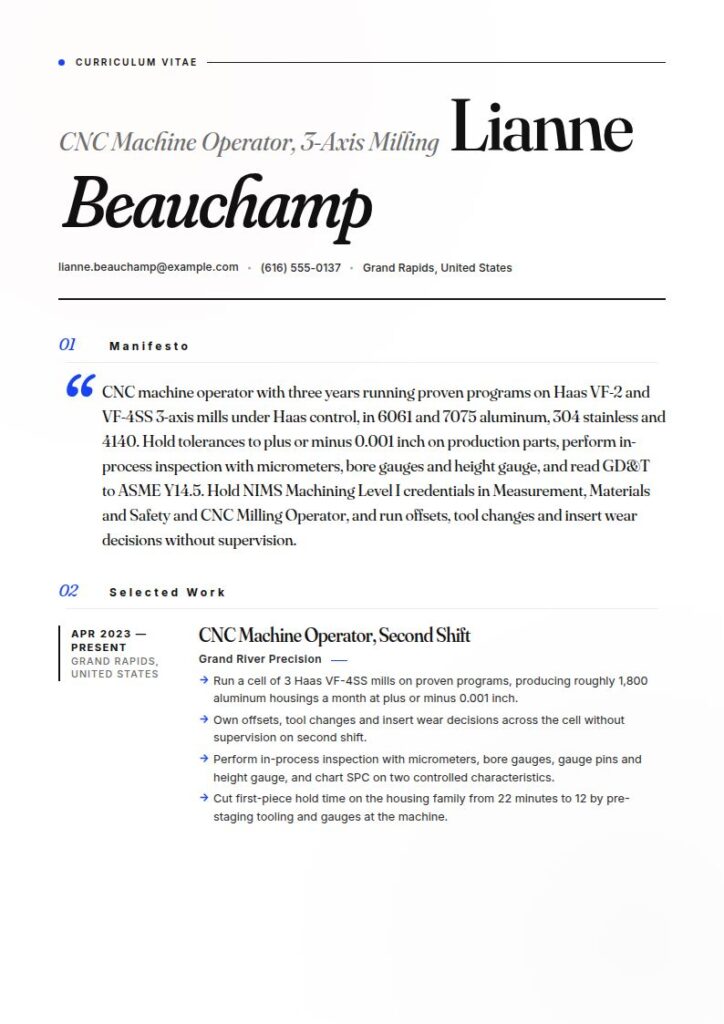
CNC machine operator with three years running proven programs on Haas VF-2 and VF-4SS 3-axis mills under Haas control, in 6061 and 7075 aluminum, 304 stainless and 4140. Hold tolerances to plus or minus 0.001 inch on production parts, perform in-process inspection with micrometers, bore gauges and height gauge, and read GD&T to ASME Y14.5. Hold NIMS Machining Level I credentials in Measurement, Materials and Safety and CNC Milling Operator, and run offsets, tool changes and insert wear decisions without supervision.
Work Experience
04/2023 - Present, CNC Machine Operator, Second Shift, Grand River Precision, Grand Rapids, United States
- Run a cell of 3 Haas VF-4SS mills on proven programs, producing roughly 1,800 aluminum housings a month at plus or minus 0.001 inch.
- Own offsets, tool changes and insert wear decisions across the cell without supervision on second shift.
- Perform in-process inspection with micrometers, bore gauges, gauge pins and height gauge, and chart SPC on two controlled characteristics.
- Cut first-piece hold time on the housing family from 22 minutes to 12 by pre-staging tooling and gauges at the machine.
08/2021 - 03/2023, Machine Operator, Deburr and Finishing, Kentwood Metal Products, Kentwood, United States
- Deburred and finished machined aluminum and stainless components, 400 to 600 parts a shift.
- Ran final visual and dimensional checks against ballooned prints before packing.
Education
01/2021 - 12/2022, Certificate, Machine Tool Technology, Grand Rapids Community College, Grand Rapids, United States
Manual and CNC milling and turning, print reading, GD&T to ASME Y14.5, and metrology.
Skills
Haas control, 3-axis milling, 80
Offsets and insert wear management, 75
GD&T to ASME Y14.5, 65
Micrometers, bore gauges and gauge pins, 80
Height gauge and surface plate, 70
SPC charting, 60
Deburring and finishing, 85
Languages
English, native
French, intermediate
Certificates
05/2022, NIMS Machining Level I, Measurement, Materials and Safety, National Institute for Metalworking Skills
Performance assessment plus proctored theory exam.
11/2022, NIMS Machining Level I, CNC Milling Operator, National Institute for Metalworking Skills
02/2024, OSHA 10 General Industry, OSHA Training Institute
Summary
A CNC machinist resume is a one page document listing the machines and controls you have run, the materials you have cut, the tolerances you hold and whether you set up or only operate. This guide gives you three adaptable versions, the machine list that decides interviews, and current Bureau of Labor Statistics pay for machinists and tool and die makers.
CNC Machinist resume examples by experience level
A CNC machinist resume is a one page document that lists machines, controls, materials and tolerances, in that order of importance to the person reading it.
Shop foremen do not read machinist resumes for narrative. They read them the way they read a capability sheet from a supplier: what can this run, on what control, in what material, to what tolerance, and does it need a setup man standing next to it. Every line that does not answer one of those five questions is filler, and a one page file that answers all five beats a two page file that answers none.
Resume guide for a CNC machinist resume
This guide and the corresponding CNC machinist resume example will cover:
- How to write a CNC machinist resume, section by section
- How to list machines, controls and axis counts so a foreman can price you
- Three adaptable summaries: operator, setup machinist and programmer
- Setup versus operation, and why the distinction decides the wage
- What the job market looks like and what you can expect to earn
How to write a CNC machinist resume
Six blocks: contact header, summary, machines and controls, experience, inspection and quality, and education with credentials. One page. Two only if you program, run five-axis work, and have a tooling record worth listing.
The machine list goes high, usually directly under the summary. It is the part of the page a foreman reads first, and burying it inside job bullets is the single most common way a qualified machinist gets passed over.
| Section | What it is answering | Where it goes |
|---|---|---|
| Machines and controls | What can this person walk up to and run on Monday? | Directly under the summary |
| Experience | Setup, operation or programming, and at what volume? | Reverse chronological, with part and tolerance detail |
| Inspection and quality | Can they prove a part is good without asking quality? | Its own block, with the equipment named |
| Education and credentials | NIMS, apprenticeship, tooling coursework | Bottom, with the credential names spelled out |
Name the control, not just the machine builder
"Haas" tells a foreman almost nothing on its own. "Haas VF-4SS, Haas control, 3-axis" tells them the machine envelope, the operator interface and the kind of work it sees. A shop running Mazak Integrex with Mazatrol will read a Fanuc-only background as a real ramp, and will say so at the interview if you did not say it first.
Write the stack as builder, model or class, control, and axis count. Haas VF-2 and VF-4SS, Haas control, 3-axis. Mazak QT-250 with Mazatrol. Okuma Genos M560-V with OSP. Doosan with Fanuc 31i. Citizen and Star Swiss with Fanuc.
Then say where you are strong and where you are only competent. A machinist who writes "strong on Fanuc and Haas, working knowledge of Siemens 840D" reads as someone who knows the difference. A machinist who lists nine controls with no qualifier reads as someone who has watched nine machines run.
Run the finished file through the free Rezoom ATS resume checker before you send it. Large manufacturers and every aerospace supplier parse applications into a system before a foreman ever sees one.
Choosing the best resume format for a CNC machinist resume
Reverse chronological, one page, single column. A skills-based format is tempting here because the machine list is the point, but it fails for a specific reason: shops read tenure as evidence that you held tolerance under production pressure, and a format that hides dates reads as a format hiding job-hopping.
Put the machine and control block above the experience anyway. That gets you the capability-sheet benefit without losing the timeline.
Include your contact information
| ✅ Right | ❌ Wrong |
|---|---|
| Lianne Beauchamp | Lianne Beauchamp |
| CNC Machinist, Mill-Turn and 5-Axis, Setup and Programming | Hardworking manufacturing professional |
| NIMS Machining Level II, CNC Milling and CNC Turning | NIMS certified |
| (616) 555-0137, [email protected], Grand Rapids, MI | (616) 555-0137, [email protected] |
Put the shift you want and your willingness to travel for install or first-off work in the header if either is unusual. Second and third shift openings are a large share of what shops are actually trying to fill, and a resume that says "available second shift" answers a question the foreman was going to ask on the phone.
Make use of a summary
Four lines: what you set up and run, the controls, the materials and tolerance band, and one number that describes throughput, scrap or setup time.
CNC machine operator with three years running proven programs on Haas VF-2 and VF-4SS 3-axis mills under Haas control, in 6061 and 7075 aluminum, 304 stainless and 4140. Hold tolerances to plus or minus 0.001 inch on production parts, perform in-process inspection with micrometers, bore gauges and height gauge, and read GD&T to ASME Y14.5. Hold NIMS Machining Level I credentials in Measurement, Materials and Safety and CNC Milling Operator, and run offsets, tool changes and insert wear decisions without supervision.
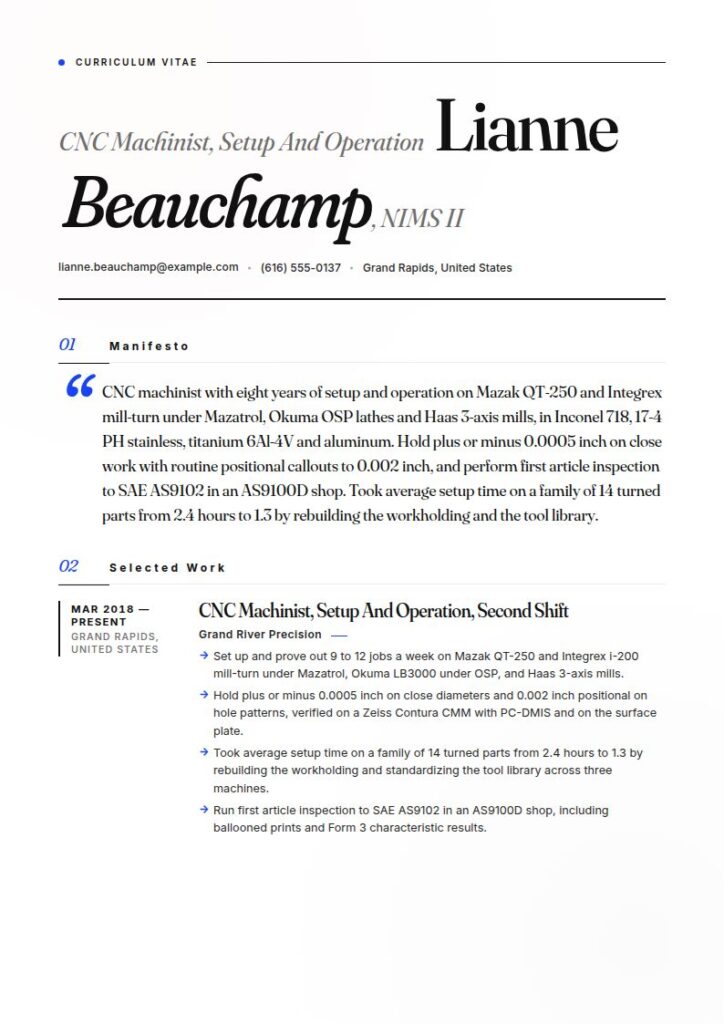
CNC machinist with eight years of setup and operation on Mazak QT-250 and Integrex mill-turn under Mazatrol, Okuma OSP lathes and Haas 3-axis mills, in Inconel 718, 17-4 PH stainless, titanium 6Al-4V and aluminum. Hold plus or minus 0.0005 inch on close work with routine positional callouts to 0.002 inch, and perform first article inspection to SAE AS9102 in an AS9100D shop. Took average setup time on a family of 14 turned parts from 2.4 hours to 1.3 by rebuilding the workholding and the tool library.
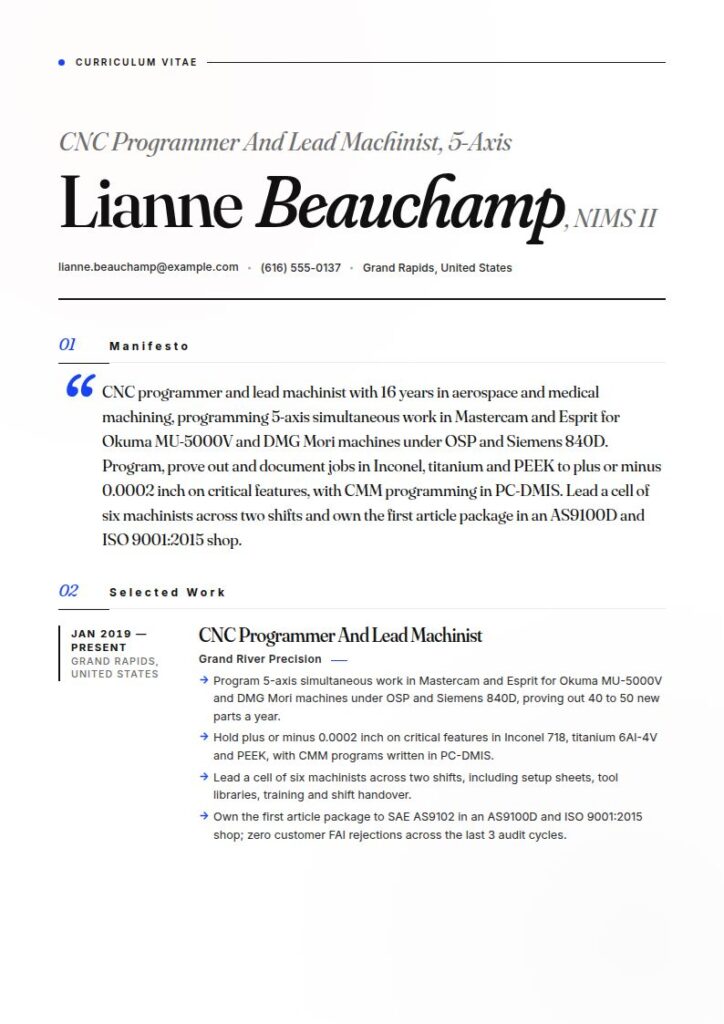
CNC programmer and lead machinist with 16 years in aerospace and medical machining, programming 5-axis simultaneous work in Mastercam and Esprit for Okuma MU-5000V and DMG Mori machines under OSP and Siemens 840D. Program, prove out and document jobs in Inconel, titanium and PEEK to plus or minus 0.0002 inch on critical features, with CMM programming in PC-DMIS. Lead a cell of six machinists across two shifts and own the first article package in an AS9100D and ISO 9001:2015 shop.
Right vs wrong: the same CNC machinist summary, twice
| ✅ Right | ❌ Wrong |
|---|---|
| Setup and operation on Mazak Integrex mill-turn under Mazatrol and Okuma OSP lathes. | Experienced with a variety of CNC machines and controls. |
| Hold plus or minus 0.0005 inch on close work, with positional callouts to 0.002 inch. | Capable of producing high-quality precision parts to tight tolerances. |
| Took setup time on a family of 14 turned parts from 2.4 hours to 1.3 by rebuilding the workholding. | Improved efficiency and reduced downtime in the machine shop. |
The right column can be quoted against a job on the board next week. The left column cannot, and the foreman reading it is quoting jobs.
Outline your experience
Employer, city, dates, title and shift. Then bullets that name a part family, a material, a tolerance and a volume. A machinist bullet without a number in it is a job description, not a record.
| Instead of | Use |
|---|---|
| Operated CNC machines to produce parts | Ran 3 Haas VF-4SS mills across a cell producing 1,800 aluminum housings a month at plus or minus 0.001 inch |
| Performed setups on lathes and mills | Set up and proved out 9 to 12 jobs a week on Mazak QT-250 and Integrex, including workholding, tool library and offsets |
| Worked with various materials | Cut Inconel 718, titanium 6Al-4V, 17-4 PH stainless and 6061 aluminum, with speeds and feeds adjusted off tool life data |
| Inspected parts for quality | Ran first article inspection to SAE AS9102 and in-process checks on a Zeiss CMM with PC-DMIS, plus micrometers, bore gauges and surface plate work |
| Reduced scrap | Took scrap on a titanium bracket family from 6.2 percent to 1.8 percent by changing the roughing strategy and the fixture clamp order |
| Programmed parts | Programmed 5-axis simultaneous work in Mastercam for Okuma MU-5000V, proving out 40 to 50 new parts a year |
CNC Machinist, Setup and Operation, Grand River Precision, Grand Rapids, MI, March 2018 to Present. Second shift.
Set up and prove out 9 to 12 jobs a week on Mazak QT-250 and Integrex i-200 mill-turn under Mazatrol, Okuma OSP lathes and Haas 3-axis mills, in Inconel 718, 17-4 PH stainless, titanium 6Al-4V and aluminum.
Hold plus or minus 0.0005 inch on close diameters and 0.002 inch positional on hole patterns, verified on a Zeiss Contura CMM with PC-DMIS and on the surface plate.
Took average setup time on a family of 14 turned parts from 2.4 hours to 1.3 by rebuilding the workholding and standardizing the tool library across three machines.
Run first article inspection to SAE AS9102 in an AS9100D shop, including ballooned prints and the Form 3 characteristic results.
Train two operators a year on offsets, insert wear and in-process gauging, and write the setup sheets they work from.
List the machines, the materials and the tolerances you actually hold
This is the block that decides interviews, and it is the one most machinist resumes leave as a vague skills list. Give it four lines, because a foreman is matching it against a specific machine that is sitting idle.
Machines: Mazak QT-250 and Integrex i-200 mill-turn (Mazatrol), Okuma LB3000 (OSP), Haas VF-2 and VF-4SS 3-axis mills (Haas control), Doosan DNM 4500 with 4th axis (Fanuc 31i), Citizen L20 Swiss (Fanuc). Familiar with Siemens 840D on 5-axis, not yet a primary control.
Materials: Inconel 718, titanium 6Al-4V, 17-4 PH and 304 stainless, 4140 and 4340, 6061 and 7075 aluminum, brass, Delrin and PEEK.
Tolerance and print: plus or minus 0.0005 inch on close diameters, 0.002 inch positional on hole patterns, 32 Ra surface finish on bearing journals. Read GD&T to ASME Y14.5, including datum structures, true position and profile callouts.
CAM and programming: Mastercam 3-axis and 4-axis, Fusion 360 for fixtures and simple parts, Esprit for turning. Edit at the control on Mazatrol and Fanuc.
Four lines, four different questions. The machine line says what you can walk up to. The material line says whether you have fought work hardening and chip control, or only cut aluminum. The tolerance line says what class of work you belong to. The CAM line says whether the shop has to give you a programmer.
Say what you have not run. "Familiar with Siemens 840D, not yet a primary control" is the sentence that stops an interview going wrong in the first ten minutes, and shops read it as honesty rather than weakness.
The difference between setup and operation is where the wage sits
Machinists had a median annual wage of $58,750 in May 2025, with the lowest 10 percent under $39,200 and the highest 10 percent above $80,010. Tool and die makers, who work almost entirely in setup, build and tight tolerance work, had a median of $64,050, a lowest 10 percent of $44,680 and a highest 10 percent above $92,680 (BLS Occupational Outlook Handbook, May 2025).
That gap of roughly $5,300 at the median, and $12,670 at the top decile, is the setup and toolmaking premium, and a resume that does not distinguish setup work from button-pushing gets read into the lower half of it by default.
So write the distinction explicitly: how many setups a week, whether you prove out first articles, whether you write or edit the program, whether you pick the workholding and the tooling, and whether anyone checks your offsets. Those sentences are worth more on the page than another machine name.
Build a snapshot of your key skills and inspection equipment
Twelve to sixteen entries in three groups. Keep the inspection group separate, because it is the shortest route to convincing a quality manager that you can run unattended.
Machining: Setup and proveout, Workholding and fixture design, Speeds and feeds optimization, Tool life management, Offsets and insert wear, Deburring and finishing, Swiss and bar feed work
Programming and CAM: Mastercam, Esprit, Fusion 360, Conversational programming in Mazatrol, G-code editing at the control, Post processor troubleshooting
Inspection and quality: Zeiss CMM with PC-DMIS, Micrometers, bore gauges and gauge pins, Height gauge and surface plate, Optical comparator, Surface roughness tester, First article inspection to SAE AS9102, SPC charting, GD&T to ASME Y14.5
List your education and NIMS credentials
Apprenticeship or program first, then credentials with the issuing body and the specific credential names. Generic "NIMS certified" is worth much less than the list.
Machine Tool Technology Certificate, Grand Rapids Community College, Grand Rapids, MI, 2017
Registered Apprenticeship, Machinist, Grand River Precision, completed 2021, 8,000 hours with related technical instruction
NIMS credentials: Measurement, Materials and Safety; Job Planning, Benchwork and Layout; CNC Milling Operator; CNC Turning Operator; CNC Milling Programming Setup and Operations; Turning Operations Chucking Skills II
Additional: Mastercam Mill Level 3 training (2023). Forklift and overhead crane certified. OSHA 10 General Industry (2024).
NIMS credentials are performance tested, and that is the part worth writing
NIMS offers 20 credentials across Machining Level 1 and Level 2, covering measurement and materials, job planning and layout, manual milling and turning, grinding, drill press, EDM, and CNC milling and turning at both operator and programming setup and operations level (NIMS, Machining Credentialing Starter Guide, accessed September 2026).
Each one takes two validations rather than one: a performance assessment, completed unassisted under a sponsor's supervision through a Credentialing Achievement Record or an industry-designed project, and a proctored 90-minute theory exam. Level I theory exams cost $35 and Level II $50 (NIMS, accessed September 2026).
That performance half is why the credential names belong on the page individually. "NIMS CNC Milling: Programming Setup and Operations" tells a shop that somebody watched you produce a part to print. "NIMS certified" tells them you passed something.
Choose the right layout and design
Single column, one page, plain type at 11 point, no photograph, no skill rating bars. Manufacturing applicant systems are frequently older than the ones in office hiring, and a two-column template with graphics arrives as a wall of run-together text.
Put the machine and control list directly under the summary. Name the control alongside the builder and the axis count. Give a tolerance band with real numbers. Separate setup work from operation. List inspection equipment by name, including the CMM and its software. Spell out each NIMS credential. Say which shift you want.
Do not write "CNC machines" with no builder, model or control. Do not claim five-axis if you have run a 4th axis indexer. Do not list every material the shop cut if you did not run it. Do not leave first article inspection and AS9102 off the page if you have done it. Do not pad to two pages; a machinist resume that fills one page well is a strong resume.
CNC machinist job market and outlook
A large occupation that is flat overall, with very heavy replacement demand and a sharp split between the two halves of it.
| Measure | Value |
|---|---|
| Machinist and tool and die maker jobs, 2025 | 344,900 |
| Machinist jobs, 2025 | 288,300 |
| Tool and die maker jobs, 2025 | 56,700 |
| Projected change, machinists, 2025-35 | +1% (+3,000) |
| Projected change, tool and die makers, 2025-35 | -9% (-5,200) |
| Projected annual openings, combined | ~30,400 |
| Typical entry-level education | High school diploma or equivalent |
| Median annual wage, machinists, May 2025 | $58,750 |
Source: U.S. Bureau of Labor Statistics, Occupational Outlook Handbook, May 2025 wage data and 2025-35 employment projections.
About 30,400 openings a year against a combined workforce of 344,900 is the number worth holding on to. Almost all of it comes from replacement rather than growth, which is why shops hire on demonstrated capability rather than on years, and why a precise machine list beats a long tenure on a vague one.
Where the jobs sit:
| Industry | Share of machinist employment | Median annual wage (May 2025) |
|---|---|---|
| Fabricated metal product manufacturing | 35% | $54,910 |
| Machinery manufacturing | 21% | $59,590 |
| Transportation equipment manufacturing | 13% | $61,920 |
| Wholesale trade | 4% | Not published on the OOH page |
| Employment services | 3% | Not published on the OOH page |
Source: U.S. Bureau of Labor Statistics, Occupational Outlook Handbook, May 2025.
What salary you can expect as a CNC machinist
The median annual wage for machinists was $58,750 in May 2025, with the lowest 10 percent under $39,200 and the highest 10 percent above $80,010. Tool and die makers had a median of $64,050, ranging from under $44,680 to more than $92,680 (BLS Occupational Outlook Handbook, May 2025).
Industry moves it more than most machinists expect. Transportation equipment manufacturing paid a machinist median of $61,920 against $54,910 in fabricated metal product manufacturing, which employs the largest share of the occupation at 35 percent (BLS, May 2025). For tool and die makers the same industry paid $78,200 (BLS, May 2025).
Inside any one shop, the things that move your number are the ones a resume can carry: whether you set up as well as run, whether you program or only edit, the tolerance class you are trusted with, whether you can sign your own first article, and whether you can be left alone on second or third shift. Each of those is a sentence, and each sentence is worth more than another line of duties.
Key takeaways for a CNC machinist resume
- Put the machine, control and axis list directly under the summary, not inside job bullets.
- Name the control alongside the builder; "Haas" alone tells a foreman nothing.
- Give a real tolerance band and the features you hold it on.
- Separate setup and proveout from operation; that distinction is where the wage sits.
- Name inspection equipment, including the CMM and its software, and say if you run first article.
- Spell out each NIMS credential rather than writing "NIMS certified".
- Keep it to one page, single column, and say which shift you want.
Build your CNC machinist resume in 15 minutes.
Related engineering resume examples
- Civil engineer resume
- Electrical engineer resume
- Mechanical engineer resume
- Chemical engineer resume
- Process engineer resume
- Structural engineer resume
- Systems engineer resume
- Facility engineer resume
- Research engineer resume
- Health and safety engineer resume
- Technician resume
- Engineering sector resume
Pair it with a matching CNC machinist cover letter.
CNC machinist resume questions, answered
How long should a CNC machinist resume be?
One page. The machine list, the tolerance band, the materials and two or three jobs fit comfortably, and a foreman reads the whole thing. Go to two pages only if you program five-axis work, build tooling, or hold a long NIMS and training record that a hiring manager will actually use.
Should I list every machine I have ever touched?
No. List what you can be productive on now, with builder, model or class, control and axis count, then a short line for what you are familiar with but would need time on. A padded machine list gets found in the first ten minutes of an interview, and a shop that has just bought a machine for you is not forgiving about it.
What is the difference between a CNC operator and a CNC machinist on a resume?
Setup. An operator runs proven programs, changes tools and inserts, adjusts offsets and inspects in process. A machinist sets up the job, picks the workholding, proves out the first part and often edits or writes the program. Say which you do, and how often, because tool and die makers, who sit at the setup and build end, had a median of $64,050 against $58,750 for machinists as of May 2025 (BLS Occupational Outlook Handbook, May 2025).
Do NIMS credentials matter to employers?
They matter most when you list them individually. NIMS runs 20 credentials across Machining Level 1 and Level 2, each requiring a supervised performance assessment as well as a proctored 90-minute theory exam (NIMS, accessed September 2026), so the specific credential tells a shop exactly which operation someone watched you perform to print.
How do I show quality experience without a quality job title?
Name the equipment and the paperwork. In-process gauging with micrometers, bore gauges and gauge pins, CMM work with the machine and software named, surface plate and comparator work, SPC charting, and first article inspection to SAE AS9102 in an AS9100D or ISO 9001:2015 shop. Those lines tell a quality manager you can release your own parts.
What do I put on a CNC machinist resume with no shop experience?
The program and the credentials, written concretely. Name the machines and controls in the school shop, the materials you cut, the tolerance you were graded to, the prints you read, and any NIMS credentials with their full names. Then add the non-shop evidence that predicts well: measurement, attendance, shift flexibility, and any maintenance, fabrication or automotive work where you held a tolerance and read a print.