Research Engineer, Energy Storage Materials Sunniva Rask M.S.
Research Engineer I
[email protected] | (505) 555-0163 | Albuquerque, United States
Profile
Research engineer with an MS in materials science and engineering from the University of New Mexico and two years in a corporate materials R&D group working at technology readiness levels 2 to 4. Built and ran the accelerated aging test bed for solid electrolyte candidates, screening 41 compositions and carrying three into prototype cells. Output to date is four peer-reviewed publications, one provisional patent application and eleven internal technical reports the product group used directly.
Work Experience
08/2012 - Present, Research Engineer I, Cottonwood Materials Research, Albuquerque, United States
- Screened 41 solid electrolyte compositions at TRL 2 to 4 and carried three into prototype coin cells for the product group.
- Designed and built the accelerated aging test bed now used by the whole group, cutting the screening cycle for a new composition from 14 weeks to 9.
- Ran X-ray diffraction, electrochemical impedance spectroscopy and galvanostatic cycling as the group's primary characterization path, roughly 300 samples a year.
- Wrote 11 internal technical reports, including the stability study that redirected a product line away from an oxide chemistry.
- Author on four peer-reviewed publications, two as first author, and named on one provisional patent application.
09/2010 - 05/2012, Graduate Research Assistant, University of New Mexico, Department of Materials Science and Engineering, Albuquerque, United States
- Built inert atmosphere synthesis workflows for sulfide electrolytes and trained four incoming students on glovebox practice.
- Thesis work produced two conference presentations and one journal article.
Education
08/2010 - 05/2012, Master of Science, Materials Science and Engineering, University of New Mexico, Albuquerque, United States
Thesis on inert atmosphere processing of sulfide solid electrolytes.
09/2006 - 05/2010, Bachelor of Science, Materials Science and Engineering, University of Minnesota, Minneapolis, United States
EAC/ABET-accredited program.
Skills
Solid-state synthesis and glovebox processing, 80
X-ray diffraction, 75
Electrochemical impedance spectroscopy, 75
Accelerated aging and failure analysis, 70
Design of experiments, 70
Python for data analysis, 75
Technical report writing, 80
Languages
English, native
Norwegian, native
German, intermediate
Certificates
11/2010, Engineer in Training, New Mexico Board of Licensure for Professional Engineers and Surveyors, NM-EI-20441
FE Materials and Other Disciplines passed October 2010.
Summary
A research engineer resume is a two to three page document that reports what each project reached rather than what it explored. This guide gives you three adaptable versions, the readiness level framing that makes research legible to an industrial reader, a method for listing patents and publications without producing a CV, and current Bureau of Labor Statistics pay data.
Research Engineer resume examples by experience level
A research engineer resume is a two to three page document that says what each project reached, who used the result, and which of your outputs a reader can go and verify.
It is an awkward document to write, because it has to serve two readers who want opposite things. A hiring manager at a corporate R&D center wants an engineering resume: scope, budget, transition, impact. A group leader at a national laboratory or a defense contractor wants to see the record of output that an academic CV carries: patents, publications, technical reports, principal investigator history. Most research engineers write one of those two documents and send it to both. The resume that wins is a third thing.
Resume guide for a research engineer resume
This guide and the corresponding research engineer resume example will cover:
- How to write a research engineer resume, section by section
- When to send a resume, when to send a CV, and how to build the hybrid
- Three adaptable summaries: early career, staff researcher and principal
- How to list patents and publications without turning the page into a CV
- What the job market looks like and what you can expect to earn
How to write a research engineer resume
Seven sections: contact header, summary, research and project experience, selected outputs, technical skills, education, and clearance or credentials if you hold them. Two pages is normal here and three is acceptable once you have a real publication and patent record.
The central discipline is that research experience is written as delivery, not as inquiry. "Investigated novel electrolyte chemistries" describes an activity. "Screened 41 solid electrolyte compositions and carried three to a 2 amp-hour pouch cell prototype" describes a result, and the second version is the same work.
| Section | What it is answering | Where it goes |
|---|---|---|
| Research experience | What did each program reach, and who took it next? | Reverse chronological, with a readiness level per project |
| Selected outputs | Patents, publications, reports: what exists and can be checked? | A named block, capped, with counts and selections |
| Funding and PI history | Can this person win and run money? | Inside experience or its own short block |
| Clearance | Can they start on the classified program in March or in March next year? | Header or a credentials line, with level and date |
Write the transition, not the discovery
An industrial reader is buying transition risk. Their real question is whether your research leaves the bench.
So end every project line with what happened next. The result went into a product line. The result went into a follow-on program with a named sponsor. The result became a granted patent. The result was a negative outcome that stopped a $3 million program early, which is a genuine and underused claim.
Research that went nowhere is normal and every reader knows it. Research described with no statement of what happened next reads as research that went nowhere and was not noticed.
Run the finished file through the free Rezoom ATS resume checker before you submit. National laboratories, prime contractors and corporate R&D groups all parse applications into a system first, and clearance and degree fields are often the literal filter.
Choosing the best resume format for a research engineer resume
Reverse chronological, two to three pages, with a capped outputs section. This is the hybrid, and it is the correct answer for almost every research engineering post.
The decision that confuses people is resume against academic CV, so decide it on the posting rather than on your self-image.
| The posting is | Send | Why |
|---|---|---|
| Corporate R&D, an industrial research center, a startup | A two-page resume with a capped selected-outputs block | The reader is buying delivery; the full publication list is noise to them |
| A national laboratory staff or postdoc post | Two to three pages, outputs expanded, PI and funding history included | Laboratory hiring committees read output records but also want program delivery |
| A defense contractor or a federally funded R&D center | Two pages, clearance and program history first, outputs capped | Clearance and program-of-record experience dominate; classified work limits what you can publish |
| A faculty or university research center post | A full academic CV, uncapped | A different document with different rules |
If the posting asks for a CV, send a CV. The hybrid is built by taking the industry resume as the base and grafting on exactly two things: a selected-outputs block with counts and a small number of named items, and a funding line that says what you have won and run. Everything else stays in resume form, which means bullets with numbers rather than paragraphs with citations.
Include your contact information
| ✅ Right | ❌ Wrong |
|---|---|
| Sunniva Rask, PhD | Sunniva Rask |
| Research Engineer, Energy Storage Materials | Innovative researcher with a passion for discovery |
| Active Secret clearance, granted 2020. US citizen. | Security clearance available |
| (505) 555-0163, [email protected], Albuquerque, NM | (505) 555-0163, [email protected] |
Put the clearance level and the year on the page if you hold one, and say whether it is active or reinstatable. A cleared candidate can start on a program in weeks; an uncleared one may take many months to be processed onto it, and that difference is worth more to a program manager than a line of research experience.
Make use of a summary
Four lines: your field, where you sit institutionally, the readiness range you work at, and your output record in counts.
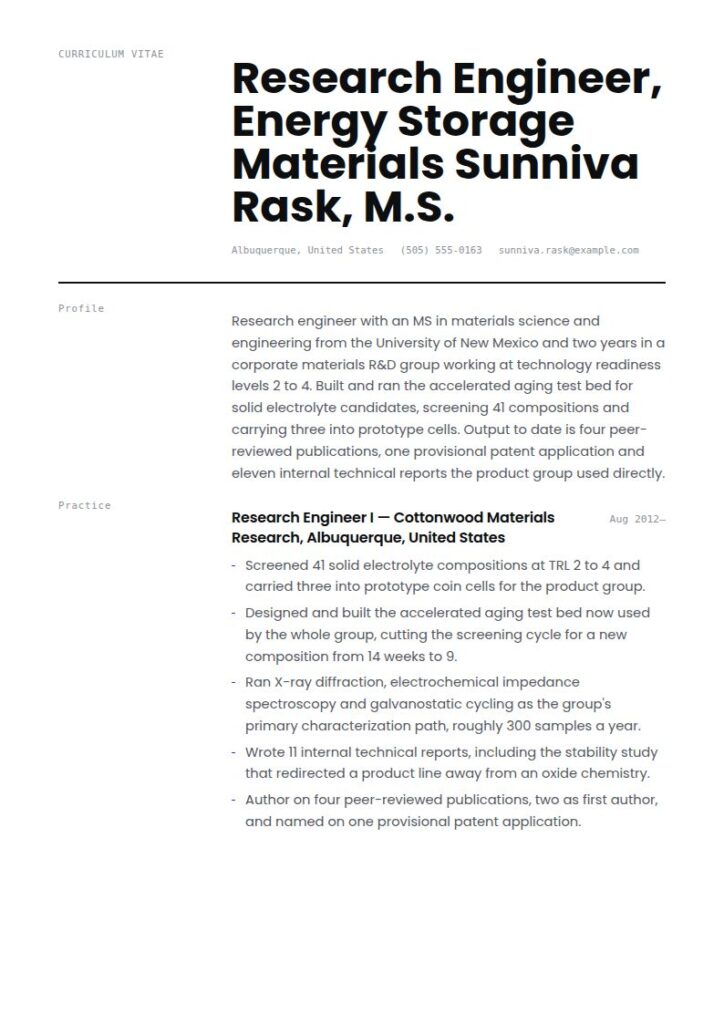
Research engineer with an MS in materials science and engineering from the University of New Mexico and two years in a corporate materials R&D group working at technology readiness levels 2 to 4. Built and ran the accelerated aging test bed for solid electrolyte candidates, screening 41 compositions and carrying three into prototype cells. Output to date is four peer-reviewed publications, one provisional patent application and eleven internal technical reports the product group used directly.
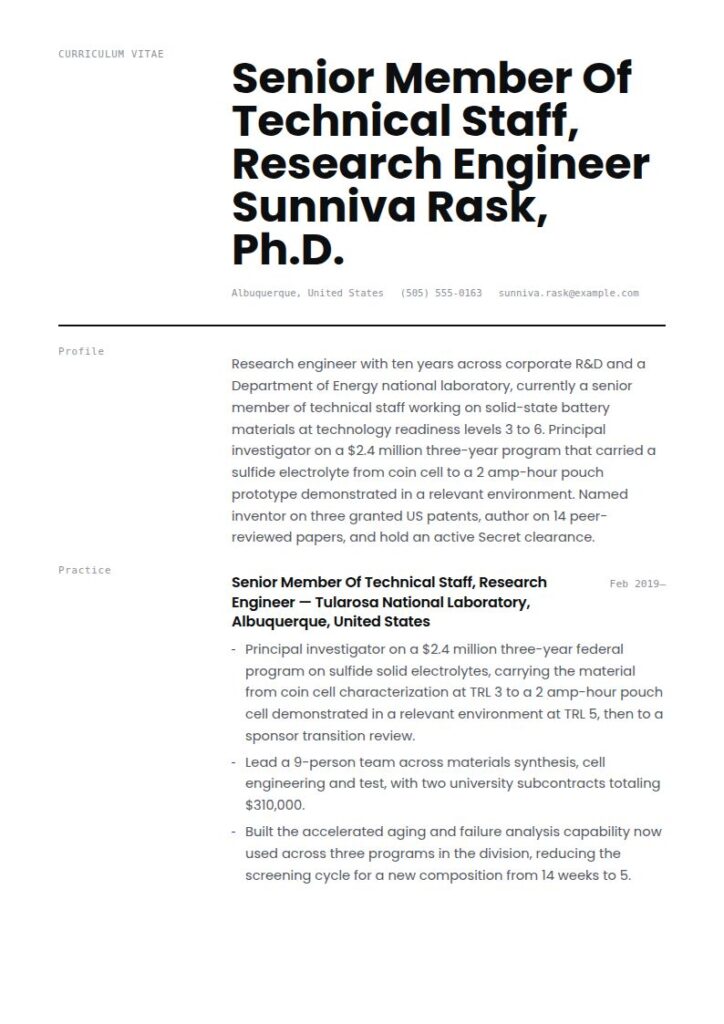
Research engineer with ten years across corporate R&D and a Department of Energy national laboratory, currently a senior member of technical staff working on solid-state battery materials at technology readiness levels 3 to 6. Principal investigator on a $2.4 million three-year program that carried a sulfide electrolyte from coin cell to a 2 amp-hour pouch prototype demonstrated in a relevant environment. Named inventor on three granted US patents, author on 14 peer-reviewed papers, and hold an active Secret clearance.
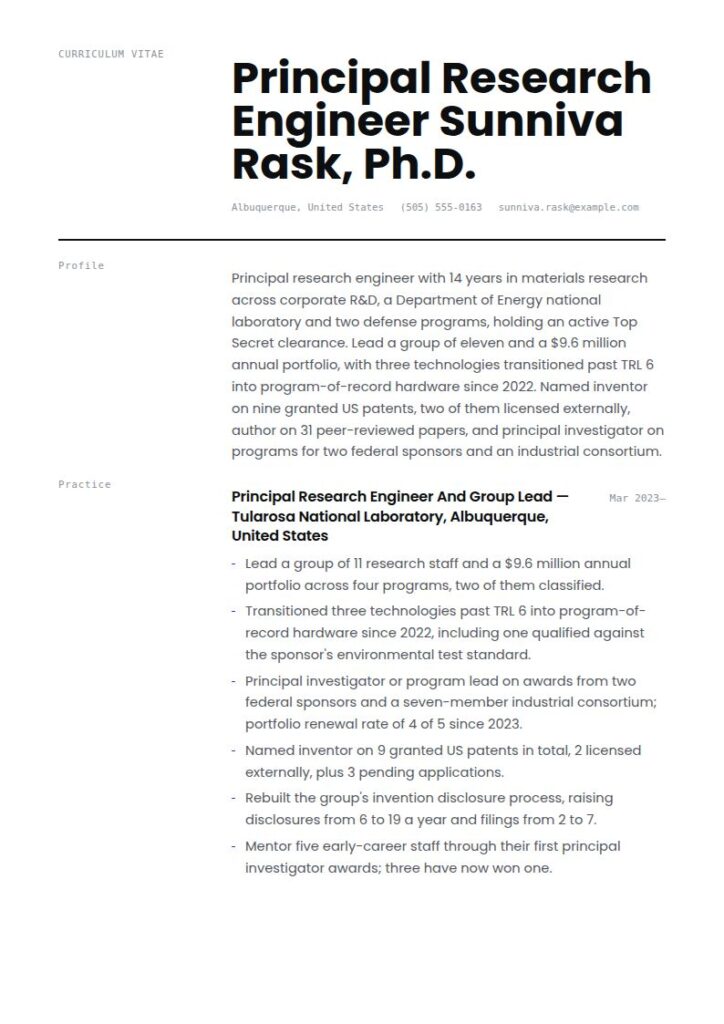
Principal research engineer with 14 years in materials research across corporate R&D, a Department of Energy national laboratory and two defense programs, holding an active Top Secret clearance. Lead a group of eleven and a $9.6 million annual portfolio, with three technologies transitioned past TRL 6 into program-of-record hardware since 2022. Named inventor on nine granted US patents, two of them licensed externally, author on 31 peer-reviewed papers, and principal investigator on programs for two federal sponsors and an industrial consortium.
Right vs wrong: the same research engineer summary, twice
| ✅ Right | ❌ Wrong |
|---|---|
| Research engineer with ten years across corporate R&D and a Department of Energy national laboratory. | Highly motivated researcher with extensive experience in cutting-edge technology. |
| Carried a sulfide electrolyte from coin cell to a 2 amp-hour pouch prototype demonstrated in a relevant environment. | Conducted advanced research into next-generation battery materials. |
| Named inventor on three granted US patents and author on 14 peer-reviewed papers. | Published widely and contributed to numerous intellectual property filings. |
The right column can be checked in about four minutes using Google Scholar and a patent search. The left column cannot be checked at all, which is exactly how it reads.
Outline your research and project experience
Employer, institution type, city, title and dates. Then one block per program, each carrying a sponsor, a value, a readiness level and an outcome.
| Instead of | Use |
|---|---|
| Conducted research on advanced battery materials | Screened 41 solid electrolyte compositions and carried three to a 2 Ah pouch cell, TRL 3 to TRL 5 over 30 months |
| Published research findings in academic journals | Author on 14 peer-reviewed papers, 6 as first author, with 2 in the sponsor's annual program review |
| Worked with cross-functional teams | Ran a 9-person team across materials, cell engineering and test, plus two university subcontracts |
| Secured research funding | Principal investigator on a $2.4 million three-year DOE program, renewed once at a higher ceiling |
| Developed prototypes for testing | Built 3 generations of test hardware; generation 3 was demonstrated in a relevant environment and transitioned to the program office |
| Filed patents on new technology | Named inventor on 3 granted US patents, 2 licensed externally, and 2 pending applications |
Senior Member of Technical Staff, Research Engineer, Tularosa National Laboratory, Albuquerque, NM, February 2019 to Present
Principal investigator on a $2.4 million three-year federal program on sulfide solid electrolytes, carrying the material from coin cell characterization at TRL 3 to a 2 amp-hour pouch cell demonstrated in a relevant environment at TRL 5, then to a transition review with the sponsor's program office.
Lead a 9-person team across materials synthesis, cell engineering and test, with two university subcontracts totaling $310,000.
Built the accelerated aging and failure analysis capability now used across three programs in the division; it reduced the screening cycle for a new composition from 14 weeks to 5.
Named inventor on 3 granted US patents from this work and author on 9 of my 14 peer-reviewed papers.
Wrote 24 internal technical reports, including the negative-result report that closed a parallel oxide electrolyte line and redirected roughly $800,000 of remaining funding.
Give every project a readiness level and a named output
This is the section that turns research into something an industrial reader can price, and it is the single biggest difference between a research engineer resume that lands and one that reads as a CV in the wrong font.
Technology readiness levels are the shared vocabulary. NASA's scale runs from TRL 1, where scientific research is beginning and results are being translated into future research and development, through TRL 4, where multiple component pieces are tested with one another, TRL 6, a fully functional prototype or representational model, TRL 8, a technology tested and qualified into an existing system, and TRL 9, proven in a successful mission (NASA, Technology Readiness Levels, accessed September 2026). The Department of Defense uses the same nine-level structure for acquisition programs, which is why a defense reader and a NASA reader will both understand a range written this way.
Write a range, not a point. "TRL 3 to 5 over 30 months" says what kind of engineer you are far more precisely than a job title does.
| If your work sits at | You are being hired to | Say this on the page |
|---|---|---|
| TRL 1 to 3 | Generate and kill ideas cheaply | Number of candidates screened, how you screened them, what you killed and why |
| TRL 4 to 6 | Get something out of the laboratory | The environment it was demonstrated in, the hardware generation, the transition review |
| TRL 7 to 9 | Qualify hardware into a system | Qualification standard, test campaign, the system it went into |
Then count your outputs, because in research the output types are not interchangeable and a reader is checking which ones you actually have.
| Output | What it proves | How to write it |
|---|---|---|
| Granted patent | You conceived something novel enough to survive examination | Title, US patent number, grant year, your position in the inventor list |
| Pending application | The work is recent and the employer thought it worth filing | Title and application number, marked pending |
| Peer-reviewed publication | External validation, and that you can write | Counts, first-author count, then three to five selected items |
| Internal technical report | Somebody inside the organization used the result | A count, plus one or two by name if unclassified |
| Prototype or test capability | You build things, not only findings | What it was, what it replaced, who uses it now |
Patents are a smaller claim than most resumes imply
Inventorship is a legal test, not a credit line. The threshold question is who conceived the invention, and a person who does not contribute to conception is not an inventor; reduction to practice by itself is irrelevant, and someone following instructions is described as merely a technician (USPTO, Manual of Patent Examining Procedure 2109, accessed September 2026).
That matters both ways. If you are on the inventor list, you contributed to conception and it is worth saying so plainly, including where you sit in the order. If you built the thing but were not named, do not write "patented" on your resume; write what you built and what it enabled.
The same precision applies to status. A granted patent, a published application and a provisional filing are three different things. Readers in research organizations know the difference, and conflating them is one of the fastest ways to lose credibility in a technical interview.
Give every project a sponsor, a value, a readiness range and an outcome. Cap the outputs block: counts for everything, then three to five selected items in full. Say whether you were principal investigator, co-investigator or technical contributor. Include negative results that saved money. State clearance level, grant year and status. Describe classified work at the level the program allows, using unclassified scope, size and role.
Do not list 40 publications in full on a resume; give the count and link a scholar profile. Do not write "patent pending" without the application number. Do not claim principal investigator on a program where you were task lead. Do not use internal program code names a reader cannot interpret. Do not describe research only as topics explored, with no statement of what it reached or who took it next.
Build a snapshot of your key skills
Twelve to sixteen entries in four groups: experimental methods, characterization and instrumentation, computation and data, and the research infrastructure you can actually run.
Experimental: Solid-state synthesis, glovebox and inert atmosphere processing, tape casting, pouch and coin cell fabrication, accelerated aging and failure analysis, design of experiments
Characterization: X-ray diffraction, scanning electron microscopy with EDS, electrochemical impedance spectroscopy, galvanostatic cycling, differential scanning calorimetry, Raman spectroscopy
Computation and data: Python, NumPy and SciPy, pandas, scikit-learn for screening models, COMSOL Multiphysics, density functional theory workflows, laboratory information management systems
Program and delivery: Proposal writing and principal investigator management, technology readiness assessment, subcontract and university partner management, invention disclosure and patent prosecution support, technical report writing
List your education, clearance and credentials
Degrees first with the field and the advisor's group area if it is relevant, then clearance, then professional credentials.
Clearance belongs on the page as a fact with a date, because it is the only item on the resume that can change a start date by six months or more. A national security clearance is granted at Confidential, Secret or Top Secret, and the Defense Counterintelligence and Security Agency now monitors roughly 4 million individuals through continuous vetting rather than periodic reinvestigation alone (DCSA, accessed September 2026). Some types and levels of clearance require United States citizenship (BLS Occupational Outlook Handbook, accessed September 2026).
PhD, Materials Science and Engineering, University of New Mexico, Albuquerque, NM, 2021. Dissertation on interfacial stability in sulfide solid electrolytes.
MS, Materials Science and Engineering, University of New Mexico, Albuquerque, NM, 2012
BS, Materials Science and Engineering, University of Minnesota, Minneapolis, MN, 2010. EAC/ABET-accredited program.
Clearance: Active Secret, granted 2020, continuous vetting enrolled. US citizen.
Selected outputs: 3 granted US patents, 2 pending applications, 14 peer-reviewed publications with 6 as first author, 24 internal technical reports. Full list and scholar profile available on request.
Choose the right layout and design
Single column, 10 or 11 point body type, no photograph. Two pages for most research engineers, three once the output record justifies it, and a separate full publication list as its own document rather than an appendix that pushes the resume to six pages.
Keep citations to one line each: authors abbreviated, title, journal, year. Full citation formatting belongs in the CV, and using it here signals that you sent the wrong document.
Research engineer job market and outlook
There is no Bureau of Labor Statistics occupation called research engineer. It is a job title that sits across several occupations, and the useful way to read the market is through the research and development industry line inside each of them.
Two of the closest matches, both from the Occupational Outlook Handbook:
| Measure | Materials engineers | Aerospace engineers |
|---|---|---|
| Employment, 2025 | 23,800 | 68,700 |
| Projected change, 2025-35 | +8% (+1,800) | +8% (+5,700) |
| Projected annual openings | ~1,300 | ~3,800 |
| Median annual wage, May 2025 | $112,860 | $134,960 |
| Lowest 10 percent | less than $72,300 | less than $86,700 |
| Highest 10 percent | more than $175,720 | more than $205,890 |
Source: U.S. Bureau of Labor Statistics, Occupational Outlook Handbook, May 2025 wage data and 2025-35 employment projections.
The research industry pays a premium in almost every engineering occupation
Look at the industry rows rather than the headline median. For materials engineers, research and development in the physical, engineering and life sciences accounts for 10 percent of employment at a median of $132,070, against an occupation-wide median of $112,860, with government at 7 percent and $137,610 (BLS Occupational Outlook Handbook, May 2025).
For aerospace engineers the same industry holds 8 percent of employment at a median of $149,260, against an occupation median of $134,960, with federal government at 15 percent and $142,630 (BLS Occupational Outlook Handbook, May 2025).
The pattern repeats across the engineering and physical science occupations: the research and development industry is consistently at or near the top of the industry wage table while employing a small share of the occupation. That is the structural fact behind the research engineer job title. These are a minority of engineering posts, they pay above the occupation median, and they concentrate in a small number of institutions: the Department of Energy runs 17 national laboratories, most of them federally funded research and development centers operated under contract (U.S. Department of Energy, accessed September 2026).
What salary you can expect as a research engineer
Pay follows the occupation you sit inside and the institution type, not the word research in your title. Materials engineers had a May 2025 median of $112,860 and aerospace engineers $134,960, against $99,520 for architecture and engineering occupations as a whole and $50,980 for all occupations (BLS Occupational Outlook Handbook, May 2025).
Three things move the number inside that. Institution type is the largest: research and development and the federal government sit at the top of nearly every industry table above, while ordinary manufacturing sits below the occupation median. Clearance is the second, because it narrows the pool of people who can legally do the work at all. The third is principal investigator history, the difference between someone who executes a program and someone who can bring one in. The last two are invisible unless you write them down.
Key takeaways for a research engineer resume
- Write a hybrid: an industry resume plus a capped outputs block and a funding line.
- Decide resume against CV on the posting, not on your self-image.
- Give every project a sponsor, a value, a readiness range and an outcome.
- Use TRL ranges, because NASA and the Department of Defense share the scale.
- Count outputs, then select three to five items in full rather than listing everything.
- Be exact about patents: granted, published or provisional, and your place in the inventor list.
- Put clearance level, year and status on the page; it moves start dates more than any bullet.
Build your research engineer resume in 15 minutes.
Related engineering resume examples
- Civil engineer resume
- Mechanical engineer resume
- Electrical engineer resume
- Chemical engineer resume
- Process engineer resume
- Structural engineer resume
- Project engineer resume
- Systems engineer resume
- CNC machinist resume
- Technician resume
- Agricultural engineer resume
- Engineering resume
Pair it with a matching research engineer cover letter.
Research engineer resume questions, answered
Should a research engineer send a resume or a CV?
Send what the posting asks for. If it does not say, send a two to three page resume with a capped selected-outputs block for corporate R&D, national laboratories and contractors, and a full CV only for faculty or university research posts. The hybrid is the default because it is readable by an engineering manager and still shows the output record a research organization checks.
How many publications should I list?
Give the total count, the first-author count, and then three to five selected items in full, chosen for relevance to the posting rather than for prestige. Add a line saying the full list is available, and keep it as a separate document. A resume that lists 40 papers is a CV, and it will be read as someone who did not understand the job.
How do I list patents on a resume?
By status, precisely. Granted patents get the title, the US patent number, the grant year and your position in the inventor list. Published applications get the application number and the word pending. Provisional filings are worth a count at most. Inventorship turns on contribution to conception, and reduction to practice alone does not make you an inventor (USPTO, Manual of Patent Examining Procedure 2109), so do not claim a patent you built but did not conceive.
How do I describe classified or proprietary work?
At the level the program allows, in unclassified terms: the sponsor type, the scope, the team size, your role, the readiness range and the outcome category. "Principal investigator on a classified program for a Department of Defense sponsor, 11 staff, technology transitioned to a program of record in 2024" carries real information and reveals nothing. Ask your security officer before you write it if you are unsure.
What do I put on a research engineer resume with no patents or publications yet?
Internal technical reports, test capabilities you built, screening campaigns with counts, negative results that changed a decision, and any conference presentation or poster. Early research work is mostly unpublished by design, and a reader who hires research engineers knows that. What they want to see is that something you did produced a decision.
Does a PhD matter for a research engineer job?
It matters most for principal investigator roles at national laboratories and for corporate research groups that expect staff to publish. It matters less at defense contractors and in applied development groups, where clearance and program experience often outweigh it. If a posting says PhD preferred rather than required and lists program delivery in the responsibilities, an MS with a strong transition record competes well.