Sunniva Rask Principal Research Engineer, PhD Albuquerque, 87106, United States [email protected] · (505) 555-0163
11 September 2026
Dr. Imani Whitfield Director of Advanced Materials Caldera Advanced Systems Albuquerque, United States
Application for Principal Research Engineer, Caldera Advanced Systems
Dear Dr. Whitfield,
I am applying for the Principal Research Engineer post in advanced materials at Caldera Advanced Systems. I have spent fourteen years in materials research across corporate R&D and a Department of Energy national laboratory, I hold a PhD in materials science and engineering and an active Top Secret clearance, and my work sits at technology readiness levels 3 through 7.
The program I would point to is a $2.4 million three-year federal award on sulfide solid electrolytes, where I was principal investigator. We took the material from coin cell characterization at TRL 3 to a 2 amp-hour pouch cell demonstrated in a relevant environment at TRL 5, with a nine-person team and two university subcontracts. Three granted US patents came out of it and two have since been licensed externally. The part I am most willing to talk about in detail is the one that did not work: the parallel oxide line, which I recommended closing after eighteen months, freeing roughly $800,000 that went into the surviving chemistry.
Your posting describes a push to qualify a new thermal management material into an existing platform, which is the TRL 6 to 7 step rather than a discovery problem. That is the part of this work I would want to own, because it is where most laboratory results quietly die and where the difference between a test plan and a qualification campaign decides whether the program survives its next review.
I can give counts rather than a list: nine granted US patents, three pending applications, 31 peer-reviewed papers and eleven principal investigator awards. My clearance is active and I can start within six weeks. Thank you for your time.
Sincerely, Sunniva Rask, PhD
Summary
A research engineer cover letter names one program you ran, the readiness level it reached, who took the result next, and the outputs that prove it. This guide gives you a full adaptable letter, what changes between a national laboratory, a defense contractor and a corporate R&D group, and how to describe classified work without saying anything you should not.
Research Engineer cover letter examples by experience level
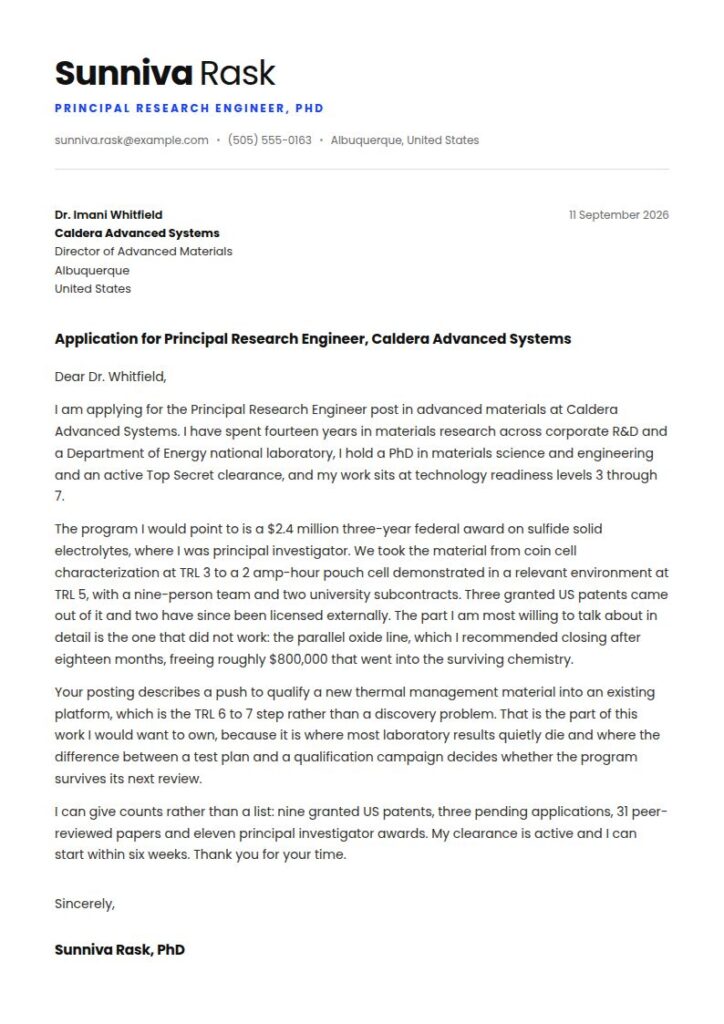
A research engineer cover letter is a one-page letter that names one program you ran, what readiness level it reached, who took the result next, and the patents, papers or reports that prove it happened.
It is not a research statement. A research statement argues for the importance of a field. A cover letter argues that you will move a specific program forward for a specific organization, which is a smaller and much more persuasive claim.
Guide to a research engineer cover letter
This guide and the corresponding research engineer cover letter example will cover:
- How to structure the letter, paragraph by paragraph
- Why one program with a readiness range beats a paragraph about your research interests
- How to describe classified or proprietary work safely
- What changes between a national laboratory, a contractor and a corporate R&D group
- The openings that get a technical file read to the end
How to write a research engineer cover letter
| Paragraph | Its job | Length |
|---|---|---|
| Opening | The post, your field, your institutional background and clearance | 2 to 3 sentences |
| Evidence | One program: sponsor, value, readiness range, what it reached, who took it | 4 to 5 sentences |
| Fit | Something specific about their work, and what you would own first | 3 to 4 sentences |
| Close | Outputs in counts, clearance status, availability, thank you | 2 sentences |
One program, fully told, beats five topics listed
The failure mode in research cover letters is breadth. A candidate lists five areas of interest, and the reader finishes with no idea what the candidate has actually finished.
Pick the program closest to the posting and give it a full arc: what it was funded to do, at what value, where it started on the readiness scale, where it ended, and what happened to the result. Name the outcome even if the outcome was a stop decision.
That single arc tells a hiring manager more about your judgment than a list ever can, because programs are where research judgment becomes visible.
A research engineer cover letter example you can adapt
Dear Dr. Whitfield,
I am applying for the Principal Research Engineer post in advanced materials at Caldera Advanced Systems. I have spent fourteen years in materials research across corporate R&D and a Department of Energy national laboratory, I hold a PhD in materials science and engineering and an active Top Secret clearance, and my work sits at technology readiness levels 3 through 7.
The program I would point to is a $2.4 million three-year federal award on sulfide solid electrolytes, where I was principal investigator. We took the material from coin cell characterization at TRL 3 to a 2 amp-hour pouch cell demonstrated in a relevant environment at TRL 5, with a nine-person team and two university subcontracts. Three granted US patents came out of it and two have since been licensed externally. The part I am most willing to talk about in detail is the one that did not work: the parallel oxide line, which I recommended closing after eighteen months, freeing roughly $800,000 that went into the surviving chemistry.
Your posting describes a push to qualify a new thermal management material into an existing platform, which is the TRL 6 to 7 step rather than a discovery problem. That is the part of this work I would want to own, because it is where most laboratory results quietly die and where the difference between a test plan and a qualification campaign decides whether the program survives its next review.
I can give counts rather than a list: nine granted US patents, three pending applications, 31 peer-reviewed papers and eleven principal investigator awards. My clearance is active and I can start within six weeks. Thank you for your time.
Sincerely, Sunniva Rask, PhD
Openings that work
| Instead of | Use |
|---|---|
| I am passionate about pushing the boundaries of materials science | I have spent fourteen years in materials research and my work sits at technology readiness levels 3 through 7 |
| I am writing to express my interest in your research engineer opening | I am applying for the Principal Research Engineer post in advanced materials |
| My research has been published in leading journals | Three granted US patents came out of this program and two have since been licensed externally |
| I am excited about the innovative work your team is doing | Your posting describes the TRL 6 to 7 qualification step rather than a discovery problem |
Say what the research reached, not what it explored
An industrial reader is buying transition risk, and a letter that describes only a topic leaves that risk entirely unaddressed.
Technology readiness levels give you the shorthand. NASA's scale runs from TRL 1, where scientific research is beginning, through TRL 4, where multiple component pieces are tested with one another, TRL 6, a fully functional prototype, and TRL 9, proven in a successful mission (NASA, Technology Readiness Levels, accessed September 2026). The Department of Defense uses the same nine-level structure, so the vocabulary carries across sponsors.
Use it in a sentence rather than as a badge: "carried the material from TRL 3 to TRL 5 over 30 months, then to a sponsor transition review" is a complete account of a program in twenty words.
Where these jobs actually are, and what they pay
There is no Bureau of Labor Statistics occupation called research engineer, so read the research and development industry line inside the closest occupations instead.
For materials engineers, research and development in the physical, engineering and life sciences employs 10 percent of the occupation at a median of $132,070, against an occupation median of $112,860 (BLS Occupational Outlook Handbook, May 2025). For aerospace engineers the same industry holds 8 percent at $149,260 against an occupation median of $134,960, with federal government at 15 percent and $142,630 (BLS Occupational Outlook Handbook, May 2025).
The institutions are concentrated too: the Department of Energy alone runs 17 national laboratories, most of them federally funded research and development centers operated under contract (U.S. Department of Energy, accessed September 2026). A small number of employers, paying above the occupation median, hiring people who can be checked. That is why the letter should be specific enough to be verified rather than broad enough to be sent anywhere.
National laboratory, contractor and corporate R&D want different letters
For a national laboratory, lead with principal investigator history, sponsor relationships and output record. For a defense contractor, lead with clearance level and status, program-of-record experience and the qualification work. For corporate R&D, lead with transition into product and the commercial consequence. For a startup, lead with what you can build alone with limited equipment. Name one specific thing from their published work or the posting itself.
Do not open with your research interests; the reader is hiring for a program, not a field. Do not list every area you have touched. Do not claim principal investigator where you were a task lead, because sponsors and colleagues overlap in this world and it will be checked. Do not name internal program code names the reader cannot interpret. Do not send a research statement with a salutation on it.
Writing about classified and proprietary work
Describe it at the level the program allows, in unclassified terms, and say that is what you are doing. Sponsor type, scope, team size, your role, readiness range and outcome category are usually all releasable.
"Principal investigator on a classified program for a Department of Defense sponsor, eleven staff, technology transitioned to a program of record in 2024" says something real and reveals nothing. If you are unsure, ask your security officer before you send it; that is a normal request and the answer takes a day.
Some types and levels of clearance require United States citizenship (BLS Occupational Outlook Handbook, accessed September 2026), and roughly 4 million people are enrolled in continuous vetting (DCSA, accessed September 2026). Stating your level, grant year and current status saves the reader a guess that materially affects the start date.
Length, format and sending it
One page, four paragraphs, 250 to 400 words, even though your resume runs to two or three pages. PDF unless the portal says otherwise, named for yourself and the post.
Give outputs as counts in the letter and keep the detail on the resume. "Nine granted US patents, 31 peer-reviewed papers" is one line; the list belongs elsewhere.
Use the same figures as your resume so the two agree. Our research engineer resume example is written with the numbers used here.
Key takeaways
- Name one program and tell its whole arc, including what happened to the result.
- Use a readiness range, because NASA and the Department of Defense share the scale.
- Give outputs as counts in the letter, not as a list.
- State clearance level, year and status if you hold one.
- Say what you would own first, in their terms, not what you admire about them.
- Be willing to name a program you stopped; judgment reads better than a perfect record.
- Keep it to one page and make every claim checkable.
Write your research engineer cover letter in 10 minutes.
Research engineer cover letter questions, answered
How is a research engineer cover letter different from an academic cover letter?
An academic letter argues for a research agenda over the next five years. An industrial research letter argues that you will move one program forward now. The academic version leads with intellectual contribution; this one leads with what a program reached and who used it.
Should I mention publications and patents in the letter?
As counts, yes, in the closing paragraph. Nine granted patents and 31 papers is one line and it is enough. The detail belongs on the resume, and a letter that turns into a citation list has stopped being a letter.
How do I write a research engineer cover letter with no patents?
Write the program instead. What it was funded to do, what you built, what you screened, what decision your result changed. Early-stage research is mostly unpublished by design, and a reader who hires research engineers knows that. A negative result that saved money is a legitimate headline claim.
Do I need to mention my clearance in the letter?
If you hold one, yes, with the level, the grant year and whether it is active. A cleared candidate can be on a program in weeks and an uncleared one may take many months, and that gap is often the single largest practical difference between two otherwise equal applicants.
How do I move from academia into an industrial research engineer job?
Rewrite your work as programs rather than as topics. Give each one a funder, a value if you know it, a duration, a team size and an outcome. Then name the readiness range honestly, which for most academic work is TRL 1 to 4, and say plainly which part of the industrial ladder you want to climb next. Pretending to be further up it than you are is transparent to anybody who has run a transition review.