Tariq El-Amin Health and Safety Engineer, CSP, CIH Baton Rouge, 70806, United States [email protected] · (225) 555-0148
11 September 2026
Ms. Coralie Boudreaux EHS Director Ascension Polymers Gonzales, United States
Application for Senior Health and Safety Engineer, Ascension Polymers
Dear Ms. Boudreaux,
I am applying for the Senior Health and Safety Engineer post at Ascension Polymers. I hold a CSP from BCSP and a CIH from the Board for Global EHS Credentialing, and I have spent the last eleven years inside PSM-covered chemical operations, owning process hazard analysis for processes covered by 29 CFR 1910.119.
The result I would most want to bring to your site is a rate, not a program. At Delta River Chemical the DART rate fell from 1.9 to 0.8 per 200,000 hours across four years, on roughly 1.1 million hours worked a year, while TRIR fell from 2.8 to 1.4 over the same period. That did not come from campaigns. It came from rewriting the management of change process so that every change to a covered process got a documented pre-startup safety review, and from a $1.4 million capital case I wrote that funded local exhaust ventilation and removed six respirator-dependent tasks entirely.
Your posting mentions a second polymerization train coming online next year. Pre-startup safety review and the mechanical integrity program for new equipment are the parts of 1910.119 I would want to own from the beginning rather than inherit, because retrofitting a mechanical integrity program onto running equipment costs several times what building it during commissioning does. I would also want to look at your exposure assessment coverage, since that is where the CIH side of my work has produced the clearest savings.
My CSP is #38114 and my CIH is #11907, both verifiable on the public rosters, and I can give four weeks' notice. Thank you for your time.
Sincerely, Tariq El-Amin, CSP, CIH
Summary
A health and safety engineer cover letter names one rate you moved, the hours behind it, the regulation you moved it under and the certification that lets a company put your name on the program. This guide gives you a full adaptable letter, the openings that work, and what changes between a plant, a construction job and a consultancy.
Health and Safety Engineer cover letter examples by experience level
A health and safety engineer cover letter is a one-page letter that gives an EHS director one rate you moved, the hours behind it, the standard you moved it under, and the credential that lets your name go on a program.
The reader already has a number problem of their own. Either a rate is going the wrong way, an OSHA inspection has left findings open, an insurer has repriced the account, or a new unit is starting up and nobody owns the hazard analysis. A letter that speaks in that vocabulary is unusual enough to be read twice.
Guide to a health and safety engineer cover letter
This guide and the corresponding health and safety engineer cover letter example will cover:
- How to structure the letter, paragraph by paragraph
- Why one rate with its denominator beats a paragraph about safety culture
- How to name the regulatory environment you have actually worked in
- What changes between a plant, a construction job and a consultancy
- The openings that get a strong file read to the end
How to write a health and safety engineer cover letter
| Paragraph | Its job | Length |
|---|---|---|
| Opening | The post, your certification, and the regulatory environment you work in | 2 to 3 sentences |
| Evidence | One rate, a before, an after, a period and the hours worked | 4 to 5 sentences |
| Fit | Something specific about their operation, and what you would take on first | 3 to 4 sentences |
| Close | Certification numbers, availability, thank you | 2 sentences |
Open with the standard, not with your commitment to safety
Every letter in the folder says the writer is committed to safety. None of them are lying, and none of them are distinguishable.
The first sentence that separates you names a standard. "I hold a CSP and have owned process hazard analysis for 14 processes covered by 29 CFR 1910.119" tells a reader more in twenty words than three paragraphs of philosophy, because it tells them the size of the regulatory machine you have run.
The standard also sorts you into the right pile. A PSM-covered site, a multi-employer construction project and a hospital are three unrelated jobs sharing one title. Name the one you come from, and if you are moving between them, say so plainly and say what transfers.
A health and safety engineer cover letter example you can adapt
Dear Ms. Boudreaux,
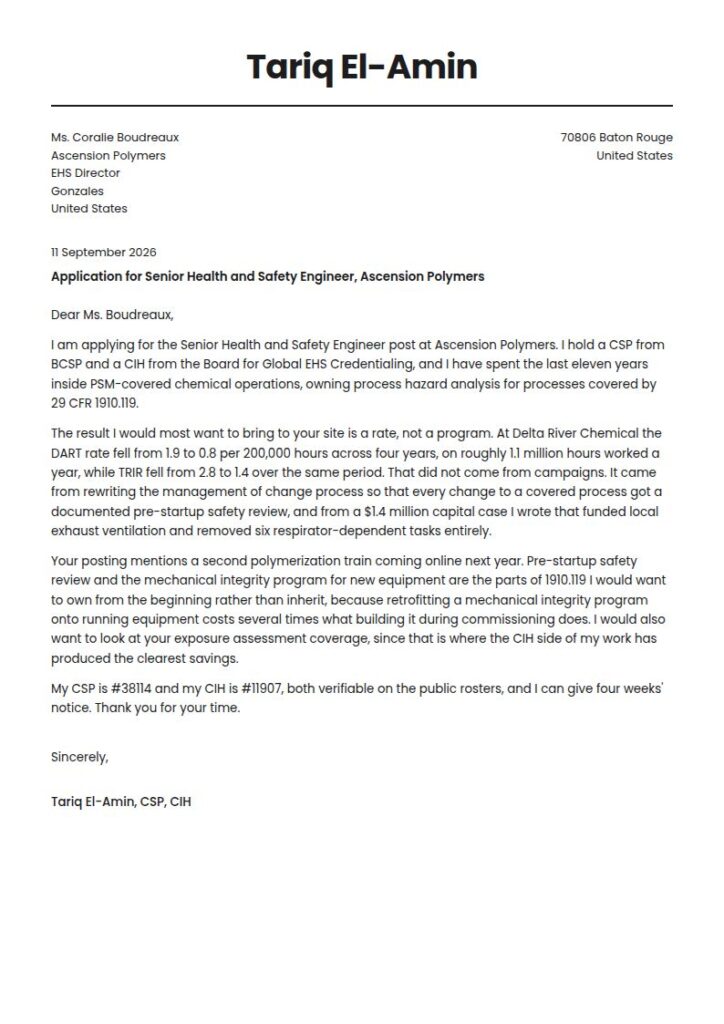
I am applying for the Senior Health and Safety Engineer post at Ascension Polymers. I hold a CSP from BCSP and a CIH from the Board for Global EHS Credentialing, and I have spent the last eleven years inside PSM-covered chemical operations, owning process hazard analysis for processes covered by 29 CFR 1910.119.
The result I would most want to bring to your site is a rate, not a program. At Delta River Chemical the DART rate fell from 1.9 to 0.8 per 200,000 hours across four years, on roughly 1.1 million hours worked a year, while TRIR fell from 2.8 to 1.4 over the same period. That did not come from campaigns. It came from rewriting the management of change process so that every change to a covered process got a documented pre-startup safety review, and from a $1.4 million capital case I wrote that funded local exhaust ventilation and removed six respirator-dependent tasks entirely.
Your posting mentions a second polymerization train coming online next year. Pre-startup safety review and the mechanical integrity program for new equipment are the parts of 1910.119 I would want to own from the beginning rather than inherit, because retrofitting a mechanical integrity program onto running equipment costs several times what building it during commissioning does. I would also want to look at your exposure assessment coverage, since that is where the CIH side of my work has produced the clearest savings.
My CSP is #38114 and my CIH is #11907, both verifiable on the public rosters, and I can give four weeks' notice. Thank you for your time.
Sincerely, Tariq El-Amin, CSP, CIH
Openings that work
| Instead of | Use |
|---|---|
| I am passionate about creating a safe workplace for everyone | I hold a CSP and have owned process hazard analysis for 14 processes covered by 29 CFR 1910.119 |
| I am writing to express my interest in the safety engineer position | I am applying for the Senior Health and Safety Engineer post, coming from an 8.4 million hour multi-site program |
| I have a proven track record of reducing workplace incidents | The site DART rate fell from 1.9 to 0.8 per 200,000 hours across four years on 1.1 million hours a year |
| I believe safety is everyone's responsibility | Your posting mentions a second train coming online, and pre-startup safety review is what I would want to own first |
Give the denominator, every time
A rate without hours is not evidence, and the person reading your letter knows it.
The incidence rate formula employers use is the number of recordable injuries and illnesses multiplied by 200,000, divided by employee hours worked. The 200,000 is the equivalent of 100 employees working 40 hours a week for 50 weeks a year (U.S. Bureau of Labor Statistics, How To Compute Your Firm's Incidence Rate for Safety Management, accessed September 2026).
Small denominators produce dramatic-looking rates. A 50-person site with one recordable case has a TRIR of about 2.0; with none, 0.0. Neither means much. The same rate across two million hours is a program.
The number your reader is measuring you against
BLS reported 2.5 million nonfatal workplace injuries and illnesses in private industry in 2024, a total recordable case rate of 2.3 cases per 100 full-time equivalent workers, down 3.1 percent from 2023 (U.S. Bureau of Labor Statistics, Employer-Reported Workplace Injuries and Illnesses, released 22 January 2026).
Health and safety engineering itself is a small, credential-heavy occupation: 22,300 jobs in 2025, projected to grow 5 percent through 2035, with about 1,200 openings a year, most of them from retirements and transfers rather than new positions (BLS Occupational Outlook Handbook, 2025-35 projections).
Two consequences for the letter. First, quote your rate against the 2.3 benchmark if it beats it, because that is the comparison the reader is already making. Second, with roughly 1,200 openings a year nationally, most of these jobs are filled from a short list, so the letter is usually read by someone who will also interview you. Write it to be defended in person.
Plant, construction site and consultancy want different letters
For a fixed plant, lead with the standard and the rate, and name the covered processes. For construction, lead with multi-employer worksite experience, the CHST or an OSHA 500 trainer card, and how you handle subcontractor control where you do not employ the workforce. For a consultancy, lead with client work, billable hazard analysis, and the industries you can walk into without a learning curve. For government, lead with inspection, citation and rulemaking literacy. Name one real thing about their operation, taken from their own materials.
Do not claim a rate for a period you were not on site for. Do not quote a rate with no hours behind it. Do not write "zero incidents" without the headcount and the hours, because on a small site it reads as luck rather than work. Do not describe compliance as an achievement; it is the floor. Do not send the same letter to a refinery and a hospital, because the regulatory machinery has almost nothing in common.
What to say when you are moving between sectors
Say it in the first paragraph and then say what transfers. The parts of this job that cross sectors are hazard analysis method, root cause investigation, recordkeeping under Part 1904, exposure assessment, and the hierarchy of controls, which OSHA orders as engineering controls first, administrative controls second and personal protective equipment last (OSHA, Job Hazard Analysis, publication 3071).
What does not cross is the specific standards and the operating culture. Name both honestly and you read as someone who has thought about the move.
Length, format and sending it
One page, four paragraphs, 250 to 400 words. PDF unless the portal says otherwise, named for yourself and the post: tariq-el-amin-health-and-safety-engineer-cover-letter.pdf.
Put your certification numbers in the letter or the signature block. BCSP and the Board for Global EHS Credentialing both maintain public rosters, so the numbers turn a claim into a verified fact in under a minute.
Use the same rates as your resume so the two agree. Our health and safety engineer resume example is written with the numbers used here.
Key takeaways
- Name the standard by citation in the first paragraph.
- Give one rate with a before, an after, a period and the hours worked.
- Say which rate it is, TRIR or DART, per 200,000 hours.
- Put the certification numbers where a recruiter can verify them.
- Say what you would own first, not what you admire about the company.
- Write a different letter for a plant, a construction project and a consultancy.
- Keep it to one page and be ready to defend every number in the interview.
Write your health and safety engineer cover letter in 10 minutes.
Health and safety engineer cover letter questions, answered
How long should a health and safety engineer cover letter be?
One page, four paragraphs, 250 to 400 words. The reader is usually the person who will interview you, and every sentence you write is a sentence you may be asked to expand on.
Do I need a cover letter if I already hold a CSP?
Yes. The certification gets you past the filter; the letter is where you say which rate you moved and under which standard. Two CSPs with the same job title can have had completely different working lives.
What do I write with no site rate to point to?
Write what you owned. JHAs completed and how you prioritized them, inspections and finding closure rates, training delivered and requalification currency, samples collected, corrective actions that became engineering controls. OSHA's own guidance ranks jobs for hazard analysis by injury rate, severity potential, single-error consequence, novelty and complexity (OSHA, Job Hazard Analysis, publication 3071), and a candidate who prioritized that way has shown judgment.
Should I mention an OSHA inspection I handled?
Yes, factually and without drama. Say the scope, what was cited if anything, what was abated, and in what time. Handling an inspection without contested citations is a real skill and most candidates have never done it alone.
How do I write to an employer in an industry I have not worked in?
Read their public materials first, then name the transferable method explicitly and say what you would need to learn. Hazard analysis method, investigation technique and recordkeeping transfer everywhere. The specific standards do not, and pretending otherwise is the fastest way to lose a technical interview.