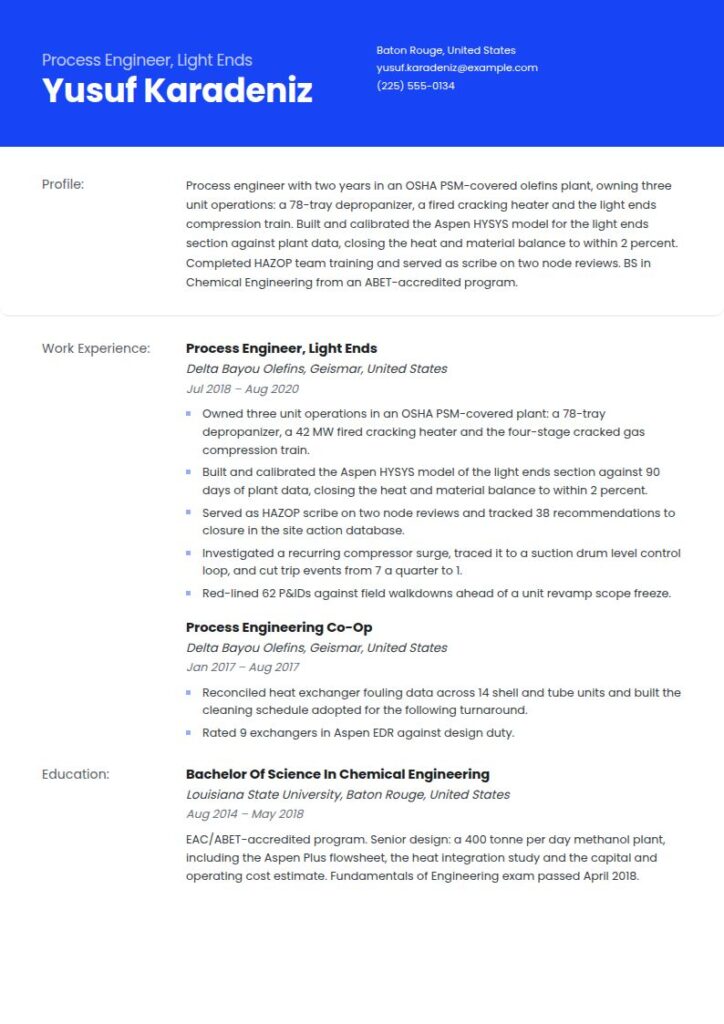
Process Engineer, Light Ends Yusuf Karadeniz
Process Engineer, Light Ends
[email protected] | (225) 555-0134 | Baton Rouge, United States
Profile
Process engineer with two years in an OSHA PSM-covered olefins plant, owning three unit operations: a 78-tray depropanizer, a fired cracking heater and the light ends compression train. Built and calibrated the Aspen HYSYS model for the light ends section against plant data, closing the heat and material balance to within 2 percent. Completed HAZOP team training and served as scribe on two node reviews. BS in Chemical Engineering from an ABET-accredited program.
Work Experience
07/2018 - 08/2020, Process Engineer, Light Ends, Delta Bayou Olefins, Geismar, United States
- Owned three unit operations in an OSHA PSM-covered plant: a 78-tray depropanizer, a 42 MW fired cracking heater and the four-stage cracked gas compression train.
- Built and calibrated the Aspen HYSYS model of the light ends section against 90 days of plant data, closing the heat and material balance to within 2 percent.
- Served as HAZOP scribe on two node reviews and tracked 38 recommendations to closure in the site action database.
- Investigated a recurring compressor surge, traced it to a suction drum level control loop, and cut trip events from 7 a quarter to 1.
- Red-lined 62 P&IDs against field walkdowns ahead of a unit revamp scope freeze.
01/2017 - 08/2017, Process Engineering Co-op, Delta Bayou Olefins, Geismar, United States
- Reconciled heat exchanger fouling data across 14 shell and tube units and built the cleaning schedule adopted for the following turnaround.
- Rated 9 exchangers in Aspen EDR against design duty.
Education
08/2014 - 05/2018, Bachelor of Science, Chemical Engineering, Louisiana State University, Baton Rouge, United States
EAC/ABET-accredited program. Senior design: a 400 tonne per day methanol plant, including the Aspen Plus flowsheet, the heat integration study and the capital and operating cost estimate. Fundamentals of Engineering exam passed April 2018.
Skills
Distillation and column hydraulics, 70
Aspen HYSYS, 80
Aspen Plus and Aspen EDR, 70
Heat and material balance reconciliation, 75
P&ID review and field walkdowns, 65
HAZOP participation and recommendation tracking, 60
Data historian analysis in PI ProcessBook, 70
Languages
English, native
Turkish, native
French, intermediate
Certificates
07/2018, Engineer in Training, Louisiana, Louisiana Professional Engineering and Land Surveying Board, EI-0031208
Fundamentals of Engineering, chemical discipline, passed April 2018.
09/2018, OSHA 30-Hour General Industry, Occupational Safety and Health Administration
Summary
A chemical engineer resume is read for two things that do not transfer freely: which unit operations you have run, and which regulatory regime you ran them under. This guide gives you three adaptable versions, the unit operations block that makes both legible, the process safety language employers screen for, and current Bureau of Labor Statistics pay and outlook.
Chemical Engineer resume examples by experience level
A chemical engineer resume is a one to two page document, and a hiring manager reads it for two things that most applicants never state plainly: which unit operations you have personally run, and which regulatory regime you ran them under.
Neither transfers freely. An engineer who has spent six years on distillation columns in an olefins plant and an engineer who has spent six years on lyophilization in a sterile fill-finish suite are both chemical engineers with six years of experience, and neither can step into the other's job in a quarter. The physics is shared. The equipment, the failure modes, the paperwork and the consequences of being wrong are not.
That is the whole design problem of this resume. Everything below is about making those two facts findable in the first ten seconds.
Resume guide for a chemical engineer resume
This guide and the corresponding chemical engineer resume example will cover:
- How to write a chemical engineer resume, section by section
- The unit operations block, and why it beats a list of job duties
- Three adaptable summaries: process engineer, senior process engineer and process technology lead
- How to write the regulatory regime you have worked under, by name
- What the job market looks like and what you can expect to earn
How to write a chemical engineer resume
Six sections: contact header, summary, unit operations and process experience, work history, education and licensure, and technical skills. One page for the first five years, two once you have plant startups, scale-up campaigns or a PE license to list.
The order is deliberate. Unit operations sit high because they are what the hiring manager is matching against, and they are usually buried three bullets deep in a job that is described by its responsibilities instead of its equipment.
| Section | What it is answering | Where it goes |
|---|---|---|
| Unit operations | Which equipment has this person actually owned? | Its own block, directly under the summary |
| Regulatory regime | Have they worked under the rules we work under? | Named in the summary and in each role |
| Process experience | What scale, what product, what changed? | Reverse chronological, with numbers |
| Simulation and tools | Can they build a model we would trust? | Grouped, with the software named by product |
Write the scale, not just the process
Every chemical engineering claim is scale-dependent, and a resume that omits scale forces the reader to assume the smallest plausible version.
"Optimized a distillation column" could mean a 30-tray column on a laboratory rig or a 120-foot depropanizer running 40,000 barrels a day. "Ran a reaction study" could be a 500-millilitre round-bottom flask or a 20-cubic-metre jacketed reactor with a runaway scenario in the relief case.
Put the number in: throughput, vessel volume, column diameter, tray count, duty in megawatts, batch size in kilograms. "Debottlenecked a 78-tray depropanizer at 41,000 barrels per day, raising recovery from 96.2 to 98.1 percent" is a sentence only someone who did it can write.
Run the finished file through the free Rezoom ATS resume checker before you submit. Operating companies and engineering contractors both parse applications into a system before a human opens one.
Choosing the best resume format for a chemical engineer resume
Reverse chronological. One page until you have five or six years, two once you can list plant startups, turnarounds or a license.
Functional formats fail because process experience compounds in a specific order: you run the unit, then you troubleshoot it, then you modify it, then you design the next one. A reader is measuring where you are on that sequence, and a format that hides the timeline hides the answer.
Include your contact information
| ✅ Right | ❌ Wrong |
|---|---|
| Yusuf Karadeniz, PE | Yusuf Karadeniz |
| Process Engineer, Olefins and Light Ends | Chemical engineering professional |
| PE, Louisiana #PE-0044917, chemical discipline | Licensed engineer |
| (225) 555-0134, [email protected], Baton Rouge, LA | (225) 555-0134, [email protected] |
If you hold a PE, put the state, number and discipline in the header. A PE in chemical engineering is uncommon enough that it is a differentiator rather than a formality, and it signals that the file belongs to someone who has done consulting, expert work or design certification.
Make use of a summary
Four lines: the unit operations, the industry and its regime, the scale you work at, and one result with a number.
Process engineer with two years in an OSHA PSM-covered olefins plant, owning three unit operations: a 78-tray depropanizer, a fired cracking heater and the light ends compression train. Built and calibrated the Aspen HYSYS model for the light ends section against plant data, closing the heat and material balance to within 2 percent. Completed HAZOP team training and served as scribe on two node reviews. BS in Chemical Engineering from an ABET-accredited program.
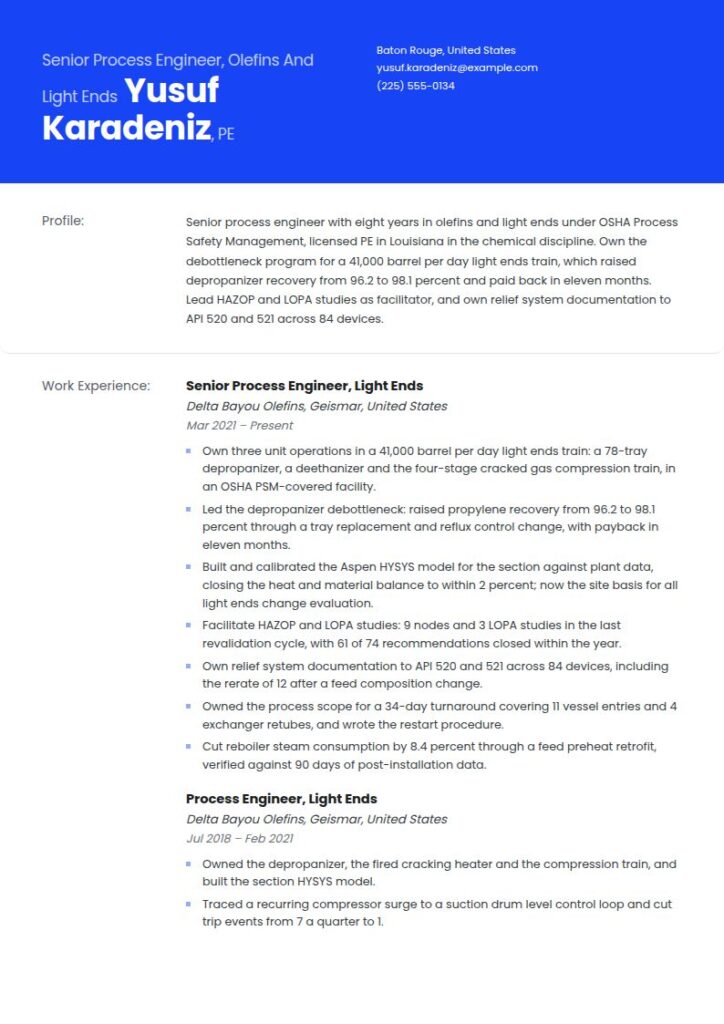
Senior process engineer with eight years in olefins and light ends under OSHA Process Safety Management, licensed PE in Louisiana in the chemical discipline. Own the debottleneck program for a 41,000 barrel per day light ends train, which raised depropanizer recovery from 96.2 to 98.1 percent and paid back in eleven months. Lead HAZOP and LOPA studies as facilitator, and own relief system documentation to API 520 and 521 across 84 devices.
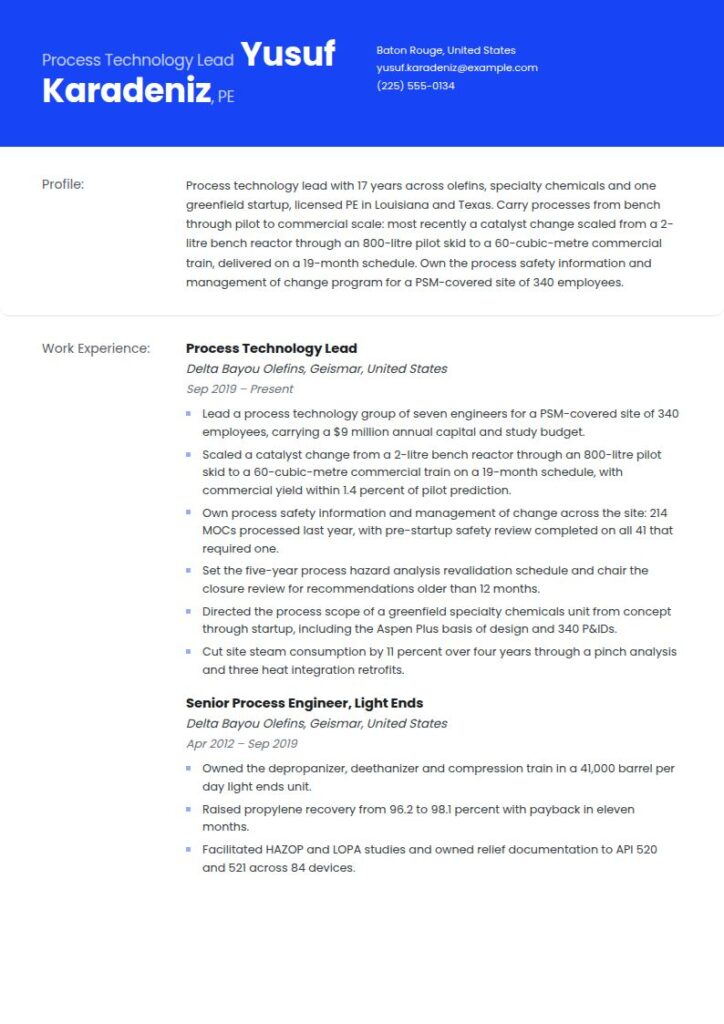
Process technology lead with 17 years across olefins, specialty chemicals and one greenfield startup, licensed PE in Louisiana and Texas. Carry processes from bench through pilot to commercial scale: most recently a catalyst change scaled from a 2-litre bench reactor through an 800-litre pilot skid to a 60-cubic-metre commercial train, delivered on a 19-month schedule. Own the process safety information and management of change program for a PSM-covered site of 340 employees.
Right vs wrong: the same chemical engineer summary, twice
| ✅ Right | ❌ Wrong |
|---|---|
| Senior process engineer with eight years in olefins and light ends under OSHA Process Safety Management. | Results-oriented chemical engineer with strong analytical and problem-solving skills. |
| Own the debottleneck program for a 41,000 barrel per day light ends train. | Responsible for process optimization and continuous improvement initiatives. |
| Raised depropanizer recovery from 96.2 to 98.1 percent with payback in eleven months. | Delivered significant improvements in plant efficiency and cost savings. |
The right column can be matched against a job requisition in seconds. The left column describes a person who might have done any chemical engineering job in any industry, which is exactly the ambiguity this resume exists to remove.
Outline your process experience
Employer, site, dates and title first. Then bullets built on equipment and numbers, not responsibilities.
| Instead of | Use |
|---|---|
| Responsible for process optimization in the light ends unit | Debottlenecked a 78-tray depropanizer at 41,000 barrels per day, raising recovery from 96.2 to 98.1 percent |
| Performed process simulation and modeling | Built and calibrated an Aspen HYSYS model of the light ends train against plant data, closing heat and material balance to within 2 percent |
| Participated in safety studies | Facilitated 9 HAZOP nodes and 3 LOPA studies, closing 61 of 74 recommendations within the first year |
| Supported plant turnarounds | Owned the process scope for a 34-day turnaround: 11 vessel entries, 4 exchanger retubes and the post-turnaround restart procedure |
| Worked on scale-up projects | Scaled a catalyst change from a 2-litre bench reactor through an 800-litre pilot skid to a 60-cubic-metre commercial train |
| Helped reduce energy use | Cut reboiler steam consumption by 8.4 percent through a feed preheat retrofit, verified against 90 days of post-installation data |
Senior Process Engineer, Light Ends, Delta Bayou Olefins, Geismar, LA, March 2021 to Present
Own three unit operations in a 41,000 barrel per day light ends train: a 78-tray depropanizer, a deethanizer and the four-stage cracked gas compression train, in an OSHA PSM-covered facility.
Led the depropanizer debottleneck: raised propylene recovery from 96.2 to 98.1 percent through a tray replacement and reflux control change, with payback in eleven months.
Built and calibrated the Aspen HYSYS model for the section against plant data, closing the heat and material balance to within 2 percent, now the site's basis for all light ends change evaluation.
Facilitate HAZOP and LOPA studies: 9 nodes and 3 LOPA studies in the last revalidation cycle, with 61 of 74 recommendations closed within the year.
Own relief system documentation to API 520 and 521 across 84 devices, including the rerate of 12 following a feed composition change.
Name your unit operations and the regulatory regime you have run under
This is the section that decides a chemical engineering resume, and it is the one almost nobody writes on purpose.
The reason is structural. Chemical engineering is taught as transferable principles, so graduates learn to describe themselves in principles. Employers hire in the opposite direction: they have a specific plant with specific equipment under a specific rulebook, and they are working out how much of your experience arrives intact. Write two short blocks and put them directly under the summary.
Unit operations owned: Distillation (78-tray depropanizer, deethanizer), Fired heaters (cracking furnace, 42 MW duty), Multistage compression (four-stage cracked gas train), Heat exchange (shell and tube, plate and frame), Fixed-bed catalytic reaction, Relief and flare systems
Unit operations supported: Extraction, Crystallization, Drying, Filtration, Pilot-scale continuous stirred tank reaction
Regulatory regime: OSHA Process Safety Management (29 CFR 1910.119), EPA Risk Management Program, API 520 and 521 relief system design, Louisiana Department of Environmental Quality air permitting
Separate owned from supported, because the difference is everything. Owning a unit means the calls at three in the morning were yours. Supporting one means you did the calculation somebody else acted on. Both are real experience and they are not the same claim, and a reader who catches you conflating them stops trusting the rest of the page.
Then the regime, because it is the part that genuinely does not transfer.
| Sector | The rulebook a hiring manager is matching against | What to name on the resume |
|---|---|---|
| Oil, gas and petrochemicals | OSHA Process Safety Management under 29 CFR 1910.119, EPA Risk Management Program, API standards | The PSM elements you owned, the API standards you design to, turnaround and startup experience |
| Specialty and commodity chemicals | PSM where threshold quantities apply, TSCA, state air and water permitting | Batch versus continuous, campaign changeover, product quality specifications |
| Pharmaceuticals and biologics | FDA current good manufacturing practice at 21 CFR Parts 210 and 211, process validation, ICH quality guidelines | IQ, OQ and PQ work, deviations and CAPA, cleaning validation, batch record authorship |
| Semiconductors | Ultra-high-purity handling, SEMI standards, hazardous gas systems | Purity specifications, gas delivery and abatement, tool qualification |
| Food and beverage | FDA preventive controls under the Food Safety Modernization Act, HACCP, sanitary design | HACCP plan ownership, clean-in-place design, thermal processing |
Process safety is a fourteen-element standard, and employers screen for the elements by name
OSHA's Process Safety Management standard at 29 CFR 1910.119 applies to processes involving listed highly hazardous chemicals at or above threshold quantities, and to Category 1 flammable gases or flammable liquids with a flashpoint below 100 degrees Fahrenheit held in quantities of 10,000 pounds or more (OSHA, 29 CFR 1910.119).
The standard names its elements: process safety information, process hazard analysis, operating procedures, training, contractors, pre-startup safety review, mechanical integrity, hot work permits, management of change, incident investigation, emergency planning and response, compliance audits, and trade secrets. It sets specific clocks: process hazard analyses must be updated and revalidated at least every five years, compliance audits conducted at least every three years, refresher training at least every three years, and incident investigations initiated within 48 hours of a catastrophic release (OSHA, 29 CFR 1910.119).
For process hazard analysis the rule names acceptable methodologies including What-If, Checklist, What-If/Checklist, Hazard and Operability Study, Failure Mode and Effects Analysis and Fault Tree Analysis (OSHA, 29 CFR 1910.119).
Write the elements you have personally owned, not "PSM experience". "Owned management of change and pre-startup safety review for a PSM-covered unit, and facilitated 9 HAZOP nodes in the last revalidation cycle" is a claim a hiring manager can price.
If you do scale-up work, write it as three named stages rather than as a project. Bench establishes that the chemistry works. Pilot establishes that it survives real mixing, real heat transfer and real residence time distribution. Commercial establishes that it survives the plant. Give the vessel size at each stage and the schedule, because the whole value of scale-up experience is knowing what breaks between the stages.
Name unit operations with their size: tray count, vessel volume, throughput, duty. Split owned from supported. Name the regulatory regime by its rule number. Name the simulation package by product, Aspen Plus, Aspen HYSYS, ChemCAD, PRO/II or gPROMS, and say what you modeled in it. Give the scale-up stages with vessel size at each one. Say whether the process is batch or continuous.
Do not write "process optimization" with no equipment attached. Do not claim to have owned a unit you supported. Do not list PSM, HAZOP and LOPA as bare keywords with no node count, study or element behind them. Do not describe a pilot result as a plant result. Do not carry a pharmaceutical vocabulary onto a refinery resume, or the reverse, because both readers notice immediately.
Build a snapshot of your key skills
Twelve to sixteen entries in four groups: process and unit operations, simulation and analysis, safety and regulatory, and plant systems.
Process and unit operations: Distillation and column hydraulics, Fired heater operation, Multistage compression, Heat exchanger design and rating, Fixed-bed catalytic reaction, Relief and flare system design
Simulation and analysis: Aspen HYSYS, Aspen Plus, ChemCAD, Aspen EDR, heat and material balance reconciliation, data historian analysis in PI ProcessBook
Safety and regulatory: OSHA PSM element ownership, HAZOP facilitation, LOPA, SIL determination to IEC 61511, API 520 and 521 relief sizing, management of change, pre-startup safety review
Plant systems and documentation: P&ID development and review to ISA-5.1, cause and effect diagrams, operating procedure authorship, DCS familiarity, turnaround scope and restart planning
List your education and licensure
Degree first with the accreditation named, then licensure with state and discipline, then certifications and training a client or an auditor asks for by name.
Professional Engineer, Louisiana #PE-0044917, chemical discipline, issued 2022. Comity registration in Texas #148822.
Bachelor of Science, Chemical Engineering, Louisiana State University, Baton Rouge, LA, 2018. EAC/ABET-accredited program. Fundamentals of Engineering exam passed April 2018.
Certifications and training: HAZOP Leader certification, DNV (2023). OSHA 30-hour General Industry (2021, renewed 2025). Aspen HYSYS advanced process modeling, AspenTech (2022). Root Cause Analysis, TapRooT (2024).
Licensure is not required for entry-level chemical engineers, and the Bureau of Labor Statistics states so directly; the route for those who pursue it runs through a degree from an accredited engineering program, the Fundamentals of Engineering exam, several years of relevant work experience and the PE exam (BLS Occupational Outlook Handbook, May 2025). NCEES offers a PE Chemical exam among its discipline exams, and describes the PE as designed for engineers with a minimum of four years of post-college work experience in their discipline (NCEES, accessed September 2026).
Choose the right layout and design
Single column, 10 or 11 point body type, clear section headings, no photograph. Operating companies and engineering, procurement and construction contractors both run applicant tracking systems, and multi-column layouts, text boxes and header graphics are where parsing breaks.
Give every acronym once in full: "Process Safety Management (PSM)". A keyword search for the spelled-out term will miss a page that only carries the initials.
Chemical engineer job market and outlook
A small occupation, growing faster than average, with most hiring coming from replacement rather than expansion.
| Measure | Value |
|---|---|
| Chemical engineer jobs, 2025 | 21,900 |
| Projected employment, 2035 | 22,900 |
| Projected change, 2025-35 | +5% (faster than average) |
| Projected annual openings | ~1,100 |
| Typical entry-level education | Bachelor's degree |
| Median annual wage, May 2025 | $125,040 |
Source: U.S. Bureau of Labor Statistics, Occupational Outlook Handbook, May 2025 wage data and 2025-35 employment projections.
That opening count is the number worth sitting with. About 1,100 openings a year nationally is a small market, and it explains why a resume that does not name its unit operations and its regime gets filtered: there are rarely enough positions for a reader to take a chance on working out what you did.
Where the jobs sit:
| Industry | Share of employment | Median annual wage (May 2025) |
|---|---|---|
| Chemical manufacturing | 28% | $112,300 |
| Engineering services | 11% | $127,090 |
| Research and development in the physical, engineering and life sciences | 9% | $124,540 |
| Federal government, excluding postal service | 4% | $133,050 |
Source: U.S. Bureau of Labor Statistics, Occupational Outlook Handbook, May 2025.
What salary you can expect as a chemical engineer
The median annual wage for chemical engineers was $125,040 in May 2025, or $60.12 an hour. The lowest 10 percent earned less than $79,420 and the highest 10 percent more than $182,880 (BLS Occupational Outlook Handbook, May 2025).
The industry pattern runs against intuition. Chemical manufacturing employs 28 percent of the occupation, the largest share by a distance, and pays the lowest median of the four largest employers at $112,300. Engineering services pays $127,090, research and development $124,540, and the federal government $133,050 (BLS, May 2025).
What moves an individual offer inside that band is mostly the two facts this page is built on. A plant hiring for a specific unit is paying for someone who has run that unit, and every year of matched unit operations experience is worth more than a year of general process engineering. The regime is the second lever: a site operating under Process Safety Management, or a plant running under current good manufacturing practice, has a real cost attached to a new engineer who has never worked under those rules, and it prices accordingly.
Key takeaways for a chemical engineer resume
- Put a unit operations block directly under the summary, with sizes attached.
- Split the unit operations you owned from the ones you supported.
- Name the regulatory regime by rule number, not as a vague safety mention.
- Give every process claim a scale: throughput, vessel volume, tray count or duty.
- Name the simulation package by product and say what you modeled in it.
- Write scale-up as three stages with the vessel size at each one.
- Name the PSM elements you personally owned rather than writing "PSM experience".
Build your chemical engineer resume in 15 minutes.
Related engineering resume examples
- Process engineer resume
- Civil engineer resume
- Electrical engineer resume
- Mechanical engineer resume
- Structural engineer resume
- Systems engineer resume
- Project engineer resume
- Facility engineer resume
- Research engineer resume
- Health and safety engineer resume
- Technician resume
- Engineering resume
Pair it with a matching chemical engineer cover letter.
Chemical engineer resume questions, answered
How long should a chemical engineer resume be?
One page for the first five years. Two once you have plant startups, turnarounds, scale-up campaigns or a PE license to list. The unit operations block earns its space on either length, because it is the fastest way for a reader to decide whether to keep going.
Do I need a PE license as a chemical engineer?
No for most industry roles. BLS states that licensure is not required for entry-level chemical engineers, and describes the path for those who pursue it as an accredited degree, the FE exam, several years of relevant experience and the PE exam (BLS Occupational Outlook Handbook, May 2025). It matters most in consulting, expert testimony and any work where a design must be certified to a public authority. NCEES offers a PE Chemical exam, and describes the PE as designed for engineers with at least four years of post-college experience in their discipline (NCEES, accessed September 2026).
How do I move between industries when the regime does not transfer?
By writing the transferable layer explicitly and being honest about the rest. Distillation is distillation; a mass balance is a mass balance; HAZOP methodology is the same whatever it is applied to. What does not transfer is the documentation culture, the failure consequences and the inspector. Name the principles and equipment you bring, state plainly that you have not worked under the target regime, and name any training you have taken toward it. Readers respect that far more than a resume that quietly implies coverage it does not have.
Which process simulation software should I list?
The ones you can open and defend in an interview. Aspen Plus for steady-state chemical process modeling, Aspen HYSYS for oil, gas and light ends, ChemCAD and PRO/II as alternatives, gPROMS for transient and custom modeling. Say what you built rather than that you used it: "built and calibrated the light ends HYSYS model against plant data" is a claim, and "proficient in HYSYS" is not.
What do I put on a chemical engineer resume with no plant experience?
Your internship or co-op written as a job with equipment and numbers, your senior design project with the scale and the economics, any laboratory or pilot work with vessel sizes and analytical methods, and the simulation you can actually build. If you passed the Fundamentals of Engineering exam, put the month. About 1,100 chemical engineer openings are projected a year nationally (BLS Occupational Outlook Handbook, 2025-35 projections), so specificity is the only thing that separates entry-level files.
Should I list P&ID work on the resume?
Yes, with a count and a role. Reviewing 140 P&IDs through three issued-for-review cycles is a different claim from developing them from a process flow diagram, and both are different from red-lining as-builts after a turnaround. P&ID fluency is one of the quickest signals that a candidate has worked on a real plant rather than only in a simulator.