
Summary
List shadowing on a resume as its own entry with the professional's name and title, the organization, dates, and, for health-profession applications, total hours. Put it in a "Clinical Experience" or "Shadowing Experience" section, or under Experience if you have little work history. Write bullets that describe what you observed and learned, not results you did not produce, and never include patient details.
To put shadowing on a resume, give it its own entry: the professional's name and title, the organization, the city and state, and the dates. For pre-med, PA, and PT applications, add your total hours. For every other job, leave hours off and focus on what you observed and learned.
That is the short answer. The details matter, though, because shadowing on a resume is read very differently by an admissions committee than by a hiring manager. A committee wants proof you understand the profession. An employer wants proof you are curious, reliable, and already familiar with the work.
This guide shows where the entry goes, when hours belong, how to write bullets that stay honest, and how to keep patient information out.
Where does shadowing go on a resume?
Put shadowing in a dedicated "Clinical Experience" or "Shadowing Experience" section when you have several placements or are applying to a health program. If you have little work history, list it under Experience. If you already have strong paid experience, place the shadowing section below it.
The right section depends on how much else you have to show.
- Student or career changer with little work history: list shadowing inside your main Experience section. It fills the same role an internship would. Our guide to writing a resume with no experience covers the rest of that layout.
- Pre-med, pre-PA, or pre-PT student: create a "Clinical Experience" or "Shadowing Experience" section. Advisors and committees scan for it.
- Experienced candidate: add a short "Additional Experience" section below your jobs. Indeed's career guide makes the same call, noting that formal work experience "usually adds more value" and should sit above shadowing (Indeed).
Augsburg University's career center also suggests a separate "job shadowing" section, or listing it under work experience if you handled administrative tasks during the shadow (Augsburg University).
| Your situation | Section name | Include hours? | Where it sits |
|---|---|---|---|
| Pre-med applicant | Clinical Experience | Yes | Near the top, after Education |
| Pre-PA or pre-PT applicant | Shadowing / Observation Experience | Yes, by setting | Near the top, after Education |
| Student applying for jobs | Experience | No | With other experience, by date |
| Career changer | Relevant Experience | Optional | Above unrelated jobs |
| Experienced professional | Additional Experience | No | Below work history |
What should a shadowing entry include?
A shadowing entry needs a title line such as "Physician Shadow," the professional's name and credentials, the organization and location, month-and-year dates, and two to four bullets. Health-program applicants should add total hours and the specialty or setting, because admissions systems ask for both.
Use the same structure as a job so recruiters and applicant tracking systems read it cleanly:
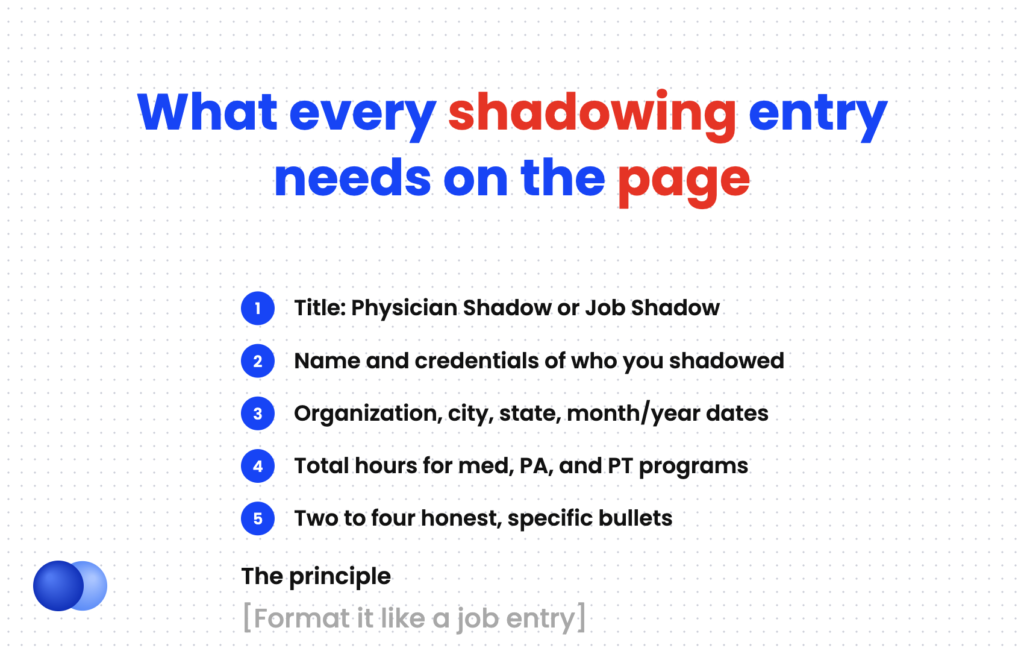
- Title: "Physician Shadow," "Physical Therapy Observer," or "Job Shadow, Marketing."
- Who you shadowed: name and credentials, such as "Dr. Priya Shah, MD, Internal Medicine."
- Organization and location: hospital, clinic, or company, plus city and state.
- Dates: month and year. Exact days add clutter.
- Hours (health programs only): "48 hours" on the title line or in parentheses.
- Two to four bullets: what you observed, what you learned, and any tasks you actually performed.
Several popular resume guides say to leave hours off entirely. That is sound advice for a corporate job, but it does not fit health-program applicants. The AMCAS Work and Activities section asks for completed hours, a contact name, and dates for each experience, including the "Physician Shadowing/Clinical Observation" type (Shemmassian Academic Consulting). PTCAS asks for the supervising physical therapist, the setting, and your completed and planned hours (Liaison PTCAS Help Center). Your resume should match what you enter there.
Physician Shadow, Internal Medicine | 48 hours
Dr. Priya Shah, MD | Mercy General Hospital, Sacramento, CA | June 2026 – August 2026
- Observed 40+ outpatient visits covering chronic disease management, preventive care, and new-patient intake
- Followed the care team through discharge planning, including coordination with case managers and pharmacists
- Learned how the physician explained treatment options to patients with limited health literacy
Should you list shadowing hours on a resume?
List shadowing hours when you apply to medical, PA, PT, dental, or other health programs, because those applications collect hours and reviewers compare them. Leave hours off for regular job applications. There, a total like "16 hours" reads as small and pulls attention from what you learned.
Hours are a currency in health admissions, so reviewers expect them. Programs set their own rules, though, and some do not count shadowing toward required experience at all.
For example, Oregon Health & Science University's PA program requires 2,000 hours of health care experience. It calls shadowing "helpful for career exploration but does not count toward hours" (OHSU). So on a pre-PA resume, keep shadowing hours separate from patient care hours. Never merge them into one total.
PT programs often want observation in more than one setting. James Madison University's pre-PT office lists eight PTCAS settings, from acute care hospitals to home health, and notes that some programs require both inpatient and outpatient hours (JMU). Show the setting on each entry so a reviewer can check that quickly.
For medical school, hours are useful but not a gatekeeper everywhere. The AAMC reports that 87% of respondents in its survey accept an alternate activity instead of clinical shadowing (AAMC). That makes the quality of your bullets just as important as the total.
Keep a shadowing log from day one
Record the date, hours, professional's name and title, setting, and one line on what you saw after every shift. Your resume, your AMCAS or PTCAS entries, and your interview answers all draw from the same log. Rebuilding hours from memory months later is where totals stop matching.
How do you describe shadowing on a resume without overstating it?
Describe shadowing with verbs that match what you really did: observed, followed, attended, learned, assisted with. Tie each bullet to a skill or insight relevant to the target role. Do not claim revenue gains, patient outcomes, or project results, because a shadow watches the work rather than owning it.
Several top-ranking guides show shadowing bullets that claim a 15% or 25% improvement. That approach backfires. A shadow rarely owns a result. When an interviewer asks how you drove a 20% increase during a two-week shadow, the honest answer undoes the bullet.
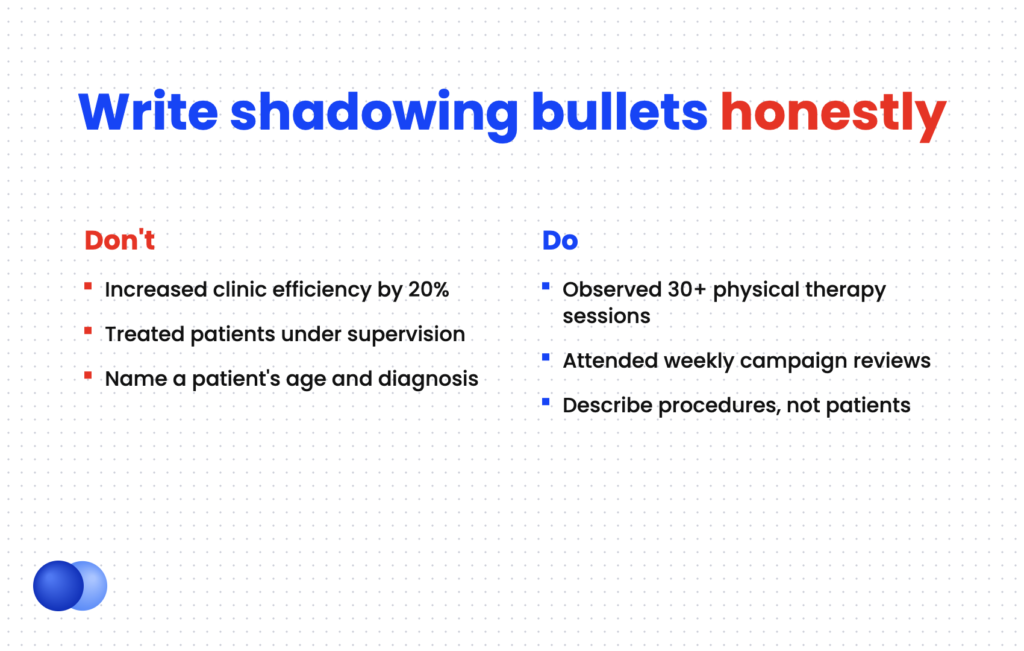
Numbers still help when they describe scope, not impact. "Observed 40+ patient visits" or "attended 6 client strategy meetings" is concrete and true.
Swapping "watched" for a stronger verb is fine. Swapping "observed" for "led" is not. Write each bullet in this order:
- Honest verb: observed, shadowed, attended, assisted, documented.
- Scope: how many visits, meetings, procedures, or projects.
- Takeaway: the skill, process, or insight you gained.
Observed 30+ physical therapy sessions across post-surgical and sports-injury patients do: Attended weekly campaign reviews and learned how the team set budget priorities do: Assisted with patient intake paperwork and room turnover when asked by staff
Increased clinic efficiency by 20% during a two-week shadowing placement dont: Treated patients with knee injuries under supervision dont: Observed a 54-year-old teacher's biopsy for suspected melanoma
How do you protect patient privacy in shadowing bullets?
Keep every clinical bullet at the level of procedures, specialties, and patient populations. Leave out names, ages paired with diagnoses, dates of specific cases, and any detail that could identify a patient. Many sites ask shadows to sign a HIPAA confidentiality agreement, and your resume falls under it.
The AAMC notes that shadowing students "may be required to sign a HIPAA compliance document" promising not to share information that could identify a patient (AAMC). A resume is a document you hand to strangers, so the same rule applies.
A safe pattern is category plus count: "Observed 12 laparoscopic cholecystectomies" or "Followed pediatric well-child visits." An unsafe pattern is a story with a person in it. Save any detailed case reflection for an interview, and keep it anonymous there too.
How do you list job shadowing outside health care?
For non-clinical job shadowing, list it like a short internship: "Job Shadow, [Function]," the company, the person's title, and dates. Skip hours. Write two or three bullets on the meetings, tools, and workflows you saw, and connect them to the job you want now.
Outside health care, shadowing usually lasts from "one day to a few weeks" (Augsburg University). That is short, so treat it as evidence of initiative rather than as a full job. A one-day shadow can go in a single line under Additional Experience. A multi-week shadow deserves a full entry.
Name the tools and processes you saw, such as "Salesforce pipeline reviews" or "Figma design critiques." Those terms match job descriptions and help with resume keywords.
If the placement had structured tasks, it may really be an externship. Our explainer on externships vs. internships helps you choose the accurate label.
Job Shadow, Digital Marketing
Shadowed Maya Torres, Senior Marketing Manager | Brightline Foods, Denver, CO | March 2026
- Attended 6 campaign planning and performance review meetings across email and paid social
- Reviewed how the team used Google Analytics dashboards to set weekly ad budgets
- Drafted three sample social posts that the manager critiqued with editing notes
How do you list multiple shadowing experiences?
Give each professional or specialty its own entry when you shadowed for a meaningful block of time. Group several short, one-day shadows into one combined entry with the total hours and a list of specialties. Order entries from most recent to oldest, and keep the formatting identical across them.
Committees like breadth, such as primary care plus a surgical specialty, so separate entries make that variety visible. Too many tiny entries, however, crowd out stronger items like research or paid clinical work.
A combined line works well for brief exposure: "Physician Shadowing, 3 specialties (cardiology, emergency medicine, family medicine) | 22 hours total | 2025–2026." Then add one bullet on what the comparison taught you.
If you also volunteered in a clinic, keep that separate. See our sibling guide on how to list volunteer work on a resume. If you worked in a lab, it belongs under research, covered in how to put research experience on a resume.
Once your entries are in place, build the full document in the Rezoom AI resume builder, which keeps section formatting consistent and ATS-readable.

Frequently asked questions
Does shadowing count as work experience on a resume?
It can sit in your Experience section if you have little other work history, but label it honestly as a shadow. It is not paid employment, and it is not clinical experience in most admissions systems.
How many shadowing hours should I list for medical school?
There is no universal number, and the AAMC reports that most surveyed schools accept alternatives to shadowing. List the exact hours you logged and make sure they match your AMCAS entry.
Should I include the doctor's name on my resume?
Yes, for health-program resumes, because reviewers may contact them and applications ask for a contact. For corporate shadows, the person's title is usually enough.
Can I put virtual shadowing on a resume?
Yes. Label it clearly, for example "Virtual Physician Shadowing," and name the program. Do not present it as in-person clinical observation.
Does shadowing go on a CV or a resume?
Both. On a CV for medical or graduate programs, list every placement with hours. On a one-page job resume, keep only the shadowing most relevant to the role.
Is a one-day shadow worth listing?
Only if it relates directly to the job or program and you have little else to show. Otherwise, mention it in a cover letter or an interview instead.


Comments