

Summary
List an unfinished degree by naming the school, the program, and what you actually completed, without implying you graduated. If you are still enrolled, add "Expected" and a date. If you stopped, write "Coursework toward" the degree with credits completed and years attended. For some college without a declared major, list the school, dates and credits earned. Employers can verify attendance and degrees, so accurate wording protects your offer.
To list an unfinished degree on your resume, name the school and program, then show what you completed: credits, coursework or dates attended. Never write the degree title alone, because that reads as a finished degree.
Knowing how to list an unfinished degree on resume drafts matters more than most people think. The National Student Clearinghouse counts 37.6 million working-age Americans with some college and no credential. You are far from alone, and recruiters see these entries every day.
This guide gives you one format for each situation, including a dedicated section on how to put some college on a resume. It also covers what other guides skip: verification checks, application form dropdowns and ATS keyword matching.
Should you put an unfinished degree on your resume?
Yes, in most cases. College coursework shows knowledge, discipline and skills even without a diploma. Include it when the credits are relevant to the job or when leaving it off would create an unexplained gap. Omit it only if it is unrelated, very brief, and your experience already covers the requirements.
Unfinished education still counts as education. A year of accounting courses tells a bookkeeping employer something real. Two years of computer science tells a help desk manager you can learn technical material.
It also helps with filters. According to Indeed Hiring Lab, 19.3% of US job postings required a bachelor's degree or higher in November 2025. That means most postings do not require one. Yet the same analysis notes that roles without formal requirements still tend to hire people with college backgrounds, so showing your coursework keeps you competitive.
Employers are also shifting toward skills. NACE's Job Outlook 2026 found 70% of employers use skills-based hiring, up from 65% a year earlier. Your coursework is evidence of those skills.
Leave it off only when the study was brief, unrelated, and long ago. A single semester of art history from 2009 adds little to an operations manager's resume.
Which unfinished degree format fits your situation?
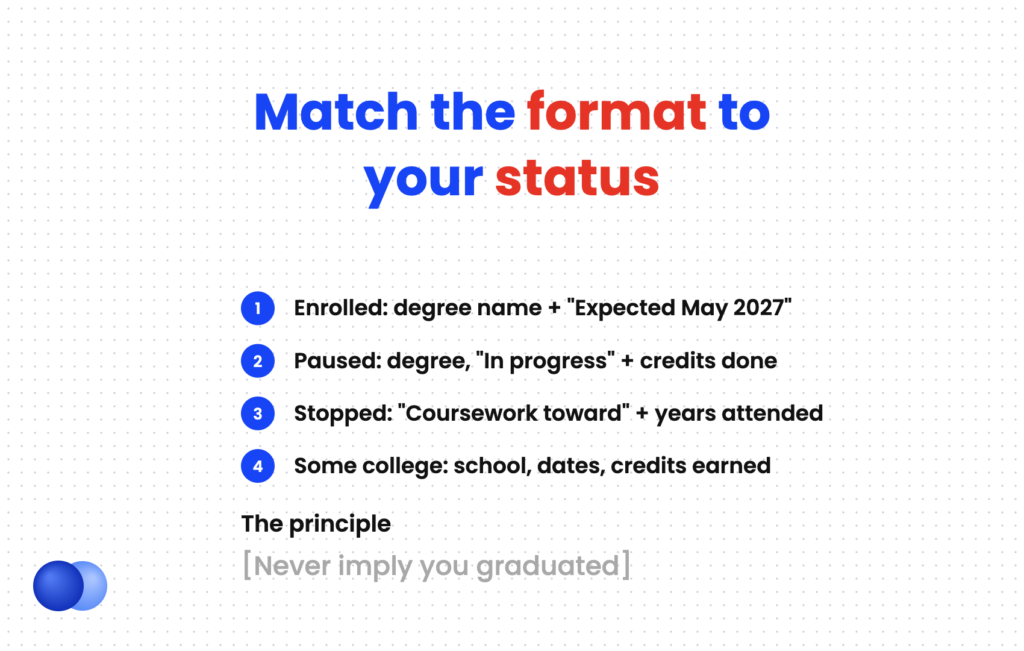
Match the format to your status. Still enrolled: degree name plus "Expected" date. Paused with a plan to return: degree name plus "In progress" and credits. Stopped for good: "Coursework toward" the degree with credits and years. Some college with no major: school, dates and credits earned.
Most guides give one or two templates. Your wording should change with your status, because each one answers a different recruiter question.
| Your situation | Lead with | Date to show | Key detail to add |
|---|---|---|---|
| Currently enrolled | Degree name | "Expected May 2027" | GPA if 3.0+, relevant courses |
| Paused, returning soon | Degree name, "In progress" | Years attended + planned return | Credits completed |
| Stopped, not returning | "Coursework toward" degree | Years attended | Credits completed, key courses |
| Some college, no major | School name | Years attended | Total credits or focus area |
| Transferred credits to a new program | Current program | Expected date | Prior school on a second line |
For currently enrolled students, our guide on how to list an expected graduation date on a resume covers date formats in more depth.
Currently enrolled Bachelor of Science in Nursing | University of Central Florida, Orlando, FL Expected May 2027 | GPA: 3.54
Paused, returning Bachelor of Business Administration, In progress | Georgia State University, Atlanta, GA 2022–2024 | 72 of 120 credits completed | Planned return: Spring 2027
Stopped, not returning Coursework toward Bachelor of Science in Computer Science | University of Texas at Dallas 2019–2021 | 64 credits completed Relevant coursework: Data Structures, Databases, Discrete Mathematics
How do you put some college on a resume?
To put some college on a resume, list the school name, city and state, the years you attended, and the number of credits you earned. Add a focus area or three relevant courses if they fit the job. Write "Some college" only as a label, never as the whole entry.
"Some college" is the phrase application forms use. On a resume, it is too vague by itself. Recruiters want to know where you studied, for how long, and what you learned.
Use this order:
- School name, city and state.
- Years attended, such as 2020–2022.
- Credits earned, such as "45 credits completed."
- Focus area or relevant courses, if they connect to the job.
If you attended community college without finishing an associate degree, the same structure applies. If you attended more than one school, list the most recent or most relevant first. Combine credits only when the new school accepted them in transfer.
Some college, general studies Portland Community College, Portland, OR | 2021–2022 30 credits completed | Focus: Business and Accounting
Some college, relevant coursework Arizona State University, Tempe, AZ | 2018–2020 52 credits completed toward a B.A. in Communication Relevant coursework: Public Relations Writing, Media Ethics, Digital Marketing
Some college plus a credential Valencia College, Orlando, FL | 2023 | 18 credits completed CompTIA A+ Certification | 2025
Pair a short education entry with a strong experience section. If work history is thin, our guide to writing a resume with no experience shows how to lead with projects and skills instead.
Where should an unfinished degree go on your resume?
Put your education section below work experience if you have a year or more of relevant jobs. Put it above experience if you are a current student, a recent student, or if the coursework is your strongest qualification for the role. Either way, keep the unfinished degree inside the education section, not in a summary.
Placement signals priority. An experienced professional with a paused degree should lead with results, then list education near the end. A current student applying for internships should lead with education.
A skills-based layout also works well if you left school to work. It lets you open with capabilities before a recruiter reaches the education line. Our resume format types guide compares the options.
For the full structure of the education section, see how to list education on your resume. If you have honors from the terms you completed, such as the Dean's List, you can still include them; see how to put Dean's List on a resume.
How do you keep an unfinished degree honest and verifiable?
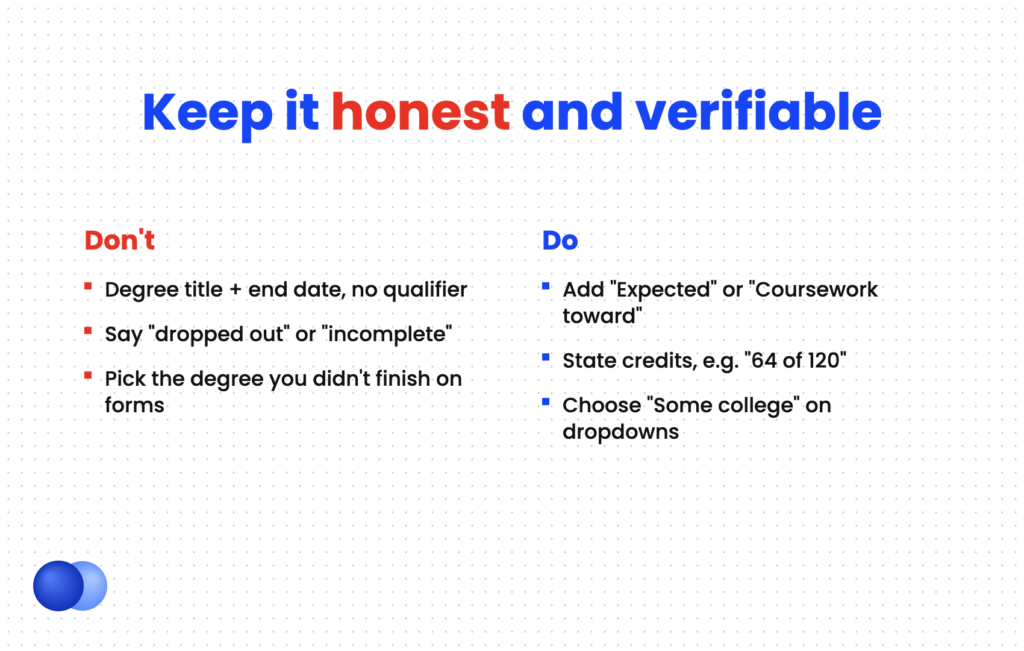
Use wording that cannot be read as a completed degree: "Expected," "In progress," "Coursework toward" or "credits completed." Keep dates and credits accurate. Many employers verify education through the National Student Clearinghouse, which covers most US degrees and records attendance, so any mismatch can cost you the offer.
This is the step most guides skip. Education is one of the easiest resume claims to check. The National Student Clearinghouse verifies degrees and attendance records for employers, covering 96% of US four-year degrees and 97% of currently enrolled students.
That means a line like "B.A., Psychology, 2019–2023" will be checked against a record that shows no degree. Even if you meant "attended," it reads as a claim you graduated. The fix is simple: add a qualifier every time.
The same care applies to online application forms. When a dropdown asks for your highest level of education, choose "Some college" or your last completed credential, not the degree you were working toward. Your resume and your form answers should tell the same story.
Add "Expected," "In progress" or "Coursework toward" to every unfinished degree do: State credits completed as a number, such as "64 of 120 credits" do: List relevant courses that match keywords in the job posting do: Pick "Some college" on application dropdowns when that is accurate
Write "Bachelor of Science" with an end date and no qualifier dont: Use the words "dropped out," "incomplete" or "failed" on the resume dont: Invent an expected graduation date you have no plan to meet dont: Explain why you left school in the education section
Let the degree name still match keywords
Applicant tracking systems often search for terms like "bachelor's" or a field of study. "Coursework toward Bachelor of Science in Computer Science" keeps both keywords on the page while staying accurate. After you write it, test your file with the Rezoom ATS resume checker. Our explainer on how ATS works covers what it scans for.
How do you explain an unfinished degree in an interview?
Give a short, forward-looking answer: why you left in one sentence, what you did next, and what you learned that applies to this job. If you plan to return, say when. Recruiters care less about the reason than about whether you can show relevant skills now.
Keep the resume free of explanations. Save them for the cover letter or interview, and only if asked or clearly relevant.
A strong answer follows three beats. First, the reason, stated plainly: work, family, cost or a change of direction. Second, what you did next, such as a job, certification or project. Third, the connection to the role.
For example: "I completed two years of accounting coursework, then took a full-time bookkeeping role to support my family. Since then I have managed payables for a 40-person company and earned QuickBooks certification. I plan to finish my degree part-time starting next year."
If the break left a gap in your work history, our guide on how to explain an employment gap offers matching scripts. Changing fields at the same time? See the career change resume guide.

Frequently asked questions
Is it OK to put college on my resume if I didn't graduate?
Yes. List the school, dates attended and credits completed, and use a qualifier such as "Coursework toward." That shows what you learned without claiming a degree you did not earn.
How do I list a degree I'm currently working on?
Write the full degree name, school and location, then "Expected" with a month and year. Add GPA if it is 3.0 or higher; our guide on [whether to put GPA on your resume](https://rezoom.io/should-i-put-gpa-on-my-resume/) explains the rule.
Should I write "some college" on my resume?
Only as a short label with details. "Some college" alone is vague. Pair it with the school name, years attended and credits earned.
Can I put a minor or double major on an unfinished degree?
Yes, if you had declared it and completed meaningful coursework. Use the same qualifier, such as "Coursework toward B.A. in History, Minor in Spanish." See [how to put a minor on a resume](https://rezoom.io/how-to-put-a-minor-on-resume/) for layouts.
Do employers check if you finished college?
Many do, especially for roles that require a degree. Background check providers and the National Student Clearinghouse can confirm degrees and attendance dates, so list exactly what you completed.
How many credits should I list?
List credits completed, and add the total required if the ratio helps, such as "90 of 120 credits." A near-complete degree is worth showing in numbers.
What if I left college many years ago?
Keep the entry short: school, years attended and credits. If it no longer supports the job, you can drop it. Then focus your resume on recent results, which the [Rezoom AI resume builder](https://rezoom.io/ai-resume-builder/) can help you draft.



Comments