

Summary
List an MBA at the top of your Education section with the school, the degree name, your concentration and your graduation month and year. Where the Education section sits depends on career stage: above Experience for recent full-time grads, below it for mid-career and executive candidates. Add GPA or GMAT only when strong and requested. Use "MBA" after your name only when the role calls for it.
To list an MBA on a resume, put it first in your Education section with the school, "Master of Business Administration," your concentration and your graduation date. The bigger decision is where that section goes. Recent full-time graduates lead with it; experienced managers put it below their work history.
Most guides stop at the format line. This one adds a placement rule by career stage, a format for each program type (full-time, part-time, executive, online and dual degree), and clear thresholds for GPA and GMAT.
The degree still carries weight with employers. In GMAC's 2025 Corporate Recruiters Survey, U.S. employers projected a median starting salary of $125,000 for MBA graduates, versus $75,000 for bachelor's hires.
How do you list an MBA on a resume?
List the school name, then "Master of Business Administration" with your concentration, then your graduation month and year. Put it first in Education, above your undergraduate degree. Add one or two lines for honors, leadership roles or a strong GPA or GMAT if they support the target job. Leave out high school entirely.
A complete entry has these parts:
- School name, including the business school if it has its own name.
- Degree name: "Master of Business Administration (MBA)."
- Concentration or focus, if relevant to the job.
- Graduation month and year, or an expected date.
- Optional extras: honors, fellowships, club leadership, GPA or GMAT.
Business school career offices follow the same pattern. Washington University's Olin Business School tells students to present education in reverse chronological order and to list concentrations either flush left or as a bullet. Maryland's Smith School also says to put the current degree first and not to list high school or prep school.
Spelling out the degree once matters for applicant tracking systems that scan your MBA on a resume for keywords. Include "Master of Business Administration (MBA)" so the entry matches searches for either form.
EDUCATION OLIN BUSINESS SCHOOL, WASHINGTON UNIVERSITY IN ST. LOUIS | St. Louis, MO Master of Business Administration (MBA), Concentrations in Marketing and Strategy | May 2026 • Consortium for Graduate Study in Management Fellow • VP of Events, Olin Marketing Association
UNIVERSITY OF KANSAS | Lawrence, KS Bachelor of Science in Economics | May 2019
Where should an MBA go on your resume?
Place your Education section above Experience if you finished a full-time MBA recently and the degree is your strongest credential. Put Education below Experience if you are mid-career or an executive, because your work history is the main qualification. Inside Education, the MBA always comes first, above your undergraduate degree.
The University of Michigan's Ross School of Business gives alumni a clear rule by stage. Young MBAs should place Education toward the top to emphasize their strongest credential. Mid-career and executive candidates should lead with Professional Experience instead.

| Your situation | Where Education goes | Why |
|---|---|---|
| Full-time MBA, graduated in last 1–2 years | Above Experience | The degree is your newest, strongest credential |
| Career switcher using the MBA to pivot | Above Experience | It explains the new direction |
| Part-time or evening MBA while working | Below Experience | Your current job carries the weight |
| Executive MBA, 10+ years in management | Below Experience | Track record matters more than the degree |
| MBA earned 5+ years ago | Below Experience | Results since the MBA tell the story |
If the MBA is part of a pivot, pair this with our career change resume guide. For senior candidates, the best resume format for experienced professionals covers how to order the rest of the page.
Should you put MBA after your name on a resume?
Add "MBA" after your name only when the job posting requires or strongly prefers an MBA, or in fields where the credential is a standard signal, such as consulting or corporate finance. Otherwise, let the Education section carry it. Never add it before you have finished the degree, and never list "MBA candidate" in the header.
A name line like "Jordan Lee, MBA" puts the degree in the first place a recruiter looks. It works when the posting screens for it. In other cases it can look like padding, and it repeats what Education already shows.
Two firm rules apply. First, use the suffix only after you complete the program. Second, keep it to the most relevant credential. "Jordan Lee, MBA, CPA" is fine for a finance controller role; a string of four acronyms is not. Professional licenses still belong in their own section; see resume certifications.
How do you list an MBA on a resume by program type?
Use the same core entry for every MBA, then adjust the label. Write "Executive MBA" or "Master of Business Administration (Executive Program)" if that is what your diploma says. Do not label part-time or online MBAs unless the degree name differs. For dual degrees, list both names on one line or as two linked entries.
Format choices change slightly by program type:
- Full-time MBA. Standard entry. Add club leadership, case competitions and fellowships, which Olin suggests including if space permits.
- Part-time or evening MBA. Most schools award the same degree, so list it the same way. Your concurrent job shows the workload.
- Executive MBA. Use the exact degree name on your diploma. Schools differ on whether the word "Executive" appears in it.
- Online MBA. List it like any other degree. The school name and degree are what matter.
- Dual degrees. Show both, such as "MBA / Master of Public Health." For two majors in one degree, see our double major guide.
MBA IN PROGRESS Ross School of Business, University of Michigan | Ann Arbor, MI Master of Business Administration (MBA), Expected May 2027 • Focus: Technology and Operations
EXECUTIVE MBA (placed below Experience) Kellogg School of Management, Northwestern University | Evanston, IL Executive Master of Business Administration (EMBA) | 2023
MBA WITH GPA AND GMAT (finance or consulting applicants) Robert H. Smith School of Business, University of Maryland | College Park, MD Master of Business Administration, Focus Area: Finance | May 2026 GPA: 3.8 | GMAT: 730
DUAL DEGREE Boston University | Boston, MA MBA / Master of Public Health (MPH) | May 2026
Should you include GPA, GMAT or honors with your MBA?
Include GPA and GMAT only when they are strong and the employer values them, mainly in consulting and finance. Smith's guidance treats GPAs above 3.5 and GMAT scores above 700 as very good. Always include fellowships, scholarships and leadership roles if space allows. Drop test scores once you have a few years of post-MBA experience.
Maryland's Smith School puts it directly: consulting firms and some finance positions ask for academic excellence, and GPAs above 3.5 and GMAT scores above 700 are considered very good. Below those marks, leave the numbers off.
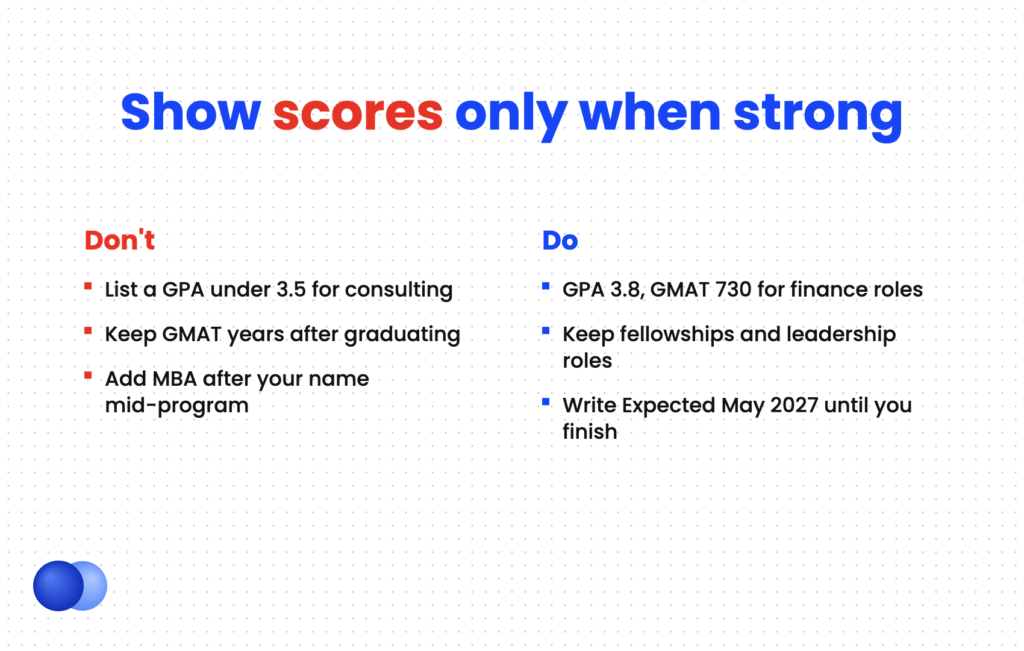
Olin places test scores under a separate "Other Data" section as optional, to include only if high. For general GPA rules, see should I put GPA on my resume. If you graduated with distinction, our guide to Latin honors on a resume shows the formatting.
Write "Master of Business Administration (MBA)" once for ATS matching
Add "MBA" after your name before you finish the program do: Put the MBA above your undergraduate degree dont: List high school on an MBA resume do: Add GPA or GMAT only for consulting or finance roles when strong dont: List a concentration that has nothing to do with the job do: Move Education below Experience once you are mid-career dont: Let MBA coursework crowd out post-MBA results
Turn the MBA into proof, not a label
A degree line shows you finished a program. A bullet shows what you did with it. Under your MBA or in Experience, add one result tied to the degree, such as a consulting project with a measurable outcome. Then reference the MBA skill in your summary so the whole page tells one story.
How do you list an MBA in progress on a resume?
List an MBA in progress with your expected graduation month and year, written as "Expected May 2027." Some schools prefer "Candidate for Master of Business Administration, May 2027." Either way, the reader must see the degree is not finished. Do not add "MBA" after your name until you graduate.
Olin's template uses the "Candidate for" format: "Candidate for Master of Business Administration, May 20xx." Both styles are correct. Pick one and keep it consistent across your resume and LinkedIn.
Placement depends on your plan. If you are studying part time and staying in your field, keep Experience first. If you are a full-time student recruiting for internships, lead with Education. Our guide to listing an expected graduation date covers the date wording, and the guide to listing education on your resume covers the full section.
Showing an MBA on a resume correctly is a small detail with real signal value. When your draft is ready, the Rezoom AI resume builder can place and format the entry for your career stage.

Frequently asked questions
Do you put MBA or M.B.A. on a resume?
Either is correct. Pick one style and use it the same way in your header, Education section and LinkedIn profile.
Should I list my undergraduate degree if I have an MBA?
Yes. List it below the MBA with the school, degree and year. Drop undergraduate honors and activities once you have the MBA and some work history.
Is it OK to list an unfinished MBA?
Yes, if you show the credits completed and do not imply you graduated. Our guide to [listing an unfinished degree](https://rezoom.io/how-to-list-an-unfinished-degree-on-resume/) shows the safe wording.
Should I put my MBA concentration on my resume?
Include it when it matches the job, such as Finance for an FP&A role. Leave it off when it is unrelated, since it adds a line without adding evidence.
Does an MBA go before or after work experience?
Before, if you graduated recently from a full-time program or are switching careers. After, if you are mid-career or in executive roles.
How long should an MBA resume be?
One page for most candidates with under 10 years of experience. GMAC's mba.com suggests [one page under 10 years and up to two pages beyond that](https://www.mba.com/how-to-apply/apply-to-programs/how-to-write-an-mba-resume/amp).



Comments