

Summary
List a double major as one degree with both majors on the same line, most job-relevant major first: "Bachelor of Arts in Economics and Political Science." Write the degree once, because a double major earns one degree and one diploma. A dual degree is different: it earns two diplomas, so it gets two separate lines. Reorder the majors for each application, and keep any minor after both majors.
To list a double major on your resume, write the degree once and put both majors on the same line, with the most relevant major first: "Bachelor of Science in Computer Science and Mathematics." That single line is the core of how to list a double major on resume. Everything else is order, labels, and knowing whether you actually have a double major or a dual degree.
That distinction trips up many graduates. It matters because a recruiter who verifies your degree will see either one credential or two. Your resume should match what your school actually awarded.
What is the difference between a double major and a dual degree on a resume?
A double major is one degree with two majors and one diploma, so it takes one line on your resume. A dual degree (or double degree) is two separate degrees, often a B.A. and a B.S., with two diplomas, so each gets its own line. Check your transcript to confirm which you earned.
University registrars define these terms precisely. Oregon State University's registrar says a dual major produces "one degree award with two majors" and one diploma. A double degree is recorded as separate degrees, and the student receives a diploma for each. It also requires at least 32 credits beyond the minimum for one degree.
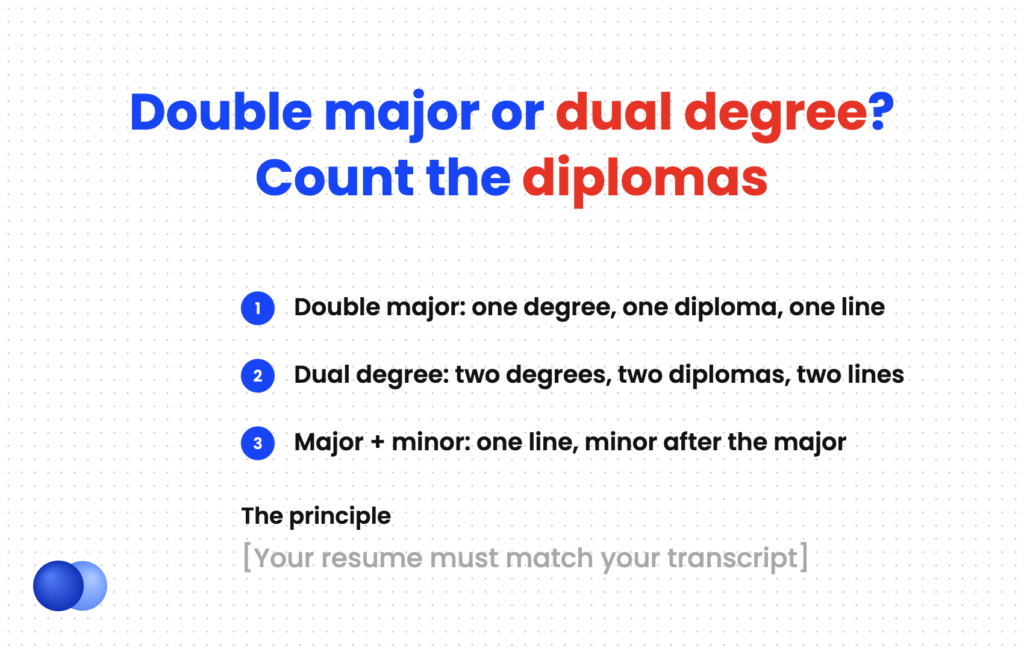
High Point University's registrar draws the same line: a double major needs at least 128 semester hours, while a double degree needs at least 160 and results in two diplomas.
| Credential | What you earn | Diplomas | How it looks on a resume |
|---|---|---|---|
| Double major | One degree, two majors | One | One line: "B.A. in Economics and Political Science" |
| Dual degree | Two degrees (e.g., B.A. + B.S.) | Two | Two lines, one per degree |
| Major + minor | One degree, one major, one minor | One | "B.S. in Biology, Minor in Chemistry" |
| Double major + minor | One degree, two majors, one minor | One | "B.A. in History and English, Minor in French" |
If you are unsure, look at your transcript or degree audit. It lists your degree type and every major recorded on it.
How do you list a double major on a resume?
Write the school, location, and graduation date, then one degree line naming both majors: "Bachelor of Arts in Psychology and Sociology." Put the major most relevant to the job first. Do not repeat the degree name, and do not split the majors across two degree lines unless you earned two separate degrees.
The format is simple. The mistakes happen when people repeat the degree or scatter the majors.
University of Texas at Austin, Austin, TX | May 2026
Bachelor of Arts in Economics and Government
GPA: 3.6/4.0
A few formatting choices are all acceptable, so pick one and stay consistent:
- "Bachelor of Arts in Economics and Government"
- "Bachelor of Arts, Double Major in Economics and Government"
- "B.A., Majors: Economics, Government"
The "Double Major" label is useful when the two fields look like they could be one program. Syracuse University's Newhouse career office uses an ampersand in its 2026 resume guide: "Bachelor of Science: Advertising (Creative Track) & Marketing." Its example lists both schools on the line above, because the two majors sit in different colleges.
For the rest of the entry, such as dates and honors, see our guide to listing education on your resume.
Which major should you list first?
List the major most relevant to the job first, even if it is not your official primary major. Readers weigh the first item most, and a keyword match in the first words of the degree line is easy to spot. Reorder the majors for each application when the two fields point to different roles.
Your school may call one major "primary." At UMass Amherst's College of Education, for example, only the primary major appears on the diploma, though both appear on the transcript. Your resume does not have to follow that order. It only has to be accurate.
So flip the order to fit the job:
- Applying for a data analyst role: "B.S. in Statistics and Biology"
- Applying for a lab research role: "B.S. in Biology and Statistics"
This is one of the easiest tailoring wins on a resume. It takes seconds, and it puts the matching keyword where a recruiter's eye lands first. Our guide to resume keywords explains how to find the terms a posting cares about.
Keep two saved versions of your education line
If your majors point to two different career paths, save two versions of the degree line and swap them per application. Then check the rest of the resume matches. A "Statistics first" education line paired with a biology-heavy summary sends mixed signals. Rezoom's AI resume builder can tailor the summary and skills to whichever major leads.
How do you list a dual degree instead?
Give each degree its own line under the same school, because you earned two separate credentials. Put the more relevant degree first. If both degrees finished on the same date, list the date once on the school line. If they finished on different dates, put each date on its own degree line.
A dual degree is two credentials, so writing it as one line undersells it. Show both.
University of Pennsylvania, Philadelphia, PA | May 2026
Bachelor of Science in Economics
Bachelor of Applied Science in Computer Science
If you earned the degrees at different times or from different schools, list each as a separate education entry in reverse chronological order. A combined bachelor's and master's program also gets two lines, with the master's first.
Where do minors, GPA, and honors go with a double major?
Add the minor after both majors, on the same line or the next. Put GPA, Latin honors, and Dean's List on a separate line below the degree. Add a relevant coursework or thesis line only if you are a student or recent graduate and the content matches the job.
Keep the order predictable: degree and majors, then minor, then academic performance.
- Minor: "B.A. in History and English, Minor in French." For more on minors, see how to put a minor on resume.
- GPA: include it if it helps you. Our guide covers whether to put GPA on your resume.
- Honors: "summa cum laude" goes on the degree line or the line below. See how to list Latin honors on resume and how to put Dean's List on resume.
- Thesis: one line, with the title in quotes, if it relates to the role.
Boston College, Chestnut Hill, MA | May 2026
Bachelor of Arts in Philosophy and Computer Science, Minor in Mathematics
GPA: 3.8/4.0 | magna cum laude | Dean's List, 6 semesters
Senior thesis: "Fairness Metrics in Automated Hiring Tools"
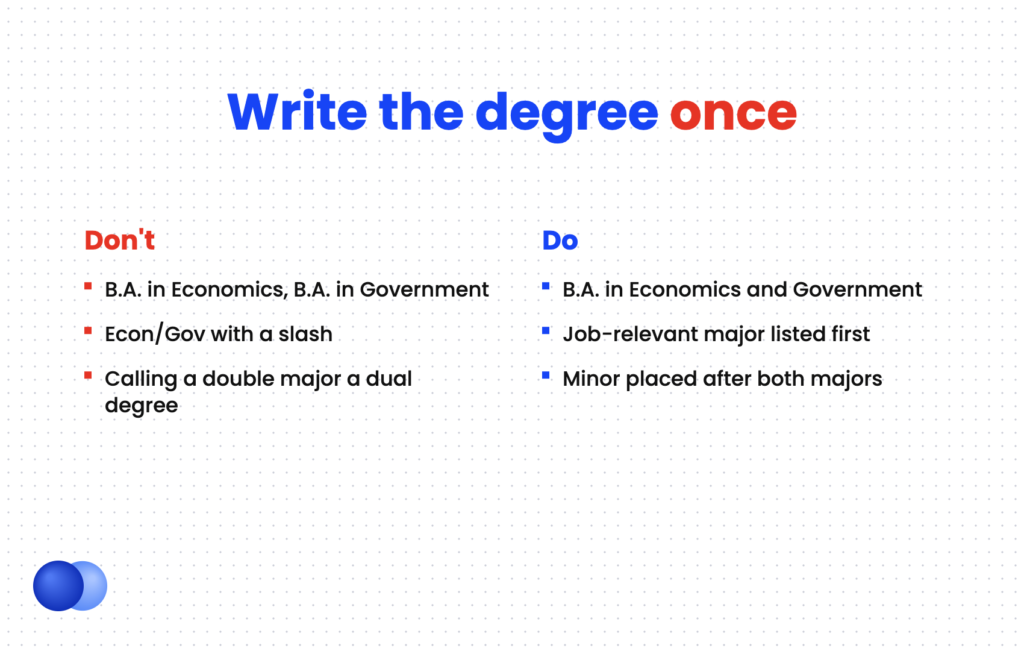
Write the degree once and join both majors with "and" or "&". do: Put the job-relevant major first and reorder per application. do: List a dual degree as two lines, since it is two credentials. do: Keep minors after both majors, never between them.
Write "Bachelor of Arts in Economics, Bachelor of Arts in Government" for one degree. dont: Use a slash like "Econ/Gov," which leaves the reader guessing. dont: Call a double major a dual degree to make it sound bigger. dont: List a second major you dropped as if you completed it.
Does a double major help your resume, and how do ATS systems read it?
A double major helps when both fields relate to the work or when the pairing is unusual and useful. It is common, so the value comes from relevance, not the label. For ATS, spell out both majors in plain text on one line; parsers store majors as a list and can read both.
Double majors are not rare. In a 2024 NBER working paper, 10.2% of American Community Survey respondents with degrees were double majors. The same study found only a small raw earnings difference of 1.2%, but it found double majors had 56% protection against earnings shocks tied to their first major.
That protection is the real story to tell an employer. Two fields make you adaptable. Say so in your summary: "Economics and Computer Science graduate who builds pricing models in Python." Our resume summary guide shows how.
On the software side, parsers expect more than one major. Textkernel's Parse API documentation defines Majors and Minors as separate list fields in each education record. Clear wording, such as "and" between majors and "Minor in" before a minor, helps the parser sort each subject correctly. Read how ATS software works for the bigger picture.
How do you list a double major that is unfinished or still in progress?
If you are still enrolled in both majors, list them normally with your expected graduation date. If you dropped the second major, list only the major you are completing, and show the second field as coursework. Never list a major your transcript will not show.
Current students can list both majors on the degree line with an expected date. See how to list an expected graduation date on resume for wording.
If you stopped one major partway through, show the coursework instead:
- "B.A. in Communication | Coursework in Data Science (18 credits)"
If you left school before finishing any degree, follow our guide on how to list an unfinished degree on resume.
Frequently asked questions
Should I put "double major" on my resume?
You can, but it is optional. "Bachelor of Arts in Economics and Government" already shows two majors. Add "Double Major" when the fields could be misread as a single combined program.
Do you list a double major on one line or two?
One line, because a double major is one degree. Use two lines only for a dual degree, where you earned two separate diplomas.
Is a double major the same as a dual degree?
No. A double major is one degree with two majors and one diploma. A dual degree is two separate degrees, usually requiring extra credits, and results in two diplomas.
Which major goes first on a resume?
The one most relevant to the job you are applying for. You can reorder the majors for each application, as long as both are accurate.
How do I list a double major and a minor?
List both majors first, then the minor: "B.A. in History and English, Minor in French." Keep the minor after the majors so readers do not confuse it with one.
Should I list a double major if I have years of experience?
Yes, keep both majors on the degree line, since it takes no extra space. Just move the education section below your work experience and drop coursework and thesis details.



Comments