

Summary
Put your GPA on your resume if it is 3.0 or higher, you graduated within the last two to three years, or the employer asks for it. Leave it off once you have a few years of full-time experience or when it is below 3.0 and not requested. Fewer employers screen by GPA now: 42% in NACE's 2026 survey, down from 73% in 2019. When you include it, list it in the education section exactly as your transcript shows it.
Put your GPA on your resume if it is 3.0 or higher and you are a student or recent graduate. Leave it off if it is lower, if you have more than two or three years of full-time experience, or if the job never asks for it.
That is the short answer to "should I put GPA on my resume." The longer answer depends on three things: your number, how long you have been out of school, and whether the employer screens by GPA. Fewer employers do than you might think.
This guide gives you a clear decision rule, the exact formats to copy, and the edge cases other guides skip, such as major GPA, transfer credits and online application forms.
Should I put GPA on my resume at all?
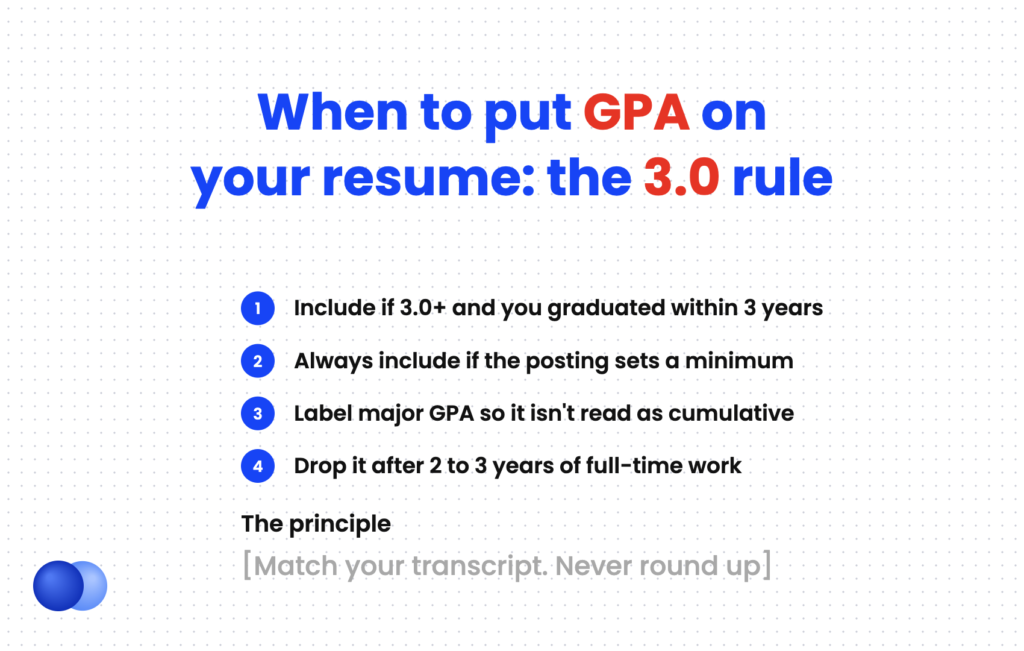
Include your GPA if it is 3.0 or higher and you graduated within the last two to three years, or if the job posting asks for it. Omit it if it is below 3.0 and not requested, or once your work experience gives recruiters better evidence of what you can do.
GPA is a proxy. Recruiters use it when they have little else to judge you on, which is why it matters most for internships and entry-level roles. Once you have real work results, those results say more than a grade average.
The good news for anyone with an average transcript: GPA screening is declining. In NACE's Job Outlook 2026 survey, only 42% of employers said they screen candidates by GPA, down from 73% in 2019. The same survey found 70% of employers use skills-based hiring, up from 65% the year before.
Still, 42% is a large share. If you are applying to finance, consulting, engineering or large campus-recruiting programs, assume GPA will be checked.
What GPA is high enough to put on a resume?
A 3.0 on a 4.0 scale is the common minimum for listing GPA, and 3.5 or higher is where it becomes a clear selling point. Between 3.0 and 3.4, include it when the posting mentions GPA or when your major GPA is stronger. Below 3.0, leave it off unless it is required.
Career centers draw the line at 3.0. Penn State Harrisburg's resume guide puts it plainly: "If your cumulative GPA is a 3.0 or above, it is beneficial to list it." Many commercial guides set a higher bar of 3.5, which is useful for competitive programs but too strict for most entry-level roles.
Use this decision table instead of a single cutoff:
| Your situation | GPA 3.5–4.0 | GPA 3.0–3.49 | GPA below 3.0 |
|---|---|---|---|
| Current student or internship applicant | Include | Include | Omit, or list major GPA if 3.0+ |
| Graduated 0–3 years ago | Include | Include if relevant to the field | Omit |
| Graduated 3+ years ago | Optional, usually drop | Omit | Omit |
| Posting says "GPA required" or sets a minimum | Include | Include | Include if you meet the minimum |
| Applying to grad school or academic roles | Include | Include | Include with context |
The last two rows override everything above them. If an employer asks for GPA and you leave it off, many recruiters will assume the worst.
Where and how should you list GPA on a resume?
List GPA in your education section, on the same line as your degree or directly beneath it. Write "GPA: 3.62" or "GPA: 3.62/4.00," use the exact figure from your transcript, and never round up. Label major GPA clearly so it is not mistaken for your cumulative GPA.
Your GPA belongs next to the degree it describes. Putting it in a separate awards section splits the information recruiters want to scan together. For a full walkthrough of that section, see our guide on how to list education on your resume.
Three formatting rules keep you safe:
- Match the transcript. Penn State Harrisburg warns that your GPA should match "what an employer would find on your official University transcript. That means no rounding up!"
- Show the scale if it isn't obvious. Add "/4.00" if your school uses a different scale, or if you studied abroad.
- Label anything that isn't cumulative. BYU's career center notes that "the default on a resume is to list the cumulative GPA," so a major GPA needs the word "Major" in front of it.
Bachelor of Science in Economics | University of Arizona, Tucson, AZ | May 2025 GPA: 3.68/4.00
Bachelor of Arts in Psychology, Ohio State University | Expected May 2027 | GPA: 3.41
B.S. in Mechanical Engineering | Purdue University | December 2025 Major GPA: 3.72 | Cumulative GPA: 3.28
Keep GPA on one line. Plain text like "GPA: 3.68" parses cleanly in applicant tracking systems, while tables, text boxes and icons can scramble it. Our explainer on how ATS works covers why.
Should you list your major GPA instead of your cumulative GPA?
List your major GPA when it is 3.0 or higher and noticeably stronger than your cumulative GPA, and always label it "Major GPA." If both are strong, show both. Never present a major GPA as your overall GPA, because background checks and transcript requests will expose the difference.
A major GPA is a legitimate way to show strength in the field you are applying to. An accounting student with a 3.1 overall and a 3.7 in accounting courses has a real story to tell.
The risk is only in how you label it. Unlabeled, a recruiter reads the number as cumulative. If a transcript later shows something lower, you look dishonest even if you meant no harm.
The same logic applies to a "last 60 credits" GPA or a GPA from one school after a transfer. Label it precisely, such as "GPA (final two years): 3.55." If you completed two majors, list both GPAs only if both are strong; our guide on how to list a double major on a resume shows the layout.
Bachelor of Science in Accounting | Rutgers University | May 2026 Major GPA: 3.74/4.00
Bachelor of Arts in Communication | San Diego State University | May 2025 GPA (final 60 credits): 3.58 | Dean's List, 3 semesters
Associate of Science in Nursing | Miami Dade College | 2024 Bachelor of Science in Nursing | Florida International University | Expected May 2026 | GPA: 3.52
Let honors carry the weight
If you earned Latin honors or made the Dean's List, those signals often do the GPA's job for you. "Magna cum laude" tells a recruiter your average was high without inviting a number-by-number comparison. See how to list Latin honors and how to put Dean's List on a resume for exact formats.
When should you take GPA off your resume?
Remove your GPA once you have about two to three years of full-time experience in your field, when a newer degree replaces it, or when it falls below 3.0 and no employer asks for it. After that point, work results and skills are stronger evidence than grades.
Your first full-time job starts a countdown. Each year of results makes your GPA a little less relevant, and by year three most recruiters no longer look for it.
Drop it sooner if any of these apply:
- You finished a graduate degree. Show the graduate GPA, if strong, and drop the undergraduate one.
- Your resume is running long and you need the line for a quantified achievement.
- You are changing careers and your degree is not in the new field.
Keep it longer if you work in academia, research, law or other fields that request transcripts well into a career. For more on what to trim as you gain experience, see how far back a resume should go.
What should you do if your GPA is low?
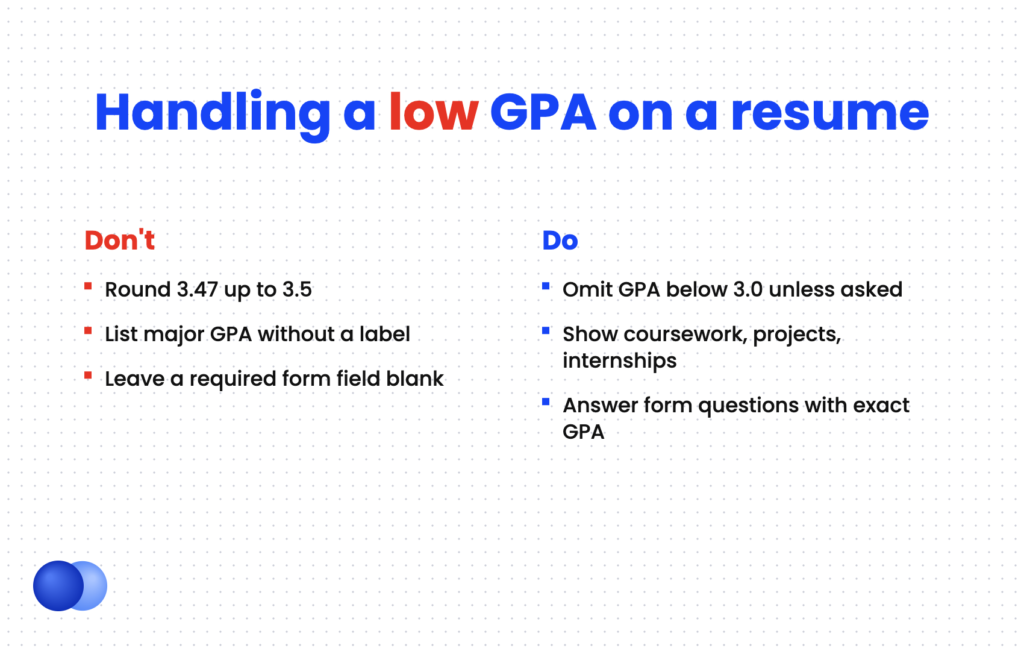
Leave a GPA below 3.0 off your resume unless the application requires it. Fill the space with stronger evidence: relevant coursework, projects, internships, certifications or a higher major GPA. If an application form asks for GPA, answer honestly and let the rest of your resume make the case.
A low GPA is rarely what sinks an application. Missing evidence is. NACE's 2026 data shows employers who skip GPA screening weigh industry experience and internships heavily instead: about 81% cite industry experience and about 79% cite industry internships.
So replace the GPA line with proof:
- Relevant coursework: list three to five upper-level courses tied to the job.
- Projects: add a capstone, research project or portfolio piece with a measurable result.
- Experience: move internships and part-time work above education. Our guide on how to include an internship on your resume shows how.
- Certifications: a current industry credential signals skill directly.
One distinction matters here. Your resume is a marketing document, so you choose what to show. An online application form is different. If it asks for your GPA, give the exact figure. Leaving a required field blank or entering a wrong number can remove you from consideration.
Copy your GPA exactly from your transcript, to two decimal places do: Label major GPA or partial GPA so recruiters know what it measures do: Include GPA whenever a posting sets a minimum you meet do: Replace a weak GPA with coursework, projects or internships
Round 3.47 up to 3.5 to clear a cutoff dont: List a major GPA without the word "Major" dont: Keep your GPA on the resume five years into your career dont: Leave a required GPA field blank on an application form
Does GPA matter to applicant tracking systems?
An ATS typically filters by GPA only when the employer sets a knockout question or minimum, usually on the application form rather than the resume. On the resume itself, GPA is parsed as text. Write it plainly, such as "GPA: 3.6," so the system reads it correctly.
Most GPA screening happens through application questions, like "What is your cumulative GPA?" The system compares your answer to a minimum the recruiter set. Your resume line then serves as a consistency check for the human who reads it next.
That is why the numbers must match. A 3.4 on the form and a 3.5 on the resume is a red flag. Before you apply, run your file through the Rezoom ATS resume checker to confirm your education section parses cleanly.
If you are building your first resume from scratch, our resume format for freshers guide shows where education should sit when it is your strongest section.

Frequently asked questions
Is a 3.0 GPA good enough to put on a resume?
Yes. A 3.0 is the common threshold career centers use for listing GPA. Include it if you are a student or recent graduate, especially when a posting mentions a GPA minimum.
Should I put a 3.2 GPA on my resume?
Usually yes, if you graduated within the last few years. If your major GPA is higher, list the major GPA with a clear label, or list both.
Do employers check your GPA?
Some do. Employers can request transcripts or verify education through background checks, and GPA-screening employers often ask for it on the application form. Always report the exact figure.
Should I round my GPA up on my resume?
No. Report the GPA exactly as it appears on your transcript. A 3.47 should stay 3.47, not 3.5.
Should I put my high school GPA on my resume?
Only if you are in high school or in your first year of college and have no college GPA yet. Once you have a college GPA, drop the high school one.
Should I include GPA if I am still in college?
Yes, if it is 3.0 or higher. Pair it with your expected graduation date; our guide on [how to list an expected graduation date](https://rezoom.io/how-to-list-expected-graduation-date-on-resume/) shows the format.
What if I never finished my degree?
You can still list the GPA for the credits you completed if it is strong. See [how to list an unfinished degree on a resume](https://rezoom.io/how-to-list-an-unfinished-degree-on-resume/) for formats. Then build the rest of your resume in the [Rezoom AI resume builder](https://rezoom.io/ai-resume-builder/).



Comments