

Summary
List an associate degree in your Education section with the full degree name as your school awards it, your program or major, the college, its city and state, and your graduation month and year. Put it first if it is your highest degree, or under a bachelor's degree if you later transferred. If you are still enrolled, add "Expected" before the date. Write the name out rather than relying only on AA, AS or AAS.
To list an associate degree on a resume, write the full degree name, your program, the college, its location and your graduation date in the Education section. If it is your highest degree, it goes first in that section. If you later earned a bachelor's, it sits directly below it.
That covers the basic entry. The harder calls come with special cases: a degree still in progress, a transfer to a four-year school, a technical degree tied to a license, or a career change. This guide gives you a format for each one, plus the naming rules most guides skip.
The degree is worth showing clearly. In 2025, workers whose highest credential was an associate degree had median weekly earnings of $1,135 and an unemployment rate of 3.0%, compared with $966 and 4.3% for high school graduates.
How do you list an associate degree on a resume?
Write the full degree name and program on the first line, such as "Associate of Applied Science in Computer Technology." Put the college name, city and state below it, then the month and year you graduated. Add GPA only if it is 3.0 or higher, and list honors or relevant coursework only when they support the job you want.
Every entry needs the same five parts, in this order:
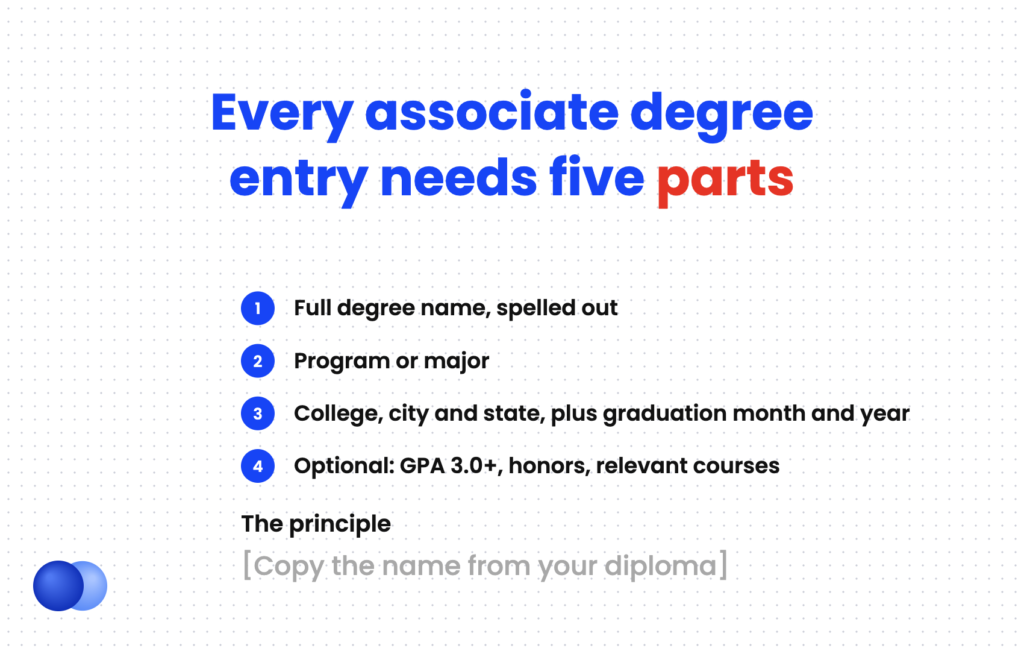
- Degree name, spelled out as your college awards it.
- Program or major, such as Nursing, Accounting or Cybersecurity.
- College name, with city and state.
- Graduation month and year, or an expected date.
- Optional extras: GPA, honors, relevant coursework or a capstone.
Career centers at community colleges agree on the basics. Monroe Community College tells students to include the complete name of the associate degree followed by the program, and not to abbreviate it. The same page suggests including GPA only if it is 3.0 or above. For a deeper look at that threshold, see should I put GPA on my resume.
EDUCATION
Associate in Applied Science, Computer Technology | May 2025
Monroe Community College, Rochester, NY
GPA: 3.4 | Dean's List, 3 semesters
Should you write AA, AS or AAS, or spell it out?
Spell out the full degree name on your resume, then add the abbreviation in parentheses if the job posting uses it. Copy the exact wording from your transcript or diploma, because colleges differ: some award an "Associate of Science," others an "Associate in Science." Matching the official name protects you during background and degree checks.
Abbreviations save space, but they cost clarity. Mt. San Antonio College's career center advises students to write out the complete degree or certificate name and include the program instead of using "A.A." or "A.S."
There is a second reason most guides miss. Colleges word the same degree differently. Monroe awards an "Associate in Applied Science," while Mt. SAC's example reads "Associate of Science in Accounting." Use the wording on your diploma so the entry matches what an employer's degree verification returns.
| Abbreviation | Full name | Typical focus |
|---|---|---|
| AA | Associate of Arts | Liberal arts, transfer to a bachelor's |
| AS | Associate of Science | Science, math, business, transfer |
| AAS | Associate of Applied Science | Career and technical fields, direct to work |
| ADN | Associate Degree in Nursing | Registered nursing (with RN license) |
| AFA | Associate of Fine Arts | Art, music, theater |
| AGS | Associate of General Studies | Broad, flexible coursework |
Applicant tracking systems match keywords, so include both forms once when a posting asks for a specific abbreviation. For example: "Associate of Applied Science (AAS), Radiologic Technology."
Where does an associate degree go on your resume?
An associate degree goes in the Education section. Put Education above Experience if you graduated recently or have little relevant work history. Put it below Experience once you have two or more years in the field. If you also hold a bachelor's degree, list the bachelor's first and the associate degree beneath it.
Placement follows one rule: lead with your strongest evidence. For recent graduates, the degree is often that evidence. For people with years of relevant work, the job history comes first and Education moves down.
Within the section, use reverse chronological order. Monroe's guidance says to list the most current degree first and the rest from most to least recent. Our full guide to listing education on your resume covers section order in more detail.
Once you have an associate degree on a resume, you can also drop your high school diploma. Mt. SAC's career center says not to list a high school diploma unless you are applying to that school or district. Our sibling guide on whether to put high school on your resume explains the exceptions.
How do you list an associate degree on a resume in special cases?
Adapt the standard entry to your situation. Add "Expected" before the date if you are still enrolled. List a transfer degree under your bachelor's. Pair a nursing or technical degree with its license in a separate section. If you transferred before finishing, list credits earned instead of a degree you do not hold.
Most associate degree holders fit one of five situations. Use the matching format below.
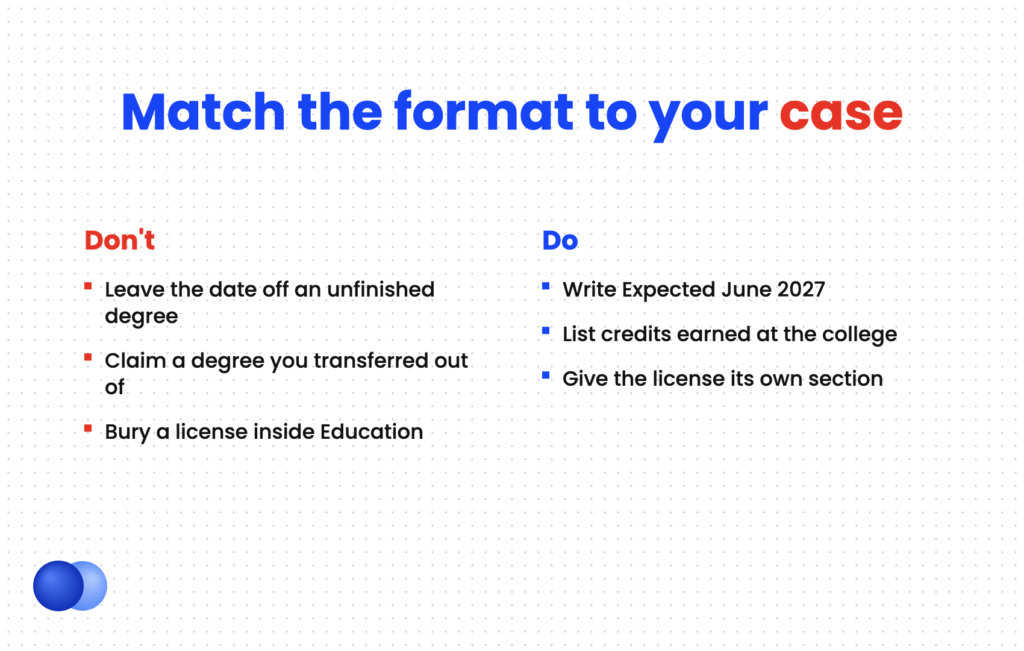
1. Degree in progress. Use the normal entry and add "Expected" before your date. Mt. SAC's example uses exactly this: "Associate of Science in Accounting, Expected: June 2025." Our guide to listing an expected graduation date covers wording options.
2. Associate plus bachelor's. Keep the associate degree when it adds a credential the bachelor's lacks, such as a technical field. Northwest Missouri State's career guide shows the bachelor's first, then the associate degree with its college and date.
3. Transferred without finishing. List credits, not a degree. The same guide models this as "Earned 32 Academic Credit Hours" at the community college. For more options, see how to list an unfinished degree.
4. Licensed or technical fields. Nursing, dental hygiene and radiography employers screen for the license as well as the degree. Keep the degree in Education and the license in its own section; see resume certifications for the format.
5. Career changers. If the associate degree is your bridge into a new field, move Education above Experience and add two or three relevant courses or a capstone project.
IN PROGRESS Associate of Science in Accounting | Expected June 2027 Mt. San Antonio College, Walnut, CA
ASSOCIATE + BACHELOR'S Bachelor of Science in Agricultural Business | May 2026 Northwest Missouri State University, Maryville, MO Associate in Applied Science, Agriculture | May 2024 North Central Missouri College, Trenton, MO
TRANSFERRED BEFORE FINISHING Coursework toward Bachelor of Arts in Psychology | 2024–2026 State University, Columbus, OH Earned 32 credit hours, Columbus State Community College | 2022–2023
LICENSED FIELD Associate Degree in Nursing (ADN) | May 2025 Valencia College, Orlando, FL LICENSES: Registered Nurse (RN), Florida, License #RN-XXXXXXX
What should you add under an associate degree?
Add details under your associate degree only when they prove job-relevant skill: GPA of 3.0 or higher, Dean's List or honors, two to four relevant courses, a capstone or clinical rotation, or a key award. Experienced candidates should keep the entry to two lines. Each extra line should answer a requirement in the job posting.
Short entries are fine. Extras earn their space only when they match the posting. Good options include:
- GPA of 3.0 or higher, per the Monroe and Mt. SAC guidance.
- Honors such as Dean's List or Phi Theta Kappa. Our guide on Latin honors on a resume shows the formatting conventions.
- Relevant coursework that names tools or methods from the posting. See how to list relevant coursework.
- Clinicals, capstones or labs with hours or outcomes.
Copy the exact degree name from your diploma or transcript
Write only "AAS" or "Assoc. Deg." with no program do: Add "Expected" before the date if you are still enrolled dont: Imply you finished a degree you transferred out of do: List your bachelor's first and the associate degree beneath it dont: Drop a technical associate degree that the job requires do: Put a nursing or trade license in its own section dont: Keep your high school diploma once you hold a college degree
Treat the degree name as a keyword
Many postings for technician, healthcare and support roles say "associate degree required." Recruiters often filter on that phrase. Spell out your degree name, add the abbreviation the posting uses, and keep it in a standard Education heading so the system parses it as a degree, not a skill.
Is an associate degree on a resume worth highlighting?
Yes. An associate degree is a completed college credential, and federal data show it pays. In 2025, associate degree holders had median weekly earnings of $1,135 and 3.0% unemployment, versus $966 and 4.3% for high school graduates. Many technical, healthcare and support jobs list it as the typical entry requirement.
Some candidates downplay the degree because it is not a bachelor's. That is a mistake. An associate degree on a resume answers a hard requirement for many roles. The Bureau of Labor Statistics projects employment in occupations that typically require an associate degree to grow by about 174,600 jobs, or 4.9%, from 2025 to 2035.
The gap over "some college, no degree" also matters. BLS data put median weekly earnings at $1,135 for associate degree holders versus $1,062 for those with some college and no degree. Finishing the credential is worth showing plainly.
If you are building your first resume around the degree, the Rezoom AI resume builder formats the Education section for you and keeps it ATS-readable. For layout ideas by career stage, browse resume examples.

Frequently asked questions
Is it associate or associate's degree on a resume?
On the resume itself, use the official name, such as "Associate of Science." In running text, both "associate degree" and "associate's degree" are common, but your college's wording is the safest choice.
Should I list my associate degree if I have a bachelor's?
Yes, if it adds something the bachelor's does not, such as a technical field, a license pathway or a related major. Otherwise, you can drop it to save space.
How do I list an associate degree in progress?
Use the normal entry and put "Expected" before your anticipated graduation month and year. Never leave the date blank, which can read as a finished degree.
Do I put my GPA with my associate degree?
Include it if it is 3.0 or higher and you graduated recently. Drop it once you have a few years of relevant work experience.
Can I list an associate degree with no work experience?
Yes. Move Education to the top, add relevant courses, a capstone or clinical hours, and pair it with any part-time jobs or volunteer work.
Should I list an online associate degree differently?
No. List it the same way as an on-campus degree, with the college name and location. The diploma does not usually say "online," so your resume does not need to either.



Comments